You Can't Do a Million Things: Sifu Edward & Sifu Julliana Armstrong Sit Down With Anthony McCarthy
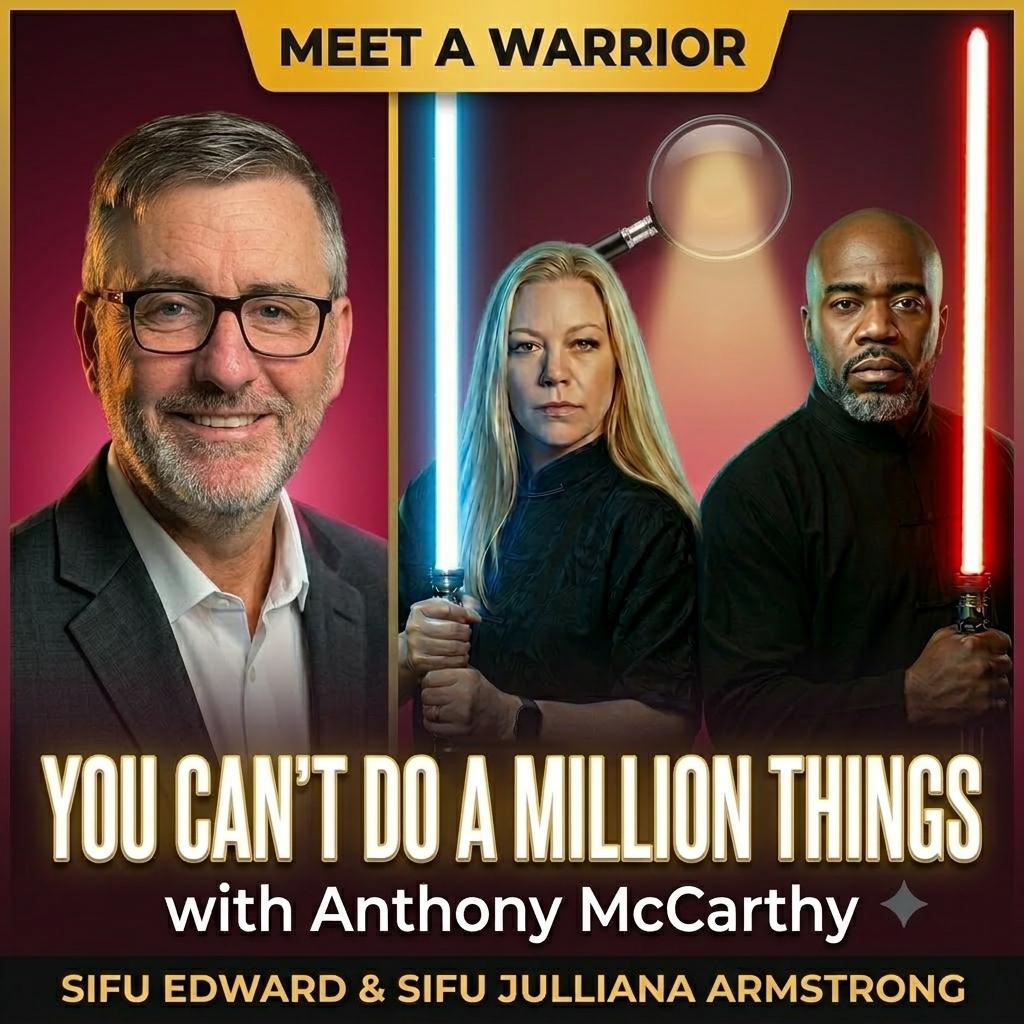
Adapted from the recorded conversation; the guest's words are verbatim. The questions are reconstructed and voiced by Sifu Edward and Sifu Julliana Armstrong.
🎥 Video podcast coming soon. The complete interview will play here once published. The full conversation is transcribed below, and the audio edition will be available on sifuarmstrong.tv.
In a new Sifu Armstrong interview, one of Ireland’s most respected marketers explains why the internet is simple and most people ruin it by refusing to believe that.
Anthony McCarthy’s story starts with a property crash that wiped out over €1.7 million of his own money almost overnight. “This isn’t a rags-to-riches story,” he told Sifu Edward and Sifu Julliana Armstrong, “it’s a riches-to-rags-to-riches story.” What pulled him out wasn’t a tactic. It was a single sentence from his father, delivered while McCarthy was sitting on the ground feeling sorry for himself, remembering the sister the family had lost to cancer at 29: “Your sister would love the problems you have.”
That reframe runs underneath everything McCarthy teaches now. His central lesson for anyone starting online is a matter of subtraction, not addition. “There’s a million ways of making money online, but you can’t make money doing a million different things,” he said. Most beginners, in his experience, try to run an email list, social media, local marketing, and an Amazon store simultaneously, and end up “extremely busy” while making nothing. The fix is choosing one lane: for McCarthy, that was list-building through contests, a tactic he carried over directly from his previous career selling kitchen cabinets.
McCarthy is equally blunt about what actually separates a serious list from a browsing one. He calls his approach “buy or bye.” “It’s the same word spelled two different ways,” he said, describing an email strategy built to filter out anyone who isn’t actually ready to commit. It isn’t cruelty, in his framing; it’s respect for the people who are genuinely in, and a refusal to spend limited energy convincing tire-kickers.
Asked how he found time to build all this as a father of five, McCarthy turned the question back on anyone who claims they’re too busy. He described asking his own students for Netflix recommendations and getting dozens of replies naming shows that run well past a hundred hours. “It’s just not a priority to you,” he said flatly, not a shortage of time, but a shortage of will to spend it differently.
What makes the conversation land is how directly McCarthy’s business philosophy and his personal one turn out to be the same idea. Focus isn’t a limitation he settled for after losing everything. It’s the deliberate discipline that let him rebuild faster the second time. Chase every opportunity at once and you catch nothing; master one thing completely, protect the people who are genuinely committed, and let momentum do the rest. It’s a lesson that translates directly onto the mat the Armstrongs run: the student who tries to learn every technique at once ends up with none of them, while the one who commits fully to a single form eventually earns the right to add a second.
In This Conversation
- Losing €1.7 million in a property crash and rebuilding through Matt Bacak’s mentorship
- “Your sister would love the problems you have,” his father’s reframe on hardship
- Why focus, not effort, is the real bottleneck for most online beginners
- The “buy or bye” philosophy for building a committed email list
- Time as a revealed priority, not a scarce resource
- Where to find Anthony McCarthy and the Legends of the Digital World summit
The Full Conversation
Sifu Edward Armstrong: Anthony McCarthy lost over 1.7 million of his own money in a property crash: went, in his words, from riches to rags to riches. I know that arc intimately. And out of the wreckage he pulled a discipline most people never learn: there are a million ways to make money, but you can't make money doing a million things. Focus is the whole game, and it's the whole game on the mat too.
Sifu Julliana Armstrong: And he carries a piece of perspective that stopped me cold. When he was flat on his back, feeling sorry for himself, his father (remembering the daughter they'd lost to cancer at 29) told him, "Your sister would love the problems you have." That one sentence reorders your entire relationship with hardship. I wanted to sit with a man who's been broken and rebuilt and still teaches with that kind of clarity.
Our guest is Anthony McCarthy, one of Ireland's most respected marketers, with three decades of sales and marketing experience, who's taught companies from Logitech to the Irish government to the EU. Anthony, welcome.
Anthony McCarthy: Lovely to be here. Thank you very much.
Sifu Edward Armstrong: Give us the origin, because it starts with a crash.
Anthony McCarthy: Very simple: necessity. I was in retail all my life, ceramic tiles and kitchen cabinets. I did a very large project, over 6.8 million was the sale, the property crash happened, the guys couldn't pay me, and I lost over 1.7 million of my own money. I was literally on my backside. A friend rang me about an event in Dublin with a couple of people coming from the States to talk about online marketing, and one of them had family from Cork, so I came up to bring them for a pint, as you do in Ireland. I went completely and absolutely skeptical, and met a guy called Matt Bacak. This isn't a rags-to-riches story. It's a riches-to-rags-to-riches story. And the funny part: Matt was a bit standoffish at first, but I'd sent some things to his mother who was talking about visiting Ireland. Later he and his wife Stephanie spent time in Cork, and we're on a train to Dublin (Americans never been on a train), and he turns to me and says, "Dude, what do you want?" I said, "I want the answer to one question only: is this BS or is this real?" And he said, "You jump on a plane next week, come stay in our basement." His basement was bigger than my house. It had its own bar. I went to meet the Wizard of Oz and I met the guy who plays the organ. He took the whole business apart in front of me, I saw the inside of it, and I was hooked from then on.
Sifu Julliana Armstrong: Before we go further. I have to sit with the thing your father said to you. Tell our warriors about it.
Anthony McCarthy: I had every reason to sit on the ground and feel sorry for myself. Over 20 million worth of property got completely annihilated. But I lost my sister when she was 29; she had cancer, and that was a kind of refocus. When I was feeling sorry for myself, my father walked in and said, "Your sister would love the problems you have." So I'm responsible for the decisions I make. And my analogy for people who feel like they're drowning. You want any way of getting rescued, so you're grasping at every piece of straw that passes. Whereas if you could just float on your back and turn around, you'd see the boat that would reach you in two minutes. People grasp at every straw, at everything, instead of getting calm and seeing what's actually there.
Sifu Julliana Armstrong: "Your sister would love the problems you have." That reorders everything. The thing crushing you today, a person who's out of time would trade anything to carry it. That's not toxic positivity; it's the hard clarity that turns self-pity back into responsibility. And the drowning image is exactly what we teach about panic: the drowning fighter thrashes and sinks; the trained one goes calm, floats, and is carried to safety. Under pressure, the amateur grabs at every straw. The warrior gets still enough to see the boat. Stillness is a skill, and it saves your life.
Sifu Edward Armstrong: You say the internet is simple and people ruin it by complicating it. Unpack that, because I hear a lesson about focus.
Anthony McCarthy: The internet is a very simple business, and that's the problem with it. Most people can't believe it's that simple. I believed it was true but didn't believe it was true, so I kept making it complicated, kept adding stuff from traditional business. I couldn't understand that I can buy a domain, set up an opt-in page, drive some traffic, get people onto an email list, and sell them stuff. I kept trying to mess that process up. The other challenge: there's a million ways of making money online, but you can't make money doing a million different things. Finding focus is the secret. Focus on two things. What's your number, where do you want to be? Everybody says, "I want to make a million dollars." Why? "Because it would change my life." That's a reason to buy a lottery ticket, not to start a business. Start with how much you need to survive, then slightly better, slightly better. It happens in increments. And you always have one of two assets: time or money. If you have money, you outsource to get back time. When I didn't have money, I had time. If you try to do an Amazon shop and build an email list and do social media and local business marketing all at once, all that happens is you run around extremely busy and don't make any money.
Sifu Edward Armstrong: "You can't make money doing a million things." Chase two rabbits and you catch none. This is the single most common way people fail on the mat, too. They collect techniques like souvenirs, dabbling in twelve styles, mastering none. The warrior drills one Form until it's flawless, then adds the second. Focus isn't a limitation; it's the entire secret. And "what's your number, and why," a goal with no real why underneath it collapses the first hard week.
Sifu Edward Armstrong: So list-building became your one thing. And you built lists in a way most people don't.
Anthony McCarthy: That was it, the complete focus. When I met speakers, I'd always ask, "What's the one thing you do every day?" And bar none, everyone on a stage said the same: send emails. I didn't have money for paid ads, and paid ads are fantastic for pouring petrol on a fire, but if you haven't started a fire, all you're doing is spending a lot of money to dampen the logs. So I went back to what I did in the kitchen business: contests. My first was with Logitech. I got 10,500 subscribers in a month. In the kitchen business I used to give away a €25,000 kitchen; everyone thought it was insane, but I'd get 100–200 entries, and out of those maybe 40 wanted a kitchen and I'd sell to 20, doing €250–300,000 of business out of one contest, and I got the kitchen free from the manufacturer plus a back-end discount deal that covered my advertising. People love to win. The traditional opt-in page just wasn't converting, because when you're starting out, nobody knows who you are, so why do they care? There are three models online: reporter, publisher, and god. Reporter is "I saw this and I think it's very good." That's just affiliate marketing done right, and it's where you start. Publisher is "I made this." God is "here's what I've done and why you should listen to me." You start as a reporter.
Sifu Edward Armstrong: For someone with no money at all, what's the honest first step?
Anthony McCarthy: Make review videos of products. A lot of launches on Warrior and JVZoo will give you a copy to review if you ask the right way and tell them you'll make six or ten videos. Then retitle them, make an unboxing video (unboxing is colossal now), and here's the secret: the very first line in your description is "Click here to get this now," with the link. People see that as they scroll on their phone, and you'll start making sales. Then post that video on Facebook groups, LinkedIn, Twitter, Pinterest, Instagram, all free traffic. Once you get a few dollars, put it on a page with an opt-in. That's how anyone with no money can build a list for free. And understand the internet is a moving river, constantly changing. If you really want to get your ass out of trouble, follow the footsteps of somebody who's already doing it. That's what I did. I learned from five or six people and blended it with what I knew.
Sifu Julliana Armstrong: You have a philosophy for your email list, "buy or bye." I love it, because it's really about commitment.
Anthony McCarthy: It's the same word spelled two different ways: buy, or bye. I'm not social on my email list. I send a ton of emails. When someone opts into our Legends Summit, they'll get 60 to 80 emails by the end. We get some abuse, but more thank-yous than abuse. And the reason I do it (something I've never really discussed) is I want to separate out the people who really want to be there from the people who don't. It's like the kitchen business: you always get tyre-kickers who come in with no interest in buying. You're welcome to stay, have a cup of coffee, but my sales staff aren't going to spend a lot of time with you, because I want to focus on the people who want to buy.
Sifu Julliana Armstrong: "Buy or bye" is the standard, dressed as a pun. Every serious training room has a version of it. You can't build a community of committed warriors if you spend all your energy on the tyre-kickers, the people who want to browse the idea of transformation without ever paying the price of it. It's not cruelty; it's respect for the ones who are truly in. You protect the intensity of the room by letting the uncommitted self-select out. The mat sorts people the same way, every single session.
Sifu Julliana Armstrong: You did all this as a father of five, now a grandfather. How do you answer people who say they don't have the time?
Anthony McCarthy: Going online was the whole reason, before, I was booted and suited at 7:30 in the morning, home at 8 at night, six days a week, and on Sunday I didn't have the energy to talk, let alone play with my kids. We had everything people wanted but no time. Once I went online, it revolutionised things, when my oldest finished school, I took the whole family to Spain, hired a villa for six weeks, and worked maybe two hours a day. When the cinemas were open and one of my kids had a bad day, we're big Marvel fans, and I could just say, "Come on, let's go, we'll be back in two hours." As for time. I did a test with my students who said they didn't have enough time. A few days later I asked, "Anybody got a Netflix recommendation?" and got about 45 posts. Game of Thrones is about 180 hours. If you can spend 180 hours on that (and I enjoyed it too), don't tell me you don't have time. It's just not a priority to you. And business is like a flywheel: static, it's hard to move the first time, harder the second, but eventually it goes over the top and the momentum carries it. You've got to push that momentum.
Sifu Julliana Armstrong: "It's not that you don't have the time. It's that it's not a priority." That is the most honest thing anyone says about discipline, and almost nobody wants to hear it. The 180 hours exist; they're just going somewhere. Everyone who ever told me they couldn't find time to train found plenty of time to scroll. You don't manufacture time. You reallocate it, and where it goes reveals what you actually value. And the flywheel is exactly the training curve: the first weeks are brutal and thankless, and then one day the momentum starts carrying you, and stopping feels harder than continuing.
Sifu Edward Armstrong: Last one. You're dyslexic, you built all this anyway, and now your sons are in the business. Tie it together, and where do people find you?
Anthony McCarthy: I'm dyslexic. I once sent an email and Matt rang me and said, "What in the name of God does this say?" So I use text-to-speech; it even understands my accent now. If you want success, you find a way. And I interrogated the support of every program I bought. I got my money's worth and more, because people like us love seeing someone show that much interest. When I met my business partner, I couldn't spell "internet." If I can do it, anybody can do it. Now three of my sons are involved, two doing marketing in college, and one packed up his job driving a forklift after we got him to make 100 grand. And if you asked what one thing I'd give up if I had to, everyone thinks it's my list. It's not. I'd give up my list today, no problem. I would not give up my connections, because with my connections I can build a list again. You can find my summits at legendsofthedigitalworld.com, and follow me on Facebook, Anthony McCarthy, you'll see my grey beard.
Sifu Edward Armstrong: Anthony, this has been fascinating, thank you so much for your time.
Anthony McCarthy: Take care.
Sifu Julliana's closing word: Two things from Anthony will stay with me. "Your sister would love the problems you have," the hard clarity that turns self-pity back into responsibility, and reminds you what a gift your struggles actually are. And the drowning image: the panicked grab at every straw versus the calm float that lets the boat reach you. Stillness under pressure is a trained skill, and it's the difference between sinking and being saved. And when someone says they've no time. It's not time they lack, it's priority.
Sifu Edward's closing word: Anthony lost 1.7 million and rebuilt, and the discipline he pulled from the wreckage is the one I'd carve above every academy door: you can't do a million things. Chase two rabbits, catch none. Master one Form completely before you touch the second. Focus isn't a limitation. It's the whole secret. Follow the footsteps of a master, protect the room for the committed, and guard your connections above everything, because relationships rebuild what any crash can take. We don't entertain warriors. We create them.
Anthony McCarthy, one of Ireland's most respected marketers, Amazon best-selling author, and founder of the Legends of the Digital World summit (legendsofthedigitalworld.com). Three decades in sales and marketing; father of five and a grandfather.
ILLUSTRATIVE RESULTS. Any revenue, enrollment, margin or retention figure in this conversation is either a documented result from one of our own operations, a figure the guest reports about their own business, or an illustrative example, never a projection of your results.
Nothing here is financial, legal or tax advice.
Stay in the Fight
This conversation is part of the Sifu Armstrong Warrior Intelligence Series: interviews with world-class performers, builders, and thinkers, filtered through the lens of the warrior's path.
Subscribe at sifuarmstrong.news for every new interview, delivered to you.
Join Club Sabernet, the member community of the whole Sifu Armstrong ecosystem, where warriors train, connect, and hold each other to the standard.
Ready to build your own floor? Find your path at sifuarmstrong.com/which-path.