Write Every Day: Sifu Edward & Sifu Julliana Armstrong Sit Down With Copywriting Legend Carl Galletti
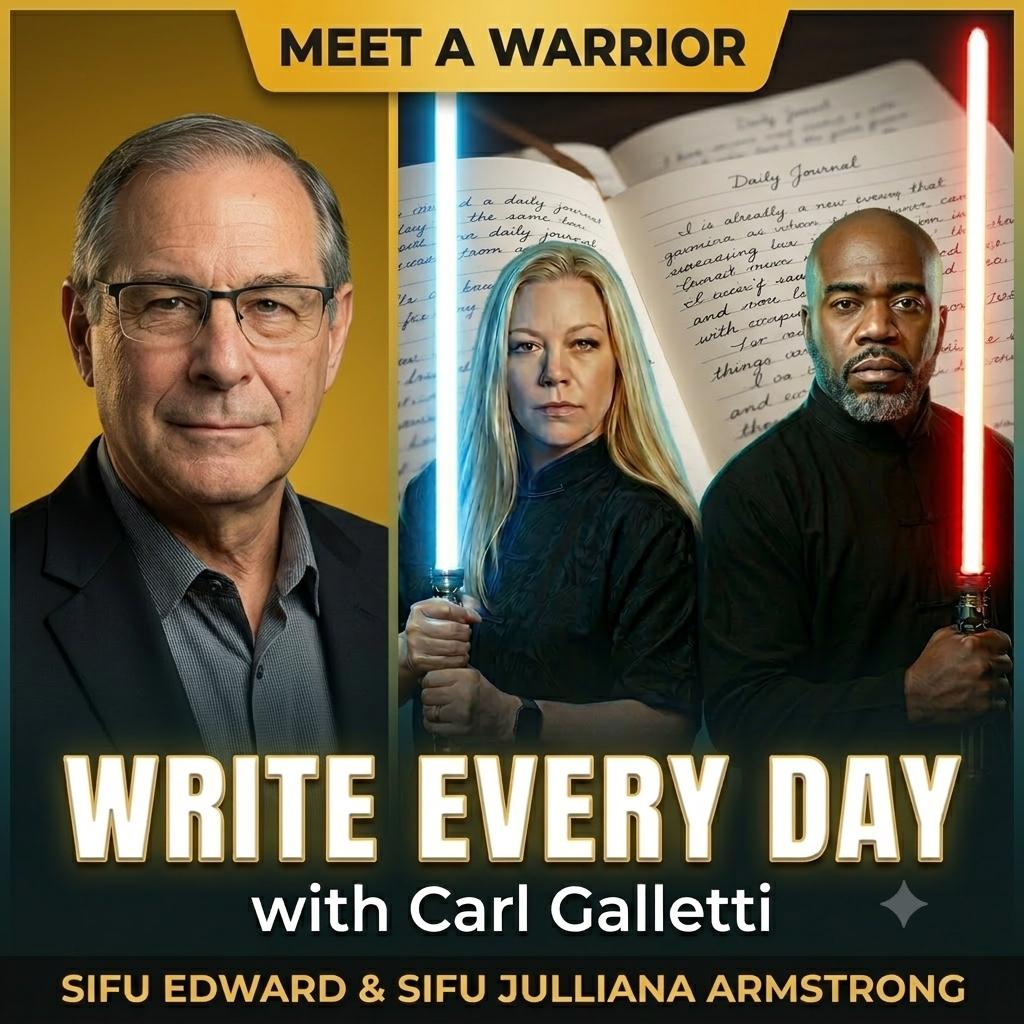
Adapted from the recorded conversation; the guest's words are verbatim. The questions are reconstructed and voiced by Sifu Edward and Sifu Julliana Armstrong.
🎥 Video podcast coming soon. The complete interview will play here once published. The full conversation is transcribed below, and the audio edition will be available on sifuarmstrong.tv.
In a new Sifu Armstrong interview, the keeper of scientificadvertising.com argues that mastery in any craft comes down to the same unglamorous discipline, daily reps and a refusal to skip the fundamentals.
There’s no secret formula in this conversation, and that’s precisely the point. Carl Galletti (one of the most respected copywriters alive, and steward of the classic advertising texts at scientificadvertising.com) joined Sifu Edward and Sifu Julliana Armstrong for the latest Warrior Intelligence Series interview with a message that cuts against every shortcut culture promises.
“You have to write every day,” Galletti said, describing how he learned the habit from writers like Stephen King and comedians like Jerry Seinfeld, who mark an X on a calendar every day they do the work and never let the chain break.
Galletti traces his own education back to the people who invented direct-response advertising in the first place: Claude Hopkins, Robert Collier, the “masters of copywriting” he discovered through mentors like Gary Halbert and Jay Abraham. His reasoning is philosophical as much as practical: “Principles never change,” he said, citing Dan Kennedy, and pointing out that human nature (what actually gets someone to buy), hasn’t shifted in a thousand years even as the platforms carrying the message have.
That same instinct for going straight to what matters shapes his advice on structure. Too many writers bury their best material in the middle of a piece, he says, when it belongs up front. “Get to the good part first. Start with the good part,” Galletti said, pointing to how director Frank Capra saved a failing film by cutting its slow opening reels entirely.
He’s equally clear-eyed about AI, warning against the assumption that a machine can write a finished sales letter from a single prompt. The real leverage, he says, is knowing the elements of good copy well enough to direct the tool: asking for twenty headlines, then choosing and combining the strongest pieces, because AI “gives you a head start, it doesn’t go the whole way.”
The numbers behind his own work back up the approach. Bundling his coaching program as a bonus for an affiliate promotion of John Reese’s Traffic Secrets, Galletti says he became the third-highest-selling affiliate with a list of only 5,000, despite competing against lists in the tens of thousands. And speaking at a seminar in the UK, he says he once sold $458,949 worth of product in a single sixty-minute session, a number he’s broken down for effect: “$127.49 per second.”
Underneath the technique is a deeper claim about what actually wins: relentless preparation. Galletti recalls copywriter Eugene Schwartz’s line about besting rivals not through better writing but better research, studying a subject until you know it better than the person who wrote the book on it.
It’s a discipline that maps directly onto what the Armstrongs teach on the mat: the unglamorous daily rep, done without an audience, is what separates the people who talk about mastery from the people who actually have it.
In This Conversation
- Why “write every day” is the whole secret, according to writers and comedians alike
- Going back to the original masters of direct-response advertising instead of copying the copy
- The Frank Capra story behind “get to the good part first”
- Where AI genuinely helps a copywriter, and where it stops
- Out-researching the competition as the real edge, not raw writing talent
- Where to find his reprints, coaching, and copywriting services
The Full Conversation
Sifu Edward Armstrong: There's a phrase in this conversation that is the entire philosophy of our federation dressed in a copywriter's clothes: principles never change. Carl Galletti has spent decades studying the original masters (the people who invented the craft), because he understood that tactics come and go, but the human nature underneath never moves. When I found a legend who insists you must go all the way back to the source, and then practice the craft every single day, I knew our warriors had to hear him.
Sifu Julliana Armstrong: And the thing that lit me up is his answer to how you get great: write every single day, mark an X on the calendar, and never break the chain. That's not a marketing tip. That's the entire secret of every champion I've ever known. The reps nobody sees are the ones that make you.
Our guest is Carl Galletti, one of the most respected copywriters alive, and the keeper of scientificadvertising.com. Carl, a pleasure.
Carl Galletti: Glad to meet you too. Pleasure to be here.
Sifu Edward Armstrong: Take us to the beginning. What first drew you into this?
Carl Galletti: Well, a long time ago, I read Confessions of an Advertising Man by David Ogilvy, and I got interested in advertising, but never did anything with it. Many years later, I went to a seminar because I was in real estate. I was sitting in the middle of this seminar (it was like $395, which in those days was a lot more money), and I looked around, there were a couple hundred people, and I started adding this all up. I said, "This is a room you rent from a hotel. There's a speaker. What is the secret of getting all these people here?" I finally deduced that it was the copywriting. The advertising got them there. So I said, "I want to know how to get people to a seminar."
I subscribed to Entrepreneur Magazine, and in the back they had these reports. I called up to order one about how to promote a seminar, and they upsold me on a package. What I didn't know is that Jay Abraham had advised them to do this, and in exchange he was able to use the list to promote his own newsletter. So he sent me a promotion. I read the sales letter and I said, "I had never ordered a newsletter for $500 for a year in my life," but by the end of the sales letter, I was just sold. I said, "If this guy charges $2,000 an hour for consultation and can write a sales letter this good, I not only want to know everything he knows, I want to know who he learned it from." In his newsletter, I got introduced to people like Claude Hopkins and Scientific Advertising. Then I got a letter from Gary Halbert (the Boron Letters), and I ordered his newsletter and became one of his first subscribers. From him I learned about the Robert Collier letter book and all the masters of copywriting. Eventually Gary and Jay Abraham hired me to write for them, and I became a freelance copywriter, and have been ever since.
Sifu Julliana Armstrong: You've been called a copywriting legend for years. What does that mean to you now, and how do you keep earning it?
Carl Galletti: Well, I wish my family felt the same way about it. To them, I'm just an average Joe. But it's great to have some degree of fame. I think it was a producer in movies who said, "You're only as good as your last picture." So the next picture, you still have to prove yourself. You always have to keep proving yourself. The only way to do that is to keep up, review the basics, and learn the new stuff. Dan Kennedy said, "Principles never change," and Jay Abraham used to say human nature is immutable. It doesn't change. What got people to buy stuff 1,000 years ago is the same thing that gets them to buy stuff today. Strategies change: TV was the latest thing, before that radio, then magazines. Tactics change often. But the principles, what it takes to sell people, doesn't change. So studying Claude Hopkins is critical, because he was there. What I call the source is the people who came up with it in the first place. They have the best insights, because they're not repeating off people before them. They're creating it anew. They have insights that are just unique, and you can learn a lot from them.
Sifu Edward Armstrong: "Go to the source." That is precisely why our nine forms are drawn from twelve martial traditions that are centuries old. Everyone else is copying the copy. We went back to the people who created the movement in the first place, because the source never expires.
Sifu Edward Armstrong: You've turned that reverence for the source into an actual business (reprinting the masters), and into coaching. Tell us.
Carl Galletti: When I started, these books weren't at the bookstores. You couldn't buy them online. I had to call Crane Publishing in Chicago, get somebody on the phone, write out a check, put it in the mail, and wait weeks. So I started accumulating all of these things, and as a sideline to my copywriting business, I sold them. I'd buy them wholesale from the publisher, sell them retail via mail order, and people like Gary Halbert and Jay Abraham would recommend people come to me. Today that's scientificadvertising.com, where I reprint the old stuff: treasures of the copywriting, advertising, and marketing industries that most people don't know about.
I also started coaching people on copywriting. I called it The Copywriter Protege Programme. The sales letter I wrote was 30 pages long. I showed it to my neighbour, who had no interest in copywriting, and he said, "Boy, I read all 30 pages of it. It was really good." I printed 300 copies, the program was about $2,000, and it had a 6% response, 18 orders for $36,000. Then I held a four-day seminar, videotaped the whole thing, and put it into a course. One guy, Garrett McDonald, took the course, then paid for an hour consultation where I critiqued his supplement catalogue. The changes might look minor, but when they retested it, it brought in an extra $500,000 a month, and they mailed that every month. It just goes to show how a small change can have a big effect. And I'm a big believer that if you're a copywriter, you should practice what you preach, write copy for your own stuff.
Sifu Edward Armstrong: Give our operators the real meat. How should someone actually write copy?
Carl Galletti: The first thing you need to do is make it new, unique, and different. It's a paradox, because how you learn to do this is by using the old guys (you get your basics from them), but when you sell something, it's got to be new to the person you're selling it to. This goes back to living on the Kalahari: you paid attention to movement, because you didn't know whether it was something you wanted to kill to eat or something that was going to eat you. Something new, something different gets people's attention. There's something called a unique mechanism, which copywriters really pay attention to. I'll give you an old example. David Ogilvy, advertising Shell Oil, came up with Platformate, a special blend. Gasoline is gasoline, but with this secret ingredient, Platformate, he demonstrated a car without it that ran a certain distance and stopped at a paper barrier, then a car with Platformate crashed right through the barrier and kept going. That's a unique mechanism. Another technique is storytelling. People love stories. That's an old technique that will never change. It's a principle. You can create trust by telling stories. "Hey, I'm telling stories right here."
Sifu Julliana Armstrong: Now the part that's my whole life. You said the way to get good at writing is deceptively simple. Write every day. Talk to me about that discipline.
Carl Galletti: If someone's interested in being a copywriter (or any kind of writer, to tell you the truth), this is what you do. You have to write every day. Now, that sounds so simplistic. Write every day, three simple words that I didn't get right away. I wasn't writing copy every day when I started out, but I learned from people like Stephen King, who has a book on writing and writes every day. Even comedians, Jerry Seinfeld says you have to write every day, and he's got this thing where you mark a calendar. When you write that day, you mark an X on it, and the next day another X, and you never stop. So I write a lot of copy, and a lot of non-copy content, every day. I even write fiction every day, stories that aren't even to sell yet, just to practice. What I've found is that the action of writing every day, you get to learn how to construct what you're writing, how to say what you mean. And one of the other techniques is to read your copy out loud, because that's an easy way to catch where you've left something out, or it's awkward, or you've gone on too long.
Sifu Julliana Armstrong: Mark the X, never break the chain. That is the entire truth of mastery, and it's the same on the mat as it is on the page. Not the one heroic session, the unbroken chain of ordinary days nobody claps for. That's what makes a champion, and it's exactly what most people won't do.
Sifu Edward Armstrong: You've embraced AI, but with a warning about how people get it wrong. And you've used copy to do some staggering numbers. Walk us through both.
Carl Galletti: I've been hot on the heels of AI since ChatGPT became an item. But copywriting has changed. It's a new tactic. The first thing people do whenever something's new is they get it all wrong, and they've done that with AI, expecting it to write the whole thing for you. You get products saying, "Just give it one keyword and it'll write the whole sales letter." Nonsense. The way you incorporate AI is you need to know the elements of your sales letter, and we still call them sales letters, even though most get put on a web page or in an email. So you break it down element by element. You might say, "Give me 20 headlines. Here's the product." It gives you 20, and you pick bits and pieces from two or three to construct a really good one, but you need to know what makes a good one, because AI gives you a head start, it doesn't go the whole way. You can write out your rough story in your own words, feed it to AI and say, "Rewrite this in good English, correct my spelling and punctuation," and it comes out perfectly punctuated with a little touch-up.
Getting back to selling your own stuff, I did affiliate sales too. John Reese had Traffic Secrets, a $997 course he only sold for 18 hours. I had a list of maybe 5,000 people. His course was great but had hardly anything on copywriting, so I gave my Copywriter Protege Programme as a bonus. I was the third-highest-selling affiliate, and the two above me had lists in the 50,000 to 200,000 range, while mine was 5,000. Then Frank Kern's Underachiever Mastery System. I bundled a full year of my Internet Marketing Super Conference recordings as a bonus and sold 71 copies for $106,287 in 24 hours, just using email with a bonus. The real job of an email is to get someone to show up at the web page to read the sales letter. That's where the sale is made. But the best thing I ever came up with: speaking at a seminar in the UK, I had 60 minutes to speak, and in those 60 minutes I sold $458,949 worth of product. I broke that down into seconds. It's $127.49 per second.
Sifu Julliana Armstrong: Two things I have to ask about, where you put the good part, and how much of this is really about research. Because I suspect the answer sounds like out-training your opponent.
Carl Galletti: The most important part is the headline, because if the headline doesn't get them interested in reading the first sentence, they'll never read the rest. And the beginning of the sales letter is the most important. When I critique people's sales letters, I always find they put the most powerful stuff not at the beginning, but somewhere in the middle. I just have them move it up to the front. One of the ways I learned this is by reading Frank Capra, the movie director. It's a Wonderful Life, Lost Horizon. In his autobiography, he talked about Lost Horizon. Everyone in the crew loved the dailies, thought it would be a big hit. But at the test screening, people walked out. He couldn't figure it out. Finally he thought, "The interesting part is when the guy gets to Shangri-La," so he threw away the first two reels, took the beginning off and started the movie on the third reel. Another test, and this time they stayed, applauded, and it went on to win major Academy Awards. Because sometimes you think you need a buildup to get to the good part. No, get to the good part first. Start with the good part.
And it's about research. Copywriters bring value, and it takes a while to ferret out and do all the research. I was talking to Gary Bencivenga once, who told me he writes only one piece a month, because he researches things. He said one reason he outperforms other copywriters is he's just so much better at researching. Eugene Schwartz said the exact same thing: "I beat other copywriters, not because I write better copy, but because I do better research. I work harder." He'd study a manuscript over and over until he knew more about the subject than the guy who wrote the book. He once pointed out to an author where, across three places in his own book, he'd said something the author swore he never said. The guy said, "You know that book better than I do, and I wrote it."
Sifu Julliana Armstrong: "Start with the good part," and "I win because I out-research." That's an athlete's confession. You don't beat the field with more talent. You beat it by out-preparing everyone, and by cutting everything that doesn't serve the moment. Throw away the first two reels. Get to the point of impact.
Sifu Edward Armstrong: Carl, this has been full of gold. Where do people find you?
Carl Galletti: First, go to scientificadvertising.com. That's got all the old, basic stuff you'll learn the fundamentals from. Then carlgalletti.com, and if you want me to write copy for you, that's a good place to go. And if you want my coaching program, there's copycoach.com. Those three places are a good start.
Sifu Edward Armstrong: Carl, I really appreciate your time, so many insights and amazing stories. Thank you for joining us.
Carl Galletti: Well, it's a pleasure being here. Thank you for having me.
Sifu Julliana's closing word: Carl handed me the whole secret in three words: write every day. Mark the X, never break the chain. And then he handed me the second half. You win by out-preparing everyone, and by having the courage to throw away the first two reels. On the mat, in the arena, on the page: the unglamorous daily rep and the ruthless cut to what matters. That's not a copywriting lesson. That's the warrior's whole life.
Sifu Edward's closing word: Carl went back to the people who invented the craft, because he understood the deepest truth we teach: principles never change. That's why our nine forms are drawn from traditions a thousand years old. You go to the source, and the source doesn't expire. Master the fundamentals from the ones who created them, then practice every single day, and never break the chain. We don't entertain warriors. We create them.
Carl Galletti, direct-response copywriter and keeper of the classics at scientificadvertising.com. Copywriting services at carlgalletti.com; coaching at copycoach.com.
ILLUSTRATIVE RESULTS. Any revenue, enrollment, margin or retention figure in this conversation is either a documented result from one of our own operations, a figure the guest reports about their own business, or an illustrative example, never a projection of your results.
Nothing here is financial, legal or tax advice.
Stay in the Fight
This conversation is part of the Sifu Armstrong Warrior Intelligence Series: interviews with world-class performers, builders, and thinkers, filtered through the lens of the warrior's path.
Subscribe at sifuarmstrong.news for every new interview, delivered to you.
Join Club Sabernet, the member community of the whole Sifu Armstrong ecosystem, where warriors train, connect, and hold each other to the standard.
Ready to build your own floor? Find your path at sifuarmstrong.com/which-path.