Work Right, Not Hard: Sifu Edward & Sifu Julliana Armstrong Sit Down With James Malinchak
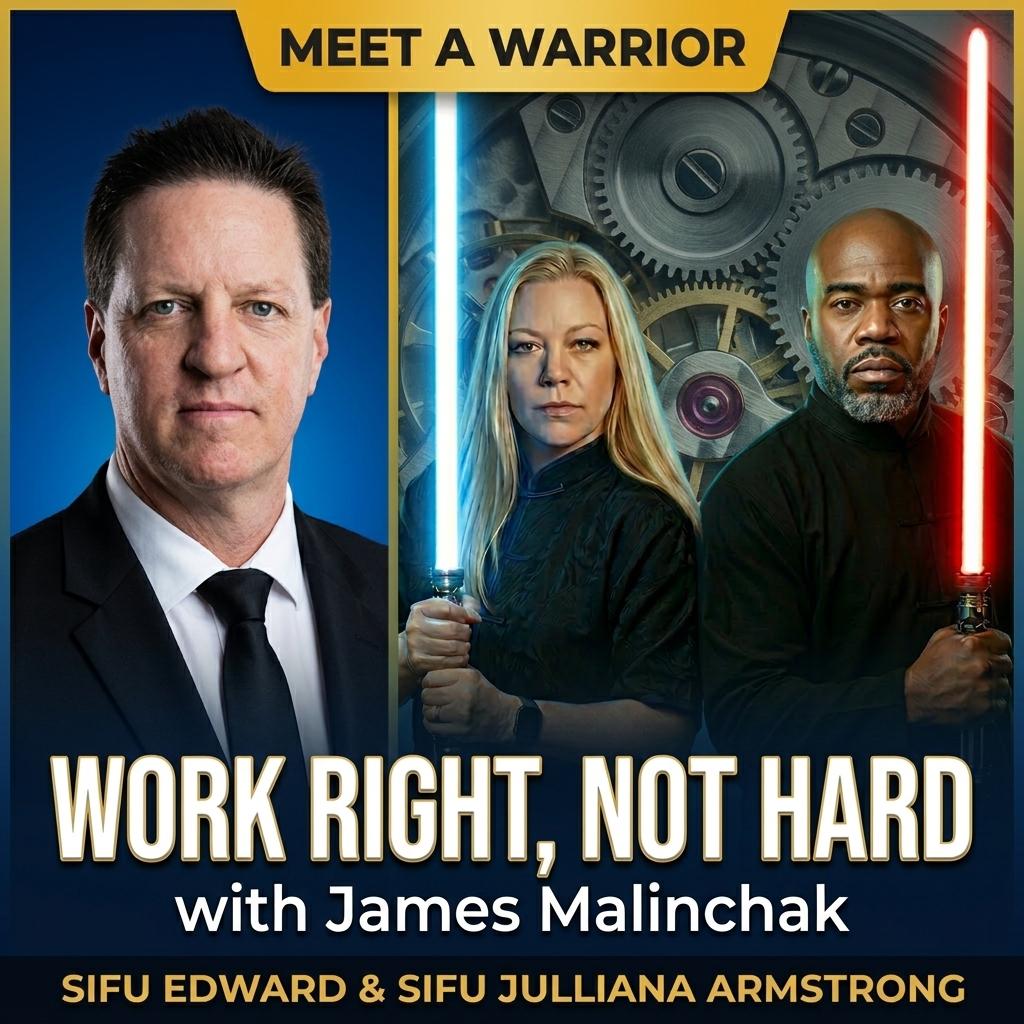
Adapted from the recorded conversation; the guest's words are verbatim. The questions are reconstructed and voiced by Sifu Edward and Sifu Julliana Armstrong.
🎥 Video podcast coming soon. The complete interview will play here once published. The full conversation is transcribed below, and the audio edition will be available on sifuarmstrong.tv.
In a new Sifu Armstrong interview, the speaker USA Today named the world’s premier speaker, trainer, and coach argues that effort alone never wins, correction does.
The world’s most driven professionals aren’t working harder than everyone else. They’re working right. That’s the case James Malinchak, keynote speaker and business coach, made in the latest Sifu Armstrong Warrior Intelligence Series conversation with Sifu Edward and Sifu Julliana Armstrong.
Malinchak, who grew up in a small Pennsylvania steel town before building a career on stages worldwide, traced his path back to a mentor who cracked open a door most people never see. “It doesn’t matter where you start in life,” he said. “It matters where you decide to finish.”
The clearest proof of his working philosophy came on a neighborhood basketball court, where he once spent an entire summer shooting 12 to 14 hours a day, weight vest on, even practicing in the dark, and still couldn’t make a shot. An older neighbor who’d never played or coached the game finally told him why. “Your elbow is sticking out every time you shoot the ball,” Malinchak recalled him saying. “Where the elbow goes, the ball floats.” The lesson reframed everything for him. “It’s not about working harder,” Malinchak said. “It’s not about working smarter. It’s about working right.”
That philosophy now shapes how he chooses his own commitments, filtered through what he calls ELF: easy, lucrative, and fun. And when it comes to explaining away success, he has no patience for the idea of luck. “If somebody believes that it’s just luck that gets handed to them,” he said, “you’re better off waiting for Moe, Larry, or Curly from the Three Stooges to show up.”
Malinchak was just as direct about the discipline of continuous learning. “The minute you choose to stop learning, you will stop earning,” he said, a philosophy that’s led him to read roughly 5,000 books, and to prepare for guest interviews by reading a subject’s own books before he ever sits down with them.
It’s a lesson that tracks with the warrior’s path the Armstrongs teach: repetition without correction only cements the flaw. The work has to be right before it can be hard.
In This Conversation
- The mentor who showed Malinchak “it’s not where you start, it’s where you finish”
- The basketball-court lesson on working right, not just hard or smart
- The ELF filter: easy, lucrative, fun
- Why Malinchak rejects luck as an explanation for success
- “Stop learning, stop earning,” reading 5,000 books and counting
- Where to find Malinchak’s books and coaching
The Full Conversation
Sifu Edward Armstrong: For most of my early years I believed that if the art was good enough, it would speak for itself. I was wrong. A martial art doesn't spread because it's excellent. It spreads because someone is willing to stand on a stage and say so. Becoming the voice of light sword, the face of the federation, was the hardest skill I ever had to learn, and it had nothing to do with a saber. So when I look at a man who turned standing on a stage into a craft, a business, and a movement, I see a teacher every operator in our world needs.
Sifu Julliana Armstrong: And I see it from the other side of the curtain. Every time I step onto a competition floor, I'm performing, the difference between the athlete who gets remembered and the one who disappears often comes down to presence, story, the ability to command a room. That's not vanity. That's leadership made visible. James spent his life mastering exactly that, so this one is personal for me.
Our guest is James Malinchak, one of America's leading keynote speakers and business coaches. USA Today named him the world's premier speaker, trainer, and coach, and he's been featured on ABC's hit show Secret Millionaire. James, it's a great pleasure to welcome you.
James Malinchak: Hey, thanks for having me. I truly appreciate it.
Sifu Edward Armstrong: I'll tell you the exact moment the door opened for me, the first time I realized people would actually pay to be moved, not just taught a technique, but genuinely inspired to change their lives. It rewired how I saw this whole thing. You're regarded as one of the best motivational speakers in the world. Was that always the ambition?
James Malinchak: No, it wasn't actually. I just remember saying, man, if I can make $2,000 a month when I was getting out of school, I'll be set for the rest of my life. That's it. I'll pay my rent, pay my car insurance, I'm good, right. And I have a friend who is kind of a celebrity here in the US. He's a former pro football player. His name is Joe Theismann, a legendary quarterback for the Washington Redskins. And I went to see him speak back in 1995. I'd never seen a speaker before. And I just loved what he did. He got up there and told stories. He motivated, inspired folks. And we went out to lunch after, and I asked him (not knowingly, very ignorantly), I said, do they pay you to be out here? And he looked at me like, yeah. And I said, well, what do they pay you, like $50 or something? He looked at me like I had nine heads. He said, "No, they paid me $10,000!" This was back in 1995. And I almost fell off the chair. "So they paid you $10,000 to do what?" He said, "to deliver that speech." I mean, Joe's $25,000 to $30,000 now. And I was like, what? They paid you to talk for 45 minutes? And Joe is the guy that started explaining the speaking industry and how it's really a business. And I'm the kind of guy. You don't have to hit me in the head with a two-by-four twice. I catch it the first time. He was right. And I can help people, I can inspire them, and they will pay me? Oh my gosh, I'm going to do this. And I did. And my first talk: well, actually I did about 80 for free, cause I didn't know anything about the business side of speaking. And then my first paid talk was $50 and a free dinner. And that's how I got started.
Sifu Julliana Armstrong: I have to ask the important question first, James, which did you enjoy more, the $50 or the free dinner?
James Malinchak: Well, I'll take the free dinner, because I actually had to drive about three and a half hours one way. And I emceed an event for about four hours, and then I drove three and a half hours back. So I think I used the $50 up in gas. I think the free dinner when I got there was better.
Sifu Julliana Armstrong: That's the part nobody romanticises, the unpaid miles before anyone knows your name. I lived that on the road to the world championship floor, and I'll tell you what made the difference: somebody further down the path who showed me it was even possible, and then cut years off my learning curve. You came from a small steel town in Pennsylvania. How did you go from those humble beginnings to becoming one of the world's most revered authors, speakers, and coaches?
James Malinchak: Well, you know, I think growing up in that small-town environment had a lot to do with it. Wonderful, great people. We had about 6,000 people in our town and we didn't have much. Dad worked in the steel mill, on the trains, hauling coal and all kinds of scrap metal. And mom was a lunch mother at the schools, meaning serving lunches to kids going to school. So we didn't have anything. And I think growing up in that environment, well, the blessing I had was a cousin who was very successful. He came from that town, and he would always invite me up to New York City to live with him. He was a commodity trader on the commodity exchange in New York (in the gold, silver, and merc pits), and a very wealthy guy. And he was the guy that showed me what's possible. That it doesn't matter where you start in life. It matters where you decide to finish, and that you could be doing, have anything you want in life. And it's something my father taught me too: that you can do anything you want in life if you don't listen to the people who will tell you you can't do something, and you just believe in yourself.
And so I think (and this is what I think is so important today for folks), you know, folks are doing certain things, they may want a bigger goal or a bigger dream, and they don't think it's possible, because they've never been shown the way, or had the door cracked open and had some light coming in. And I think that's what my cousin did for me. I saw this whole world, you know what I mean? This guy had a Rolls Royce and things like that. I was a steel mill town kid. I didn't even know that was even possible for somebody like me, but because he cracked the door and showed me just a glimmer of light...
Now, what I tell people all the time: people will give you a cracked door with a glimmer of light and an opportunity, or some advice, but then you've got to get off your ass and do something with it. I was just fortunate that I followed it. Here's my rationale: if this man is successful and very wealthy and has tons of celebrity people that look up to him, maybe I ought to listen to him and do what he says. And so that's all I did. My part was easy. I just had to execute on the plan, the path that he already created for himself. I just had to do it for me. I don't want to say it was easy (it was a lot of long hours and things like that), but I didn't have to create it. So folks, look for somebody who already has what you want. They've already figured it out. Then go up and ask them to mentor you. And if you have to pay them to consult or coach you, you do that, because they will not just cut your learning curve in half. They'll cut it back 90%, cause they already figured it out.
Sifu Julliana Armstrong: That's exactly why we built a real lineage into LSTA, Grand Masters, the Shadow Council, a path where the people ahead of you hand down what they paid for in sweat so you don't have to bleed for it twice. But I want to push on something, because people love to explain away a story like yours with one word. They say, "Well, you got lucky." On the competition floor there is no such thing as luck. There's only what you prepared. What would you say, James has luck played a part in your success?
James Malinchak: Absolutely not. No. Relying on luck, that's an easy way out. That's like saying, you know, I watched the movie The Secret and the universe is going to give me everything, so I don't actually have to do anything. I'll just sit on my couch and I'll wait for customers to come in, or I'll wait for money to walk in, or I'll wait for the love of my life to crawl through the window, because I'm giving it up to the universe. Come on, let's get real. If somebody believes that it's just luck that gets handed to them. I mean, you're better off waiting for Moe, Larry, or Curly from the Three Stooges to show up. No. It was when preparation meets opportunity, and then you get off your butt and you do something about it. No, I absolutely do not believe it's luck.
Sifu Julliana Armstrong: "Preparation meets opportunity." That's the whole World Games Pathway in four words. And it leads me straight to something I care about deeply as a competitor, because I learned it the hard way in the training hall. There's a difference between grinding and grinding correctly. How hard do you push yourself, James, and how do you think about the work?
James Malinchak: Wow, I love this question, because I grew up in a steel town and I watched my father, who was the hardest working man I've ever known in my life. He'd get a day off from the mill, and he would, you know, put a fence around the yard. That's his day off, right? Or he'd get a day off and he'd dig up sewer pipes for the sanitation department. He'd do hard manual labor. And I used to believe that hard work is what it takes. So it wasn't until I got out on my own and started being an entrepreneur and thinking things through that I realized something: it's not about working harder. And most people say it's about working smarter, and I said, well, that's not quite it either. It is not about working harder. It is not about working smarter. It's about working right. If you do things the right way, you don't have to work hard, because you've got things going for you.
Here's how I learned this. When I was playing high school basketball, there was a playground, and my goal was: what if I work hard all day long, all summer, 12 hours a day shooting? Then I'm going to be a pretty good shooter, and I might get offered a scholarship too. So I did that. I was out there 12, 14 hours. As a matter of fact, I even worked really smart. I worked as a busboy, made some money, went to the paint store and bought a paintbrush, a tape measure, and some paint, and I painted a three-point shooting arc out there so I could shoot from far away, because I was thinking, boy, if I get used to this, when it comes time in a few months for the regular season, I'm going to be ready. I used to wear weight vests. I used to do wrist curls. I'd be out there 12, 14 hours a day. I used to shoot at night, because my theory was, if I can make the baskets when it's dark, I can make them when the gym lights are on in the game. I was working hard, I was working smart: preparing myself, getting my legs strong, my wrists strong. And I couldn't make a shot for about six weeks.
And finally, one day I got mad. I threw my shirt down and I kicked the ball down the street. And there was a man, Mr. Mason, who would sit on the swing in his yard, overlooking the basketball court. And he got up from his swing and walked over to me and said, "Malinchak, come here. I'll tell you why you're missing your shots." And I said, "Well, did you play?" He says, "Nope, never played in my life." I said, "Did you coach?" He said, "Nope, never coached." And I'm thinking, how the heck is this guy who never played and never coached going to tell me why I'm missing my basketball shots? Sarcastically, I said, "Good, Mr. Mason, tell me." He said, "Well, you're working hard, I'll give you that, kid. You're out here 12, 14 hours a day in the hot sun. And in theory you're working smart, cause I see the weight vest, and you've got the paint and the paintbrush and the line and all that. But son, you're not working right." I'm like, "What are you talking about, I'm not working right?" He says, "Your elbow is sticking out every time you shoot the ball. I'm watching you shoot a curveball. There's an old line in basketball: where the elbow goes, the ball floats. Kid, get your elbow in and shoot the ball the right way, and I bet you make your shots." And I did. I made them then, and I made them from farther out, and it was so easy to make the shots. I could go out there for an hour, 90 minutes, shoot the right way, and I was done for the day. I didn't have to work hard 12, 14 hours a day. So it's not about working harder. It's not about working smarter. It's about working right.
Sifu Edward Armstrong: That story is going to live on the wall of every academy in the federation, James, because it's the entire philosophy of how we teach a form.
Sifu Julliana Armstrong: It really is. A beginner drills a strike ten thousand times with the elbow flying out, and all they've done is make the flaw permanent. The master's job isn't to make you work harder. It's to fix the elbow before the repetitions set. That's the difference between a black belt and someone who's just exhausted.
Sifu Edward Armstrong: And it raises the question I had to answer as I built this thing past myself, James. How you decide where your own energy goes. Once the art started growing, I couldn't be everywhere. What keeps you focused on the right things now?
James Malinchak: Well, it has to be fun for me. I mean, I've got to enjoy it. It has to be fun. It has to be easy. I heard this term one time somewhere, ELF. I can't remember where I heard it. ELF: E-L-F. And I kind of liked the term: easy, lucrative, and fun. And so I'm at a point: well, I'll give an example. I just got off a call with a guy who has this new site, and it's to empower kids and teach them leadership and entrepreneurship and all that. And he's got Les Brown and all these different celebrity thought leaders on there. And he wanted me to do some programs to help the kids. And I said, hey man, part of my passion is helping kids. So I'm in, under one condition: how much time and effort and work do I have to put in? And he said, oh, it'll just be like one 40-minute interview that I do with you every three or four months. I said, oh, because it's easy. It's lucrative, because he's got thousands of folks that will find out about me, so that'll turn into business. And it's fun, because I love talking about stuff like this, and I especially love helping kids. Well, it's easy to say that's something I want to do and focus on. So for me personally, it's got to be in my superpower, if you will, and it's got to be easy, lucrative, and fun.
Sifu Edward Armstrong: Easy, lucrative, and fun is exactly the filter I'd give a new Academy Commander deciding which battles to fight. Now I want to go to the root of you, because in our world we say a warrior is shaped by their lineage, the masters and the family they came from. Who are your heroes? Who do you look up to?
James Malinchak: Well, definitely my mom and dad. I'm from a steel town, not having much, but two of the wisest people I've ever met, because they gave me life wisdom. My mom said, enjoy all the success that you want, but never forget your family and your friends, always keep them a top priority, and always tell them you love them and care about them. I mean, that should be taught in every school in the world. My dad was the one who told me, you can do anything you want in life if you don't listen to the people who tell you you can't do it, and if you always believe in yourself. I mean, why isn't that taught in every university, every school, every grade in the world? So it was nuggets like that.
But I also believe you don't go to school once in your life. You're in school every single day of your life. The minute you choose to stop learning, you will stop earning. And I don't just mean an income. I mean earning growth, where you continue to grow. I always said, if you want to earn more, you've got to grow more. So earning is more than just money. But I'm constantly learning. I've read about 5,000 books. I just went on Amazon and got three more books last night. I just connected up with Leigh Steinberg, who's a super sports agent, represents 300 professional athletes. If you ever saw the movie Jerry Maguire with Tom Cruise, this is kind of the real Jerry Maguire that they based the movie on. And I'm interviewing him for my coaching clients, coming up in about four weeks. So what did I do? I went on Amazon and bought both of the books that he wrote, and I'll read those books before we do the interview. And I'll know more about how he thinks and what he tries to teach people than probably anybody who's ever interviewed him, cause nobody took the time to read his books. So I'm always learning. I've always got new mentors in the form of books, audios, podcasts, et cetera.
Sifu Edward Armstrong: "Stop learning and you stop earning." That's the warrior code exactly. The day a master decides he's done being a student is the day he stops being a master. And you've turned your own learning into a whole library. I've spent years building a curriculum that transmits this art, the 9 Forms, the whole body of work. Tell us about the books you've written.
James Malinchak: Yeah. So actually, just popping up today, well, you know, pandemic, things started a few months ago, I finished two more books. Because I told all my coaching clients, and I have about 30-some coaching clients, and right now it's $25,000 and $100,000 for our coaching levels. I told them, as soon as this all happened, I said, we're not going to be back to some normalcy for another year, so don't panic, protect yourself, but get into proactive production mode. Don't sit here, don't go watch television. What can you move up that you were going to do 12 months, 18 months, three years from now? Move it up now and get it done. So for me, it was like, hey, I've got these two other books I was going to do in a year or two, let me move them up now. So I've written a book called Millionaire Success Secrets. It's 33 ways (what I call millionaire top achievers) 33 ways millionaire top achievers act and think, because seven- and eight-figure entrepreneurs think way differently than everyone else. That's the reason they're seven- and eight-figure entrepreneurs. Millionaire Success Secrets. I wrote Millionaire Selling Secrets, all strategies and ideas from the seven- and eight-figure-level people. Millionaire Referrals Secrets, how to get a whole bunch of business referrals. Millionaire Entrepreneurs Secrets. I have Millionaire Networking Secrets. And then I wrote a whole bunch of books in the speaking profession as well, cause I do a lot of speaking.
Sifu Julliana Armstrong: Here's what I love about that, James. You didn't wait to feel like an author, you just produced. And it connects to something I see in our warriors all the time: they sit on a lifetime of hard-won wisdom and call it "nothing special." A fighter who's been through what they've been through has a book in them and doesn't even know it. How do you tell someone to actually go about writing one?
James Malinchak: Ah, great question. No, first of all, what I try to teach people who want to do a book is: you already have a book done. You've probably got information out there somewhere. You wrote blog articles, you put Facebook posts out, you put Twitter posts out. I told a very famous celebrity one time. I was speaking at an event, and I'm looking out as I'm on stage and I'm like, I know this guy who's sitting in the front row. And this guy came up to me after, and I'm like, oh my gosh, it really is the guy. And so we were talking about books and all that, and I said, you know, you have a television show, and at the end you put out tweets that are inspirational, right? I've watched some of your shows. He goes, yeah, yeah, I've done that. And I said, why don't you just go get all the tweets and put one or two on a page and bind it up? That's your book. Because the stuff that you put out is very inspirational and encouraging. Why do you have to sit down and write a whole bunch of stuff? And he was like, dang, I never thought about that. And I said, you know, one of the best-selling books of all time is Life's Little Instruction Book, and it's just one or two sentences on a page of good wisdom and nuggets that people need to hear. Just do that. Just go get your tweets. That's your book.
I did a book one time for somebody as a surprise birthday present for her. She didn't even know it was going to be done. I went on her Facebook page, and she puts out great wisdom and encouragement, and I pulled off a hundred of her posts that she wrote over the previous three years, and I put one on a page. I had a cover designed, put it together, and presented it to her as a birthday present. And all it was, was her Facebook posts that she already wrote. She had never thought that stuff could turn into a book. I'm like, why? It's great wisdom. Let's just put it on paper.
Sifu Edward Armstrong: That's a lesson our whole community needs. Your story is already content; you just have to honour it. Speaking of getting the message out, we've been pouring ourselves into sifuarmstrong.tv and carrying the art across borders, because the reach is how you change more lives. What's next for you, James? What are you working on right now?
James Malinchak: Oh man. I'm actually launching a podcast and a big YouTube channel, and building up the social media side, because it's something I never really cared about in the past. And now I realize that in this part of my life, I can reach and help more people. I get this all the time. I'll be working with somebody and they'll be like, man, I've been in 10 different coaching programs, and I never get told the stuff that you tell me about, like how to profit and make money. You just cut right to the chase and show me so many ways. And here's what I get: how come more people don't know about you? I'm not like that. I mean, I worked with some of the biggest thought leaders in the world behind the scenes, and big celebrities. Like in the movie Hitch, Will Smith played Hitch. He never advertised, people just came to him. And that's kind of like me. But I get that all the time, and I just thought one day, you know what? It's a shame that the things I'm blessed to know aren't going to help as many people as possible. So that's really what I'm focused on. How do we get this out there? So I hired an Instagram team, I hired a YouTube team to build a YouTube channel, and in the next couple of months we're going to go full force. I've got a podcast team that's going to be doing our podcast and blasting it out.
Sifu Edward Armstrong: That instinct (that it's almost a disservice to keep what you know to yourself) is exactly why we stopped hiding behind the dojo doors and started broadcasting. Before we close, James, for the warriors who want to find you, where should they head?
James Malinchak: Real simple: www.BigMoneySpeaker.com. BigMoneySpeaker.com. Real simple to remember. And by the way, there's a little tip for everybody: anybody who's ever going to have a website: create a website that's really easy to remember with words, and number two, that creates an image in people's minds when you say it, because they will never forget it. You will always remember BigMoneySpeaker.com, because when I say those words, you actually see it in your subconscious mind.
Sifu Edward Armstrong: James, thank you so much for your time. It's been great, and good luck with the podcast, the YouTube channel, and everything else you're building.
James Malinchak: Ah, thank you, I really appreciate you having me. Thank you so much.
Sifu Julliana's closing word: The thing I'll carry from James is the steel-town playground and the man on the swing. Twelve hours a day in the sun, weight vest on, and the shots still wouldn't fall, because the elbow was wrong. That's every warrior I've ever watched plateau. A flaw drilled ten thousand times is still a flaw, repetition only makes permanent what's already there. Find the person who can see your elbow, fix it, and the whole game gets easy.
Sifu Edward's closing word: James proved you can come from a town of six thousand with nothing and still decide where you finish. He found the cracked door, walked through it, and then spent his life cracking it open for everyone behind him: from a stage, from a book, from a podcast. That's the authority's real job: not to be the best-kept secret, but to be the voice that shows the next person it's possible. Get off your butt, find the master who'll cut your curve by ninety percent, and work right. We don't entertain warriors. We create them.
James Malinchak, keynote speaker and business coach; named the world's premier speaker, trainer, and coach by USA Today; featured on ABC's Secret Millionaire. Author of the Millionaire Secrets series. Find him at BigMoneySpeaker.com.
ILLUSTRATIVE RESULTS. Any revenue, enrollment, margin or retention figure in this conversation is either a documented result from one of our own operations, a figure the guest reports about their own business, or an illustrative example, never a projection of your results.
Nothing here is financial, legal or tax advice.
Stay in the Fight
This conversation is part of the Sifu Armstrong Warrior Intelligence Series: interviews with world-class performers, builders, and thinkers, filtered through the lens of the warrior's path.
Subscribe at sifuarmstrong.news for every new interview, delivered to you.
Join Club Sabernet, the member community of the whole Sifu Armstrong ecosystem, where warriors train, connect, and hold each other to the standard.
Ready to build your own floor? Find your path at sifuarmstrong.com/which-path.