Work On It, Not Just In It: Sifu Edward & Sifu Julliana Armstrong Sit Down With Bret Ridgway
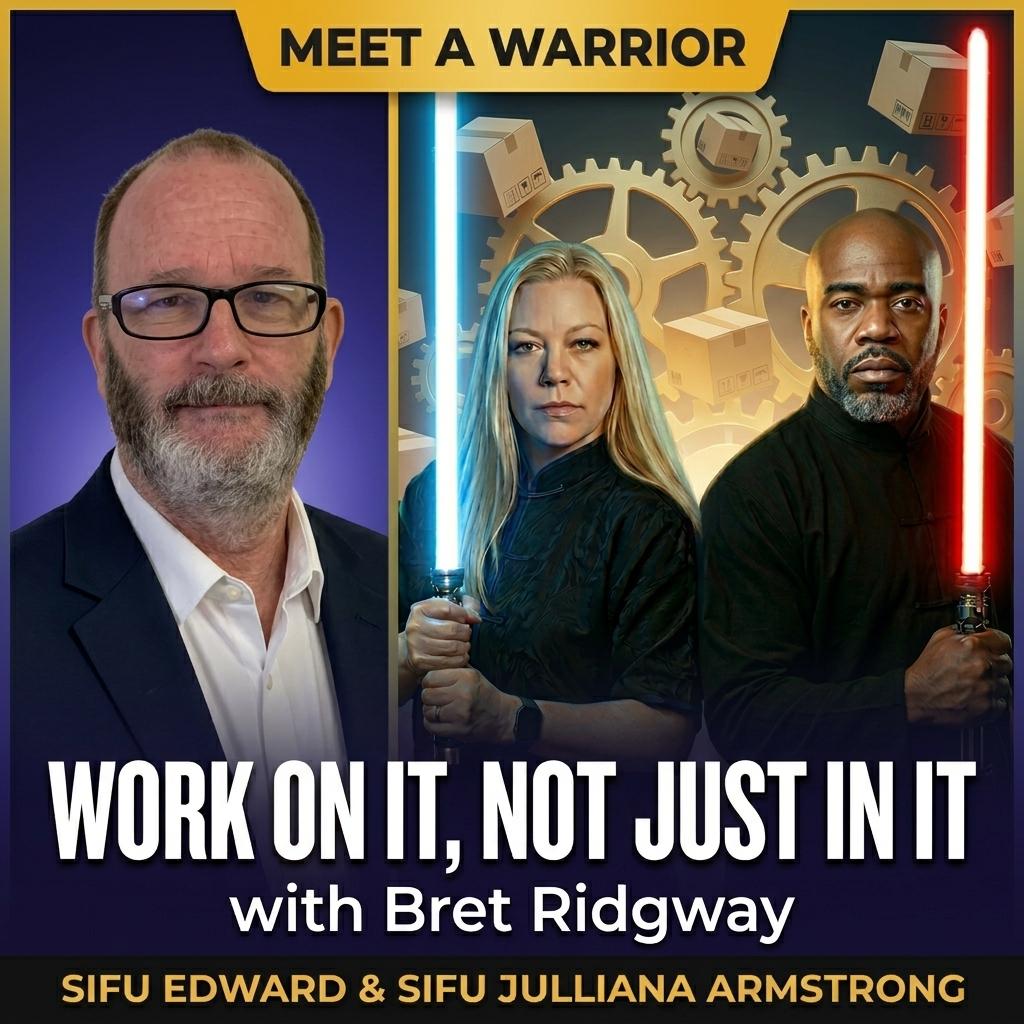
Adapted from the recorded conversation; the guest's words are verbatim. The questions are reconstructed and voiced by Sifu Edward and Sifu Julliana Armstrong.
🎥 Video podcast coming soon. The complete interview will play here once published. The full conversation is transcribed below, and the audio edition will be available on sifuarmstrong.tv.
In a new Sifu Armstrong interview, the founder of Get Ship Done explains why physical products are making a comeback, and why the biggest mistake he sees is printing before the marketing works.
Bret Ridgway has spent two decades running the unglamorous machinery behind other people’s businesses, physical-product fulfillment, first as Speaker Fulfillment Services and now rebranding as Get Ship Done. He joined Sifu Edward and Sifu Julliana Armstrong for the latest Warrior Intelligence Series conversation with a warning every operator who touches physical inventory needs to hear.
Ridgway’s path into fulfillment started almost by accident, building one of the first portal websites in the plant-engineering and maintenance industry back in the mid-1990s, selling VHS tapes, books, and manuals directly to mechanics and electricians. A chance meeting at a Florida conference eventually led to running the back-of-room sales table at an early internet-marketing conference in Las Vegas, and a few years later a fellow marketer asked him to take over fulfillment for his own products. What began as a favor for one client formally became a company in 2002, and has since grown to serve far more than the speakers it was originally built for.
Ridgway’s cautionary tale involves a client who printed a beautiful full-color cookbook and shipped fifteen pallets to his warehouse, chasing a lower per-unit cost on the bulk order. Five and a half years later, fourteen and a half of those pallets were still sitting on the rack. “You’re far better off paying a little bit more per unit until you know you can move the product,” he said, a hard lesson in proving demand before scaling supply.
He also laid out the standard information-marketing pricing rule: a roughly ten-to-one markup between hard cost and retail price, and if a market won’t bear a higher price, the fix isn’t discounting. It’s stacking perceived value through coaching, webinars, or bundled extras until the price the market already accepts starts to make sense.
Ridgway believes physical products are turning a corner after years of digital-only delivery, because something you can hold stays visible in a way a forgotten download never does. “A physical product sitting on the shelf is a reminder. I need to read this, I need to watch this,” he said, pointing to a publishing industry running four-to-five-month print lead times because demand has surged. He’s seen clients lose 80 to 90 percent of subscribers converting a newsletter to digital-only, and watched a $497 physical product upsell convert at 90 percent even when a cheaper digital version was on the table.
His daily discipline is deliberately modest. Rather than blocking out hours for strategic work he rarely finds time for, Ridgway commits to what a friend calls “five-minute marketing”: one small, proactive act toward growth every single day, whether that’s a LinkedIn message or a call to a past client. “Work on your business, not just in your business,” he said, describing a habit that compounds because it’s small enough to never skip.
The through-line across pricing, inventory, and daily habit is the same: don’t chase the impressive number before you’ve earned it, whether that’s a print run, a discount, or a block of “someday” time you never actually find. Prove the small version works, then let it grow.
In This Conversation
- The client who printed 15 pallets of a cookbook and still had 14.5 sitting five years later
- The 10-to-1 markup rule, and how to raise perceived value instead of racing to the bottom on price
- Why physical products are making a comeback after years of digital-only delivery
- The hybrid model top marketers use, instant digital delivery paired with a physical mail-out
- “Five-minute marketing”: one small proactive act a day instead of a big block of time you never find
- Where to find Get Ship Done and ShipYourBooks.com for book fulfillment
The Full Conversation
Sifu Edward Armstrong: Bret Ridgway runs the unglamorous engine behind a lot of famous businesses, physical-product fulfillment, through his company Get Ship Done. And since we ship real steel and real gear at the Trading Post, his world is our world. He gave us two lessons every operator who touches physical product needs: don't over-print before your marketing works, and spend your time only on what only you can do.
Sifu Julliana Armstrong: And he articulated something I feel deeply, that a physical object holds a kind of presence a screen never can. A book on the shelf, a record in your hands, is a constant reminder, real estate in someone's home. That's the saber on the wall, the gi in the closet. The physical thing summons you back to the practice in a way a forgotten download never will. I loved talking to him about it.
Our guest is Bret Ridgway, founder of Speaker Fulfillment Services, now rebranding as Get Ship Done. Bret, a pleasure.
Bret Ridgway: It is such a pleasure to be with you folks today.
Sifu Edward Armstrong: Take us through how the business started, and what fulfillment actually is, for operators who've never considered it.
Bret Ridgway: Way back in the mid-1990s, I put up the first portal website in the plant engineering and maintenance industry (MaintenanceResources.com), selling VHS tapes, books, and manuals to mechanics and electricians. Around then I met a guy named Carl Galletti at a conference in Florida, which led to a joint venture, and when Carl put on his first internet marketing super conference in Las Vegas in 1999, he asked me to come handle the back-of-the-room sales table. I didn't even know what back-room sales was, but I'd never been to Vegas, so I went, and that's where I met a lot of the big names in the industry. A couple years later, Jim Edwards cornered me and said, "I know you do fulfillment for your own sites. Will you take over some for me?" So around 2002 we formally put Speaker Fulfillment Services together. We're now rebranding as Get Ship Done, because we work with a lot more than speakers.
And what fulfillment is: if you're selling a product online, you need some way to get it into your customers' hands. Many people do it themselves, which is fine, but if you've been marketing very long you realise your time is most valuably spent on sales, marketing, and product creation. The things only you can do. So you connect an e-commerce platform to a company like ours, an order pops over to our system automatically, and we ship it out on your behalf.
Sifu Edward Armstrong: "Your time is most valuably spent on the things only you can do." That's the operator's whole discipline, and it's the master's too. A Sifu does not spend the day mopping the dojo floor, not because it's beneath them, but because the hours they'd spend mopping are hours not spent teaching, which is the one thing only they can do. Ruthlessly hand off everything that isn't yours to do, so your energy goes where it's irreplaceable.
Sifu Julliana Armstrong: You believe physical products are coming back, and the reason is about presence. That's my whole world.
Bret Ridgway: We're starting to see it turn around. When we began, it was all about the big-box package, spend a thousand or two thousand dollars and expect 16 CDs, two big manuals. The day of the big box has largely come and gone as the world switched to digital delivery. But the turnaround is coming, because people still want touch and feel, something in their hands. How many of us have bought a product online, downloaded it, and forgotten where it was sitting on the computer, never to look at it again? A physical product sitting on the shelf is a reminder. I need to read this, I need to watch this. The book industry had almost its biggest year ever last year, and lead time on getting books printed is running four to five months, they're so busy. It's real estate in people's homes.
Sifu Julliana Armstrong: "Real estate in people's homes." That's exactly it, and it's why the physical object matters so much in a discipline like ours. A course you downloaded and forgot is a resolution that quietly died. But the saber mounted on your wall, the gi hanging in your closet, the belt in the drawer. Those are daily summons. Every time you walk past, they ask, "Are you training?" A physical thing keeps you present with your commitment in a way no fleeting screen ever can. Presence is a kind of accountability, and you can't scroll past it.
Sifu Edward Armstrong: You have a cautionary tale about over-printing that our operators need to hear, because it's an inventory lesson we know well.
Bret Ridgway: It depends on the product, but most home-study courses, our minimum run is just a dozen units. You don't need to do hundreds or thousands. What you don't want to do. I had a client a few years ago who printed a beautiful full-color cookbook and shipped us 15 pallets of books. Five and a half years later, there were still 14 and a half pallets sitting on a rack. People fall into the trap of thinking, "If I print more, I'll get a lower per-unit cost," and then they can't sell them. You're far better off paying a little more per unit until your marketing channels are working so fluidly that you know you can move the product, then you do a higher run. It kills me to see people order massive quantities and then, frankly, not have a clue how to sell it, and it just sits.
Sifu Edward Armstrong: Fourteen and a half pallets, five years later. That's a lesson written in dust. It's the false economy of the bulk discount, and we've lived it. The ego wants the big number, the impressive order, the lower unit cost on paper, and it ties up your capital and your space in product you haven't earned the right to hold yet. Prove you can move it first, in small runs, then scale. Discipline in inventory is the same as discipline in training: don't take on more than your current capability can actually handle.
Sifu Edward Armstrong: Give our operators your pricing wisdom, the markup rule and perceived value.
Bret Ridgway: The standard rule in the information-marketing world is a 10-to-1 markup: whatever the hard cost of getting your product into your customer's hands, charge about ten times that. So if a product costs you $15 to produce and deliver, it needs to be a $150 product or more to work long-term, so you have money for marketing and all the other expenses. There are hard topics and soft topics. Hard topics like making money in real estate command a higher price than soft topics like relationships. But if the market just won't pay more than $97 in your niche, you figure out what you can package for no more than about $10. And the key question is: if my product is only worth $97 in the marketplace's mind, what can I do to increase the perceived value? Because it's all about perceived value: maybe some individual coaching, some webinars, other things you package with the physical product so you can charge $197, $397, or more.
Sifu Julliana Armstrong: Your daily habit is a phrase I want every warrior to hear, five-minute marketing. Explain it.
Bret Ridgway: As a founder I have flexibility. I roll into the office when I'm ready, and I'm involved in a lot of charity work, so my team runs the day-to-day. They like to say I'm just a pretty figurehead. But I try to focus every day on: what am I going to do today, marketing-wise, to grow our company? It might be a ten-minute activity, but something proactive every day: going on LinkedIn, reaching out to book coaches, catching up with a previous client. My friend Armin calls it five-minute marketing. Even if it's only five minutes a day, what can you do to proactively grow your business, not just work in your business, but work on your business?
Sifu Julliana Armstrong: "Work on your business, not just in your business," and the five-minute version is what makes it actually happen. The reason people never work on the big picture is that it feels like it requires a huge block of time they never have. He's proven it takes five minutes: one proactive act a day, done consistently, compounds into enormous momentum. It's the same as the warrior who can't find an hour to train but can always find five minutes to drill one thing. The small, daily, proactive rep is never as small as it looks. Consistency does the heavy lifting.
Sifu Edward Armstrong: Your closing case for the hybrid model (physical and digital together) is compelling. Make it.
Bret Ridgway: The ideal these days is a hybrid model. When someone orders, you should deliver something digital right away so they can start consuming immediately while the physical product ships. But the smartest marketers marry the two. There's a gentleman with one of the longest-running coaching programs in the industry. You'd think a membership site would be all digital, but he sends a physical monthly magazine, because he recognises the value of putting something physical in front of people every month. It's so easy to get out of sight, out of mind with digital-only. I had a client convert a newsletter to digital-only and lose 80 to 90% of their subscribers. And Ali Brown had a $497 physical product she converted to digital for immediate delivery, but smartly offered an upsell to still get the physical version for $200 more, and about 90% of people took the physical version. They wanted something in their hands, and paid $200 more to get it, even though they could've had the digital for less. The best place to find us is GetShipDone.com, or ShipYourBooks.com for book fulfillment. There's a calendar link if you want to schedule a chat with me.
Sifu Edward Armstrong: Ninety percent paid more for the physical version. That tells you everything about what people actually value. Bret, this has been genuinely useful. Thank you.
Bret Ridgway: My pleasure.
Sifu Julliana's closing word: Bret named the thing I've always felt about our craft. A physical object holds a presence a screen can't touch. The saber on the wall is a daily summons; a physical thing in someone's hands keeps you present with your commitment in a way no forgotten download ever will. And his five-minute marketing is the small daily rep in disguise: five proactive minutes, done every day, compound into momentum nothing else can buy.
Sifu Edward's closing word: Bret runs the engine behind the physical side, and his lessons are ours at the Trading Post. Spend your hours only on what only you can do. Don't over-print before you've earned the right to hold the inventory, prove you can move it, then scale. Raise perceived value instead of racing to the bottom on price. And put something physical in your warrior's hands, because 90% of people will pay more to hold the real thing. We don't entertain warriors. We create them.
Bret Ridgway, founder of Speaker Fulfillment Services, rebranding as Get Ship Done (getshipdone.com); physical-product fulfillment for the information-marketing industry and beyond. Book fulfillment at shipyourbooks.com.
ILLUSTRATIVE RESULTS. Any revenue, enrollment, margin or retention figure in this conversation is either a documented result from one of our own operations, a figure the guest reports about their own business, or an illustrative example, never a projection of your results.
Nothing here is financial, legal or tax advice.
Stay in the Fight
This conversation is part of the Sifu Armstrong Warrior Intelligence Series: interviews with world-class performers, builders, and thinkers, filtered through the lens of the warrior's path.
Subscribe at sifuarmstrong.news for every new interview, delivered to you.
Join Club Sabernet, the member community of the whole Sifu Armstrong ecosystem, where warriors train, connect, and hold each other to the standard.
Ready to build your own floor? Find your path at sifuarmstrong.com/which-path.