Who, Not How: Sifu Edward & Sifu Julliana Armstrong Sit Down With Marketplace SuperHeroes' Lisa Somers
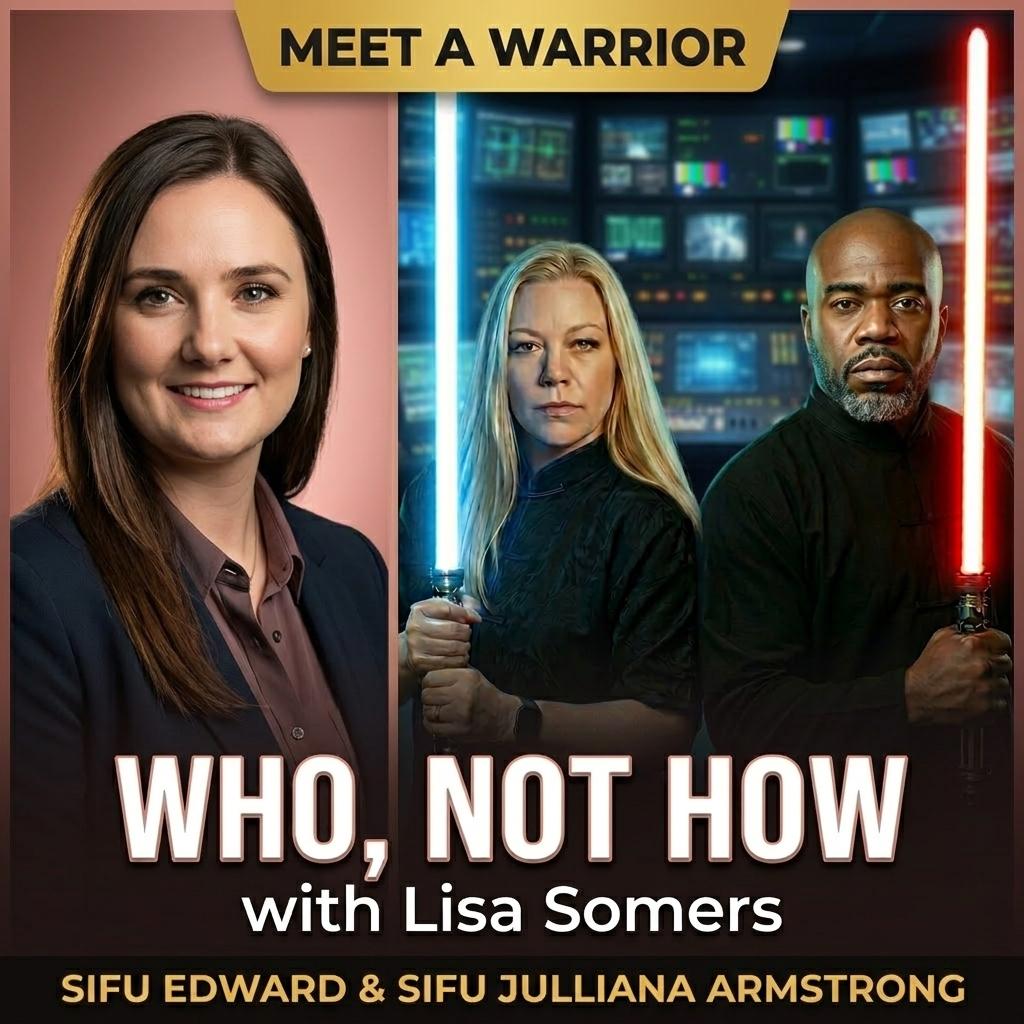
Adapted from the recorded conversation; the guest's words are verbatim. The questions are reconstructed and voiced by Sifu Edward and Sifu Julliana Armstrong.
🎥 Video podcast coming soon. The complete interview will play here once published. The full conversation is transcribed below, and the audio edition will be available on sifuarmstrong.tv.
In a new Sifu Armstrong interview, the CEO who scaled a family business teaching Amazon selling opens up about self-doubt, sibling partnership, and the shift from doing everything yourself to building a team that can.
Lisa Somers came into the business her brother founded as a customer support rep while studying to be a psychologist, and worked her way into running the whole operation. She walked Sifu Edward and Sifu Julliana Armstrong through that climb in the latest Warrior Intelligence Series conversation, including the parts most founders don’t admit out loud.
Leading a team years older than her in her early twenties came with real self-doubt, she said. “Definitely self-doubt has been the biggest thing for me that’s held me back,” Somers said, describing how she’s learned over time to step back in meetings and let her team lead rather than needing to be the one talking. The shift, she said, came down to trust: “The biggest thing for me I’ve learned personally is really just asking for help and not trying to do it all yourself.”
That lesson extends into how she now thinks about growth generally. Where the early years were defined by doing everything the hard way, she’s rebuilt her whole approach around leverage. “I’m always looking for the who, not the how is a big principle that we use all the time,” Somers said, finding the right person to own a problem rather than solving it personally. The old instinct to grind, she added, used to feel like a badge of honor it no longer is.
Somers is equally blunt about people who write off crowded markets as dead. Skeptics said the same thing about email lists and webinars, she said, and it’s never actually true for the person who does the work properly. “Everything is dead recently for some reason, but not if you know how to do it properly,” Somers said. Rather than pummeling a list with repeated “the webinar is on” messaging, she says the company builds campaigns around a narrative: one, called the eight-hour workweek, reframed running an Amazon business the way Tim Ferriss reframed the traditional job.
Running the company alongside her brother required its own boundary-setting, learning to separate “brother” from “business partner” so neither role bled into the other, while still trusting him completely with the parts of the business he owns. “I know he wouldn’t let me down, and he knows I wouldn’t let him down, and that’s just a really nice, and probably quite a rare thing in business to have,” she said. That division of labor, she said, is what let them build something meant to last rather than a course that pops up and disappears.
It’s the same lesson the Armstrongs preach to every operator building an academy: find the right people, hand them real ownership, and stop wearing the hardest path as a trophy.
In This Conversation
- Rising from customer support rep to CEO inside a family-founded company
- Confronting self-doubt while leading a team twice her age
- “The who, not the how,” the leverage principle that reshaped the business
- Why “everything is dead” is never true for the person who does it properly
- Building a working partnership with her brother without losing the sibling relationship
- Where to find Marketplace SuperHeroes and connect with Lisa
The Full Conversation
Sifu Edward Armstrong: One of the quiet truths of building a federation is that you grow faster on other people's platforms than on your own. You borrow reach, you partner, you let someone else's audience meet your standard. When I found a leader who scaled a global education company on exactly that principle, and who teaches ordinary people to build real income on the largest marketplace on earth, I wanted our operators to hear how she thinks about leverage, focus, and building something that lasts.
Sifu Julliana Armstrong: And what struck me is how honest she is about the mental side: self-doubt, the pressure to prove yourself, learning to go quiet in the room and let your team lead. That's the athlete's whole education: your ego is the thing that slows the team down. I wanted to get into that.
Our guest is Lisa Somers, CEO of Marketplace SuperHeroes, the platform that has helped thousands of people worldwide build businesses selling on Amazon. Lisa, welcome.
Lisa Somers: Thank you so much. Really delighted to be here and chat all about all things' internet marketing and Amazon.
Sifu Edward Armstrong: I always want to know where a builder actually started, because it's never at the top. Tell us about your background and how you came to run Marketplace SuperHeroes.
Lisa Somers: Absolutely. So I am CEO of Marketplace SuperHeroes, and the company was founded in, I believe, 2014 by my brother actually. So that's a whole topic we can possibly get into about working with your siblings. But it was founded then, and I came along a little bit later because I was actually studying to be a psychologist and I thought I was going to have a very corporate career as a clinical psychologist or something along those lines. And I was studying, and actually I found that a lot of what I had hoped psychology would be and that career would be, it wasn't really, it was very, you have to exist within the system and you have to do things a certain way.
And I was never very good at that. Even in school I was always the annoying kid with her hand up for every question or just blurting out the answer. So I wasn't existing very well within those systems. And at the time, my brother, Stephen, had started this little course, as we used to call it back then because he was an Amazon seller himself, and he identified that there wasn't really anyone providing good education in that space back then. Certainly not for people outside of the US and he was obviously based in Ireland where we're from. So he started a course with his then business partner at the time.
And then I came along a little bit later as a customer support representative, would you believe? Because I wanted to see what was going on over there. Was it going to be something that could give me a bit of pocket money while I was a broke student studying as a psychologist. And then after that, it was a case of I was looking around the business and I was spotting lots of opportunities for reducing the chaos, I would say. And anybody who's in an early stage course coaching business probably knows what that chaos is like. You're just launching things whenever you feel like it the day before. No one on your team really knows what they're doing.
You don't even really have a big team. And there was lots of things that were just not really working that well. And so I sort of took it upon myself to try and fix some of these glaring issues. And that was how I began my, I was going to say my ascent, which sounds like I became royalty or something. It wasn't quite that fancy, but that was sort of how I began moving up through the company until eventually now I run the business.
Sifu Edward Armstrong: The company launched in 2014. How quickly after that did you come aboard, and what did it look like in those bootstrapped early days?
Lisa Somers: It was about 2016. It really only got going in 2015, I would say. There was a small number of clients we had and it wasn't very big. I remember my brother was actually, he would be cold calling people on the phone, "Hey, do you want to learn how to sell on Amazon? We've got a course." We didn't have all of the funnels and all of the say joint ventures and things like that that we have now. So it was very bootstrapped and very basic at the time because we were learning. So I came along at the start and I began reading Russell Brunson's books, the DotCom Secrets, Expert Secrets, all the OGs, we'll know those.
And I was also reading a lot of MJ DeMarco books, so all about Millionaire Fastlane and trying to understand, "Oh, I don't have to have a nine to five, I don't have to have a traditional job. We can build something that is very different and allows us to create freedom in our lives." I travel around the world with my partner now, and the only reason I can do that is because I don't have to ask for time off because I work for myself. So I think it was a case of just getting stuck into learning about marketing obviously.
And then also for me, because I knew I was someone who could organise things and make sure the team were all pulling in the right direction and building a team in the first place, then I got really into leadership and operations and all of those topics. And so I went on a deep dive of studying all of those things in order to help us grow the business and that's been the journey we've been on ever since.
Sifu Julliana Armstrong: I want to slow down on the personal side, because the thing nobody warns you about (in competition or in leadership) is the self-doubt. You were leading people twice your age in your early twenties. Walk us through both journeys: the company's, and your own.
Lisa Somers: I mean, I'll take the company first. That's almost easier to do. I think, like I said in the beginning, and anybody who has an idea for a course, you're just trying to get clients in. You'll do that in a scrappy way. In the beginning that's the best way, I would argue. I always say... People ask me, "If I want to do this, how do I do it?" I'm like, "Just find three to five people that'll pay you a couple of thousand dollars and you can deliver it on Zoom." Don't go and build out a whole big funnel and a whole course because people might get halfway through and go, "This isn't helping me, it's not what I want to learn and all of that."
So we were scrappy in the beginning and then we had a couple of lucky breaks, I would say. Obviously they weren't just luck, we put in a lot of work to get them, but we did get lucky in some ways where we found quite a large YouTube channel that talked all about Amazon. And so we actually partnered with them where they would make content about us. They would promote us to their audience. And so that was one of the first big breaks of, we were getting lots of people coming into the programme because we had leveraged someone else's audience.
And that was a huge takeaway for us then, and something we continue to do to this day because it is quite difficult to build an audience, as I'm sure lots of listeners here will know. But when you can access other people's audiences, it makes it a lot simpler. So we would run webinars to their list and they would get on with us and endorse us and all of that. And then that really started the snowball of people coming into the course, which at the time was a 997 of course great pricing and just DIY programme. And then after that we went and built out a coaching offer, a five or 6K coaching offer, and now we have low tickets and all of the above.
But that was kind of one of the biggest things that happened for us at the time, was just discovering that accessing other audiences was a much faster way to grow, getting on podcasts, doing all of the things that we still do now. And then we really, from there, the journey of the company has been discovering what we're really good at and what we're not good at, and outsourcing what we're not good at to people who are. So one thing we have become excellent at is creating campaigns. So email marketing campaigns, we would be well regarded in that space because we do a lot of things differently where most people will just promote a webinar and it'll be, "Hey, the webinar is on, come to the webinar."
Whereas we will craft narratives around campaigns. So we did one time that was called the eight-hour work week, and it was sort of a take on the 4-Hour Workweek by Tim Ferriss, and it was about running an Amazon business in eight hours a week. So we've come up with ideas that then enable us to craft campaigns that feel new and interesting, and they're value and content led. So even if someone comes through the whole thing and they don't buy, they're usually not annoyed. They're like, "Wow, that was great." And so the next time they might buy.
Whereas what a lot of people are doing still to this day, I mean I see it all the time, is they're just pummeling their list with, "The webinars on, the webinars on." And people are just unsubscribing and getting really upset. So I think that's the development of how we've marketed the company. That's probably been the biggest piece is learning how to craft those campaigns and actually monetize our buyers. Because again, something most people are, they're very focused on new leads and new blood into the business, whereas we actually put a lot of focus on upgrading people and getting them cross-sold into other things.
So that's been a way for us to really get as much value out of our list as we can and come up with those campaigns to do that. So that's probably a bit on the development of the company. Another thing would be selling less offers and just selling your existing offers in more intelligent ways. So if you have a webinar for a two grand programme, then run a pop-up Facebook mini group to sell it, run a VSL or video sales letter. There's different ways that you can sell the same thing. You can also put different pricing in place so that if someone didn't want to come in on your three payment plan, would they come in on a 12 payment plan?
So I think that's been a big lesson. We went through the phase of creating a new offer nearly every month, and it was like all fulfilment had to be done and delivery, and new coaches had to come in and all of that. And we went through a lot of that chaos, especially during Covid because our business actually doubled in size during Covid because of course people were looking for ways to work from home to not rely on their job. And so selling on Amazon was a great vehicle to do that, but in the doubling of size of the business, we ran into a lot of chaos.
And so actually it was about learning how to manage that chaos and stick to the true drivers of the business, which ultimately for us are bringing leads in, getting them into our one or $2,000 offer and then moving them up into our higher ticket stuff. And of course we use low ticket offers to do that. We use free things to do that. We have a whole host of things we do, but then it's not about going and starting the next business now and the next one and jumping around here and building just everything you can possibly build.
And I think for me, speaking of my journey in the business, obviously understanding psychology helps a lot because I think for a lot of entrepreneurs, there's a lot of ADHD going on in most entrepreneurial brains. And so it's a case of going, "We understand that we're going to want to do new and shiny things all the time." That is a fact. And so it's a case of really being able to use data to decide what is the best move for the business and for us, because I know many of my friends in this space have gone off and done 10 different things at the same time and it's all fallen apart, and we've nearly been guilty of that.
Thankfully we pulled it back at the last minute over the years. But it's really a case of being able to focus. And I think my own journey has been an interesting one because I definitely had a lot of beliefs about myself that were quite limiting for a long time. I'm 30 now, but I was whatever, 22 or 23 maybe when I got started. And so people on my team, we had people that were in their fifties who were now, I was their boss or whatever, and I used to feel really strange about things like that. "Why would they want to listen to me? I don't know enough. I haven't been here long enough."
And obviously with time and with experience, you overcome a lot of those beliefs. But definitely self-doubt has been the biggest thing for me that's held me back, I would say. And I think probably that's true of most leaders in any business where you wake up sometimes and go, "What should I be doing? Does everyone else know what to do? Because I don't know what to do." And that's where you bring in mentors and consultants and people to come in and help you when you're stuck. And I would say that the biggest thing for me I've learned personally is really just asking for help and not trying to do it all yourself.
Because when you do it all yourself, you get the two-second glory of, "Yes, I fixed it all, I solved it." But the business can't grow at the same rate as it can when you truly expand your thinking and allow other people to come in and help. I used to feel like I had to contribute all the time. If we were in a meeting, I just would be talking, and obviously I'm talking a lot now, but I think it's okay in this situation. But I would just be talking a lot and now I'm really quite quiet in our meetings. I'm letting our team lead the meetings, and I'm sometimes just providing comedic relief.
They tell me, I hope that's true, but really it is being able to be confident enough in yourself to step back and allow other people to step forward. And lastly, I think for me it's a case of leverage. We didn't really leverage a lot of things in the early days. It was like we did everything the hired way, and now I'm always looking for the who, not the how is a big principle that we use all the time, but really just looking at what is the 80/20, what is the way that we can achieve the result we want with the least amount of stress and difficulty?
Whereas before, it was almost like a badge of honour to do it in the most stressful way. So that's been a big shift I think for me personally in the business.
Sifu Edward Armstrong: That phrase ("the who, not the how") has come up on this platform from builders who never met each other. It's the entire logic of our Academy Commanders: I can't be in every academy, so I find the right who and give them the system.
Sifu Edward Armstrong: You mentioned your brother, and Sifu Julliana and I know something about building alongside family, because we've built this entire federation as husband and wife. It can be the greatest strength or the sharpest friction. How did the two of you make it work?
Lisa Somers: I mean, I have to give him a lot of credit. He's a genius marketer and many of these concepts I'm talking about, he brought to the table for us as well. So it's not like I'm the mastermind behind all of this in our business. Really he's been phenomenal at growing it, and I sort of keep the train on the tracks because he's such a speedy mover. And for us, it was a case of figuring out the division of responsibility, was the biggest thing because we used to be sort of in each other's business all the time for want of a better term, and we would be working on the same things, and it was just a bit messy.
And that was in the much earlier days. And now in the last few years, we've really got this lovely division of he is growing the business and he is overseeing our marketing and a lot of our partnerships, and then I'm running the business. So I'm looking at everything else that doesn't fall under that, and I'm still looking at that, but more so from an oversight perspective or strategic perspective. And what we do together is we set the strategic direction of the company and then we sort of branch off into the different areas and off we go.
So for me, it's more about making sure the team know what they're doing, making sure our finances are in check, making sure everything is running smoothly and looking at all of the things that grow the business. And he's very much focused in that area. And that's been great for us. There was a couple of times for sure in the last few years where I've had that phone call where I'd say, "Hey, you're my brother, you're supposed to stick up for me." And he'd say, "Well, I'm not your brother in this situation. I work with you." And I am the same in reverse. So it was a case of learning that separation of family and work.
And there were times where we would have a tough day at work and then I would go and see his kids that evening at his house and we would hang out and have fun. So I think that's been big, it's just almost seeing each other as different people when we're in those roles and not seeing each other as brother and sister. But the great thing about it is we have quite a similar brain in many ways. And so I sort of know what he's going to say before he's going to say it and the same with me. So we can move very quickly on decisions, and we both watch and read the same marketing material from other people.
So we're sort of studying the same things, which helps us always be aligned or certainly most of the time. So it used to be interesting and never very difficult, but just there were moments of, "Oh, how is this going to work and how do we do this?" And now I would say we have a pretty smooth system in place and we actually have a lot of fun. And that's the great thing. I mean, for us it's about building something long term. We don't want a course that pops up and disappears overnight. We've been doing this for a long time, and I'm sure there'll be other adventures we go on together, but really it's wonderful to be able to do that with your family and have someone that you just trust with your whole life.
I know he wouldn't let me down, and he knows I wouldn't let him down, and that's just a really nice, and probably quite a rare thing in business to have.
Sifu Julliana Armstrong: That division of responsibility (knowing whose lane is whose) is exactly what saved us. Edward drives the art and the mission; I carry the competition floor and the athlete's side. You stop stepping on each other the day you both trust the other to own their half.
Sifu Julliana Armstrong: We built our whole Ageless Warrior avatar around a truth your clients seem to share, most people don't actually want the Lamborghini, they want their time back. Talk about the life this business has given you.
Lisa Somers: Sure. I mean, we really don't subscribe to the whole being an internet marketer by Lamborghini type mentality. We've never really been like that. But what I will say is for me, I've spent the last year travelling the world. I've been in Bali, I've been in Dubai, been all over Europe. I'm in the UK now, which isn't very fancy because I've lived in Ireland, so it's only over the pond, but I've been in the US a lot. And all of that is, especially for me, I've been really proud of myself actually, that I have a life that I can just pay for all of that without a problem, and I'm not sitting there counting my digits in my bank account, going down and worrying about it anymore.
I think neither of us live a very flashy lifestyle really. We're not really interested in that. We're interested in reinvesting in businesses, and that's what we do. Like I said, we don't do anything excessive because we just believe in keeping our heads down and working. And as I said, I've been around long enough now to see many of my friends who they have some success, their lifestyle creeps up considerably. And before you know it, they're in massive debt because they have a huge mortgage, they have three cars outside, they're trying to keep up with everybody else on Instagram or on Facebook or whatever.
And sometimes that makes sense if your audience needs that from an ad standpoint, you have to sort of portray that lifestyle. But actually what we've cultivated is a brand where most of our clients are sort of a little bit older. They're in their late forties to early sixties, so we're not going after the 21-year olds. We do have some of them, but that's not our primary audience. They actually don't want the Lamborghini lifestyle. They want more time with their kids. They want to be able to afford to go on holiday a few times a year. It's quite easy for us to present that lifestyle because that is our lifestyle, and we don't have to do anything excessive to do that.
But yes, it's been brilliant. And the big thing for me is freedom of time. I can take a day off whenever I feel like it, and I don't choose to because I love what I do, but at the same time, if I have to bring my dog to the vet, I can just do that. Or if I want to go on holiday, I can just do that. There's no asking anybody for time off or anything like that and you just have complete freedom. And the biggest thing that's given me is the ability to learn more because I have time to sit and read a book and go through a course or whatever, and we're always learning. Just because we've had some success in business doesn't mean that we just stop.
We're constantly looking at what other people are doing and making sure that we keep our game up so that we can maintain our own success in our business.
Sifu Edward Armstrong: There's an old distinction we teach operators, working in the academy versus working on it. It sounds like you've built the business to run on rhythm rather than heroics. Is that fair?
Lisa Somers: I don't know if it's really that I would say I happen to like the way the business runs and I fit in with that more so. There are many... I have friends that work an hour a day and their business does several millions a year, and they're very happy and they don't want to really grow or scale it. We're not really in that camp. We're always looking to do more and to grow. And so we do work quite a bit. We don't do anything crazy. There's no 12 hour days happening, but I probably work six hours a day, and I'm always thinking too, so I don't know how many hours a day that is, but it probably adds up.
So I don't even know if it's sort of building it around my lifestyle more so than I've just fit into a rhythm now. But certainly there was a time where I was working a lot more, but I wasn't working on the business. I was working in the business. And I know we've talked about that to death in the marketing space and whatever, but I don't know if I fully understood that actually until probably the last two years. I was like, "Well, but this is really important and I have to do it." And the more you do that, there's always going to be things that are really important.
But now I'm looking at mapping out the next quarter and what campaigns are we running and how much revenue and profit is that bringing in, and what partners are we looking to work with and all of those things. And we're always looking for new partners and new audiences to work with and pay commission to. That's the game we're in. But ultimately, it does take a bit of time. It's not wasted time anymore, wasted energy. It's more so dialled in, leveraged activity.
Sifu Edward Armstrong: For the operators reading this who want to understand the actual model. Where do they go, and what exactly are you teaching people to do?
Lisa Somers: Yes. So you can go to marketplacesuperheroes.com, there's a free training on there, which will bring you to webinars. So if you want to learn webinar skills, you can check that out and see how we do our webinars. But what we teach is primarily two models. We teach Amazon wholesale and reselling or otherwise known as arbitrage. So basically what those models are, it's for people who don't even have a business yet, or of course if you had one and wanted something else that'll bring you additional income in.
But basically what you are doing is, in the case of wholesale, reaching out to suppliers, you're working with them to order a small quantity of their products, and then you're getting them listed on Amazon, shipped in there and sold. And then reselling is a little bit more, you see that Converse have a sale on their website. So you go on there and you buy five pairs of Converse, and you sell them for an additional profit on Amazon. So there's a lot more to it than that. But essentially most of Amazon is made up of smaller individual sellers, which I don't think a lot of people know that, but it's one of the biggest marketplaces obviously, that we have, and it's a huge, huge vehicle for sellers.
And so we've really just found a lot of success. We moved thousands of students at this point now who've gone through our programmes, learned to do this. They're not people who have a lot of business experience typically. We actually have a lot of people who are professionals in real estate or even dentists and random things like that. Engineers seem to love it because it's quite like, what's the word, sequential. So we have a lot of people like that in our programmes, and really they're just in there learning how to sell products on Amazon and make money from that.
So a lot of people ask me, do I have to have a brand or do I have to sell a specific type of product? And the answer is no. You're selling already proven items. So things like Converse, even Crayola Crayons, and there's tonnes of brands that you can sell that work really well, and obviously people are buying all the time, so you don't have to go off and start your own website and drive traffic and any of that. You're leveraging Amazon's platform to do all of that.
Sifu Julliana Armstrong: I hear athletes do this too: "that division is too deep, everyone's already there, why bother." You hear the same about Amazon: too crowded, too competitive. When people say the space is saturated, what do you tell them?
Lisa Somers: I think people say that about lots of things. Like I've heard people say email lists are dead, webinars are dead. Everything is dead recently for some reason, but not if you know how to do it properly. So with Amazon, there's ways that we have to optimise what you're doing to enable you to make sales. And also with Amazon, there's a thing called the buy box, which I'm not sure if many people are familiar with, but throughout the day, Amazon rotates the sellers that you're buying from. So if you're looking at Crayola Crayons, for example, it's not going to be the same seller the entire day.
It will rotate who is sort of on that listing if you're doing wholesale, for example. So in that case, Amazon is enabling you to make sales. Amazon is putting you on the page in front of something and going buy this, right? So there's built in ways for Amazon to help sellers to do that. And we only sell items that we have a whole research system. We have everything in place to make sure you're not selling things that are just so competitive that you're never ever going to make money. We vet products, we go through things to make sure that they're the right items.
And like you said, we have entire coaching programmes that work with people on it to make sure that they have all that support, they have everything they need to really be successful with it. And it's like anything, people say to me, "How much money can I make? Am I going to be successful overnight? How does this work?" And it is like anything, you can log in and never watch a video and then say it wasn't good and you failed at it, right? There's so many people that just actually don't take action on the material, and there's not really very much we can do about that but I encourage people.
All I can say is we have many people in our community that are doing quite well with the programmes and making enough money to go on their extra holiday or do the things that they want to do. So it's probably one of the easiest ways to get started, like we're saying, because you don't have to create an audience. You don't have to do all of those things. With internet marketing in comparison, that's the big hurdle, is figuring out the offers, figuring out the audience, all of that. And it's just a nice way to not have to worry about that and to be able to make a nice side income.
Sifu Julliana Armstrong: It's clear you love what you do. For anyone who wants to find you and the work. Where should they go?
Lisa Somers: You can go to marketplacesuperheroes.com. Also, if you want to connect with me, I'm on Instagram or Facebook. So Facebook, Lisa Somers, S-O-M-E-R-S is my name. And then on Instagram, my handle is, itsLisaSomers. Very original, I know. So you can follow me there, send me a DM if you have any questions or anything. I'm always happy to chat to people who are interested in the same things I'm interested in. So that's the best place to get me.
Sifu Edward Armstrong: Lisa, thank you. This was a genuine pleasure. We wish you and Marketplace SuperHeroes every success, wherever the road takes you next.
Lisa Somers: Thanks so much.
Sifu Julliana's closing word: The line I'll carry off this mat is "everything is dead… but not if you know how to do it properly." I've heard a hundred versions of that in competition, this style is finished, that division is too deep. It's never true for the person who does the work properly. Saturation is just a story people tell to excuse not learning the craft.
Sifu Edward's closing word: Lisa proves two things I drill into every operator: borrow reach before you build it, and stop wearing struggle as a medal. The badge of honour was never doing it the hard way. It was building something that outlives the effort, then trusting the right who to carry it. Find the person, hand them the system, get out of the way. We don't entertain warriors. We create them.
Lisa Somers, CEO of Marketplace SuperHeroes (marketplacesuperheroes.com), the global platform teaching Amazon wholesale and reselling. Find her on Instagram @itsLisaSomers and on Facebook as Lisa Somers.
ILLUSTRATIVE RESULTS. Any revenue, enrollment, margin or retention figure in this conversation is either a documented result from one of our own operations, a figure the guest reports about their own business, or an illustrative example, never a projection of your results.
Nothing here is financial, legal or tax advice.
Stay in the Fight
This conversation is part of the Sifu Armstrong Warrior Intelligence Series: interviews with world-class performers, builders, and thinkers, filtered through the lens of the warrior's path.
Subscribe at sifuarmstrong.news for every new interview, delivered to you.
Join Club Sabernet, the member community of the whole Sifu Armstrong ecosystem, where warriors train, connect, and hold each other to the standard.
Ready to build your own floor? Find your path at sifuarmstrong.com/which-path.