Value First: Sifu Edward & Sifu Julliana Armstrong Sit Down With Super Connector Charles Byrd
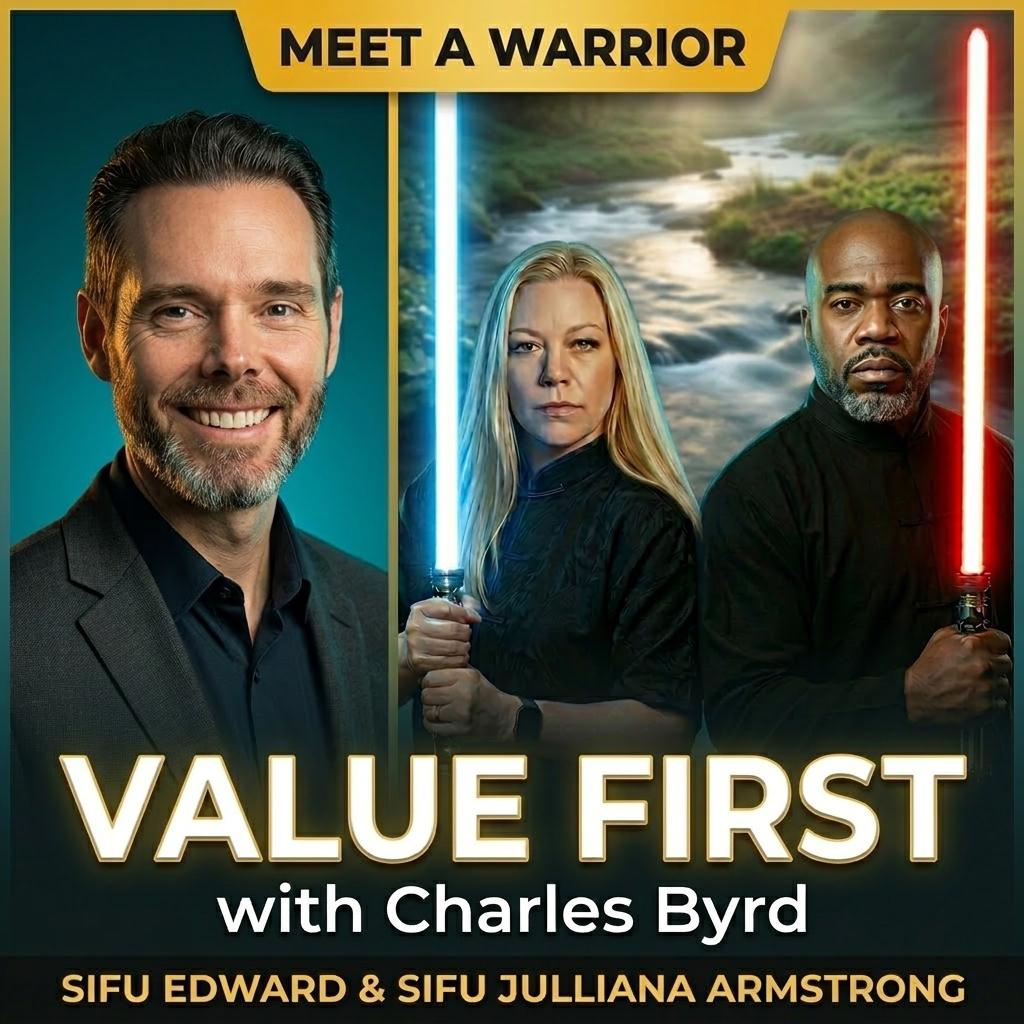
Adapted from the recorded conversation; the guest's words are verbatim. The questions are reconstructed and voiced by Sifu Edward and Sifu Julliana Armstrong.
🎥 Video podcast coming soon. The complete interview will play here once published. The full conversation is transcribed below, and the audio edition will be available on sifuarmstrong.tv.
In a new Sifu Armstrong interview, the joint venture expert behind Pure JV argues that the strongest business relationships are built by giving value with zero expectation of return.
Charles Byrd left a director’s chair at a billion-dollar Silicon Valley software company with no list, no audience, and no connections, and built an entire practice out of the realization that other people already had his ideal clients sitting in their communities. He walked through that pivot with Sifu Edward and Sifu Julliana Armstrong in the latest Warrior Intelligence Series conversation.
The leap itself required total commitment, he said, recalling a piece of wood on his desk that reads “I can, I will. End of story.” His reasoning against hedging is direct: “If you’re walking a line between two paths, you’ll probably fail at both. But if you just commit to one, the path forms right in front of you,” Byrd said.
That same instinct for going all-in shapes his entire philosophy of partnership. Rather than treating relationships as trades (clicks for clicks) Byrd built his practice on giving before any ask ever surfaces. “Value first simply means wherever you go, you’re seeking to provide value to people regardless of what the outcome is on the other side,” he said, describing how he routes a dozen to twenty referrals a week to people regardless of whether it benefits him directly.
He credits much of his staying power in relationships to something he calls the power of the ping, a habit of reaching out the moment someone crosses your mind, with nothing attached. It started, he said, when a friend told him, “Hey, if I ever come to mind, just ping me,” and Byrd decided to apply the same habit to everyone he knows. The payoff, he says, isn’t calculated. It just compounds, showing up later as unexpected joint ventures and referrals from people who were never asked for anything in return.
Byrd is candid that he sees corporate security as more illusion than fact. Diversifying revenue across many partners, he argues, puts an entrepreneur in a safer position than any single paycheck ever could, a principle he applies deliberately to how he tests and deepens every business relationship, one small engagement at a time before going deeper. He breaks joint ventures into four categories: presenting to other people’s audiences, referral partnerships, embedded partnerships, and social JVs like podcast interviews, and says the embedded kind, where one offer is built directly into another, are “the very ones that make many of my clients tens of millions of dollars over time because it’s a single deal that’s made that represents ongoing lead flow.”
It’s a philosophy that mirrors exactly what the Armstrongs have built their own alliances on: nobody scales a movement alone, and the relationships that last are the ones built on service, not leverage.
In This Conversation
- Leaving a director’s chair at a billion-dollar company with no list and no plan
- “Burn the boats”: why committing to one path beats hedging between two
- The “value first” philosophy behind routing referrals with no expectation of return
- The power of the ping, staying top of mind without ever asking for anything
- Why diversifying across many partners is safer than any single paycheck
- Where to find his consulting and the Flow mastermind
The Full Conversation
Sifu Edward Armstrong: No movement was ever built alone. Light Sword Training Academy didn't grow because I was the best fighter in the room. It grew because I learned to build alliances, to walk into a room of people who already had what I needed and offer them something real before I ever asked for anything. Our entire Global Alliance Tour runs on that principle. So when I found a man who turned alliance-building into a science, I knew our operators had to hear him.
Sifu Julliana Armstrong: And what I respect is that he leads with giving. In the competition world it's easy to treat everyone as a rival, but the athletes and coaches I've gone furthest with are the ones I served first: shared a drill, made an introduction, showed up for them. Charles built an entire philosophy on that, and it's the warrior's code wearing a businessman's suit.
Our guest is Charles Byrd, a super connector, speaker, and joint venture expert who helps entrepreneurs create dependable revenue without the stress of paid advertising, combining a Silicon Valley background with a unique mastery of partnerships. Charles, thank you for joining us.
Charles Byrd: Thank you so much for having me. It's a pleasure to be here.
Sifu Edward Armstrong: I walked away from a secure place in a franchise to build something of my own, so I know the weight of leaving a "safe" seat behind. You did the same. You left a director's chair at a billion-dollar company. Take us through that journey from Silicon Valley to becoming a joint venture expert.
Charles Byrd: Sure. So where that's led to, and then I'll tell the backstory. I help businesses scale with joint ventures speaking and systematic referrals to get you in front of more of your ideal clients leveraging other people's audiences. And so how that began, as you noted, I worked in the Silicon Valley for 15 years, was a director at a billion dollar software company, left to get a taste of the entrepreneurial freedom I read about in books, started with a low ticket productivity course as my first product and being new to the online space, didn't yet have a list or connections. So started going to a lot of events and connecting with people online and quickly found my new peer group of entrepreneurs already had my ideal clients in their communities. So started setting up presentations to other people's audiences, delivering a high value training and offering the deeper dive course and started growing the lists, making sales, making a positive impact.
So I thought, since this is working, what if I take my IT and systems background to simplify and systematise the entire joint venture process, which I did. And eventually people wondered how I book two to six joint venture promotions per week for my offers to other people's audiences. And I was at a mastermind in Aspen and my phone's blowing up with texts and Messenger messages, people knocking on the room door going, "How do you line up so many of these deals?" So I decided to put together my first high ticket event called Pure JV, and that's the market I've been serving ever since. At this point, through an eight-week consulting offer that walks companies through helping you create your unique joint venture strategy for your particular product and market, helps you identify your most profitable partners, communities, stages, referral partners, shows you how to connect to those partners through warm channels so there's no cold outreach.
My favourite part, how to guide the conversations to land the deals frequently on the first call, operationally how to execute the deals along with turning each one into two or three more. I've had 12 clients who've added 1.25 to 12 million in additional revenue for clients on stage with Tony Robbins so far this year, one that just got booked on Joe Rogan, Alex Hormozi's a client through one of his acquisition.com companies who just joined me at a 50% event I just hosted in Austin. Tony Robbins CEO is in our sales pipeline as is go high level and click funnels. So it's a framework for just building great relationships with people, providing value first and guiding those directly into winning outcomes.
Sifu Julliana Armstrong: There's a moment every competitor knows, the instant you stop hedging and commit fully to the floor. No safety net, no looking back. That's when everything changes. How long ago did you make that leap from Silicon Valley, and what did committing actually feel like?
Charles Byrd: That was nine years ago and it was kind of a bigger decision to decide to not go get another corporate job, but instead start my own thing, and I'm looking for it on my desk here, I had a piece of wood made when I committed to starting the business that says, "I can, I will. End of story," meaning burn the boats, figure it out. And I found that to be pretty key because if you're walking a line between two paths, you'll probably fail at both of them. But if you just commit to one, the path forms right in front of you because you have directed your attention, money, thought, energy, passions towards something, and as people see where you're going, they dive into support you.
Sifu Edward Armstrong: "Burn the boats." That's the exact energy it took to start an entirely new martial art with people whispering that it would never last. And not everyone in your corner believes at first. When you made that leap, were the people who love you skeptical, or did they join you on the journey?
Charles Byrd: A little of both. A little of both. I had countless conversations with my dad who is trying to get me to go back into a corporate job and I was like, "Nope." The conversation with my wife was much easier, thankfully. I said, "Babe, I'm thinking to just start a company and figure out something new instead of getting another job." And she's like, "Awesome, babe, you can do it." I was like, "Okay." That was that. Because I've had other friends whose wives were not supportive and they're still stuck at a job they hate because they didn't have the support or gumption to take that risk on their own.
What's funny is it's actually way less of a risk than staying in a job where you have no control if they're going to lay you off the next round of layoffs, where as an entrepreneur, and yes, there's places on the way where the road can have bumps in it, but once you have a product and service or service that people want and need, you're actually diversifying your revenue across a whole range of clients, putting you in a dramatically safer position than you would be getting your paycheck from one place. It's the equivalent of people in the online space only paying for Facebook ads and any algorithm change, any problem with an account, something gets hacked, they make an ad that doesn't work right, and the whole thing gets shut down. They're not diversified. Where it's through partnerships, each new partner you're bringing on adds to your lead flow volume, you have a higher conversion, you're only paying based on actual results and you're diversified across partners. Each partner is an independent lead source putting you in a lot safer position.
Sifu Julliana Armstrong: That word "safer" is doing a lot of work, and I want to challenge it the way I'd challenge a young fighter who won't enter a tournament because losing feels risky. Staying small to avoid risk is its own slow death. Your Silicon Valley world is famously boom-or-bust is that the risk you were stepping away from?
Charles Byrd: Well, it's more that people have the illusion that working for one of those big companies is safer than starting their own company. But the fact is, it's not. Anytime they feel like doing a reorg or a layoff, you have zero control over that. And when all your income, basically all your eggs are in one basket and you're not the one steering the ship. Whereas an entrepreneur, like I typically have 15 plus high ticket clients at a time, if not more. My revenue is diversified across a whole range of sources. So you're in a lot safer position. Now, granted, you need to get the product market fit, you need to have an offer that converts. There's hurdles on the way.
But when you commit to the path, you test, you refine, you work on things, you get people results and then keep iterating, then you are in a lovely position to diversify your leads and revenue thereby putting you in a much safer position than you would be in a corporate job while giving you astoundingly more freedom to work where you want with who you want and how you want, of course, based on your model. But ideally, you're engineering a model that fits around your core goals to begin with.
Sifu Edward Armstrong: Diversifying across many partners instead of betting everything on one source. That's exactly why I built a federation of academies rather than a single school. If one falters, the movement stands. So why joint ventures specifically, Charles? Was it that same instinct for security?
Charles Byrd: Well, I just saw that opportunity very early. The first back-to-back industry events, it's like online industry events that I attended, my first product was almost done. It wasn't fully complete, but probably 85% done. And I was like, "When I get this course done, who am I going to offer this to?" I, at the time, had no list, no community, you're just brand new in the space. And the second event I ever went to, which they were a week apart, it was at a mastermind with about 12 entrepreneurs, gorgeous resort in Austin.
And I'm sitting across the table and the guy on the other side, he has 186,000 subscribers to his thing. And the gentleman over here has this whole event where he's matching up all these big players to connect and collaborate and this person with six different businesses in these different markets. I'm like, "Why don't I just go make friends with the guy who already has my ideal clients in his community right now? He already built that whole community. I have a tonne of value to share with a community like that. So why not go talk through where there's positive synergies and offer a way to provide those people value while monetizing for both parties, so it's taking better care of their client base while giving them a revenue stream with zero fulfilment. So it's pure profit for promoting and also being a feeder to grow my business, my list and positive impact with the people I was able to work with."
So I kind of had the decision all of us have when it comes to lead sources, you can either pay for traffic, which I didn't have a clue how to do and didn't feel inspired to learn that or hire it out. You can do content marketing, which does work, but it typically takes about a year of consistent posting and things like that to build that following and gain the traction or just go make friends with the person with a 200,000 person list where they promote you two or three weeks later, you add thousands to your email list, add a bunch of clients. It just seemed like by far the most efficient way to go about it.
Sifu Julliana Armstrong: You talk about "value first" relationships, and that phrase stopped me, because it's the opposite of how most people network, and it's exactly how a true martial arts community works. Explain what value first means, and how it applies to joint ventures.
Charles Byrd: Sure. So value first relationships mean as you interact with basically anybody, certainly people that could be ideal partners or clients, human nature comes in and kind of asks, "What's in it for me?" And this is the opposite where when you meet people, you listen to what they are trying to achieve and accomplish and provide avenues to help facilitate that. Ideally, things that are relatively quick for you to provide. Some examples of that and some of my go-to ways of doing that is listening to someone who their ideal client is or ideal partners, and then offering connections to those folks. So just as an example, I get 12 to 20 referrals a week to million dollar plus businesses. The call I just got off right before this happened to be an intro to a gentleman running a nonprofit. Now, where he's at in that launch of a brand new nonprofit doesn't align very well with how I serve folks, but I simply listened to what he's up to and teed up a connection that can get him funding and access to all kinds of businesses that would be interested in tapping into what he's doing.
Now, if he was doing something that also aligned with the way I serve and support, I would provide that same value that I just did on the last call and I would guide it into another winning outcome, whether that's lining up a JV, a speaking opportunity, a referral partnership, or potentially they'd be a great fit for a client and then I invite them down that path. So value first simply means wherever you go, you're seeking to provide value to people regardless of what the outcome is on the other side because it creates this whole wake of goodwill in front of you where every room you walk in, people are happy to see you because you've hooked them up in all kinds of ways over time, and you're never asking for anything in return. But things flood back in return because of just how you show up in the world and people knowing you're genuinely on their team and care about their goals.
Sifu Edward Armstrong: A wake of goodwill in front of you. That's the warrior's reputation, earned by service long before it's needed. For the operator who's inspired and wants to actually do this, walk us through the basic steps of setting up a successful joint venture campaign.
Charles Byrd: Sure. So there's four primary types of joint ventures, and those include presenting to other people's audiences. Those could be coming into high level groups delivering a high value training like High Ticket Masterminds or inside of other people's high ticket fulfilment programmes. Another part of presenting to other people's groups could be a webinar where one party's doing a mailing to their list, you're coming in and delivering a webinar. Usually in that context, you're making a direct offer on the session. The next type of JVs are referral partnerships. So most of us get referrals, but I call them referrals by luck, meaning you're not controlling the volume or quality of those referrals where when you systematise it and you're doing it very consciously with some very handpicked high quality referral partners, that becomes a type of joint venture where you're actively managing and very much in control over the volume and quality of handpicked warm intros you're getting.
Then there are embedded partnerships. This is where your product services or messaging are inside of other people's offers. So imagine an offer where someone's buying, let's say a book publishing package and someone else who has a podcast production offer is embedded inside it. So someone's buying a book publishing and podcast offer because one offer is embedded in another. When done correctly, those are my favourite kinds of JVs and the very ones that make many of my clients tens of millions of dollars over time because it's a single deal that's made that represents ongoing lead flow.
And then there's social JVs. Simply, things like podcasts and interviews much like this one where in my view the listener's sharing the message is great. The real value is connecting with the hosts or guests to take those relationships a lot deeper and turn those into joint ventures, referral partnerships, speaking opportunities, and or leverage for client acquisition where appropriate.
Sifu Julliana Armstrong: That last one lands for me, because this very conversation is one of those, and I'd rather build a real relationship with you than just air an episode. So many people treat partnerships as a cold trade: I'll send you clicks if you send me clicks. How do you maintain and nurture these relationships so they go deeper than the transaction?
Charles Byrd: Absolutely. I don't like transactional JVs. I know there's whole segments of the JV world that that's just how they operate. I go about it very differently and guide my clients too, which ends up working out quite well for them. Where you're building strong relationships with your partners, you're looking out for them, you're engineering the transference of trust and authority and integration across customer journeys and things like that where there still always is a value exchange, but it's not the annoying I'll send this many clicks if you send that many clicks. I find that world very lame. It's not a satisfying way to live life. I'd far prefer having five to 10 ultra high quality friends and partners where we're all looking out for each other and teeing up amazing things because you end up going way further. When something feels transactional, it's just far less satisfying and doesn't have longevity that goes with it. It's not to say that will never happen, but it is kind of the opposite of how I guide people to do it.
As far as maintaining relationships over time, there's something I call the power of the ping. And that is, well, I'll tell a brief story about it. So I was at an event several years ago with a friend of mine and we were hanging out for two and a half hours talking. And as the conversation was winding down, he's like, "Hey, if I ever come to mind, just ping me." And it struck me as so strange. What if you're having dinner with your kids? Or what if you're delivering a webinar or a training? And then I was like, "Well, screw it. I'll just do that with everyone," because if something reminds you of someone, that's typically enough reason to ping them, maybe you just talk to one of their good friends. Maybe you just booked a flight to a city they live in. Maybe you just got a new piece of technology you know they would be super into. That's enough reason to just check in and say hi.
In fact, when I was doing a fireside chat last week at my flow event in Austin with Robin Alex co-founder of Go HighLevel, he was like, "Some people will send you these extravagant gifts and unique things." And he's like, "It doesn't mean as much as someone just pinging you to check in and say hi and see how you're doing." One is far more authentic. Point being, by being proactively in touch it keeps you top of mind. You're looking out for ways to serve and support over time, which means you're not just showing up in their texts or inbox when you need something. Instead, you've been there for them the whole way. And by being top of mind, it creates all kinds of opportunities.
As an example, my friend and client, Kane Minkus, who I've helped generate $12 million through joint ventures, he's super into tech and he has a Zoomzilla wall like Tony and all of that. And I got a new full frame camera and I was sending him a video. I'm like, "Dude, check out my new Sony." And he's like, "Cool Sony. Hey, would you like to be part of a JV with me, Kevin Harrington, John Assaraf?" I'm like, "Hell yeah, I would." Now, I didn't ping him about that. I had no idea he was doing that. But by just being a friend and being top of mind, it creates all kinds of opportunities and synergies from it.
Sifu Edward Armstrong: It's the old phrase. Your network is your net worth.
Sifu Julliana Armstrong: And I have to smile, because you just mentioned John Assaraf. We had John on this very platform talking about training the brain. The web of these relationships really is everything.
Charles Byrd: Yeah, it's a fact.
Sifu Julliana Armstrong: When I'm building a training partnership, I can feel within a few sessions whether it's going to make us both better. How do you measure the success of a joint venture. What should we be watching for?
Charles Byrd: Well, we'll go a little beyond metrics. For one, just how it is to work with them, to enjoy working with them, how did your audience and product fit? How did those things align? How was conversion, of course, because you want to make sure that JVs you're putting time and effort are actually doing what they're intended to. And in the world of joint ventures, the 80/20 rule is very much in effect. So that's 80% of the revenue coming from 20% of the JVs. So I think it's a combination of how you enjoy working with a company, a team, a founder, audience alignment and conversion, of course.
And so I like doing one-off types of promotions or engagements with someone to see how it clicks and works. And the ones that do really well, those are the ones to dig deeper and turn into stronger embedded partnerships. So yeah, it's the relationship working together and then the financial results along with the results that the client base are actually getting. That's of course a key part of it.
Sifu Edward Armstrong: Test with a single engagement, then deepen the ones that click. That's exactly how we vet alliance partners on the Global Alliance Tour before we ever build something lasting together. I could talk strategy with you for hours, Charles. For the warriors who want to learn more and work with you, where can they find you, and what can you offer?
Charles Byrd: Sure. You can pop over to CharlesByrd.com, B-Y-R-D. That gives more information on the kind of work we support folks with to create a core joint venture strategy, identify your most profitable partners, communities, stages, referral partners, and basically get you up and going. So this is for people with existing products or services. You're known for what you do, your offers are already converting and you're looking to really ramp up your leads through partnerships. So yeah, CharlesByrd.com.
And we also have a high-end lead flow mastermind group called Flow, and that website is flowmastermind.us as in us. So those would be the two pathways. One exploring, supporting you to grow and scale through partnerships and the other, a whole community. 95% of those folks have worked with me one-on-one anyway. So it's a whole community of people trained to think in that value first mindset. They're trained in JVs, referrals, and all running seven-figure plus companies.
Sifu Edward Armstrong: Thank you for sharing so many insights with us today. We really appreciate your time. Once again, Charles Byrd, thank you.
Charles Byrd: My pleasure. Thanks so much for having me.
Sifu Julliana's closing word: What I'm taking from Charles is the power of the ping, the small, unprompted check-in that says "I was thinking of you" with nothing attached. Every great training partnership and rivalry-turned-friendship I have was built that way, one genuine touch at a time. You don't bank relationships by showing up only when you need something. You bank them by being there the whole way.
Sifu Edward's closing word: Charles confirmed the engine behind our whole Global Alliance Tour: an alliance isn't a trade. It's a brotherhood with a handshake. Burn the boats and commit to one path so the way forms in front of you. Lead with value and let the goodwill build a wake ahead of you. Diversify your strength across many partners so no single loss can topple the movement. That's not just how you grow a business. It's how you build something that outlives you. We don't entertain warriors. We create them.
Charles Byrd, super connector, speaker, and joint venture expert. Founder of Pure JV and the Flow mastermind. Find him at CharlesByrd.com and flowmastermind.us.
ILLUSTRATIVE RESULTS. Any revenue, enrollment, margin or retention figure in this conversation is either a documented result from one of our own operations, a figure the guest reports about their own business, or an illustrative example, never a projection of your results.
Nothing here is financial, legal or tax advice.
Stay in the Fight
This conversation is part of the Sifu Armstrong Warrior Intelligence Series: interviews with world-class performers, builders, and thinkers, filtered through the lens of the warrior's path.
Subscribe at sifuarmstrong.news for every new interview, delivered to you.
Join Club Sabernet, the member community of the whole Sifu Armstrong ecosystem, where warriors train, connect, and hold each other to the standard.
Ready to build your own floor? Find your path at sifuarmstrong.com/which-path.