To the Vectors Go the Spoils: Sifu Edward & Sifu Julliana Armstrong Sit Down With Steven Alvey
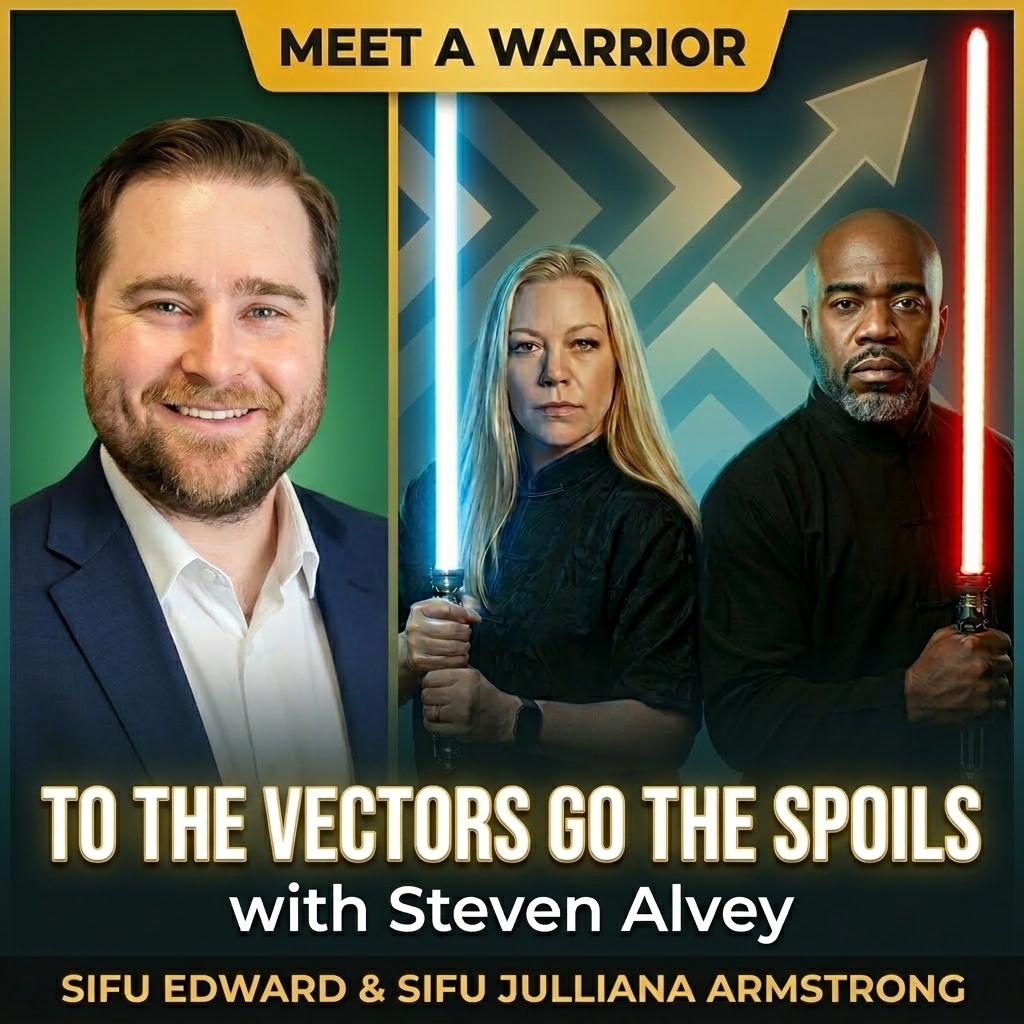
Adapted from the recorded conversation; the guest's words are verbatim. The questions are reconstructed and voiced by Sifu Edward and Sifu Julliana Armstrong.
🎥 Video podcast coming soon. The complete interview will play here once published. The full conversation is transcribed below, and the audio edition will be available on sifuarmstrong.tv.
In a new Sifu Armstrong interview, the private-label-rights innovator argues that willpower is unreliable, so he builds physical structures that force the right behavior instead.
Willpower runs out. That’s the premise Air Force veteran and private-label-rights innovator Steven Alvey built his entire approach to discipline around, in a conversation with Sifu Edward and Sifu Julliana Armstrong for the latest Warrior Intelligence Series installment.
Alvey, who served roughly eleven years of active duty before walking away from a military pension to build an online business full-time, said the leap came with real stakes attached, a fifth child on the way and no safety net to fall back on. “Failure quite literally not being an option is probably the only reason I made it,” he said.
That same self-awareness now shapes how he structures his entire working life. Rather than relying on motivation, Alvey builds physical mechanisms that force the right behavior. “If discipline is something that you lack,” he said, “set up mechanisms that force you to live a disciplined life.” His example: an alarm clock placed in another room, against a glass door, so hitting snooze requires getting out of bed entirely. “It sounds a little sad and pathetic,” he said, “but that’s what I needed to vector myself.”
Alvey stumbled into his signature business almost by accident. A private-label-rights launch he’d scheduled purely as a stopgap between two other projects outperformed everything else he’d built. “The market literally told me they liked this and wanted more,” he said, “and I continued down the PLR path.”
He was candid, too, about his natural tendencies. “My natural inclinations are toward laziness,” Alvey said, a trait he says the military’s structure masked for fifteen years, and one he now manages deliberately, with assistants whose job is partly to help him turn off his “work brain” at the end of the day and protect time with his wife and seven children.
It’s the same principle the Armstrongs build into the warrior’s path: discipline isn’t a feeling you wait for. It’s a structure you build so the right choice becomes the easy one.
In This Conversation
- Walking away from a military pension at year eleven, with a fifth child coming
- Why Alvey builds structure instead of relying on willpower
- The alarm clock across the room, engineering discipline on purpose
- How a stopgap PLR launch became his signature business
- Managing a natural pull toward laziness with outside structure
- Where to find Alvey’s work at stevenalvey.com
The Full Conversation
Sifu Edward Armstrong: Steven Alvey spent eleven years in the Air Force and then did the terrifying thing. He walked away from the pension at the eleven-year mark, with a fifth child on the way, because failure was the only outcome he refused to allow. He's a warrior who traded one uniform for the entrepreneur's fight. And he taught us something profound about discipline: you don't wait to feel it. You build the machinery that forces it.
Sifu Julliana Armstrong: And I love that under the whole thing is family. Seven kids and a hobby farm. That's what the fight is for. He's honest that his natural inclination is toward laziness, and that the reason he wins anyway is that he engineers his environment so the right thing happens whether he feels like it or not. That's the most useful truth about discipline anyone has told us on this show.
Our guest is Steven Alvey, Air Force veteran, private-label-rights innovator, and endorsed by the likes of Brian Tracy and Kevin Harrington. Steven, welcome.
Steven Alvey: Hey, man. Thanks for having me.
Sifu Edward Armstrong: Give us the background, because it starts in the military and on a dream.
Steven Alvey: There's nothing super special about my background. I was an army brat, grew up mostly overseas in Europe, graduated high school, followed my father into the military, about 11 years active duty plus four in the reserves. I live in the Midwest, married, got seven beautiful, crazy children, live on a small acreage where we tend chickens and enjoy the good life. And I actually remember the exact minute the change happened. I was on a guard shift late at night at an Air Force base, and my wife and I had recently been dreaming (the dream home, the dream acreage), the thing where you spend a week addicted to Zillow looking at houses way outside your means. I didn't care about the house so much; I wanted a plot of land to raise my kids with livestock, the whole hobby-farm thing. And I realised, if I'm going to do that, I need more income. The enlisted Air Force salary wasn't going to cut it. So I typed in those words, "how to make money online," and that was going down the rabbit hole. I tinkered with it for a few years on the side, without much success. But that's how it came about, there was something in life I wanted, and I knew I'd need more money.
Sifu Julliana Armstrong: Then you did something genuinely brave. You walked away from the pension. Tell me about that decision.
Steven Alvey: In the military there's an assumption that once you pass the ten-year mark, you might as well stay till retirement for the pension. It's a very tempting deal. But I said to my wife, "I'm not going to do it. I'm going to jump ship at year 11 when my enlistment ends, and do this internet marketing thing full-time." It was pretty scary. My wife was very scared, and honestly so was I. We were both anxious. It was bittersweet. We knew what we wanted, but the risk of leaving a steady job for the entrepreneurial journey is huge. At the time we had four kids and had just found out we had a fifth on the way. So the pressure was on. Failure was not an option. And I think having my feet to the fire, failure quite literally not being an option, is probably the only reason I made it. If I'd had something to fall back on, I would've gotten distracted, gotten lazy, procrastinated. Those are all things I struggle with in general. But there was nothing to fall back on.
Sifu Julliana Armstrong: "Failure not being an option is the only reason I made it." That's a profound and honest thing to admit. It's the whole logic of burning the boats. You cut off the retreat on purpose, because you know your own weakness. A comfortable fallback is the enemy of the breakthrough. You put your family's future on the line and let that pressure forge you. That's not recklessness. That's a warrior who understands exactly how he's wired and uses it.
Sifu Edward Armstrong: What actually got you to your first real success, because I hear a familiar name in there.
Steven Alvey: The most attractive thing to me was the lifestyle, the time freedom, being able to carve out my own day and have that extra time with the family. After a whole bunch of dabbling and falling victim to shiny object syndrome, when I finally left active duty and had to make this happen, I joined a program by a guy named John Thornhill. On paper it's a coaching program, but the most important part is that at the end, he and the program leverage their assets (their email list and traffic), to help you have a profitable launch. That was scary; the solutions that work best are the high-ticket ones, and I had no money, so I didn't even tell my wife about that investment. But I pulled the trigger and worked hard at it for about six months. My first launch did around $25,000, and most importantly built a customer list of 500 people. That went well, but it was a payoff I only arrived at after six months of hustling, which I think is always going to be the case.
Sifu Edward Armstrong: We actually sat with John Thornhill on this very series, so our readers know the exact program that launched you. And I love that the value wasn't just the training, it was that he handed you his audience for your launch. That's the Academy Commander model: a master doesn't just teach you, he lends you his platform to get you off the ground.
Sifu Edward Armstrong: You became a PLR innovator almost by accident. How?
Steven Alvey: We actually started with a software solution (a lead generation product), but supporting software is a headache. How I got into PLR is funny; I didn't intend to. I had a PLR launch scheduled between my first and third launches, only meant as a stop-gap to bridge the gap and pay the bills. I wasn't expecting anything to come of it. And it ended up being astronomical, way more successful than I thought, the conversion rates on the front end and the upsells were phenomenal, and people were saying it was one of the best funnels they'd ever seen. So you step back. You were planning to go one direction, and the market told you something completely different. The market literally told me they liked this and wanted more, so I continued down the PLR path.
Why give away the rights? A couple of answers. The first is money. It's lucrative because the market loves it. It has what I call vertical appeal: everybody wants PLR (the newbies, the veterans, the rock stars), they use it as bonuses, lead magnets, content repurposing. Compare that to a course on collecting opt-ins on a WordPress page, which only appeals to newbies. And there's something appealing to me about the relationship: what I'm providing isn't knowledge, "click here and do this," but an asset they can incorporate into their business. Those customers tend to be more action-oriented, because they've recognised the need to acquire an asset and go take action with it.
Sifu Edward Armstrong: Walk our operators through what a launch actually takes, because I sense it's a mammoth.
Steven Alvey: A launch is huge. You've got product creation, which may involve a whole team or, when you're starting, just you making everything yourself. That's how I did it my first time. Then the customer-facing stuff: the sales pages, the sales copy, coming up with a novel marketing concept, a unique selling proposition, a unique mechanism, what makes someone stay on your page in the first five seconds when they've seen the same thing a thousand times this month. Then the backend technological stuff, the member's area, splitting the offer into a front end and upsells. Coordinating a backend webinar, a high-ticket backend offer. And the big thing, the hardest part for newbies: the affiliate relationships. In this space, most launches are affiliate-driven, so you establish relationships and get people to drive traffic and recommend what you've built to their tribe. Your first one might be a six-month project; even today, by launch day I wish I'd taken six months. At a minimum it's two months of work. We do about two to three big public launches a year.
Sifu Julliana Armstrong: Brian Tracy and Kevin Harrington have endorsed you, but I noticed your personal heroes are two obscure figures from the 1800s. Tell me about them.
Steven Alvey: With Kevin Harrington, it was mostly around my story, leaving the military and beating the odds. With Brian Tracy, more emphasis on copywriting; I got to show off my copywriting chops in San Diego and learn phenomenal things from him. But my heroes right now, as I focus on becoming better at work output and diligence, are a guy named Louis Martin and a guy named Garcia Moreno, both alive in the 1800s: both absolute tanks, machines when it came to being focused, disciplined, and diligent, with a good work-life balance. Those are my top two as I go through the process of trying to become a more disciplined, more diligent person.
Sifu Julliana Armstrong: I love that your heroes aren't the famous names who endorsed you. They're two disciplined men from two centuries ago, chosen for the exact quality you're trying to build in yourself. That's how you pick a hero on purpose: not for their fame, but for the specific virtue you're hunting. It's the same reason a student studies a particular master's footwork. You become what you deliberately admire.
Sifu Julliana Armstrong: And this is the thing I most want our warriors to hear, how you handle discipline when it doesn't come naturally.
Steven Alvey: For the first two years it was terrible. I didn't adapt well to no longer having a boss. Life became fun (you can wake up and say, "we're going to the zoo, everybody get dressed"), but it takes its toll. Lots of stress, chaos, all-nighters, just trying to get a basic life routine under control. So now we've got things that ensure a relatively orderly day. I've got little rules that prevent me from focusing on work during family time, and a couple of assistants whose job is literally to keep me focused and to turn off my work brain at the end of the day. My natural inclinations are toward laziness. The only reason that wasn't a characteristic for 15 years is that I was in the military and it wasn't an option. So discipline is key, and if discipline is something you lack, go outside of yourself and set up an infrastructure, mechanisms that force you to live a disciplined life. There's a phrase from the founding fathers debating the constitution ("to the vectors go the spoils") about creating mechanisms that modify behaviour. I have a hard time not hitting snooze, so I put my alarm in the next room, against a glass door, so I have to get out of bed and walk into the other room to turn it off. It sounds a little sad and pathetic, but that's what I needed to vector myself so that part of my day is orderly.
Sifu Julliana Armstrong: That is the most useful thing anyone has said on this show about discipline, and it's exactly what we teach. Willpower is unreliable, everyone's runs out. So you don't depend on it. You build the structure: the fixed training time, the belt test on the calendar, the training partner waiting for you, the alarm across the room. You engineer an environment where the disciplined choice is the only easy one. "To the vectors go the spoils." Design the machine, and let the machine carry you on the days your motivation doesn't show up.
Sifu Julliana Armstrong: What's the biggest motivation under all of it?
Steven Alvey: It's just the family. I know it sounds cliché, but it all comes down to the wife and kids. Being able to maintain a great lifestyle. And the most important aspect isn't the stuff or the material. It's the time, the memories. I want my kids to grow up not only comfortable financially, but with great memories of awesome quality time we spent together. That's been the big driving factor for the last several years.
Sifu Edward Armstrong: What's next, and where do people find you?
Steven Alvey: Business-wise, I try to come up with a new angle every time. Something the market isn't currently emphasising. But the biggest thing coming up is a hiring decision: I've been in talks with a potential general manager to take over most of the workload of product launching, so I can step away and work on a new aspect of the business. That would be the most transformative thing since I started. It's very hard emotionally to let go of the day-to-day creative stuff, but I remember what John Maxwell taught: if you can find someone who does what you do at least 80% as well as you, hand it off. Because most people want it done 100% as well, and if they can't find that, they'll keep slaving away inside their business instead of working on it, until they retire. You can't wait for perfection. People can find me at stevenalvey.com, or just look me up on Facebook and shoot me a message.
Sifu Edward Armstrong: Steven, thank you so much for your time. It's been a genuine pleasure, from one veteran of a hard discipline to another.
Steven Alvey: Great talking to you. Thanks so much.
Sifu Julliana's closing word: Steven gave us the most practical truth about discipline I've heard: don't wait to feel it, engineer it. The alarm across the room, the assistant who turns off your work brain, the rule that protects family time. Those are vectors, and to the vectors go the spoils. He knows his own weakness and builds a machine that beats it. And under all of it is the real prize: not the acreage, but the memories his kids will carry. That's a warrior who knows what he's fighting for.
Sifu Edward's closing word: Steven walked away from the pension at year eleven with a fifth child coming, because he refused to leave himself a retreat. And then he did the wisest thing a person prone to weakness can do. He stopped relying on willpower and built the structure. Don't wait to feel disciplined. Build the dojo, the schedule, the accountability, the machinery that makes discipline automatic. Then hand off at 80% and go build. We don't entertain warriors. We create them.
Steven Alvey, US Air Force veteran and private-label-rights innovator, endorsed by Brian Tracy and Kevin Harrington. stevenalvey.com.
ILLUSTRATIVE RESULTS. Any revenue, enrollment, margin or retention figure in this conversation is either a documented result from one of our own operations, a figure the guest reports about their own business, or an illustrative example, never a projection of your results.
Nothing here is financial, legal or tax advice.
Stay in the Fight
This conversation is part of the Sifu Armstrong Warrior Intelligence Series: interviews with world-class performers, builders, and thinkers, filtered through the lens of the warrior's path.
Subscribe at sifuarmstrong.news for every new interview, delivered to you.
Join Club Sabernet, the member community of the whole Sifu Armstrong ecosystem, where warriors train, connect, and hold each other to the standard.
Ready to build your own floor? Find your path at sifuarmstrong.com/which-path.