Think Who, Not How: Sifu Edward & Sifu Julliana Armstrong Sit Down With Promote Labs' Jeremy Gislason
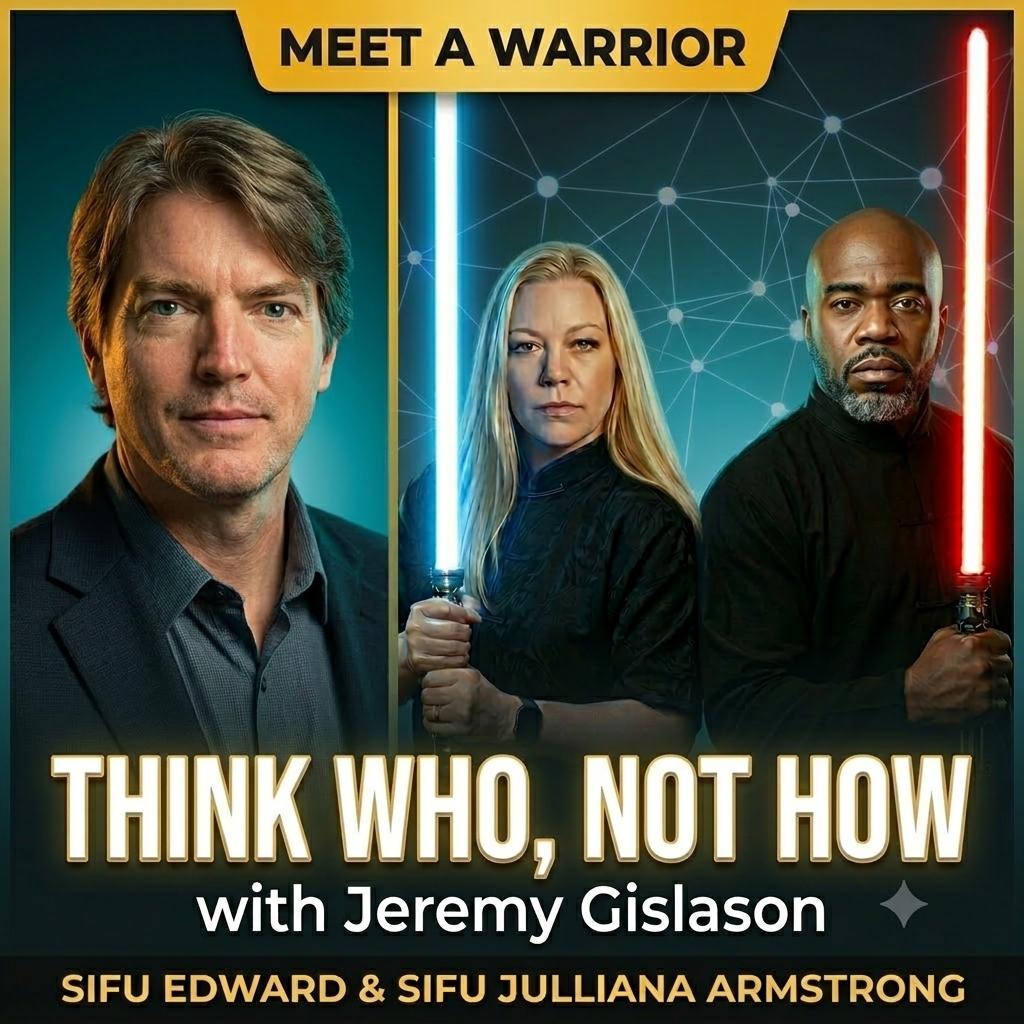
Adapted from the recorded conversation; the guest's words are verbatim. The questions are reconstructed and voiced by Sifu Edward and Sifu Julliana Armstrong.
🎥 Video podcast coming soon. The complete interview will play here once published. The full conversation is transcribed below, and the audio edition will be available on sifuarmstrong.tv.
In a new Sifu Armstrong interview, the software builder behind ProductDyno and Feedback Fox explains how leverage, not hustle, has powered a two-decade partnership.
Jeremy Gislason and his business partner Simon Hodgkinson made two to three million dollars together before ever meeting in person: trading ideas over Skype audio calls, years before Zoom existed, running on nothing but trust. That partnership, and the philosophy behind it, was the center of Gislason’s conversation with Sifu Edward and Sifu Julliana Armstrong on the latest Warrior Intelligence Series.
Gislason’s path started in Japan, teaching English, reading Robert Kiyosaki’s Rich Dad, Poor Dad, and searching for passive income before the modern internet even existed. He lost money learning the ropes at a company called ISO Register, then built his own list-driven membership site, which caught the eye of promoters like Joel Comm and Mike Filsaime. That relationship led him to Simon, and together they built what became Promote Labs, SaaS tools born from solving their own problems first, from Member Speed to ProductDyno, Feedback Fox, and Post Gopher.
The partnership works, Gislason says, precisely because they don’t share an office. “If we were together in the same office, we probably wouldn’t get as much work done because we’d just be goofing off,” he said. Instead, Simon supplies the ideas and Gislason handles execution, with a weekly accountability check-in the only structure they need.
The philosophy that runs through everything they build is deceptively simple. When Gislason and Hodgkinson need something done, they don’t ask how to do it themselves. They ask who can do it. “Don’t think, 'How do I do this?' Think, 'Who can I get to do this?'” Gislason said, describing a discipline that keeps their team small (fewer than a dozen people, all remote, all coordinating on Slack), while still shipping dozens of products over the years, and quietly killing far more than they ever release.
Underneath the tools and the leverage sits one older, more foundational habit that Gislason says never stopped mattering, no matter how the technology around it changed: “Make sure you build your list. No matter what you do, you need to be building your mailing list.” It’s the same instinct that first got him noticed, and the same one he says every builder eventually has to relearn.
Gislason also isn’t precious about scrapping work. Last year the pair spent roughly six months building a new software project before concluding it would never work and killing it outright, a habit he says has to stay easy, because getting too attached to a project means never letting go of the ones that aren’t working. He credits his family, and the freedom to work in short bursts throughout the day rather than a rigid schedule, as the real fuel behind two decades of staying in the game.
Gislason’s advice to anyone starting out is to get motivated by something sturdier than money (family, freedom, the refusal to trade hours for dollars forever), and then find the people who are strong exactly where you’re weak. It’s a version of the same lesson taught on the mat: build the tool the mission actually needs, then hand it to the people who can carry it, so your own energy stays where only you can spend it.
In This Conversation
- Making millions with a business partner he hadn’t met in person, over Skype audio calls
- How Promote Labs builds software to solve its own problems first, then sells the fix
- The “two-pizza team” discipline that keeps a remote company small and fast
- Why Gislason and Hodgkinson can scrap six months of work without losing motivation
- The line that guides every decision: “don’t think how, think who”
- Twenty years, dozens of tools, and an estimated million people touched along the way
The Full Conversation
Sifu Edward Armstrong: A federation runs on its infrastructure as much as its forms. Behind every Academy Commander there has to be a system: software, delivery, the unglamorous machinery that lets a master teach instead of wrestling with technology. We built ours rather than rent it, and our guest is a man who has spent twenty years building exactly that kind of tooling for entrepreneurs around the world.
Sifu Julliana Armstrong: And he built it the way the best partnerships are built. He and his business partner made millions together before they'd ever met in person, working remotely on pure trust, each playing to his own strength. As someone who builds this brand alongside my husband, I know that's the secret: complementary warriors, total trust, and the discipline to stay in your lane.
Our guest is Jeremy Gislason, one half of Promote Labs, creators of ProductDyno, Feedback Fox, Post Gopher and dozens more tools, alongside his partner Simon Hodgkinson. Jeremy, welcome.
Jeremy Gislason: Hi, happy to be here.
Sifu Julliana Armstrong: I have to start where the host's instinct went, with everything you build, when do you actually rest?
Jeremy Gislason: When do I rest? Well, I wouldn't say resting, but I try to take a lot of breaks. I work from home, so no commute, no stressful office conditions. It's a pretty relaxed atmosphere. So about every hour, I'll just get up from a desk and go play with the dogs or go outside and sit on the patio or talk to my wife or just run an errand. And so I don't really feel like I'm working all day. I just do things as needed, whether it's morning, afternoon, nighttime. So, yeah.
Sifu Edward Armstrong: You clearly love it, and love is what sustains the long game. Take us back, your background, and how Promote Labs came to be.
Jeremy Gislason: Sure. I was living in Japan back in the 90s. That's where I met my wife and we had three boys, and we had our own English school where I taught English as a second language. After a couple years I just knew, hey, I don't want to be doing this when I'm in my 40s, because it takes a heck of a lot of energy jumping around with the kids. So I started looking for passive income opportunities, and I read Rich Dad, Poor Dad by Robert Kiyosaki, and that made me think, "Okay, passive income. How do I do it?" This was when the internet was just getting going. We bought our first computer, started going online, and I saw Amazon pop up, and I'm like, "Okay, now you have some income coming in 24/7, even if you're sleeping." That really clicked. I lost a lot of money in the process, but it was a learning experience. I call it the same as going to college where you just spend some money and learn.
I ended up at a company called ISO Register, and there is where I met a lot of connections, Frank Kern, Mike Filsaime, John Reese, Andrew Fox. I learned how web one works, put up websites, built mailing lists. And that's one key that's always stuck with me: make sure you build your list. No matter what you do, you need to be building your mailing list, your contact list.
My first website on my own was surefirewealth.com. The problem I saw was there were a lot of resell rights and private label eBooks on the market, and it was just a hodgepodge of ways to deliver stuff, a mess. So I tried to solve it: I made a membership site inspired by Amazon, nicely laid out, with reviews. Some of the people I'd gotten to know (Joel Comm, Mike Filsaime), would promote it, and that was a light-bulb moment. These guys just sent thousands of people to my website. I'm now paying them thousands in commissions. I'm like, "Maybe I could also be an affiliate marketer on the side too."
During that process I met Simon, who's currently my business partner, Simon Hodgkinson. We started off by being each other's customers, which is kind of funny. We got to talking and said, "Why don't we do something together?" We put together the Marketing Main Event back in 2006, did a couple hundred thousand in a week. Then we released what became Member Speed software, basically a SaaS that let people build membership sites back when it was a new concept and very hard to do. The real eye-opener was when we did 1.7 million in a week. My wife had no clue what I was even doing. She just saw me writing stuff on whiteboards. So that's when we formed a company, later renamed Promote Labs. And since then we've just kept creating software-as-a-service solutions, bigger ones like ProductDyno, simple ones like Feedback Fox and Post Gopher, FlipGuardian for authors, plus a whole line of courses. For every one product we have out, there's probably 10 we've scrapped or sold off, and 50 we killed in brainstorm sessions.
Sifu Julliana Armstrong: Here's the part that fascinates me as someone who builds alongside a partner: you and Simon are in different countries (you in the US, him in the UK), and you made millions before you'd ever met. How does that work?
Jeremy Gislason: That's right. Me and Simon worked together for about two or three years without ever actually meeting in person, and we made like two, three million together without ever meeting. This is before the work-at-home stuff, before Zoom. We'd just hop on Skype and talk. We didn't even have video calls back then, it was just audio. We just trusted each other and went with our intuitions, and it worked out.
Me and Simon have talked about this, and we're like, if we were together in the same office, we probably wouldn't get as much work done because we'd just be goofing off or going out for beers. So we find we're a lot more productive working on our own, but holding each other accountable each week when we have our Monday meetings. He's very creative, he has a lot of ideas, and I'm more on the execution side. So we fit, we work well together. We had no intention of forming a company or making a billion dollars. We just said, "Maybe we could create something together, have fun doing it, and help a lot of people on the way." And that's what we did.
Sifu Edward Armstrong: Creative and execution, two halves of one fighter. That's exactly the partnership I lean on every day. Now, the thing I most want our operators to hear: where do your ideas come from, and what's your philosophy on building versus buying the tools you need?
Jeremy Gislason: Well, I thank a lot of that to Simon. His mind is always wandering. A lot of ideas just don't make it past the idea phase, but the ones that do sometimes turn into a product. We try not to overanalyze too much, analysis paralysis, where you never release anything. We go with our gut. And I try to always look at the future: this worked five years ago, but is it going to work next year? Where are things headed? We're always trying to solve problems, and in the beginning, we were trying to solve our own problems.
For example, when we created Member Speed, we just wanted that for ourselves. Rather than license something that would cost 10, 20,000 a year, we built our own. Same with countdown timers. We built one about six years ago before page builders had integrated them, because we wanted one and nobody had one. So a lot of times we'll have a problem ourselves, and then we'll see, "Could we make this, or do we need to buy this?" If it's something like Slack, of course we buy it. But if it's something simpler that could be done, we'll make it.
And we keep the team really small. I think it was Jeff Bezos with the "two-pizza team", if you have two large pizzas and there are too many people on the team that they go hungry, the team's too big. So just enough people to eat two large pizzas is perfect. We've got less than a dozen people, all remote, all on Slack. It's our virtual office. We haven't used email internally for about five years.
Sifu Edward Armstrong: "Build your list, no matter what" and "build the tool you can't buy," Terry Dean and Travis Ketchum preached the first on this platform, and the second is exactly why we built our own operator infrastructure instead of renting someone else's.
Sifu Julliana Armstrong: And you've clearly killed plenty of projects along the way. How do you keep each other motivated when you have to scrap six months of work, and where does your drive come from?
Jeremy Gislason: We try not to get overly attached to our projects, because if you do, you're never going to let go. Just last year we spent probably six months on a new software project, and by the time it was half done we're like, "This is just never going to work," so we scrapped it. The thing is, once we have the idea and the framework, we always try to find the who to get it done, because there's no way we could do it all ourselves. So I think that's pretty important: don't think, "How do I do this?" Think, "Who can I get to do this?"
As for motivation. I've kind of always been motivated my whole life. I listen to a lot of Tony Robbins type of stuff, and I probably spend one to two hours a day learning, usually via podcasts and newsletters. That keeps me excited because there's always something new. But the biggest motivator for both of us is our families. Simon has a son, I have three. And my wife fully supported me, especially in the early years when I was losing money rather than making money. She just kept encouraging me: "Okay, well, now you know what didn't work."
Sifu Julliana Armstrong: "Don't think how, think who," Daven Michaels said almost the exact same words to us, and it's the truth that frees every builder. You're clearly motivated by family and freedom. If you had to hand a warrior one or two tips from your whole journey, what would they be?
Jeremy Gislason: Everybody's motivated by different things. You don't want to be motivated by money alone, because you'll get burned out. For me it was always family, but also freedom. I did not want to be commuting, going to an office, having somebody tell me when I can take a bathroom break. I might as well go to prison. So freedom was a big motivator, and providing a good life for my family. And basically not selling myself by the hour, because there's only so many hours in a day. Anybody trading time for money is going to hit a threshold. Even if it's a million dollars, it's still a threshold. So if you can leverage your time, leverage your knowledge, leverage what you do as a creator, that's the key.
Too many people say, "I'd like to start a business, but I just don't have time." It's a constant excuse. You've got to make the time. I was running two businesses at the same time, plus dropping my kids off at school every day and playing with them in the parks. The best way to leverage is to start building a team. People say, "Well, I can't afford a team." Partner with somebody, or put them on profit share. I knew a guy with 10 or 12 people on his team, nobody got a salary, they all just split the profits. So: be motivated by the right thing, use leverage, and don't think how, think who. Look at what you're good at; you should be doing that task. Anything else you don't enjoy or aren't good at, outsource it, hire it, or partner it.
Sifu Edward Armstrong: "Play to your strength; delegate the rest." That's how I freed myself to stay on the mat instead of drowning in operations. Do you have any sense of how many people your tools have touched over the years, and where should people find you and what's next?
Jeremy Gislason: Oh wow. As far as our own customer list, we figured out a year or two ago that we'd sold over 130,000 products of our own over the last 15 or 20 years. And then if they're using our software, their customers see it too, if a ProductDyno customer has 50,000 members in his site, they're using our product every day. So it's hard to track, but I'd like to think we've touched a million people over the last 20 years. Everybody we can help inspire or give ideas to, I'm grateful for.
The best place is promotelabs.com. I started in web one, evolved through web two, and now we're hitting web three. That's something Simon and I are very excited about. We were early to bitcoin back in 2014, '15. Some things didn't work out, but we tried. Now with the metaverse and NFTs, it's exciting, and we're working on some new projects. The best way to stay up to date is to get on our mailing list at promotelabs.com, where you can find all our courses and products. And you can follow me on Twitter at JeremyAGislason, though I'd say the mailing list is best.
Sifu Edward Armstrong: Jeremy, thank you so much for being so generous with your time and knowledge. We're sending our best to you and Simon.
Jeremy Gislason: Yeah. Thank you very much.
Sifu Julliana's closing word: Two builders in two countries, total trust, complementary strengths, millions made before they ever shook hands. That's the partnership I live every day. And the line I'm keeping is "don't get overly attached to your projects." On the mat and in business both, the warrior who can't let go of the thing that isn't working never gets to build the thing that does. Hold your creations with an open hand.
Sifu Edward's closing word: Jeremy gave us the operator's quiet superpower: build the tool you can't buy, keep the team small enough to share two pizzas, and above all. Don't think how, think who. Daven Michaels told us the same; when the wise keep drawing the same map, you follow it. Build the infrastructure the art needs, then hand it to the people who'll carry the art, and leverage your hours so you're free to do the one thing only you can do. We don't entertain warriors. We create them.
Jeremy Gislason, co-founder of Promote Labs (ProductDyno, FlipGuardian, Feedback Fox, Post Gopher and more) with partner Simon Hodgkinson. Find their tools, courses, and mailing list at promotelabs.com.
ILLUSTRATIVE RESULTS. Any revenue, enrollment, margin or retention figure in this conversation is either a documented result from one of our own operations, a figure the guest reports about their own business, or an illustrative example, never a projection of your results.
Nothing here is financial, legal or tax advice.
Stay in the Fight
This conversation is part of the Sifu Armstrong Warrior Intelligence Series: interviews with world-class performers, builders, and thinkers, filtered through the lens of the warrior's path.
Subscribe at sifuarmstrong.news for every new interview, delivered to you.
Join Club Sabernet, the member community of the whole Sifu Armstrong ecosystem, where warriors train, connect, and hold each other to the standard.
Ready to build your own floor? Find your path at sifuarmstrong.com/which-path.