The Tipping Point: Sifu Edward & Sifu Julliana Armstrong Sit Down With Neil Stafford
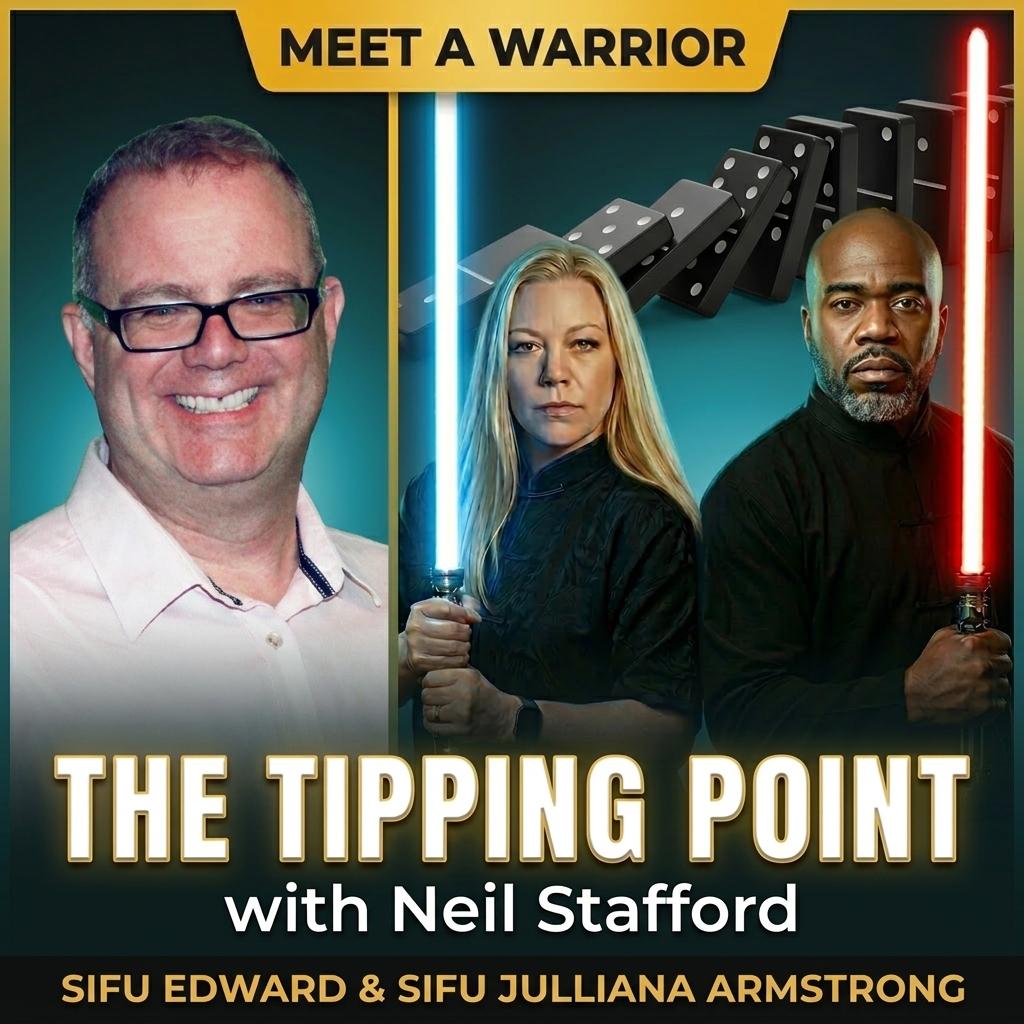
Adapted from the recorded conversation; the guest's words are verbatim. The questions are reconstructed and voiced by Sifu Edward and Sifu Julliana Armstrong.
🎥 Video podcast coming soon. The complete interview will play here once published. The full conversation is transcribed below, and the audio edition will be available on sifuarmstrong.tv.
In a new Sifu Armstrong interview, the online business veteran explains why the first small win of any venture matters more than the money attached to it, and why a golden career can still be a cage.
Long before dial-up gave way to broadband, Neil Stafford walked into a computer shop in Wigan, England, and announced he wanted to build websites. He didn’t know how. That admission (and what he did next) anchors his conversation with Sifu Edward and Sifu Julliana Armstrong for the Warrior Intelligence Series.
Stafford bought design software he could barely afford, picked up a beginner’s guide to HTML, and taught himself to build pages he freely admits were rough. “They were ugly. Really, really ugly. But I saw some sort of potential in it,” he said. That potential turned into a side project selling commissioned oil paintings online: placed through a magazine advert, paid for by a check mailed through the post, because no online payment systems existed yet to collect the money any faster.
That first envelope, Stafford said, marked something bigger than a single sale. “That was our tipping point. First sale generated online, and the tipping point is, 'This could work,'” he said. He returns to the phrase often, describing it as the moment any venture crosses from hope into evidence, the first thousand-dollar month, the first ten-thousand-pound month, each one its own small proof that something real is underway.
The push to build that “plan B” in the first place, Stafford said, came from watching a well-paid financial services career quietly close in around him. The job came with a company car and real bonuses, but the trade-off was steep. “The company owns you basically,” he said. “The higher you climbed the ladder, the more success and income you had, but less and less time.” Phone calls at one in the morning to prepare stock market disclosures were part of the deal, and part of what convinced him the ladder wasn’t worth climbing indefinitely.
He credits a piece of advice from a family member, delivered when he was a teenager, for planting the idea years before he needed it: “Always have a plan B.” DJing filled that role for a while. Then the internet did. When the late nights and the stolen hours finally tipped over into something sustainable, Stafford let the side project become the main one.
The Armstrongs drew a direct line from Stafford’s story to the discipline they teach at LSTA, that the first clean rep, the first small proof a technique works, carries more weight than any trophy that follows, because it converts belief from a guess into a fact a person can build on.
It’s the same lesson underneath every art built on repetition: the win that matters most is rarely the biggest one. It’s the first one.
In This Conversation
- Teaching himself HTML from an “Idiot’s Guide” and building admittedly ugly websites
- The first online sale, an oil painting, paid for by check through the post
- “That was our tipping point”: why the first small win matters more than the money
- Escaping a financial services career that “owns you”
- “Always have a plan B,” advice from a family member that shaped a life
- How a side project became the main one
The Full Conversation
Sifu Edward Armstrong: I love a story that starts with somebody teaching themselves something from scratch, badly, and refusing to stop. Neil Stafford bought a book called the Idiot's Guide to HTML and built websites he freely admits were hideous, and then used them to escape a corporate career that, in his words, owned him. That's the whole arc we believe in: teach yourself the thing, survive the ugly early reps, and build your way to freedom.
Sifu Julliana Armstrong: And the moment I connected with is the tipping point, the first small win that isn't really about the money at all, it's about belief. One check through the letterbox and suddenly "this could work." Every competitor knows that exact instant. I wanted to talk to it.
Our guest is Neil Stafford, a man who swapped his corporate career for an online business. Neil, welcome.
Neil Stafford: Hi. Good to speak to you again.
Sifu Edward Armstrong: When did you kick this off, and what was that unusual first product?
Neil Stafford: Oh, my word. I will say back when the internet was gas powered. Very short story: when the internet started taking off, if you remember the mid 1990s, web designers were getting paid a fortune to build simple three, four, five page websites. So I said, "Oh, I can do that, I'm sure I can." I walked into a local computer shop in Wigan where I live in the Northwest of England, one of those in an old converted terraced house with computer parts everywhere. And I said, "I want to build websites." He said, "You need Dreamweaver." I said, "I love it." He goes, "It's 300 pound," which is about $500. I went, "Oh! That's a lot." But I managed to take a deep breath and bought it, and then I wandered over to the local bookstore and bought the Idiot's Guide to HTML (the forerunner to the dummies book), and proceeded to try and teach myself how to build websites. Long story short, I did, and my word, they were ugly. Really, really ugly. But I saw some sort of potential in it.
My first sale online was back in May 1998, and that was for, believe it or not, an oil painting. Now, I wasn't the artist. My design and artistic skills are like a three-year-old with a crayon. But a friend of mine, Paul, was an artist, and it developed out of an idea. I used to go with him to craft fairs to keep him company, and one time a lady came up to me and said, "Does he do paintings from photographs?" And I went, "Yes." I had no idea whether he did or not. I took a deposit and said, "Paul, can you do this?" He said, "Yes." So he did a painting from photographs, she was happy, and we started commissioning more. Then we placed adverts in magazines where people would ring up for an information pack: pre-digital photography, so we'd take photographs, scan them, print material, send it out. And I went, "I've got an idea. Instead of getting them to ring up, this newfangled internet thing (I know how to build websites, ugly websites." We had no way of taking payments), no PayPal, no Stripe, and the banks wanted your firstborn and your profits for life. So we just put the brochure up online on a horrible GeoCities address, placed the adverts, and waited.
To put it into context, in 1998 the person had to buy the magazine, take it home, read the classifieds, turn the computer on, connect via dial-up, read through the ugly website, print off an order form, write the check, write the envelope, put a stamp on it, and walk to a post box. But lo and behold, that's what happened. An envelope popped through the letterbox with a check inside for 95 pounds, about $150 at the time, and it was our first order generated online, although it was an offline payment, if that makes sense.
Sifu Edward Armstrong: "Does he do paintings from photographs?" "Yes." You didn't even know if it was possible. You said yes first and figured it out after. That's the operator's reflex, and it's the courage most people never find. The ugly websites, the check in the post, none of it matters next to the fact that you committed before you had the answer.
Sifu Julliana Armstrong: That first check. How did it actually feel?
Neil Stafford: Wow. I always talk about tipping points with people. That was our tipping point. First sale generated online, and the tipping point is, "This could work." There is something in this. And whether you're going for your first sale online, your first thousand-dollar month, your first ten-thousand-pound month, each one of those is a tipping point that takes you past that point of, "This works. Where could it go?"
Sifu Julliana Armstrong: That's it exactly, the first win isn't the money, it's the proof. Before it, you're running on hope; after it, you're running on evidence. I've felt it after a single point in a match that suddenly told me "you belong here." Once a warrior crosses that line and believes it's possible, everything downstream gets easier, because now you're not asking if, only how far.
Sifu Edward Armstrong: What were you doing before all this, and what pushed you to build a way out?
Neil Stafford: Past careers have been working for an insurance company in customer service, working in shops, being a mobile and club DJ for a good few years. When I started looking at the internet side, I'd actually settled into a bit of a career in financial services. And I always say I can't give a rags-to-riches story, because I had a pretty good career. I was climbing the ladder. But one thing I did was look ahead, and I didn't like what I saw where I was going to be in five or ten years. Many years ago, when I was 15 or 16, a family member who was very successful said, "Have a plan B, Neil. Always have a plan B." My deejaying was plan B for a while. Then when I started in financial services, this internet thing came along, and that started to be my plan B. My career was well paid, great bonuses, company car. But on the outside looking in, you say, "Oh, they're successful." What they didn't see was the company owns you basically. And the higher you climbed the ladder, the more success and income you had, but less and less time. I've had phone calls at one o'clock in the morning to put a paper together to be released to the stock market because something had been said by my boss's boss. And that was another tipping point: thinking, "Hang on a minute, this isn't right." So for me it was, "Okay, let's get this plan B rolling and see where it can get to."
Sifu Edward Armstrong: "The more success, the more income, but less and less time, the company owns you." That's the golden cage, and it's exactly why I walked away from a franchise. Success on someone else's terms is still a leash. "Always have a plan B" isn't pessimism. It's the refusal to let one entity own your whole life. Build the thing that's yours.
Sifu Julliana Armstrong: Neil, thank you. This has been a real pleasure.
Neil Stafford: Good to speak to you.
Sifu Julliana's closing word: Neil gave us the truest word for the beginning of any journey: the tipping point. That first small win (one check, one point, one clean rep) that whispers "this could work." It's worth more than the money, because it converts hope into evidence, and evidence is what carries you through everything that comes after. The first small win isn't the money. It's the proof. Once a warrior believes it's possible, everything changes.
Sifu Edward's closing word: Neil taught himself an ugly craft from a bookstore guide, said "yes" before he knew the answer, and used it to escape a career that owned him. That's the whole path in miniature: teach yourself, commit before you're ready, survive the ugly reps, and build the plan B that becomes plan A. Never let one master own your whole life. We don't entertain warriors. We create them.
Neil Stafford, internet marketing veteran from the Northwest of England who swapped a corporate career in financial services for an online business. (This written feature covers the bridged version of the conversation. Hear the full interview on sifuarmstrong.tv.)
ILLUSTRATIVE RESULTS. Any revenue, enrollment, margin or retention figure in this conversation is either a documented result from one of our own operations, a figure the guest reports about their own business, or an illustrative example, never a projection of your results.
Nothing here is financial, legal or tax advice.
Stay in the Fight
This conversation is part of the Sifu Armstrong Warrior Intelligence Series: interviews with world-class performers, builders, and thinkers, filtered through the lens of the warrior's path.
Subscribe at sifuarmstrong.news for every new interview, delivered to you.
Join Club Sabernet, the member community of the whole Sifu Armstrong ecosystem, where warriors train, connect, and hold each other to the standard.
Ready to build your own floor? Find your path at sifuarmstrong.com/which-path.