The Scariest Number Is One: Sifu Edward & Sifu Julliana Armstrong Sit Down With Ex-Lawyer Shawn Casey
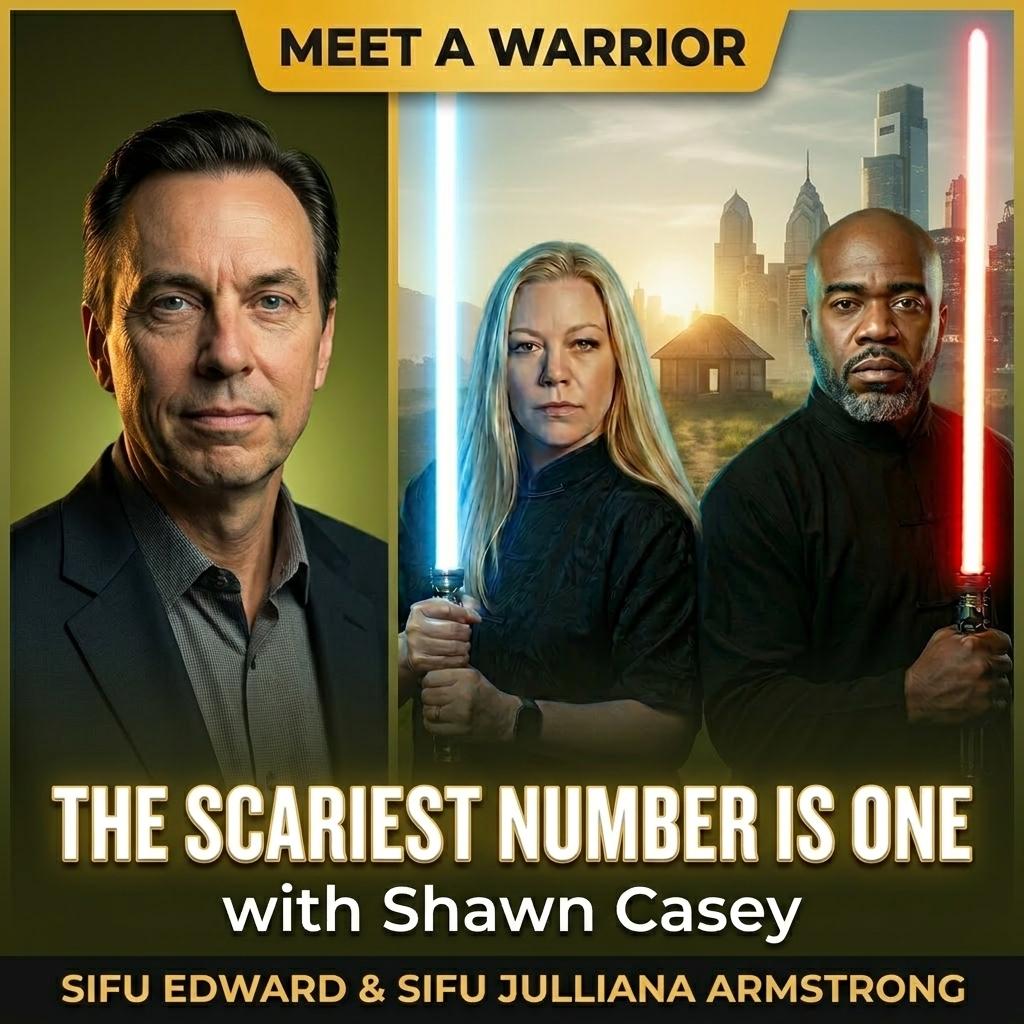
Adapted from the recorded conversation; the guest's words are verbatim. The questions are reconstructed and voiced by Sifu Edward and Sifu Julliana Armstrong.
🎥 Video podcast coming soon. The complete interview will play here once published. The full conversation is transcribed below, and the audio edition will be available on sifuarmstrong.tv.
In a new Sifu Armstrong interview, the WebFire and Increase Billing founder explains the hard-won lesson behind thirty years of building online: never let one platform hold your livelihood hostage.
Shawn Casey left the law in the early 1990s for direct-response marketing and has spent the three decades since building software, email, and e-commerce tools, but the lesson he wanted operators to hear most, in a new Sifu Armstrong interview with Sifu Edward and Sifu Julliana Armstrong for the latest Warrior Intelligence Series conversation, was about dependency, not tactics.
Casey’s path started almost by accident: a legal-topic speech at a real estate conference led Ron LeGrand to tell him he needed a course to sell, and by 1995 Casey had left law practice entirely to become part owner and CEO of LeGrand’s company, teaching entrepreneurs across the country. He moved fully online around 1999, riding the dot-com boom into a business built on capturing a small, steady slice of a much larger flow of money rather than chasing all of it.
The lesson Casey returned to again and again concerned merchant accounts, the systems that let a business process credit cards. Relying on a single processor, he warned, leaves a business exposed to a shutdown with no warning and no recourse, especially for membership businesses that can no longer rebill customers once cut off. “When most people find out they need more than one merchant account is the day they get shut down with the one they have,” Casey said, describing how approval rates on any single account quietly erode over time (sometimes falling from 90 percent to 80 percent or lower) without a business owner ever realizing revenue is leaking away.
Casey built Increase Billing specifically to manage that risk across multiple accounts, describing clients whose approval rates roughly doubled once the problem was diagnosed and corrected.
Casey’s team has also built an AI system that quietly recovers revenue lost to failed subscription payments: recapturing 20 to 30 percent of declined transactions each month without ever contacting the customer directly, he said, turning what most membership businesses simply write off as churn into recovered income.
He was equally direct about why he still values email over social platforms after all these years. Chasing a free audience on social media means competing for attention against creators with audiences no smaller business can match, he said, while email remains a channel a business actually controls. “If you can push the send button and send email, you control whether that message gets delivered,” Casey said, calling the current moment a “second golden age” for the channel precisely because so many businesses have rediscovered that fact.
Now approaching 65 with no plans to retire, Casey said he’d rather keep building than spend his days on a golf course, driven as much by the challenge as by watching the people his tools have helped transform their businesses.
It’s a lesson the Armstrongs have lived themselves: never build on ground someone else can pull out from under you. Own the platform, own the list, own the channel that reaches your own people.
In This Conversation
- From courtroom to conference stage: how Casey left law for marketing
- Why relying on one merchant account is a hidden business risk
- How approval rates quietly erode over time without an owner noticing
- Building Increase Billing to manage payment risk across multiple accounts
- Why email is entering a “second golden age” as social reach dries up
- Turning 65 with no interest in retirement
The Full Conversation
Sifu Edward Armstrong: I walked away from a career that looked successful from the outside because I refused to build my life on someone else's foundation. Shawn Casey did the same. He left the law to build his own thing, and thirty years later, the single hardest-won lesson he teaches is one I'd tattoo on every operator: never let one gatekeeper hold your entire livelihood. The scariest number in business is one.
Sifu Julliana Armstrong: And I love that at sixty-five he has zero interest in retiring. He says he'd hate himself playing golf five days a week. He's in it for the challenge, the adventure, and for watching the people he's helped transform their lives. That's the Ageless Warrior, still hungry, still building.
Our guest is Shawn Casey. A former lawyer turned marketer, based in Georgia, and the mind behind WebFire, Macrolead, and Increase Billing. Shawn, thank you for joining us.
Shawn Casey: Welcome. Glad to be here.
Sifu Edward Armstrong: Start with the pivot. What made you leave the law for marketing?
Shawn Casey: Well, that's actually pretty simple. If you talk to a lot of lawyers or barristers in England, it's not any fun in most cases. People only come to you as a lawyer like, "I got hit by a car," "Somebody died," "I'm getting divorced." It's generally something bad happened. You're not dealing with happy people. You're having a positive impact by trying to solve their problem, but it's just very negative energy. So it wasn't hard to convince me that I should be doing something else.
But I was fortunate, early nineties, to start working with a guy named Ron LeGrand. There was a gentleman named Ernie Kessler who said, "Hey, I need somebody to speak at a conference in Washington, D.C. on a legal topic." So I went down with my wife on the July 4th weekend and spoke, and afterward people came up saying, "Do you have a course so I know how to do this legal stuff for my real estate investments?" And I said, "No." I met Ron LeGrand there and he said, "You need to make a course, and if you make a course, I'll let you speak at my events and sell it." I went home and created an information product. This is the days when you had a physical printed manual and a three-and-a-half-inch floppy disc and cassette tapes. We'd cart these things to events. That was my first foray. That led, in 1995, to me moving to Jacksonville, becoming part owner and CEO of Ron's company, teaching entrepreneurs and real estate investors all over America. That's how I got out of practising law and transitioned into the business of direct response marketing.
Sifu Julliana Armstrong: You said the transition required thinking differently. As someone who's had to rewire how I think under pressure, I want to understand that shift.
Shawn Casey: Well, I never had doubts I was moving in the right direction, as much as that the transition required thinking differently. When you go to law school, they just pound it: you've got to think logically, take emotion out of it. And really, selling is all about emotion. It's not A plus B equals C. It's, if you're experiencing and suffering from A and you would like to get to B, then our product C can help you transition from A to B. It's such a different thing, so much emotion, a different way to look at things. I constantly have to remind myself, because there are times I would sum up someone's entire thing for one of our consulting clients and be like, "Look, it's just this." And then I have to go back and go, "Okay, let me give you the ten-minute explanation, but the summation is three sentences", but I've got to work them through the emotions of it.
Sifu Julliana Armstrong: You said your wife was in the business with you and on the road handling the back of the room. That partnership matters, Edward and I know. Tell me about the support.
Shawn Casey: I didn't have any law partners, so I didn't have that problem. But my wife, who I was in business with (we had our real estate closing business), has always been supportive of all my efforts, even when it meant going on the road constantly. Part of the time she was actually on the road with me, handling the back of the room, checking people in, answering questions. She experienced a lot of that hard life too. She's always been 100% supportive. Now that we're successful it's easy to say, but she recognises where that came from. We like to travel: Belgium, Switzerland, Germany, Austria, all over the U.K., France, a Mediterranean cruise that hit seven countries. We're gone a lot, but we're gone a lot because of this internet business, where I can get up in the morning and while she's having a cup of coffee, I can check on stuff, manage stuff, make things happen, and I'm not tied down.
Sifu Edward Armstrong: You went online around 1999, right into the dotcom boom and bust. How did that hit you?
Shawn Casey: It was interesting. One of the first things I did online was generate co-registration leads. Somebody signs up on a form and can sign up for multiple lists at the same time. We were giving away vacations and cruises to get people to sign up, and selling the leads to companies funded by venture capitalists for a dollar or two. Two interesting things happened. One, more than one of the guys I was selling leads to said, "We don't know what we're going to do with this, but we have X amount of money and we have to buy leads. Our entire mandate is we raised a million dollars and we've got to buy $500,000 worth of leads because we're going to do something with them eventually." And then as those companies imploded, some didn't pay their bills, and we ended up getting pennies on the dollar in bankruptcy court because they didn't actually have a business model. It was just, everyone's throwing money at the internet. They got some of it, and thankfully they gave it to me, which worked out well for me, but not for their investors. In 1999 I left what I was doing with Ron to focus primarily on the internet. You could see it was going to be the future. I'll be the first to admit I had no idea it would get to be where it is now. But the great thing about something where there's so much money flowing. You don't have to get all of it. You just have to get a little stream you can syphon off, and there's still potentially millions of dollars in that small percentage of the billions transacted every year.
Sifu Edward Armstrong: Let's talk about what you build now, and there's one hard-won lesson in here I want every operator to hear, about not depending on a single gatekeeper.
Shawn Casey: We're in a lot of stuff. I have a partner named Brian Koz, more than a decade now. How we got together: we were at a mastermind event and I was whining because I kept trying to get software developed and getting horrible results. I'd give somebody $10,000 and they'd give me something that never worked. Brian said, "I don't understand why you find this so hard," and started showing me stuff his programming team had done. That led to our first major project, WebFire, which has been out there probably ten years: a suite of software tools that help you promote your business online, get better search rankings, find leads, find blogs to guest post on. One of the great things about a SaaS business is that people sign up, and if you deliver and they're using it, they'll stay customers forever. We have customers who've been with us since the first beta version.
We have another product called Macrolead, a business lead search engine: more than a hundred million businesses sourced into a database with phone, email, and social media. And we have Increase Billing, an advanced product for e-comm companies where we optimise the transaction flow. Now we're going to get down in the weeds, because people who want to grow their business will run into two issues nobody warns them about. The first thing is you get a merchant account so you can process credit cards. Maybe that's Stripe. The problem with Stripe is they automatically approve you, let you run, and then one day they say, "Okay, you're shut off." It doesn't matter why. When they do that, you're out of business. If you have a membership product, you're really screwed, because you can't rebill anybody, Stripe has all the data. It's similarly a bad plan if you have just one regular merchant account, because if they shut you off, you're still screwed because they have all the data.
The first thing you want to do once you get to any size is have more than one way to process credit cards. If you ask your merchant account broker, they say, "You don't need to do that, everything's fine." That's what they all say until it's not. The day you get shut down, there are millions of horror stories of businesses who have no idea what they did wrong but suddenly can't sell anything. Once you get multiple merchant accounts, you'll discover that over time some or all of them erode in their processing approvals. Day one, 90% of orders go through. Year two, 85%. Year three, 80%. You've created a negative response somewhere in the system of some group of banks who decided they shouldn't let you get customers through them anymore. You're losing 10% of your entire business and you have no idea, because to you it's just, "This is what I get." What Increase Billing does is manage and optimise across multiple accounts. We've had guys getting only 40% approvals who were making great money. They didn't realise they were missing out. Literally, they doubled their business overnight once we got them better processing. And when you have a membership program, by definition every month not everyone pays you. The decline rate on something non-essential might be 20 or 30%. We built an AI system that recaptures 20 or 30% of that without ever contacting a customer. That's like free money, because you already have the customers. When most people find out they need more than one merchant account is the day they get shut down with the one they have.
Sifu Edward Armstrong: Stop there, because that is the deepest lesson in this whole conversation, and it's why I left a franchise. The scariest number is one. One gatekeeper who can shut you off, one master who owns your data, one landlord who can end your business by changing their mind. That's not a business, that's a hostage situation. Own more than one door. Own the ground you stand on.
Sifu Edward Armstrong: You've built across wildly different niches over 30 years: information, software, even survival gear. Walk us through that range.
Shawn Casey: When I started online, I didn't know what existed. We started off just being a service provider, generating leads, building an email list. After talking to people who wanted to know what I was doing, I created a book called Mining Gold on the Internet: 22 ways you could generate traffic, build a list, and make sales for free or low cost. We eventually sold more than a hundred thousand copies. That got me a big customer base and connected me with other people training people online. You've probably heard of Frank Kern. Frank was my biggest affiliate at one point, going back more than 20 years. Frank said, "I'm going to create this membership thing," and I said, "Well, I'm working on a membership thing." So we created it together, the first internet-marketing-focused membership that we know of. We had to pay guys to build software so we could do it. Frank, who is brilliant, said, "We need to give people these trainings with this screen capture software I just found called Camtasia. People are going to love this online video training thing." Which of course was exactly right. We created a membership called Cashflow Circle: monthly training videos, interviews with top marketers like Robert Allen, plus the practical "here's how to set up a pay-per-click campaign."
Later we became partners with Brian and moved into all kinds of software. About seven years ago we created a business primarily in the survival niche (information, training, and products like flashlights and knives and tactical pens), and in that business alone sold more than a million products. We've phased out of that to focus back on software. We've got three or four more products in the pipeline, ranging from email marketing tools to an incredible stock analysis program our lead programmer has developed over years, because he's not only a brilliant programmer, he loves investing. He's sourced terabytes of data off corporate filings. The kind of stuff big equity firms on Wall Street do that normal humans wouldn't even think about.
Sifu Julliana Armstrong: You're about to turn sixty-five and have no intention of retiring. Why keep going?
Shawn Casey: Showing up at my office? Really. I'm going to turn 65 and I have no intention of being an old retired guy, because I'd be completely bored. I live in a country club community, beautiful golf course. I have friends who've retired and play golf five days a week. I wouldn't last two weeks. I'd be so miserable and frustrated I'd hate myself. I'm much better off playing once every couple of weeks, hitting a couple of good shots I can remember fondly, and then not torturing myself again. This is fun. The challenge, the adventure, something new to try. Not everything we come up with works. We've built things that are colossal failures, spent hundreds of thousands on some of them. But when you get something that works and you can refine it and work the marketing campaign, that's really awesome. The other part is we've been able to help so many people, people who never thought of marketing online or running a business, that I've helped sell millions and millions of dollars of products. We have people whose businesses we've literally transformed. That's a great feeling. Obviously it's not completely altruistic. We get paid for it, and we get paid well because we deliver great results. Just like Microsoft or Google. You deliver great things, you get paid for it. But the future is more software and more ways to help people start, grow, and refine a business, because there is still so much opportunity.
Sifu Julliana Armstrong: You said something that stuck with me, that email is having a second golden age, because it's the one channel you actually control. In a MrBeast world, that's a powerful idea.
Shawn Casey: People often ask me, "Is it too late to get started on the internet?" The answer is no. When I started, what was really hard is nobody knew what to do, everyone was isolated. Now there's so much information, so many resources. And oddly enough, I think we're coming into the second golden age of email. The early days were a golden age because you could send an email and the responsiveness was amazing. But I see now, from the data on the growth of email sending companies, how many businesses are saying, "I need to build an email list, I need to reach my customers." Because if you can send email every day, you can make money. If you've got a couple thousand people on the list and you're not making money, you're just not sending the right stuff.
If I had to guess, a lot of promotional ideas shifted to social media thinking you can build a free audience. But now if you're not massive on social media, you can't get seen. You're getting dominated by what goes viral. You can't beat MrBeast, the king of YouTube, who gets hundreds of millions of views. So where do you go? You go to a playing field you can play in and control your audience. You build an audience on Facebook or Instagram or TikTok that's free: maybe you get reach, maybe you don't, it's up to them. But if you can push the send button and send email, you control whether that message gets delivered. That's still a very different thing than hoping Facebook is going to show your latest post, because they probably won't.
Sifu Julliana Armstrong: That's it exactly, control the stage you stand on. You can't out-spectacle the biggest act in the arena, but you can own a room where the door is yours and the audience actually came to see you. That's sovereignty, whether it's an email list or a mat full of your own students.
Sifu Edward Armstrong: Shawn, this has been fascinating. Where should people go to find you?
Shawn Casey: Two places, webfire.com for our suite of tools that will help you promote your business online and get great results. And if you've got an e-comm business processing more than a million dollars a year, look at increasebilling.com, because that's where we can help you get more money from the transactions you're already processing. Love to hear from anybody. You can contact us through those sites. We wish everyone great success starting, building, growing, and selling their business.
Sifu Edward Armstrong: Shawn, thank you so much for being so generous with your time.
Sifu Julliana's closing word: Two things I'm keeping. At sixty-five, Shawn would rather show up at the office than play golf, because the challenge is the point, and the reward is watching people he helped transform their lives. That's the Ageless Warrior, and I hope I'm exactly that at sixty-five. And "control the channel you send on." You can't out-spectacle the biggest act in the arena, but you can own a room where the door is yours. Build the stage nobody can take from you.
Sifu Edward's closing word: Shawn gave us the single sharpest sentence for any builder: the scariest number is one. One gatekeeper who can shut you off is not a partner, it's a leash. I left a franchise for exactly that reason. I refused to let one entity own the ground my life stood on. Own more than one door. Own your list. Own your data. Never build your house on rented land. That's the whole reason I left the franchise. We don't entertain warriors. We create them.
Shawn Casey, former lawyer turned direct-response marketer, based in Georgia; creator of WebFire (webfire.com), Macrolead, and Increase Billing (increasebilling.com).
ILLUSTRATIVE RESULTS. Any revenue, enrollment, margin or retention figure in this conversation is either a documented result from one of our own operations, a figure the guest reports about their own business, or an illustrative example, never a projection of your results.
Nothing here is financial, legal or tax advice.
Stay in the Fight
This conversation is part of the Sifu Armstrong Warrior Intelligence Series: interviews with world-class performers, builders, and thinkers, filtered through the lens of the warrior's path.
Subscribe at sifuarmstrong.news for every new interview, delivered to you.
Join Club Sabernet, the member community of the whole Sifu Armstrong ecosystem, where warriors train, connect, and hold each other to the standard.
Ready to build your own floor? Find your path at sifuarmstrong.com/which-path.