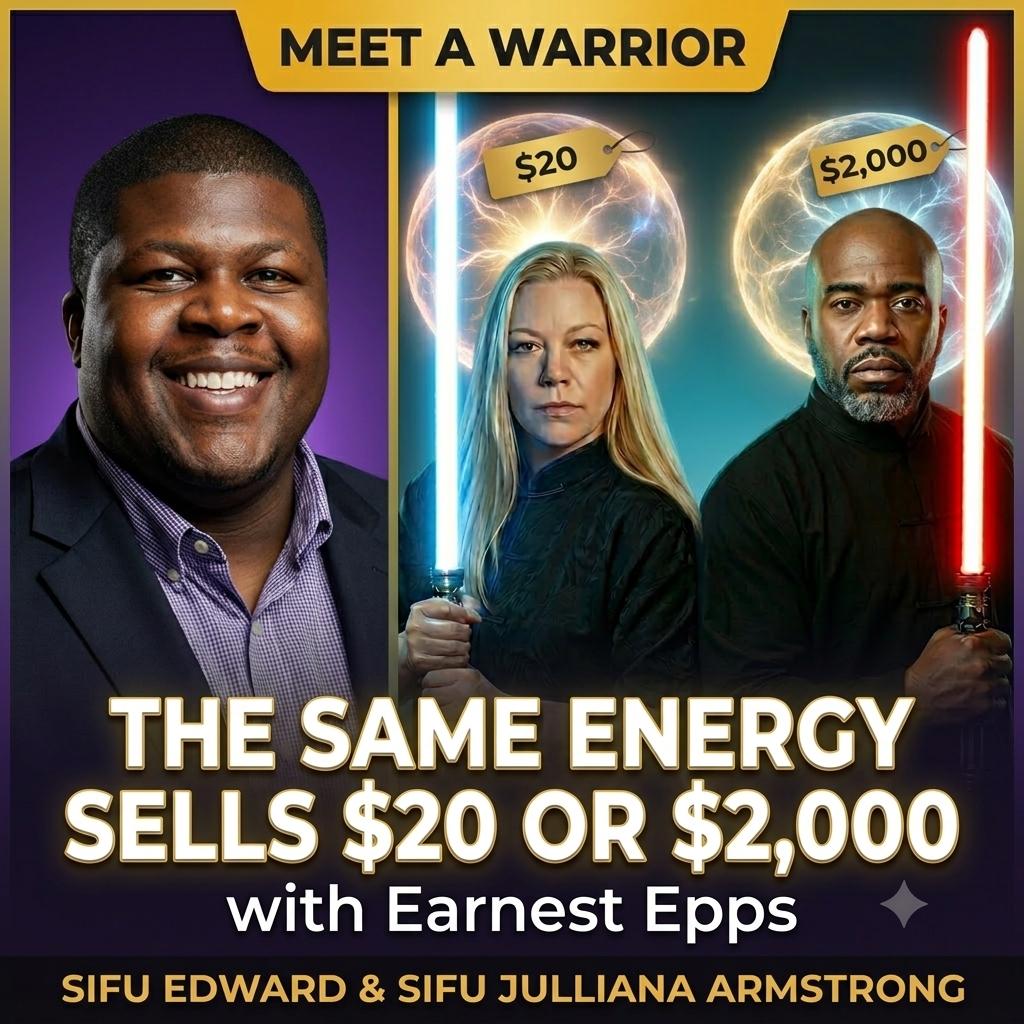
The Same Energy Sells $20 or $2,000: Sifu Edward & Sifu Julliana Armstrong Sit Down With Earnest Epps
Adapted from the recorded conversation; the guest's words are verbatim. The questions are reconstructed and voiced by Sifu Edward and Sifu Julliana Armstrong.
🎥 Video podcast coming soon. The complete interview will play here once published. The full conversation is transcribed below, and the audio edition will be available on sifuarmstrong.tv.
In a new Sifu Armstrong interview, the high-ticket drop-shipping expert traces a straight line from getting fired from his “dream job” to a business that runs without him.
Earnest Epps thought he’d made it, a near six-figure corporate salary in his early twenties, a company car, flights across the country managing projects for billion-dollar brands. Then a restructuring call ended it, and Epps told Sifu Edward and Sifu Julliana Armstrong, on the latest Warrior Intelligence Series, that it broke him in a way he didn’t expect. “It crushed my soul,” he said, describing an identity crisis so severe it nearly triggered a panic attack, because the job had quietly become who he thought he was.
He rebuilt from a Barnes & Noble business-book shelf, buying Social Media Marketing For Dummies because, in his words, he needed to start there, and later leaned on a Warren Buffett line about needing to make money while you sleep to pick e-commerce over the stock market or real estate. What followed was a deliberate study of “real” corporate retailers instead of internet hype. He modeled the top hundred retail companies in the world, discovered major brands like Samsung, Panasonic, and LG would allow drop-shipping for legitimate small businesses, and built contracts most beginners assume are out of reach.
The pricing philosophy Epps developed became the backbone of his business: sell fewer, higher-priced products rather than chasing volume on cheap ones. Rather than needing to move 100,000 units of a $10 product to hit a million dollars a year, he found a niche of electric fireplaces selling for $800 to $1,000 apiece, where a couple sales a week would do the same work. “It takes literally the same energy, time and effort to sell a $20 product as it does a $2,000 product,” he said, the brand-building, the marketing, and the website all cost the same labor regardless of price point, so pricing low simply leaves money on the table for identical work.
That system now runs largely without him. Modeling Apple’s consistent in-store experience across locations, Epps built processes precise enough that a team of virtual assistants (managed by another manager) keeps his flagship store generating roughly half a million dollars a year while he works, by his own estimate, about an hour a week.
The most candid moment of the conversation wasn’t about business at all. Epps admitted he took work calls in the delivery room while his first two children were born, negotiating inventory orders as his wife gave birth. Looking back, his regret is blunt: “If I could go back and smack that Earnest, I’d say, 'Hey dummy, focus on the family and what’s going on in life.'” He says he’d never return to that corporate grind, in large part because of what it cost him at home.
Today Epps says he’s documented helping more than twenty-five people become millionaires through e-commerce, and describes the freedom his systems bought him as the real point of building any of it in the first place. He recalls a client casually mentioning, live on a training call, that they’d just sold their store and quit their job (news Epps hadn’t heard until that moment), and says hearing updates like that from people going through his programs is what makes the work worth doing.
In This Conversation
- Getting fired from a “dream job” and the identity crisis that followed
- Studying the top hundred retail companies instead of following internet hype
- The high-ticket pricing insight: “the same energy sells $20 or $2,000”
- Building an Apple-style system precise enough to run without him day to day
- The confession about taking business calls in the delivery room, and the regret behind it
- Helping others reach freedom through e-commerce systems built on real, branded products
The Full Conversation
Sifu Edward Armstrong: Earnest Epps got fired from what he thought was his dream job and built a high-ticket e-commerce operation that runs without him. And he gave our operators a pricing truth we live by: it takes the same energy to sell a $20 product as a $2,000 one, so why sell cheap? That's the whole logic of the premium a real master commands.
Sifu Julliana Armstrong: And under the business is a story that hit me hard. When he lost that job, he had a full-blown identity crisis (an ugly cry, near a panic attack), because the job was who he thought he was. And later he confesses he was on business calls in the delivery room while his children were being born, and says if he could go back, he'd "smack that Earnest and tell him to focus on the family." That's a warrior's reckoning with what actually matters, and I needed to talk about it.
Our guest is Earnest Epps, US e-commerce and drop-shipping expert. Earnest, great to meet you.
Earnest Epps: Yes, indeed. Excited to be here.
Sifu Julliana Armstrong: Take us to the bottom. The day the dream job ended.
Earnest Epps: It wasn't a nice, sexy start. I got fired from my corporate job. The cute version is "let go," but at the end of the day you got fired. And it crushed my soul, because I had the dream job: early-to-mid 20s, almost a six-figure income, the company paying for my car, my cellphone, my gas, flying me all over the US managing projects for billion-dollar brands. I thought I made it. I thought I'd be CEO one day, work there 40 years. Then I got a phone call that the company was restructuring, and they were restructuring me out of the restructure. It broke me mentally and spiritually. I cried like a baby, not the sad cry, the ugly cry, snot and tears, I almost had a panic attack. And it was mainly because the job was also my identity, and I didn't realise I was wrapped up in all that. So I said, "I'm never going to work for anyone else again. I've got to figure out how to do something in my life."
Sifu Julliana Armstrong: "The job was my identity, and I didn't realise it." That's the wound underneath so many of these stories, and it's a profound one. You built your whole sense of self on a thing that could be taken away with a phone call, and when it was, you didn't just lose a paycheck, you lost who you thought you were. But here's what I see: that shattering is exactly what forced you to find out who you actually are, apart from any title. You are not your job, not your rank, not the badge someone else can revoke. What they took away was a role. What you found underneath it was a warrior. And that turned out to be far bigger than the job ever let you be.
Sifu Edward Armstrong: So how did you find the path, and I love that you're honest it started with a "For Dummies" book.
Earnest Epps: I literally walked into Barnes & Noble and said, "I'm going to start a business," went to the business section, and the first thing it led me to was social media marketing. I bought Social Media Marketing For Dummies, because I said, "Shoot, I'm a dummy, I don't know anything about this." I tell people I'm not the sharpest tool in the shed, but I learned to do the fundamental things really, really well, with so much tenacity and consistency and persistence that it makes it look like I'm a rockstar. Then I ran across a Warren Buffett quote: "If you don't learn how to make money while you sleep, you're going to work until you die." So I bucketed the best vehicles: stock market, real estate, and e-commerce, because all three let you make money while you sleep. I had no money for stocks, real estate needs money at the table, but e-commerce I could start with a couple hundred dollars, and with drop-shipping you could have millions of dollars of inventory you don't pay for upfront, collect the profit first, and pay the purchase order after. Plus the internet doesn't shut off. It's on 24/7. So that was the direction.
Sifu Edward Armstrong: "I'm not the sharpest tool, but I do the fundamentals with tenacity, and it makes it look like I'm a rockstar." That is one of the most important things anyone has said on this show, and it demolishes a myth. Mastery is not exotic talent. It's ordinary fundamentals, executed with relentless consistency until they look like magic. The black belt isn't doing secret techniques; they're doing the same basics as the white belt, ten thousand times more precisely. Tenacity on the fundamentals beats brilliance on the flashy every single time.
Sifu Edward Armstrong: You built the business on a principle worth its own headline, success leaves clues, and you chose who to study very deliberately.
Earnest Epps: Success leaves clues. So almost 10 years ago I said, let me look at the top online retail businesses in the world and see how they run business. Not some YouTuber in his early 20s that barely has armpit hair yet. I said, I need to go study real corporate people who do this for real. I looked at the top hundred retail companies (the Amazons, the Walmarts, the Targets), and the number one thing they all had in common is they're not working with fly-by-night random companies nobody knows. They work with real, branded products. So I asked: do these brands allow drop-shipping even for a small new company? And the answer is yes. I got contracts with Samsung, Panasonic, LG when I was brand new. All they want is that you're a legit registered business with a real phone, email, and website. And working with real domestic brands is your risk mitigation, because there's a contractual, legal honoring process, unlike some fly-by-night overseas company that can just ghost you and disappear with the customer's money you're now liable for.
Sifu Edward Armstrong: "I need to study real people who do this for real, not the loudest kid on YouTube." That is the discernment that saves a career. In every field, the internet is drowning in confident amateurs, and the beginner can't yet tell the master from the noise. So you did the wise thing. You went to the proven, the ones with decades and results, and modeled them. Success does leave clues, but only if you're studying the right people. Follow the one who's actually walked the path, not the one with the biggest following.
Sifu Edward Armstrong: And then the pricing insight our operators need, high ticket. Make the case.
Earnest Epps: I developed the concept of high-ticket e-commerce, focused on higher-priced products. Because if I wanted a million dollars a year selling $10 products like everybody else, I'd have to sell 100,000 units. At $100 products, still 10,000 units. But at $1,000 products, I'd only have to sell a thousand. That's only a couple a week. I found there were 200,000 people looking for electric fireplaces at an $800-to-$1,000 average price point, some commercial ones up to $4,000-$5,000. And here's the thing I've said on stage next to Gary Vaynerchuk and the CEO of Shopify, and no one's ever said I'm wrong: it takes literally the same energy, time, and effort to sell a $20 product as a $2,000 product. You have to build a brand, build and optimize a website, learn marketing and advertising, acquire the same skillsets no matter what. The only difference is you make more money per transaction on the $2,000 product. It's just what it is.
Sifu Edward Armstrong: "The same energy sells $20 or $2,000." Write that on the wall of every operator who's afraid to charge what they're worth. The work of building the brand, earning the trust, mastering the craft is identical whether you price low or high, so pricing low is just leaving money on the table while doing all the same labor. This is exactly why we position the Sifu Armstrong name at the top and never apologize for it. A master's time is not a discount bin. Charge for the transformation, not the trinket.
Sifu Edward Armstrong: The business runs without you now. What makes that possible?
Earnest Epps: Success is a system. Think about it. You go to an Apple store in the USA and one in Barcelona, and it's the same products, the same questions, the same guidance, because Apple has a retail system that works. So when you develop your own systems and processes and put them in place, that's what makes the business sustainable, even during a pandemic or a recession. Once you get good, you build a team, hire virtual assistants to run the day-to-day. I work maybe an hour in the business now, and the only reason I say "maybe" is I have a team managing the team. My main business, which I launched almost 10 years ago, does half a million dollars a year consistently without me being involved in the day-to-day, because there are systems and processes in place.
Sifu Julliana Armstrong: Now the part I most wanted to sit with. You would never go back to that corporate life, and the reason is heartbreaking and important.
Earnest Epps: Absolutely not, because it's about the freedom. I sold myself to that job, seven days a week, not five. Why do you get so much growth at 23? Because I was working a hundred hours a week, flat-out working everyone. And everything else took a backseat. The clearest example of how bad it was: when my first two kids were born, I was in the hospital on conference calls. She's delivering babies, giving birth, and I'm saying, "Hey y'all, send that P&L in, did we get that inventory order for the store on Main Street?" It was bad. No one should be doing that. If I could go back and smack that Earnest, I'd say, "Hey dummy, focus on the family and what's going on in life. This whole job isn't worth slaving away at that level." So I would definitely not go back to that.
Sifu Julliana Armstrong: On conference calls while your children were being born. Thank you for being brave enough to say that out loud, because it's the warning so many people need before it's too late. You had convinced yourself the job was worth it. The promotions came precisely because you sacrificed everything real for it. But no title, no P&L, no billion-dollar brand is worth missing your child's first breath. The whole point of building freedom is to be present for the people you're building it for. A warrior who wins every battle and loses his family hasn't won anything. You learned it, and now you get to be there. That's the real victory.
Sifu Julliana Armstrong: And now you spend your days making other people free. What does that give you?
Earnest Epps: I've personally documented helping over 25 people become millionaires through e-commerce, and over 100 people generate over a hundred thousand dollars with their stores. I was on a training last week and a client casually mentioned, "By the way, I just sold one of my e-comm stores and quit my job", live on the call, and I had no idea. We get people retiring, sending me updates randomly, because they went through our programs. So it's really amazing to know that every single day, someone's life is being made better as a result of me being the best version of me. You can find me at earnestepps.com, and Earnest Epps on any major social platform.
Sifu Edward Armstrong: Earnest, this has been a genuine pleasure, thank you for the wisdom and the honesty.
Earnest Epps: No problem.
Sifu Julliana's closing word: Earnest lost a job and had an identity crisis, because he'd built his whole self on a thing a phone call could take away. You are not your title, and when they took his, he found out who he actually was, and it was bigger than the job ever let him be. And his confession about the delivery-room conference calls is a warning every driven person needs: no victory at work is worth missing the people you're fighting for. Being present is the whole point.
Sifu Edward's closing word: Earnest hands our operators two truths to carry. Mastery is fundamentals executed with tenacity until they look like magic, not exotic talent. And the same energy sells the cheap thing or the premium one, so charge for the transformation and never apologize for the value you bring. Study the real masters, not the loudest voice; build systems so the work outlives your hours; and use the freedom to be present, and to make other people free. We don't entertain warriors. We create them.
Earnest Epps, US e-commerce and high-ticket drop-shipping expert, trainer, and speaker; his flagship store has run at half a million dollars a year, largely hands-off, for nearly a decade. earnestepps.com.
ILLUSTRATIVE RESULTS. Any revenue, enrollment, margin or retention figure in this conversation is either a documented result from one of our own operations, a figure the guest reports about their own business, or an illustrative example, never a projection of your results.
Nothing here is financial, legal or tax advice.
Stay in the Fight
This conversation is part of the Sifu Armstrong Warrior Intelligence Series: interviews with world-class performers, builders, and thinkers, filtered through the lens of the warrior's path.
Subscribe at sifuarmstrong.news for every new interview, delivered to you.
Join Club Sabernet, the member community of the whole Sifu Armstrong ecosystem, where warriors train, connect, and hold each other to the standard.
Ready to build your own floor? Find your path at sifuarmstrong.com/which-path.