The Rigged Game: Sifu Edward & Sifu Julliana Armstrong Sit Down With The Million Dollar Decision's Robert Rolih
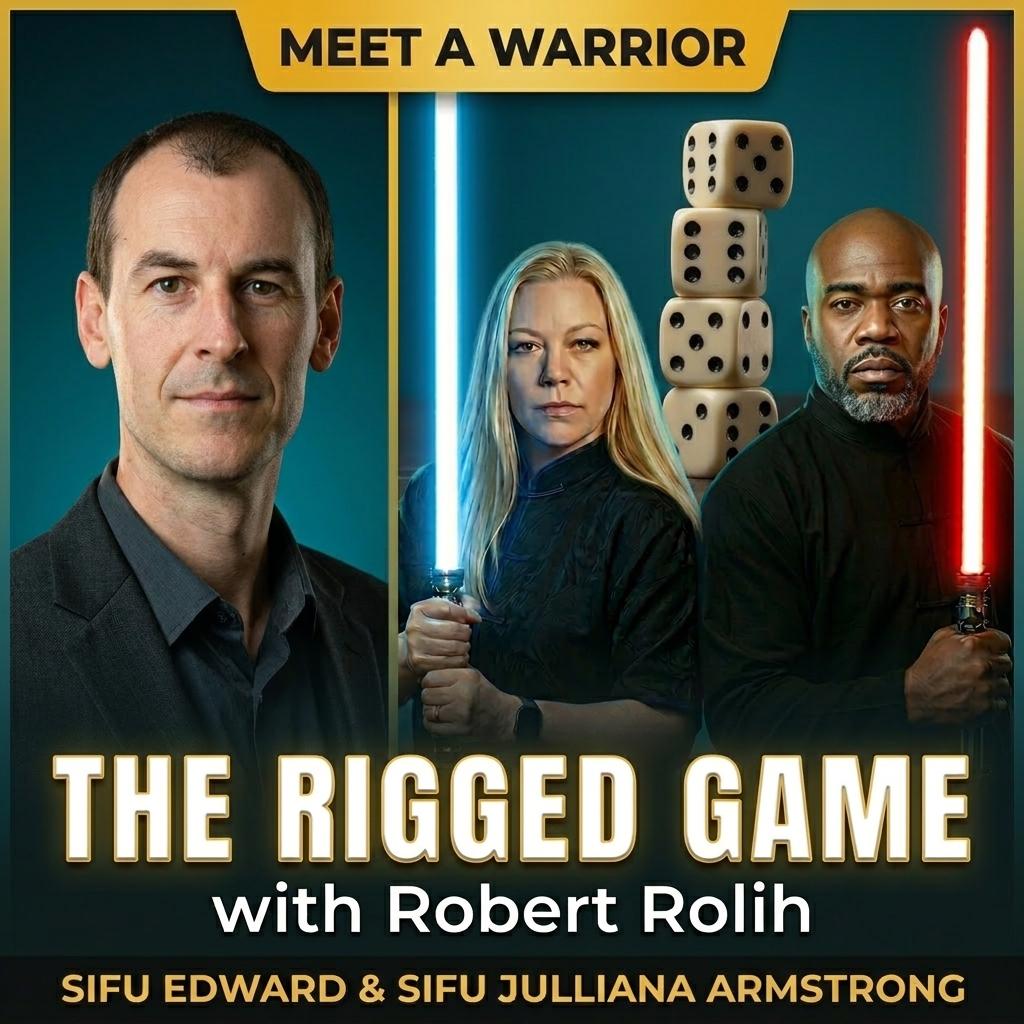
Adapted from the recorded conversation; the guest's words are verbatim. The questions are reconstructed and voiced by Sifu Edward and Sifu Julliana Armstrong.
🎥 Video podcast coming soon. The complete interview will play here once published. The full conversation is transcribed below, and the audio edition will be available on sifuarmstrong.tv.
In a new Sifu Armstrong interview, the author of The Million Dollar Decision explains how he lost money trusting financial advisors, and why he now says investing success comes down to psychology, not timing.
Robert Rolih grew up in a small village in Slovenia, built a company from nothing, and then watched years of profits quietly disappear into the hands of financial advisors and bankers he’d trusted without understanding what they were charging him. He shared that reckoning with Sifu Edward and Sifu Julliana Armstrong in the latest Warrior Intelligence Series conversation.
The wake-up call sent him into three hundred books and years of conversations with financial industry insiders, and what he found troubled him. “This game is rigged, and if you don’t know the right details, these people will basically rob you in plain sight,” Rolih said, pointing specifically at management fees that look small on paper (1% or 1.5%), but compound into a devastating difference over decades.
He’s just as direct about short-term trading, a world he tested firsthand before walking away from it entirely. “When you realise that and when you dig deeper and you see that basically this whole industry is totally rigged, then that it’s a losing game,” he said, arguing the odds are worse than a casino’s because at least casinos are honest about the math.
For people frozen by fear of loss, Rolih’s answer isn’t reassurance about the market. It’s a warning about the alternative. Money sitting under a mattress, he says, is guaranteed to lose purchasing power to inflation (by his estimate, currency lost “approximately 25 to 40% of its purchasing power” over the last decade), while history shows no ten-year period in which stocks have gone down overall. The dividing line, in his view, is temperament as much as strategy: “Only optimists are making money in the investing world. Doomsayers are always on the sidelines,” Rolih said.
He’s also candid about where investors get hurt worst, not just fees, but outright fraud. Scam brokers, he warns, will show fabricated profits on a login screen before demanding more deposits to “release” a withdrawal that was never real to begin with, a pattern he says is rampant in crypto as well as traditional trading.
That psychological framing carries through even his view of new technology. Asked whether AI changes the equation, he was skeptical that it solves the actual problem. “It’s a psychological game. It’s a game where the people who have the right psychology, they win,” Rolih said, noting that people who know intellectually not to panic-sell often do it anyway.
It’s a conclusion that lands the same way in competition as it does in markets: everyone knows the right move under pressure. What separates outcomes is who actually holds their nerve.
In This Conversation
- How years of trusted financial advice quietly cost him a fortune
- Why “the game is rigged,” and the fee math most investors never see
- Short-term trading versus a casino: which one is actually worse
- The real cost of playing it “safe” under the mattress
- Why he says investing is a psychological game AI can’t solve
- Where to find his book, blog, and free webinar
The Full Conversation
Sifu Edward Armstrong: I learned the hard way that building something valuable is only half the battle, protecting it is the other half. I left a franchise that was quietly taking what I'd built. So when I found a man who was quietly robbed by the very financial advisors he trusted, taught himself the truth by reading three hundred books, and now protects ordinary people from the same fate, I knew our operators (who work so hard to build income) needed to hear him.
Sifu Julliana Armstrong: And what pulled me in is that he says investing is ultimately a psychological game, that the people with the right psychology win. That's my whole world. The market and the competition floor both punish panic and reward the disciplined long game.
Our guest is Robert Rolih, internationally acclaimed author of The Million Dollar Decision, speaker, and investment strategist who rose from a small village in Slovenia to become a trusted authority on protecting and growing wealth. Robert, lovely to meet you.
Robert Rolih: Yeah, hi. It's great to be here, so I hope that I can give some value to all the listeners.
Sifu Edward Armstrong: Take us on the journey, from a small village in Slovenia to becoming the person who exposes how the financial industry really works.
Robert Rolih: Yeah, it's quite an interesting story. When I was young, a teenager, I was born in a very small backwater village in Slovenia. And Slovenia is, of course, a very small country, only two million population. But when I was growing up, even though we didn't have money at home, my parents were blue collar workers, I always dreamt about a better life, becoming wealthy and becoming someone.
And when I was a student, I started my own company. And after like five years of hard work, this company started to produce quite a lot of profits. And at that time, of course, I was totally financially illiterate and I knew that I should invest a part of the money that I'm making, but I didn't know how. So I trusted financial advisors, bankers, and other players in the financial industry. And after years and years and years of investing with them, I realised that basically most of my money was gone.
And that was a wake-up call. I was totally devastated at that time. And I made a decision that I need to take financial matters into my own hands, that I cannot trust financial advisors, bankers, and all these gurus that are in this niche. So I started to dig deeper into what is happening behind the scenes of the financial industry. And I read more than 300 books, I went to all the best workshops and especially, I talked with a lot of financial industry insiders. And after a couple of years of doing that, I realised that unfortunately, the financial industry is not on our side when it comes to investing. That this game is rigged, and if you don't know the right details, these people will basically rob you in plain sight.
So yeah, that is why later, I found out that, of course, most people have the same problems as I had. They trust financial advisors and other players in the financial industry, and of course, they're losing money without even knowing it. So that is why I decided to start to share my knowledge to help people avoid making the same mistakes that I did in my career.
Sifu Edward Armstrong: "The game is rigged, and they'll rob you in plain sight." I felt that exact sentence the day I understood a franchise had built its fortune on my back. Betrayal is expensive tuition, but it's the tuition that finally makes you take the reins.
Sifu Edward Armstrong: Let's get specific about the mechanism. In your experience, is the problem that an advisor is more interested in their own commissions than in your outcome?
Robert Rolih: Yeah, that's one of the main reasons why most people underperform the markets or even lose their money when investing, because a lot of players, not all of them, but a lot of players in the financial industry, their interests are not aligned with your interests. For example, if you are a financial advisor or if you run a fund or whatever, you are charging certain management fees. And these fees, of course, even if they are very small, like 1% or 1.5%, people, investors think that these fees are small. But in reality, when it comes to the long-term effect of these fees, these fees can be devastating for your interests. So just by lowering these fees when investing, you can accumulate 2, 3, 4, 5 times more money over the long run compared to paying this fees.
Sifu Julliana Armstrong: There's a moment in any craft when the illusion breaks and you see the whole thing for what it is. What was that moment for you. Where you knew the system was built against the everyday person?
Robert Rolih: Yeah, that was maybe... What hit me the most was that basically when... I'm a long term investor and everything that I teach is long-term. But there is a whole industry of short-term trading, short-term investing, day trading, swing trading and so on. And basically, when you go into the details, when you look behind the scenes of that, you see that only brokers and people who are running these courses are making money when it comes to short-term trading. So this is really something that I experienced firsthand because I was there, I was learning about short-term trading also and so on at one point in my career, and I visited the best courses and so on. And me and all of my fellow students there, nobody was making money.
And when you realise that and when you dig deeper and you see that basically this whole industry is totally rigged, then that it's a losing game. It's a game that you cannot win when it comes to short-term trading. So that is why I'm only doing long-term investing now and very successfully.
Sifu Julliana Armstrong: Is it fair to call it a casino? And once you started pulling back that curtain. What's the reaction been from the industry itself?
Robert Rolih: Yeah. Of course, a lot of these experts who are in the short-term trading space don't like me, of course, but that comes with everything that I do, so I cannot avoid it. The casino analogy is a very good analogy, but when it comes to short-term trading, it's even worse than going to casino.
So there are certain studies that show that much less people who conduct short-term trading are successful compared to going to casino. So basically, and if you draw the line, it's much more profitable for you if you just regularly go to casino compared to short-term trading. And we all know that going to casino, you'll lose money mathematically. All the casinos know that, the CEOs of all the casinos, they will tell you there is no way that you will make money going to casino. But in the short-term trading space, it's even worse.
Sifu Julliana Armstrong: "It comes with everything that I do, so I cannot avoid it." Anyone who tells the truth in a rigged room makes enemies. You learn to wear that as confirmation you're standing in the right place.
Sifu Edward Armstrong: Your book, The Million Dollar Decision, is a real resource. For someone just starting their journey. What are the foundational steps everybody should take?
Robert Rolih: So the first thing, of course, is to become financially literate, to understand what is investing, what are the financial assets that you can invest in to understand what is the difference between high-fee products and low-fee products.
Let me just give you an example here. Mutual funds or a lot of pension plans, they have high fees compared to ETFs or index funds, which are low-fee investing product. In both cases, you are investing in big baskets of stocks, in global stocks, but you can choose, will you pay small fees for that and you will keep most of the returns? Or will you pay high fees for that and the financial industry will take most of the returns? So in the book, this is the main message of the book. If you lower the fees for your investments, you can make much, much, much more money.
Sifu Edward Armstrong: What about the misconceptions, and the outright predators? Where do people get hurt most?
Robert Rolih: Well, definitely things about commissions and fees and short-term trading, like I already mentioned. But then there are a lot of, also people fall for a lot of scams. They trust wrong people. They open accounts with brokers that are not really there. There are a lot of criminal organisations, big criminal organisations, and their only business is scamming people. So there are a lot of brokers where you can open an account, they tell you, "Oh, we will trade with your money, we'll give you great profits."
And they even show you - you know - when you log-in to your accounts…, you see these huge profits and so on, but the money is not really there. This is all just virtual. And behind the scenes, they already stole your money. And then when you want to withdraw that money, they will tell you, "Oh, there are some problems and you need to deposit some more money in order to withdraw your existing money." And, of course, they will still also get money from you and so on.
So there are a lot of scams like this also in the crypto space, for example. When it comes to crypto, there are even more scams where there are even all these meme coins and small tokens. And this investing field is basically filled with all scams and such things.
So as an investor, you need to stay away from this. You need to only invest through regulated big brokers that are very safe. And even if they go out of business, nothing happens to your holdings because they have your holdings in separate accounts. If you are investing in crypto, you should only use big and reputable exchanges like Kraken, Coinbase, and similar.
So you need to stay safe in this area because if you lose, let's say 10,000 pounds by falling for one of these schemes, this is not just 10,000 pounds. If you have invested this 10,000 pounds into, for example, ETFs, you would double your money in like five to seven years and then double it again in additional five to seven years. So this is the thing, you don't only lose the 10,000, but you lose also all the future profits that you could have by you being scammed.
For anybody not aware of what an ETF is, when it comes to investing in the stock market, the stock market historically have been the most profitable way or asset class to invest in, much more profitable than real estate, than gold, than bonds and so on. So when it comes to investing in stocks, there are different stock funds that you can invest in. And stock fund means simply a basket of stocks. You don't want to invest in individual stocks because each individual stock, like Apple or Amazon or Tesla, they can go out of business or they can go down. So it's very risky to invest in just a couple of individual stocks, and that is why most investors invest in baskets, in large baskets of stocks, where you invest, at one time, you invest in like 500 stocks. And these are funds. But then there are different types of funds. And ETFs or exchange traded funds, these are low-cost funds. They have the lowest possible commissions and fees. And these commissions and fees are like 10 to 20 times lower compared to, for example, mutual funds. And over the long run, this has an enormous effect on your investment returns.
Sifu Julliana Armstrong: A lot of people freeze because they're terrified of losing everything, so they keep their money "safe" under the mattress. How do you talk to that fear?
Robert Rolih: Yeah, this is a very good question, and the answer is very simple. Right now, if you are not investing, if you keep your money under the mattress or in your bank, inflation will definitely eat away quite a lot of your purchasing power over time.
So for example, in the last 10 years, our currency lost approximately 25 to 40% of its purchasing power. So this means that if you keep your money under the mattress, you are losing money every single day. You are losing purchasing power every single day. And the only thing that you can do to preserve your purchasing power is to invest in the right assets.
And stocks will go up and down. Okay? Definitely, stocks will go up and down. But if you are a long-term investor, and if you are investing with a time horizon of at least 10 years, there has never been a 10-year period in our history where stocks would go down over that period of time.
So yeah, of course, if the aliens invade tomorrow, the stock market will go down. If the asteroid hits the Earth, the stock market will go down. If the financial system crumbles, the stock market will go down, of course. But you need to be realistic about these things, and you need to understand that only optimists are making money in the investing world. Doomsayers are always on the sidelines, are never investing. But the cost of this over the last 10 or 15 years was that you lost out on like 300 to 400% returns. So if you were in stocks, if you were consistently investing in the stock market in low-cost ETFs, for example, you would have made like 300% return on your money. But if you were on the sidelines, your money would basically just be devaluated through inflation. So yeah, this is something that you need to understand.
So it's okay to have money under the mattress for like a couple of months or maybe up to one year, but longer than that, it's very risky. It used to be, so in the old times where there was no inflation, it was like investing was risky. But now, because of this inflation and money printing and so on, now not investing is riskier.
Sifu Julliana Armstrong: You said something I want to end on, because it's my whole world: that this is fundamentally a psychological game. Even people who know not to panic-sell do it anyway. And you don't think AI changes that?
Robert Rolih: Well, no, because it's like investing is all about psychology. And even though people know that they shouldn't trade in the short term, even though they know that they should not sell when there is a market panic, they do it. So yeah, it's a psychological game. It's a game where the people who have the right psychology, they win.
So yeah, the technology, artificial intelligence and so on, they can, of course, give you some guidelines and they can select good funds for you and so on. But in the end, it comes to human psychology. So yeah, it has always been like this and it will always be like this.
Sifu Julliana Armstrong: That's it exactly. On the competition floor, everyone knows the technique. The medal goes to whoever holds their nerve when the pressure spikes. The market is the same arena.
Sifu Edward Armstrong: For our readers who want to start, favourite places to open an account, and where do they find you and the free webinar?
Robert Rolih: Yeah, so the most important thing is that you need to use regulated brokers. And these are, for example, you have AJ Bell, you invest in the UK, you have Interactive Brokers, you have Vanguard, you have Revolut, for example, also allows you to buy index funds. There are a lot of these brokers. Maybe just if you go to ChatGPT or Google, just enter regulated brokers in the UK or best UK stockbrokers and you will find a good selection, because there are a lot of them that are really good.
And to find me. It's robertrolih.com, so my name and surname together dot com. And you will see right at the top, there will be a free webinar and so on. And also, I have a very good blog. There are a lot of free articles, really interesting ones. So it's Robert and then R-O-L-I-H. It's a difficult surname to spell, but it's R-O-L-I-H.
Sifu Edward Armstrong: Robert, thank you. I could speak with you for hours. The Million Dollar Decision is one of the finest financial books I've come across, and we appreciate you pulling back the curtain for our warriors.
Robert Rolih: Yeah, thank you for inviting me. I hope that I managed to give you some good information, and I wish you a lot of great returns in the future. Bye.
Sifu Julliana's closing word: Robert confirmed the thing I feel every time I step onto the competition floor: everyone knows the right move, but only the disciplined actually make it under pressure. Panic-selling and choking are the same failure. The optimist who stays in the game and holds their nerve. That's who wins, in the market and on the mat.
Sifu Edward's closing word: Every operator we train works ferociously to build income. Robert's warning is the other half of the lesson: the game is rigged for those who don't know the details, and a fortune unprotected is a fortune already leaving. A warrior who builds an empire and never protects the treasury is just training someone else's fortune. Learn the fees. Guard the gate. Play the long game. We don't entertain warriors. We create them.
Robert Rolih, author of the best-selling "The Million Dollar Decision," speaker, and investment strategist. Free investor webinar and blog at robertrolih.com.
ILLUSTRATIVE RESULTS. Any revenue, enrollment, margin or retention figure in this conversation is either a documented result from one of our own operations, a figure the guest reports about their own business, or an illustrative example, never a projection of your results.
Nothing here is financial, legal or tax advice.
Stay in the Fight
This conversation is part of the Sifu Armstrong Warrior Intelligence Series: interviews with world-class performers, builders, and thinkers, filtered through the lens of the warrior's path.
Subscribe at sifuarmstrong.news for every new interview, delivered to you.
Join Club Sabernet, the member community of the whole Sifu Armstrong ecosystem, where warriors train, connect, and hold each other to the standard.
Ready to build your own floor? Find your path at sifuarmstrong.com/which-path.