The Celebrity CEO: Sifu Edward & Sifu Julliana Armstrong Sit Down With Ramon Ray
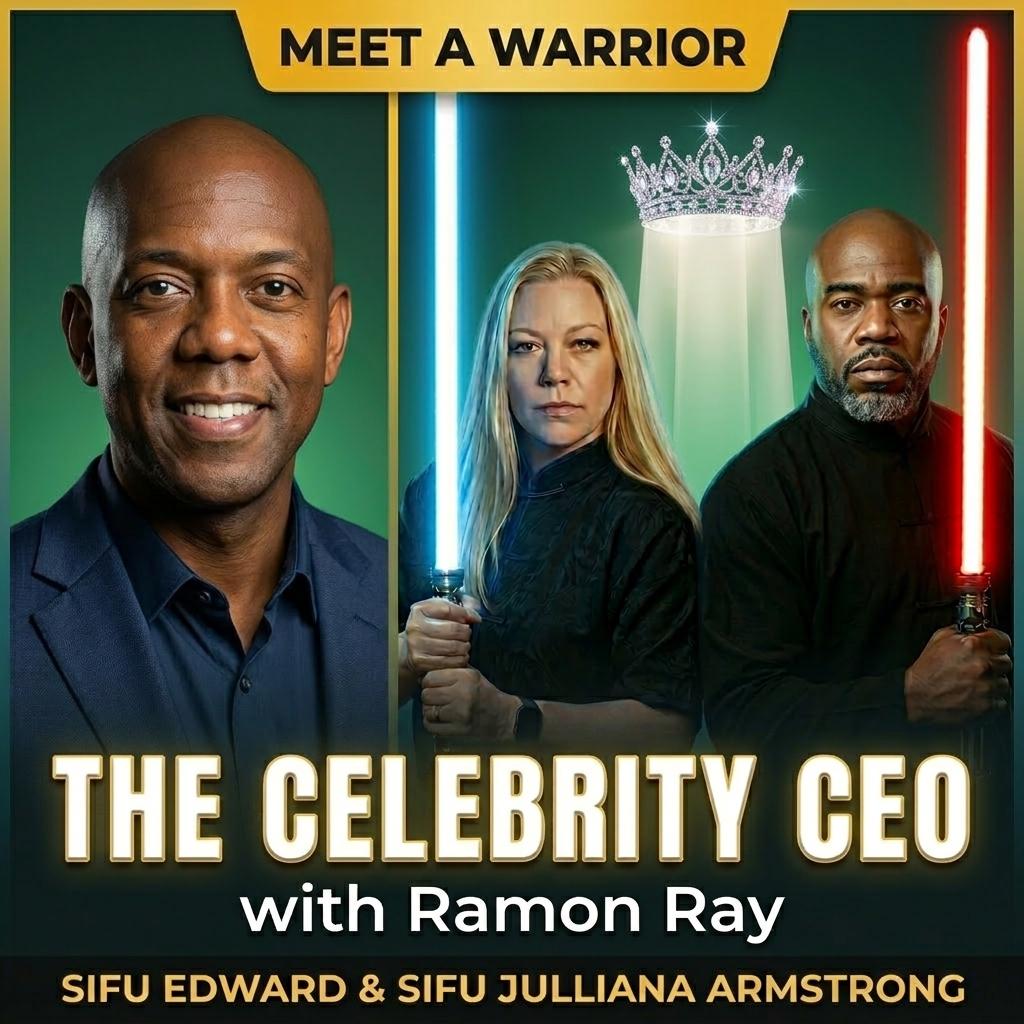
Adapted from the recorded conversation; the guest's words are verbatim. The questions are reconstructed and voiced by Sifu Edward and Sifu Julliana Armstrong.
🎥 Video podcast coming soon. The complete interview will play here once published. The full conversation is transcribed below, and the audio edition will be available on sifuarmstrong.tv.
In a new Sifu Armstrong interview, the author of The Celebrity CEO argues that a strong personal brand isn’t vanity for a small-business owner. It’s the asset that gets you invited to the sale in the first place.
Ramon Ray has founded five companies and sold three, and when Sifu Edward and Sifu Julliana Armstrong asked him, for the Warrior Intelligence Series, what actually drove those exits, his answer wasn’t about growth hacks or funding rounds. It was relationships.
Ray’s career started at the United Nations, at what he calls the cusp of the dot-com era: dial-up modems, floppy discs, the Mosaic browser before there was a Netscape, let alone a Google. A chance question about his speaking fee turned into bylines for Inc. and Black Enterprise, and from there into a career built around content, speaking, and (eventually), a string of companies including SmartHustle and SmallBizTechnology, both later sold. His exits weren’t headline-grabbing nine-figure deals, he’s quick to point out, but “a few hundred thousand dollars” each, achieved almost entirely through personal connections rather than brokers. “You build good relationships, do good to people, build something of value,” he told the Armstrongs, “then you have the right to proactively say, 'Hey, does somebody want to buy it from me?'”
That belief in relationships over paid acquisition sits underneath his best-known book, The Celebrity CEO, and the core argument he brought to the conversation: small-business owners routinely under-invest in their own visibility, assuming personal branding is reserved for founders with Bezos- or Branson-level wealth. Ray pushes back hard on that. “We don’t have to be hidden,” he said. “We can leverage it as an asset in our business.” His formula is deliberately simple: awareness first, so people know you can solve their problem, then consistent nurturing that builds trust, with sales following as a natural consequence rather than something you have to force. “People work with people they know, like, and trust,” he said.
Asked how an entrepreneur actually measures a personal brand (since, unlike a sale, it doesn’t show up cleanly on a spreadsheet) Ray offered a test that reframes the whole goal. It’s not whether you closed the deal. It’s whether people are talking about you when you’re not in the room, and whether you’re getting pulled into conversations at all. “It’s not the sale that’s most important,” he said. “It’s, am I at least invited to the conversation?”
Ray also walked through the unglamorous infrastructure behind that visibility: a Facebook-first social strategy (his best-performing platform, ahead of LinkedIn and Instagram), an email newsletter he nearly lost to a silent RSS feed error, and (above all) owning his own domains and website rather than renting an audience from a platform that could change the rules overnight. Repurposing one piece of content across a speech, a podcast, and a blog post, he argued, is simply how a solo operator competes with larger teams.
The conversation closed on a personal note: Ray’s daughter was expecting his first grandchild as the interview was recorded, a reminder, he said, that no exit or brand outlasts the people in your life.
For the Armstrongs, Ray’s insistence that founders step into the light rather than hide behind a logo lands as a familiar truth. An art doesn’t spread on merit alone; it spreads because someone was willing to be its face, and to earn the trust that makes people want to follow.
In This Conversation
- Ray’s start at the United Nations at the dawn of the dot-com era
- Selling three companies (SmartHustle, SmallBizTechnology, and an events business) mostly through personal relationships
- The three-step personal-brand framework: awareness, nurturing, then sales
- Measuring a brand by whether you’re “invited to the conversation,” not just by the sale
- Why Facebook, an email newsletter, and owned domains matter more than chasing every platform
- Ray’s news of an imminent first grandchild
The Full Conversation
Sifu Edward Armstrong: I learned the hard way that an art doesn't spread on merit alone. It spreads on a name people can rally behind. For years I resisted putting myself out front; it felt like ego. Then I understood it was the opposite: if I wouldn't be the face of light sword, no one would carry the standard, and the whole movement would stay invisible. So when I found a man who teaches exactly that (how an ordinary entrepreneur becomes the recognised face of their field), I knew our operators needed him.
Sifu Julliana Armstrong: For me it's even more direct. When I walk onto a competition floor, I am the brand, my face, my presence, my story is what people remember long after the score. Whether you're an athlete or a CEO, the lesson is the same: you can't hide behind the work and expect to be known. Ramon built a whole body of teaching around that, and it's exactly what every warrior who wants to lead needs to hear.
Our guest is Ramon Ray, a serial entrepreneur, keynote speaker, and best-selling author who has launched five companies and sold three. He publishes ZoneofGenius.com and wrote The Celebrity CEO to help small business owners build their brands. Ramon, it's great to meet you.
Ramon Ray: It's great to be here. Thank you so much for having me on this amazing podcast, Internet Marketing Newsletter. Glad to be here and serve your audience. Anytime I can help small business owners or entrepreneurs or anybody in between, it's always a fun day for me. So thank you for having me.
Sifu Edward Armstrong: I've come to believe the whole LSTA empire was built on a single currency, not technique, not even marketing, but relationships. The Global Alliance Tour, the operators who license academies, the masters who vouch for us, none of it happened without trust built one handshake at a time. You've founded five companies and exited three. What are the biggest lessons you've taken from building and growing your own businesses?
Ramon Ray: Sure. And for my journey, it's not been the billion dollar, even hundreds of millions of dollars of exits that we may read in headlines on Bloomberg or CNBC or BBC, depending on where you're at. But mine have been in no shame full embracing it, a few hundred thousand dollars. And some people may, "Wow, Ramon, maybe that's not a lot," but when you think about it, that's still the top 1%, maybe even of the 1% in the U.S. context, 30 million businesses and I'm sure several million more globally. So my point is, the biggest lesson learned is really the power of relationships and connectivity. Recently I was appointed as the Bitdefender Small Business Ambassador. Bitdefender is an amazing company that helps small businesses stay secure. That was due to relationships. Or I think about me being on stage with Daymond John, Jason Feifer, Von Trapp, or other name-dropping intentionally.
My point to answer your question, the biggest lesson learned was at the level I'm at, at large, part is about relationships. You can do Alex Hormozi, and I love what he did to those who don't know the reference, but spend quite a bit on Facebook ads and build up credibility. But for me, listen, you build good relationships, do good to people, build something of value, then you have the right to proactively say, "Hey, does somebody want to buy it from me?" And/or organically somebody will see it and say, "Hey, would you like to sell that?" So that's the biggest lesson I've learned, the power of relationships, not withstanding the things we can get into of scalability and processes and systems and all of those things, but relationships is the biggest thing I can think of.
Sifu Edward Armstrong: Relationships as the real asset. That's a warrior's truth dressed in a businessman's clothes. I'm always fascinated by the starting line, because everyone who builds something was once a beginner who didn't know what they didn't know. How did your journey start? How did you enter this world in the first place?
Ramon Ray: Well, that's a great question, but I spent some years moving forward from being a child and all those kinds of things. But my professional career, I got one of my first jobs at the United Nations. It wasn't my first one, but one of my first jobs at the United Nations. And while there, was the cusp of this current.com era. There was the steam engine era. I'm sure there was a guy there were like, "Ooh, we have steam." And he got into steam engines or there was the gal who fabrics. I was a little after that. But this was the cusp of this current season of.com. Now we're in this, there was the AI season, which we're in, you have apps and mobility. I was the seasons of computer technology and modems and networking and Wi-Fi and Intel was at its primacy or primacy. So that's where I got in just context, AOL, CompuServe, America, all this blogging before it was called blogging.
And that gave me the foothold to know how to instal or repair computers and the updating software that come on a thumb drive or a floppy disc, and the beginnings of downloading the Mosaic browser, which is the precursor to Netscape, AltaVista before there was Google. So that was the era I was in. I'm 50 plus years old, that was the era I was in. And from there, I parlayed that into being a motivational professional speaker. Somebody just asked me, they saw me doing some things, "Ramon, what's your fee to speak?" And then Inc. Magazine and BLACK ENTERPRISE, two prominent USA Magazines publications said, "Ramon, can you write for us?" And that started again, the journey today of content monetization and being paid to speak. That was a compressed version of how I got to be who I am today.
Sifu Julliana Armstrong: I love that you got in at the cusp of an era, because that's exactly where we sit with light sword, the founders of something the world hasn't fully discovered yet. You're widely known for the book The Celebrity CEO. For anyone who hasn't come across it, explain the concept, and why it matters so much for small business owners.
Ramon Ray: Yeah, one of my deep passions is of course, entrepreneurship. Having started a few companies, as you already said, sold a few. So I love entrepreneurship and scaling and hiring and the thrill of going into debt or not, or however you build it, but the risks, that excites me, it's how I'm built. But yes, the core thing, one of my expertise is, because I've done it myself several times, is how do you build your personal brand? How do you take who you are, your face, your voice, how you show up, your smile, your credibility, how I interact with the radio or a podcast host or not? All these things becomes your brand. So that's my specialty because I have several books. I do my podcasts, I have websites, I produce content. I've been on Fox Business and MSNBC and Associated Press and all these things. So how do you build your personal brand?
And three simple things I like to talk about is, one, is getting awareness for who you are. That's important. If people don't even know, oh, he has a solution for me, game over. So one is awareness. Awareness of that I have a problem to solve her problem. It's all the same principle, awareness.
Number two is nurturing. What am I doing on a consistent basis to nurture that relationship, nurture that relationship, and/or to build trust? And once I do that, sales will then follow.
So that's the summary of it is to challenge all entrepreneurs, all small business owners. We have the opportunity to leverage the power of our personal brand to be more known. We don't have to be hidden. We can leverage it as an asset in our business.
Sifu Edward Armstrong: "We don't have to be hidden." We had David Fagan, the Icon Builder, on this platform recently, and he said almost the same thing. You can't hug a building. Everyone knows Bezos owns Amazon, Branson is the face of Virgin. But so many founders want to hide behind the company. Are you firmly of the belief that people do business with people, not companies?
Ramon Ray: Absolutely. You take a look at this short time we've been together, right, we had some banter, had some fun, had some laughter before we started? We connected and I realised that my voice of course is being heard today, but the point I'm making is that, yes, people work with people they know, like, and trust. My friend John Jantsch says that of Duct Tape marketing and kudos to him for his business now is run by his daughter. But yeah, it's so true. And I think that and even mention the names you mentioned Jeff Bezos, Richard Branson, I think those gentlemen and wealthy ladies as well, whoever it may be, they were famous because of their wealth to some degree, because of their charisma, because of showing up. And so that's that, yes, but I don't want the small business owner that owns the $200 million construction company or the $3 million agency.
You even have a better chance than Jeff Bezos or Richard Branson because them, it was their huge wealth and they're the face of it. They were gregarious and caricature, right? So that is a good example, but I encourage you, you own that little wax company that generated $800,000 in sales, don't just rely on only Facebook ads. Put yourself in the ad maybe. Go out to the local chamber, do something different, Mr. Beastish, these things work. And I'm not at their level, but as the audience has noted, yeah, I've had some success, largely if it's been, I do Facebook ads, I do all the normal marketing things, but largely it's been because of my personal brand too.
Sifu Julliana Armstrong: That resonates with how we think about every Academy Commander, the operator who puts their own face and story forward will always out-recruit the one who hides behind a logo. But here's the question I wrestle with as a competitor, because the scoreboard is obvious but a brand isn't: when you're building a personal brand, how do you measure success? What signs tell us we're on the right track?
Ramon Ray: Yeah, I think a few ways that one can measure their personal brand, I think one, are people talking about you when you're not in the room, ideally in a good way? I think that's one. Are they mentioning your name? You're not going to get the sale all the time, but is your name floated in the digital hallways, especially what you do? So that's one.
I think number two, are you invited to the conversations, "Hey, Ramon, we're talking about this, that or the other," or, "We thought this is going to be a good opportunity for you." That's good. Are you getting referrals?
Where I'm getting at here, it's not the sale that's most important as far as this aspect of personal branding and being a celebrity CEO and building a brand. It's, am I at least invited to the conversation?
Sifu Edward Armstrong: "Am I invited to the conversation." That's exactly the seat we're fighting for on the world stage with the art itself. You distribute your content everywhere: social posts, videos, podcasts, the stage. With only so much energy in a day, how do you decide where to put it?
Ramon Ray: Yeah, talking about social, I'll distil this to, how do I decide where I put my energy? And there's a lot of places I could be, and whether it's by accident, intentionality, by default, over the years, I've realised my strong is social platforms, focusing on that, on this part or the help is really Facebook where I have the most engagement. I can post on LinkedIn and I get some engagement but Facebook, for me. Somebody else, it could be Instagram, somebody else, it could be TikTok, somebody else, it could be Pinterest, but for me it's Facebook, and it's LinkedIn and Instagram to some degree. Those three platforms, which happen to be some of the largest, those are my best platforms. Do I have content on TikTok? Yes. Do I have content on other platforms? Yes.
And I will add one more thing. Don't neglect a good email newsletter. I noticed the traffic to my website was down for some reason. I'm like, "What's going on? Man, I'm not famous, who's attacking me or what's happening?" I realised, to get a little geeky, I know many of the audience will know this, but the RSS feed, for whatever reason, there's an error in it. Still, there's an error, the RSS feed. And so my email newsletter, how I have it set up wasn't going out. But the point is, when I fixed it, traffic is back up again. So other thing, don't forget a good email newsletter.
And I would say a good website. Having a domain name is a powerful way to build a business. Having the .net, having the .com, those are two powerful things that every small business should have. You can look at, one of my partners is Verisign. They specialise of course, in being the domain registrar and other partners they work with.
So a good website, good domain name, and an email newsletter, those are powerful assets that people shouldn't forget about because you own that real estate.
Sifu Julliana Armstrong: "Own that real estate." That's why we obsess over our own platforms instead of renting an audience. Speaking of which, one of yours is zoneofgenius.com. For anyone who hasn't found you yet, what is it, and how do people gain from it?
Ramon Ray: Zoneofgenius.com is, I birthed it a few years ago. This is after I started smarthustle.com and sold it, started smallbiztechnology.com and sold it. But zoneofgenius, it's that destination for entrepreneurs to really have curated insight what they need to know that day for their business. And so is it in many ways, like many similar sites, I'll shout out Inc. and Entrepreneur and others, sure, content for small businesses, but for those who get to know Ramon Ray, this is my version of the world of how I want people to grow their businesses. Zoneofgenius, our tagline is, we help entrepreneurs live life fulfilled. This is where you get insight on mindset, on technology, on leadership, on culture, a potpourri dish, or day to day of what you need to be a better entrepreneur. That's what you'll find at zoneofgenius.com.
Sifu Julliana Armstrong: That's the same spirit as Club Sabernet for us, one home base where the community comes to get sharpened. I understand you've got several other properties too. Take us through them, and the lesson behind running more than one.
Ramon Ray: Sure. Thank you for asking. Yeah, and the bottom line, again, for the listener, this is a lesson learned, other websites I have, but this is also a lesson learned for all of you. You don't have to have just one channel. You don't just have to have one property. You should take your content and mix and match it. You had a good speech somewhere, hire somebody, go to Fiverr or Upwork, wherever you want to go or yourself, cut that up. The good speech you gave could be a featured podcast, the speech you gave could be a blog post. So I want to just let that lesson be learned. It's beyond Ramon. But yeah, zoneofgenius.com for sure is the flagship site of where people can get insight from me. There is of course, ramonray.com, R-A-M-O-N-R-A-Y, ramonray.com, which is based on there, but the flagship site for my speaking and things.
Those who are interested in personal branding insight, celebrityceo.com. And then of course, as I mentioned, I've recently, I partner with Bitdefender and our main message there, and that's Bitdefender, sometimes I speak fast, Bitdefender, main message there is really to help small businesses know we want you to protect your brand. You go home at night, you lock the door of your house, you leave your car, you boop boop. If it does that remote key entry, you lock your car door. Is your small business being secure? Malware is real. Ransomware is real. Cyber criminals want to attack your business. And so we encourage you to check out bitdefender.com/ramon, and you can get insight on how to protect your small business as well.
Sifu Edward Armstrong: Taking one asset and making it work in a dozen places. That's how we turned one conversation like this into an article on sifuarmstrong.news and an episode on sifuarmstrong.tv. Now, you've exited three businesses. For the operator who's built something and is thinking about an exit one day, what process did you go through?
Ramon Ray: I think there's two ways you can do it, could be three, but regardless of how you do it, this is consistent before I get to the two ways, know your numbers. And Marcus Lemonis says that, and I have challenge knowing my numbers, but do you at least know what profit you made? Do you know what loss you made? Do you know your balance sheet? Do you know how much debt you have? Do you know how much assets you have? You know the cash flow cycle? You know that the value of a customer, you have some basics of how the business flows, and of course, if you have an inventory based business, a physical product business, there's a lot more you need to know. What are the product, the SKUs that are most profitable? What does it cost, the cost of goods sold for what you're having? So you've got to know the basic elements of your business. So important.
Having said that, I think two broad paths I find to sell your business. One, you can go through a broker or a marketplace, there's Flippa, and also so many other channels that you can list your business and people who are looking to buy can find you. So that's one.
I did mine really through personal connections. "Hey, buddy," Jane Doe or John Doe, whoever it is, "You have a thriving business, maybe a little bigger than mine, or you're looking to buy up, would you like to buy this asset?" So those are broadly two ways. Once you built it, you have the numbers, its solid, list it on any number of marketplaces and/or sub point of that going through a broker and there's many who their business is to match you. That's a very honourable way to do it. And/or for me, personal connections. "Hey, listen, I'm building this widget. I noticed you have millions of widgets. Would you like to buy my two widgets to add it to your widget empire?" So like that. So either way, there's somebody out there who wants your business, you just have to find them.
Sifu Julliana Armstrong: Everybody pictures the exit as the glory moment, but you've said it was hard. The first time you stepped onto that floor did you find it daunting, or was it the excitement of doing something new?
Ramon Ray: Yeah, I found it daunting all three times. One time it was me and a partner, we sold our event business called Small Business Summit. Could it have been more, could I have done it smarter? Could I have? Sure. But you know what? For me, part of the win is just somebody wanted to buy your business at a multiple. It seems weird, but that was a win right there, and it was daunting. It took a lot out of me, because I'm not a detailed person. See, I'm not Mr. Evaluation, I'm not good at the numbers. That's not my strength. So reading the legal agreements, and of course they want lower, I want higher, but amongst friends, you'll work it out. So that was one.
And then the second business I sold, my blog, smallbiztechnology.com. Sold it at a time when I needed the cash. So should I have held onto it? Could I have gotten more from it? I'm sure, but I'm so grateful that, again, somebody said, "Ramon, here, we will pay you for this asset."
And then the third business was Smart Hustle, and that was the hundreds of thousands of dollars sold to ZenBusiness, which is Mark Cuban is on the board of that company. And I was honoured. I was happy with that, very happy with that exit, for sure. It was a fair price for both of us. And yeah. So all three were daunting, and I'm sure when I sell my next two or three or four companies, it'll be just as daunting. But I know I have good friends like you or others who are around me who I can lean on that they maybe have expertise I don't have or they can guide me, so...
Sifu Edward Armstrong: I want to ask about the letting go, because for most builders the company is their baby, handing it to someone else feels like a kind of loss. I've had to release things I poured my soul into. How did that feel for you, Ramon? Strange, or freeing?
Ramon Ray: Yeah, how does it feel to let a business go? I'm often asked that. I had one buddy of mine in church say, "Ramon, you sold..." I think it was Smart Hustle. "Why did you? How could you?" He asked, "That's your baby." And I get that for many things we build, but maybe I'm a total entrepreneur. To me, they're just assets. Because in fairness, it's one thing I'm going to a factory, going to a building, maybe you're working with people for 20, 30 years, you're seeing them every day. But in an online world, I can still work with, connect with DM, LinkedIn, text, have lunch with, have a share pizza with anybody. The asset, especially digital, it's generally just an asset. Smallbiztechnology.com, I owned it for 20 years, but it was freelance bill. It wasn't like I was, "Jenny, it's good to... Here's the keys, I'll never see you again." It's a domain. It's goodbye. Yeah. So for me, there was no emotional attachment to it at all.
Sifu Julliana Armstrong: So it was more of a "thank you, next."
Ramon Ray: That never changes and that's why I guess, exciting. When I sold ZoneofGenius, if I do, man, I still know all the people and we'll get together.
Sifu Edward Armstrong: Let me push for an exclusive, because our warriors love knowing what's next. Is there anything bubbling away in the background you can reveal to us?
Ramon Ray: Well, I will give you an exclusive. Here's an exclusive Ramon Ray. I have a call coming up in four days with a major, major online broadcaster who everybody knows their name, they've been around for 20 years. I want to do a show with them. So depending on when you're listening to this broadcast, this interview, you guys hit up Ramon Ray, I don't know when you're going to hear this, and you email me, ramon@ramonray.com, and say, "I heard you on the Internet Marketing Newsletter podcast, and you said something cool is going to launch." So ask them about that. That's one breaking news. Literal it is. It's an online big broadcaster.
And then number two, there's a big publisher that I'm working with, and I may have some news about them. So those on the Internet Marketing Newsletter podcast, you've heard it here first. And you can email me or DM me and say, "Ramon, what was the news? What happened?"
Sifu Julliana Armstrong: We'll be watching for both, and there's an even bigger headline in your personal life. Just before we started you mentioned your daughter is about to give birth. Congratulations, your first grandchild!
Ramon Ray: That's right, my first grandchild. My first grandchild, and my daughter indeed is getting ready to give birth as we have this discussion. And possibly when people hear it, I'll say that I'm a grandfather one week or three months old, depends.
Sifu Edward Armstrong: From all of us (to you, your daughter, and your whole family) congratulations. That's the legacy that outlasts any company.
Ramon Ray: Jesus, please. Thank you.
Sifu Edward Armstrong: Before we close, Ramon, for the warriors who want to learn more about you or work with you, where should they go?
Ramon Ray: Absolutely. First thing I want everybody to do is be a big thanks to the whole team behind Internet Marketing Newsletter podcast and show the whole ecosystem, big thanks to that team and them for doing it. So please give them love and tag them.
Second of all, really two things I'd say to do, one, go to zoneofgenius.com. If you're hearing the sound of my voice and you're loving the energy, loving what I'm saying, go there and you'll hear from me on a regular basis, zoneofgenius.com, there's a pop-up and other things you can sign up to hear from me so you don't miss out.
And then I want to make sure you secure your brand. That's so important, secure your brand. Join my partners Bitdefender. If you go to bitdefender.com/ramon, get some tips and insights on how you can secure your brand to build a better business. So hackers and ransomware and all those malicious people, cyber criminals, do not attack your business. But this is Ramon and it's been a pleasure to be here today.
Sifu Edward Armstrong: It sounds like an exciting time in your life right now. We wish you all the very best.
Ramon Ray: Thank you so much.
Sifu Julliana's closing word: What stayed with me is Ramon's measure of a brand: are people talking about you when you're not in the room? On the competition floor you only control the minutes you're out there, but the reputation you build does the talking the other 99% of the time. Show up real, connect before you sell, and earn your seat at the conversation. That's a brand. That's how a warrior becomes a name.
Sifu Edward's closing word: Ramon confirmed what I resisted for years: an art needs a face, and a movement needs a name people can love. Awareness, then nurture, then the sale follows, never the other way around. He built it on relationships, owned his own real estate instead of renting a crowd, and held his creations with an open hand. Every Academy Commander, every warrior who wants to lead, take note: don't hide behind the logo. Step into the light and let them know you. We don't entertain warriors. We create them.
Ramon Ray, serial entrepreneur, keynote speaker, and author of The Celebrity CEO. Publisher of ZoneofGenius.com and Bitdefender Small Business Ambassador. Find him at zoneofgenius.com · ramonray.com · celebrityceo.com · bitdefender.com/ramon.
ILLUSTRATIVE RESULTS. Any revenue, enrollment, margin or retention figure in this conversation is either a documented result from one of our own operations, a figure the guest reports about their own business, or an illustrative example, never a projection of your results.
Nothing here is financial, legal or tax advice.
Stay in the Fight
This conversation is part of the Sifu Armstrong Warrior Intelligence Series: interviews with world-class performers, builders, and thinkers, filtered through the lens of the warrior's path.
Subscribe at sifuarmstrong.news for every new interview, delivered to you.
Join Club Sabernet, the member community of the whole Sifu Armstrong ecosystem, where warriors train, connect, and hold each other to the standard.
Ready to build your own floor? Find your path at sifuarmstrong.com/which-path.