The Audience Wants You to Win: Sifu Edward & Sifu Julliana Armstrong Sit Down With Devon Brown
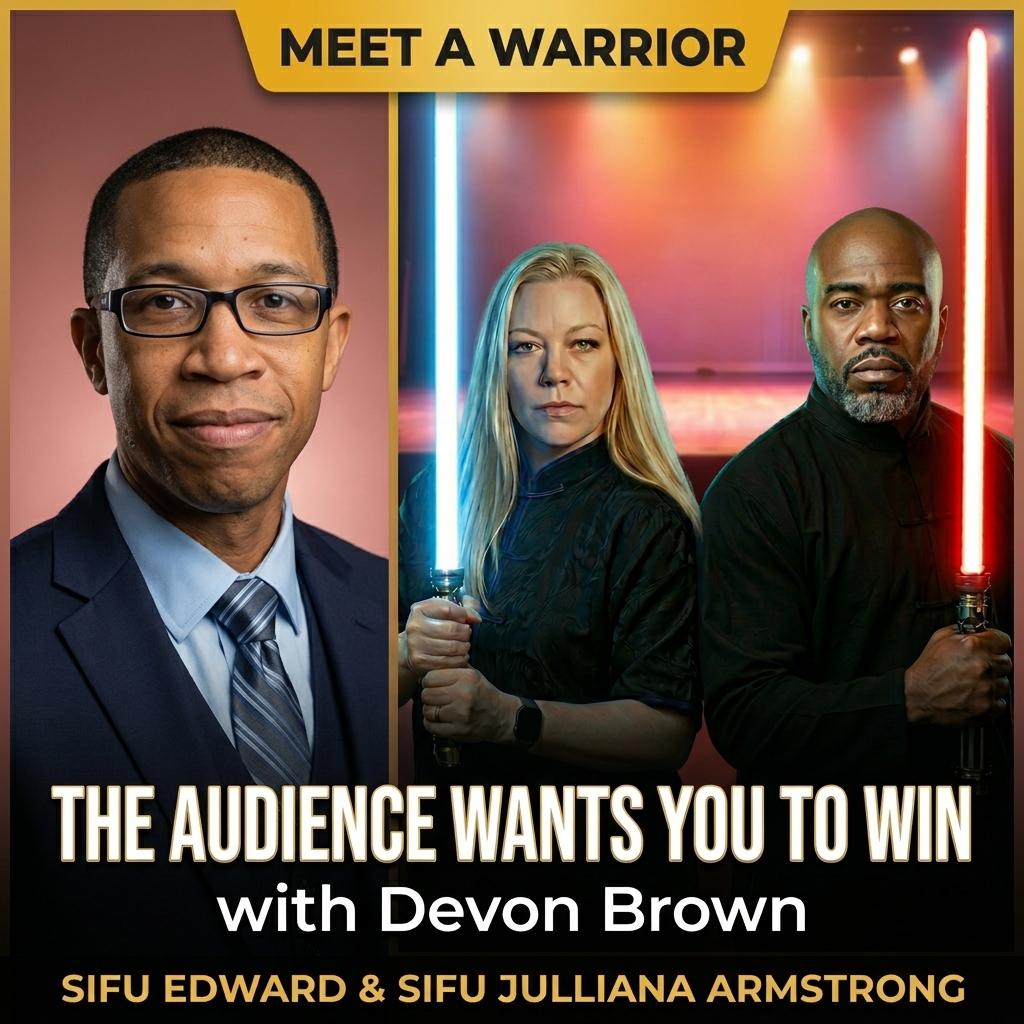
Adapted from the recorded conversation; the guest's words are verbatim. The questions are reconstructed and voiced by Sifu Edward and Sifu Julliana Armstrong.
🎥 Video podcast coming soon. The complete interview will play here once published. The full conversation is transcribed below, and the audio edition will be available on sifuarmstrong.tv.
In a new Sifu Armstrong interview, the internet marketer turned top event MC argues the crowd was never the enemy, and that failure and quitting are two entirely different things.
Devon Brown has taught TaeKwonDo, danced hip-hop in nightclubs five nights a week for over a decade, worked as a college mascot, and now MCs major events for Russell Brunson, Tony Robbins, and Dean Graziosi. That unusual résumé produced one of the most useful reframes of fear the Warrior Intelligence Series has captured, in Brown’s conversation with Sifu Edward and Sifu Julliana Armstrong.
Brown’s advice for stage fright starts by flipping the premise entirely. Most people assume an audience is sitting in judgment, he says, when the opposite is true. “The audience, selfishly, they want you to win,” he said. “Have you ever gone to a comedy show hoping the comedian bombs? Never.” Once a performer feels that, the fear has nowhere to live, because the exchange stops being about surviving judgment and starts being about serving the crowd’s hope.
That confidence was hard-won. Brown spent years failing at internet marketing after getting his start in 2001, losing tens of thousands of dollars while selling cars and teaching TaeKwonDo just to get by. The turning point wasn’t a new tactic. It was understanding why he kept losing. “I wasn’t a failure. I just kept giving up. Those are two different things,” he said, describing how chasing overnight wins caused him to abandon business after business right before any of them had time to work.
His break came in 2005 working phone sales for marketer Matt Bacak, which put Brown, with zero speaking training, in front of 700 people at a Mark Victor Hansen event after the scheduled MC couldn’t be found. He got a standing ovation and never left the stage again. Years of nightclub dancing had already taught him how to read and hold a crowd, a skill he says has nothing to do with formal training and everything to do with instinct built through repetition. His mother, he admits, thought he was insane for chasing entrepreneurship instead of using his college degree, and yet she was the one who supported him through the years he was broke before any of it paid off.
Brown also coined a word for what he believes he does best: edutainment, the combination of entertaining a crowd and making a concept click, the same lightbulb moment he chased both as a hip-hop dancer and as a martial-arts instructor. When COVID cancelled every event on his calendar overnight, he leaned on the idea that every obstacle carries a gift, using the forced pause to write and pivot into virtual MC work.
Brown says he’s shared stages with some of the biggest names in the industry, but insists the experience taught him the opposite of what most people expect: the famous names aren’t a different species. “They’ve decided to live into their truth without fear, to live wholly into who they are,” he said, adding that he’s seen “everyday people” on stages impress him just as much. His own ritual before stepping out reflects the same idea, a deliberate reminder to slow his breathing and focus less on being judged and more on how much he can give the room.
His closing advice for anyone with a message: start sharing it ugly and simple, on a sixty-second video, rather than waiting for a polished, thousand-person stage that may never come.
In This Conversation
- Why the audience “selfishly” wants a performer to succeed, and how that reframes stage fear
- The years of failure and the line that reframed it: “I wasn’t a failure, I just kept giving up”
- Selling cars and teaching TaeKwonDo while living with his mom before the turnaround
- Getting thrown on stage in front of 700 people with zero preparation, and never leaving
- Coining “edutainment”: entertaining enough to captivate, teaching enough to change someone
- Finding the gift inside the COVID shutdown and pivoting to virtual events
The Full Conversation
Sifu Julliana Armstrong: Every so often a guest is practically one of us, and Devon Brown is exactly that. He taught TaeKwonDo, he was a hip-hop dancer, a school mascot, and now he's arguably the number-one event MC in the world. His whole life has been about commanding a room, which is my native language. And he handed me the single best reframe for stage fear I've ever heard: the audience, selfishly, wants you to win. I couldn't wait.
Sifu Edward Armstrong: And under the showmanship is a hard-won lesson every operator needs. He failed for years, lost tens of thousands, and the day he understood why changed everything: "I wasn't a failure, I just kept giving up." He also coined a word that describes exactly what we do (edutainment), because he learned to captivate a crowd as a dancer and to make the lightbulb go on as a martial-arts instructor, and married the two.
Our guest is Devon Brown, internet marketer, Two Comma Club winner, and the go-to MC for events with Russell Brunson, Tony Robbins, and more. Devon, welcome.
Devon Brown: Thank you so much for having me.
Sifu Edward Armstrong: Give our operators the quick background.
Devon Brown: My claim to fame is two things. Number one, I've been a "successful" internet marketer for about 15 years. I got my start in 2001 and failed miserably, lost tens of thousands of dollars, and it wasn't until somewhere between '07 and '09 that I finally figured out how to make it work. Since then I've been a Two Comma Club award winner, had a number-one product on ClickBank, and I focus on the affiliate marketing world. And simultaneously, I've gotten the reputation as the number-one MC in the event space. I MC big events for Russell Brunson, Dean Graziosi, Tony Robbins, Brendon Burchard, Rachel Hollis. When they need an MC, I'm the guy they call.
Sifu Julliana Armstrong: You've shared stages with the biggest names alive. When I asked who impressed you most, your answer surprised me. Tell it.
Devon Brown: Here's the most honest way I can answer that: a lot of the big names we see are no more special than the people who are not big names. I can say great things: Russell Brunson is one of the nicest people you'll ever meet, Tony Robbins is Tony Robbins, but overall, they're all just people. What they've done is they've decided to live into their truth without fear, to live wholly into who they are and spread their message. And I've heard "everyday people" on stages who impressed me as much or more than some of the biggest names. So if you're listening: the people you idolize, give them their props, but understand they are no more special than you.
Sifu Julliana Armstrong: "They live into their truth without fear." That is the entire difference, and it's the most liberating thing a person can hear. We build these masters up in our minds into a separate species, as if they were born with something we lack. They weren't. They just committed fully, out loud, without the fear that keeps most people small. The champion isn't a different kind of human. They're a human who stopped hiding. That means the door they walked through is the same one standing open in front of you.
Sifu Julliana Armstrong: And before the success came years of failure. What did you finally understand?
Devon Brown: I felt like a failure. In this industry, we see the stories of the most successful (the 3% or 4%), and we think that's the average, the rule instead of the exception. So when I was burning through all that money, I thought, "This stuff doesn't work, it's a scam, or maybe it's me." And honestly, I was doing a lot wrong, because I didn't have the stick-to-itiveness I needed. My biggest challenge, and I didn't realise it until later, was that I wanted things to work overnight. I thought the story was "Bob launches a business Monday and is a millionaire by Wednesday." So if I started something Monday and wasn't rich by Wednesday, I'd jump to the next business, losing everything I'd put into the first. It wasn't until I understood the importance of consistency that I realised: I wasn't a failure. I just kept giving up. And those are two different things.
Sifu Julliana Armstrong: "I wasn't a failure. I just kept giving up. Those are two different things." That sentence should be on a wall in every training room. Failure is an outcome; quitting is a choice, and it's the only one that's actually permanent. You weren't losing because you lacked the ability. You were losing because you kept abandoning the ground right before it turned to gold. Chasing the overnight win is how people guarantee they never get the earned one. The mat only rewards the person who stops jumping to the next thing and stays.
Sifu Edward Armstrong: Your path there is a winding one: including, I noticed, teaching martial arts.
Devon Brown: I graduated from Georgia Southern, where I was hilariously one of the top 16 mascots in the country. I graduated in 2000 and, instead of using my degree, decided to be an entrepreneur. I jumped into MLMs, real estate, internet marketing, everything. And while I was doing that, I was also selling cars and teaching TaeKwonDo and living with my mom, trying to make ends meet. My mom thought I was absolutely insane. Her idea was, "Why don't you just use your degree?", which is the standard thinking of most of the world. But when the stuff hit the fan and I found myself broke, she was the one there to support me. I would not have been able to crack the code without her support along the way.
Sifu Edward Armstrong: Selling cars by day, teaching TaeKwonDo, living with your mom, refusing the safe path everyone told you to take. That's the unglamorous middle of every success story, the part nobody photographs. And a mother who thinks you're insane but shows up when you're broke is a particular kind of gift. I'll also note: the discipline you built teaching martial arts didn't go to waste. Nothing you learn on the mat ever does. It just shows up later in an arena you didn't expect.
Sifu Edward Armstrong: So what actually turned it around?
Devon Brown: In 2005 I met Matt Bacak, an old-school internet marketer who had an ad in the paper looking for a phone sales guy for his big-ticket coaching program. I'd been selling cars and failing in internet marketing, and I thought, "I know sales, and I understand this industry. Let me get a job with this guy." That relationship changed everything. Three months in, Matt flew to an event by Mark Victor Hansen, co-author of Chicken Soup for the Soul, my first big event with all these famous speakers. Matt was supposed to go on stage and they couldn't find him, so Mark Victor Hansen's assistant literally threw me on stage with no preparation, in front of 700 people. I was 26, and being naturally drawn to the stage, I did well. Got a standing ovation. Matt found out and said, "Devon, you're going to MC all our events." Over the three years I worked with Matt, two things happened: I saw behind the scenes of how people actually make money online, that there's real work and effort, and the importance of building a list and an audience, and I became an event MC. Marketers on the come-up saw me on stage and asked me to do their events, and here we are.
Sifu Julliana Armstrong: You'd never done public speaking, yet you commanded 700 people cold. And you've got the best cure for stage fear I've heard. Walk me through both.
Devon Brown: I'd done zero public speaking, and I've never been trained in stage presence. But I was a school mascot, and my late teens and twenties were spent in nightclubs dancing. I'm a former hip-hop dancer, five or six nights a week for 12, 14 years. So understanding and engaging a crowd comes naturally. And my advice for anyone nervous: first, understand that the audience, selfishly, wants you to win. Have you ever gone to a comedy show hoping the comedian bombs? Never. The better you do, the more they get from the experience. People are scared because they think the audience is judging them, when really the audience is pulling for them. And second, audiences don't want perfection. They want authenticity. One time Matt told me to kill 15 minutes because a speaker was running late, and the only thing I could think to do was hip-hop dance with the audience at an internet-marketing event. The feedback was amazing. "That's the most fun I've ever had at an event, I'm going to show my kids those moves." By being authentically myself, I gave them permission to be authentically themselves.
Sifu Julliana Armstrong: "The audience wants you to win." That reframe dissolves the whole fear, and it's true in every arena, the stage, the ring, the demo floor. The crowd is not the enemy sitting in judgment; they came hoping you'd be great, because your greatness is a gift to them. Once you feel that, you stop performing to survive their judgment and start performing to serve their hope. And authenticity over perfection. That's the deepest truth of presence. A flawless, guarded performance leaves people cold; a real, imperfect, fully-yourself one gives everyone watching permission to drop their own armor. That's when a room truly opens.
Sifu Julliana Armstrong: You talk about everyone having a song to sing, and you have a ritual before you step out. Both feel like the same thing.
Devon Brown: I heard a woman on stage once answer "what's the meaning of life?" with: "everyone is here to live the fullest expression of themselves. Every person has a song inside them, and your job is to sing that song as authentically as possible." That hit me. It made me ask what song I want to sing. What would I dare to do if I knew I couldn't fail, as Brian Tracy asks; what's as natural to me as swimming is to a fish. And my ritual before I go on stage: I slow my breathing and say to myself, "Throw your sexy on it." That's from my nightclub days, when we were "in the zone," captivating the whole crowd, we'd call that zone "sexy." So it's a note to me to be authentic, let the magic flow through me, and be less concerned with them judging me and more concerned with how much I can give. It puts me in my zone of, "I'm here to serve, I'm here to share what I've got, and that's the only thing I need to do to be successful."
Sifu Julliana Armstrong: "I'm here to serve." That's the whole secret hiding inside a nightclub catchphrase. The instant you shift from "how am I being judged?" to "how much can I give?", the fear has nowhere to live, because it was always about you and now it's about them. Every great performer, every great fighter demonstrating a form, makes that flip. And "everyone has a song to sing" is the same truth we believe about every warrior. There's a fullest version of you in there, and the fear you feel about letting it out is just the size of it. Sing it anyway.
Sifu Edward Armstrong: You coined a word that's basically our whole model, edutainment. And COVID tested all of it.
Devon Brown: I can't take credit for the word, but edutainment is educating in an entertaining way. Two things I love: as a hip-hop dancer, I loved when someone said "watching you dance made my whole night better." And teaching TaeKwonDo as a martial-arts instructor, I loved when little Timmy or Susie came up and said, "I didn't understand this move before, the lightbulb went off, now I get it." Entertaining to the point of "you gave me a better experience," and educating to the point of "now I understand and I'm more fulfilled." I asked, how can I do both? And the first thing I'd tell anyone with a message: start sharing it as ugly and simply as possible: pull out your phone, record 60-second videos, don't worry about perfect. There's no substitute for experience, but that experience can be a 30-second reel, not a thousand-person stage. And when COVID cancelled every gig I had overnight, I leaned on a book called The Obstacle Is the Way: every obstacle has a gift in it, so approach it head-on. The gifts: I finally had time to write, I got a much-needed break from the stage, and the industry shifted to virtual, so I became a top virtual MC too.
Sifu Edward Armstrong: Edutainment is the closest anyone's come to naming what we do, and here's the beautiful tension. Our creed is "we don't entertain warriors, we create them." But you've shown that the entertaining is how you open the door; the creating is what happens once they walk through. A dancer captivates, a Sifu makes the lightbulb go on, and you learned both. That's exactly it: captivate to draw them in, then transmit something that changes them. And "find the gift in the obstacle" is the stoic's version of everything we teach about adversity.
Sifu Edward Armstrong: What's next, and where do people find you?
Devon Brown: What's next is living fully into the "Awesome on Stage" brand: teaching people how to be captivating and clear, whether on a raised platform, a YouTube channel, a virtual event, or just standing up at work. As Shakespeare says, all the world's a stage, so I mean being awesome on the stage of life. If there's one thing I have more experience in than 99.9% of the world, it's being on stage in some capacity, TaeKwonDo instructor, hip-hop dancer, mascot, speaker, MC. My goal for the next three years is to be one of the world's foremost experts at helping people become awesome on stage, and to launch a New York Times bestselling book about it. You can find me at devonbrown.com.
Sifu Edward Armstrong: Devon, this has been a genuine pleasure, from one lifelong performer-and-teacher to another. Thank you.
Devon Brown: The pleasure was all mine.
Sifu Julliana's closing word: Devon is family, a TaeKwonDo instructor and a lifelong performer who commands a room the way we command an arena. His gift to every warrior who fears the stage, the ring, the demo floor: the crowd is not the enemy. They came hoping you'd be great. Stop performing to survive their judgment and start performing to serve their hope, and the fear has nowhere to live. The big names aren't a different species. They just live into their truth without fear. So can you.
Sifu Edward's closing word: Devon's hardest-won line belongs on our wall. "I wasn't a failure, I just kept giving up." Chasing the overnight win is how you guarantee you never earn the real one. And his word, edutainment, names our own tension perfectly: captivate to draw them in, then create something that changes them. We don't entertain warriors, but we entertain to reach them, and then we forge them. Stay when everyone else quits, sing your song without fear, and find the gift inside the obstacle. We don't entertain warriors. We create them.
Devon Brown, internet marketer, Two Comma Club winner, and one of the world's top event MCs; former TaeKwonDo instructor and hip-hop dancer. Building the "Awesome on Stage" brand at devonbrown.com.
ILLUSTRATIVE RESULTS. Any revenue, enrollment, margin or retention figure in this conversation is either a documented result from one of our own operations, a figure the guest reports about their own business, or an illustrative example, never a projection of your results.
Nothing here is financial, legal or tax advice.
Stay in the Fight
This conversation is part of the Sifu Armstrong Warrior Intelligence Series: interviews with world-class performers, builders, and thinkers, filtered through the lens of the warrior's path.
Subscribe at sifuarmstrong.news for every new interview, delivered to you.
Join Club Sabernet, the member community of the whole Sifu Armstrong ecosystem, where warriors train, connect, and hold each other to the standard.
Ready to build your own floor? Find your path at sifuarmstrong.com/which-path.