The Armstrong Voice: Sifu Edward & Sifu Julliana Armstrong Sit Down With Swiped.co's Mike Schauer
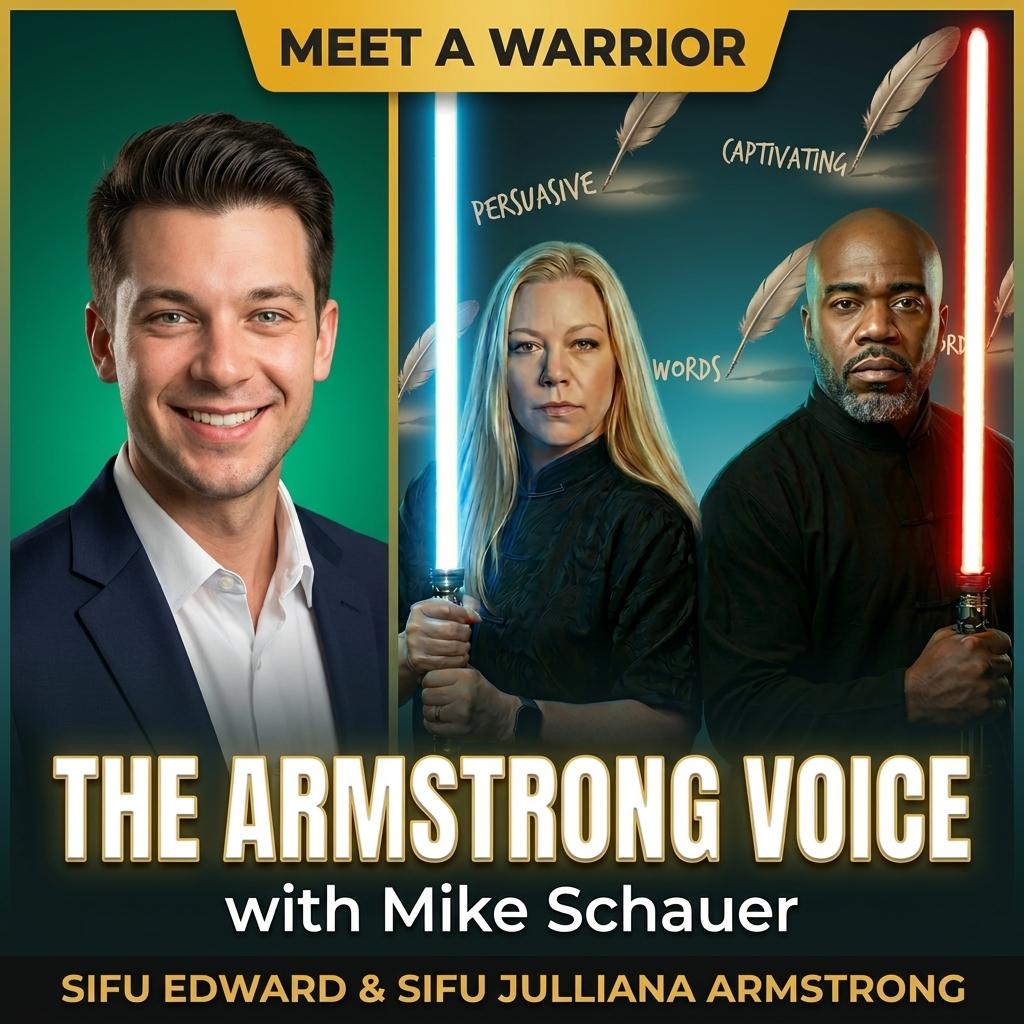
Adapted from the recorded conversation; the guest's words are verbatim. The questions are reconstructed and voiced by Sifu Edward and Sifu Julliana Armstrong.
🎥 Video podcast coming soon. The complete interview will play here once published. The full conversation is transcribed below, and the audio edition will be available on sifuarmstrong.tv.
In a new Sifu Armstrong interview, the founder of the reverse-engineering copywriting resource explains why we’re all salesmen already, just some of us are doing it in writing.
Mike Schauer never set out to build the internet’s go-to copywriting archive. He started as a designer obsessed with whether a website actually converted, and only discovered what he was doing had a name after a friend pointed it out. That accidental path was the subject of his conversation with Sifu Edward and Sifu Julliana Armstrong on the latest Warrior Intelligence Series.
“We’re all salesmen in our own way, and so this is just in writing,” Schauer said, describing copywriting in its plainest form: writing with the intent to move someone to a specific action. What makes it hard, he says, is that on the page you lose every tool a salesperson normally relies on (tone of voice, facial expression, the “jazz” of live video), so the words alone have to do all the work.
Schauer built Swiped.co as a side project, a “swipe file” style inspiration site for copy the way design inspiration sites already existed for visuals. The momentum surprised him, and he says he stopped taking client work entirely once the site took off. What sets his teaching apart, he says, is that it’s entirely reverse-engineered: breaking down real, working examples piece by piece rather than teaching abstract formulas, the same approach he used to teach himself coding and design. He’s since built Chrome extensions that let anyone save and annotate sales pages the same way he does, turning his personal workflow into a tool others can use.
His sharpest insight was about selling something an audience has never encountered before, a problem that maps directly onto marketing anything genuinely new. Working with a client building an unfamiliar fantasy-game business app, Schauer’s advice was to stop trying to explain the new thing in isolation and instead connect it to something the audience already understands. “You have to bridge the gap between what people know and what they know now,” he said: starting from a familiar reference point, like book summaries, and building forward from there.
Schauer’s other core discipline is research before writing, knowing an audience’s fears and triggers well enough to write as if you’re already standing in their shoes, rather than relying on formulas alone. Good copy, in his view, isn’t about natural talent; it’s about preparation deep enough that the writing looks effortless once it’s done. He also keeps consulting deliberately small and selective, taking on clients only when they reach out already excited to work with him rather than advertising for the work at all, a filter, he says, that keeps every project one he actually wants to do.
Now Schauer is building tools so other copywriters can do their own version of what he’s spent over a decade doing by hand, a shift, he says, that every idea worth building eventually has to make, moving from one person at the helm to something bigger than any single creator. He’s also candid that plenty of people assume they’ve already got the skill until they see their own writing fail to convert, and that seeing the result for themselves, rather than being told, is usually what turns someone into a believer in the craft.
In This Conversation
- How a designer accidentally became one of the internet’s most-cited copywriting teachers
- Copywriting defined in its simplest form: “we’re all salesmen... just in writing”
- Why Swiped.co teaches through reverse-engineering real examples instead of abstract formulas
- The “bridge the gap” method for selling something an audience has never heard of
- Research and preparation as the real difference between good copy and bad
- Building tools so others can do their own version of the reverse-engineering process
The Full Conversation
Sifu Edward Armstrong: I had to learn that founding a martial art the world has never seen is, first and last, a problem of language. Before anyone steps on the mat, the words have to do the work. They have to take a person who's never heard of light sword and make them feel the warrior already living inside them. That's copywriting, and it's the most undervalued weapon in any builder's arsenal. So I was thrilled to sit down with the man who, for over a decade, has run the single best resource on earth for it.
Sifu Julliana Armstrong: And what I love is how he came to it sideways. He was a designer obsessed with whether the thing actually worked, and the writing turned out to be the part that converted. That's a competitor's instinct: don't fall in love with how it looks, fall in love with whether it lands. Words that land are a craft you train, and Mike is a master of it.
Our guest is Mike Schauer, who for over a decade has run Swiped.co, a goldmine for anyone serious about copywriting and marketing. Mike, welcome.
Mike Schauer: Yes, amazing to be here. That was a great intro.
Sifu Edward Armstrong: I built LSTA on pure conviction before I had any plan, just a fire I couldn't ignore. It sounds like Swiped started the same way. Take us back to your background and how it began.
Mike Schauer: Yeah, definitely. So we can start at right before, or a few years before I started it, because it's all connected. So my first love and initial skill was design. So I was a designer for a while, would help people with logos, with branding, building websites. And then naturally I started doing the writing when I was building people's websites. And I had no idea that that was called copywriting. So just naturally, if you're coming from, because I would come from a conversion perspective of if I'm going to work on this person's stuff, I want it to convert. And in my mind, just naturally I could not see that happening without the writing being good. So eventually, and thankfully not too many projects in, a friend of mine said, okay, that's delivering way more than you're supposed to. That's not web design, that's copywriting and you should be charging extra for it.
So I did, I started doing that, and I realised that I was very much into this just before I knew what copywriting was, because I was into sales and conversions. So after that, basically imagine as a designer that I'm visiting sites that are inspiration sites, right? And this is so common in the design world where you have these different sites with other examples and you go there for inspiration. So as I'm diving more into the copy world, I'm like, oh, this would be amazing if there was a site but it was for copywriting like that, because we have something called the Swipe File that so many people have been selling Swipe File stuff for a long, long time, but no one had anything like that.
And I had learned how to code at that point. I loved design, right? So I built the whole site. I was just on rocket fuel for a few weeks where I was super excited about it and this was just a side project. It was not a grand plan or anything. And from there, I think because of how I got into it, because of my excitement around it, it just, the momentum was huge and all of a sudden I'm getting unexpected messages from people saying, this is amazing. This is so cool. And I'm just sitting there like, oh, that's great because, I think it's cool and I wanted to do this, but I wasn't thinking about what other people were going to think. And I think that that mindset has actually served me a lot in my life.
There is one approach that you can take of, alright, we've got the problem, we're going to solve it and we're going to go, like, basically that perspective is more if you're just saying, I want to start a business, right? But if you're just going with the flow of things, it's like, wow, I'm so excited about this. Well, why would I be excited about it? It means that there's other people that have to be excited about it because I know that there's other people like me out there and it just worked out that way. And so I just stuck with it and eventually I stopped taking clients and I was just working on it full time.
Sifu Julliana Armstrong: "I wasn't thinking about what other people were going to think." That's a kind of freedom most people never find. Tell us how the business actually works now, the free archive, the membership, and how you handle consulting.
Mike Schauer: It could [lead to consulting]. It's funny, the way that I do consulting now, I do not advertise it. I do not seek it. It's only if someone is truly excited to speak to me where they reach out. Dude, I need to hear your perspective because I don't want to write a whole sales letter just because it's time consuming for somebody else. But what I will do, and I'm happy to do is take a look at what they're doing and as a part of it, I would rewrite some things or give my own ideas, but I'm not doing a whole project from scratch just because of time. But if somebody reaches out to me and they're like, oh, I'll do it, I love your work, then just like anything else, just like the interview, I want to work with people that are excited to work with me.
Sifu Edward Armstrong: "I want to work with people who are excited to work with me." That's exactly how we choose who gets to carry the standard. Now, for anyone hearing the word and not quite knowing what it means. Give us your definition of copywriting.
Mike Schauer: So copywriting in the most basic way is you are writing with a certain intent to, you could say, get someone to take a certain action, right? In the most plain and simple words. And this is people that don't understand it or they're like, oh, I need to learn how to write copy. I'm like, all right, have you written something to somebody where you would like them to take a certain action? And so if you did, then in your head you were probably thinking to yourself, even if it was subconsciously, what do I say to get this person to do this? We're all salesmen in our own way, and so this is just in writing, and because it's in writing, it does make a difference because you don't have vocal tonality, you don't have facial expressions, you don't have all of the jazz you get today from video. So you have to approach it in a specific way, and that can make it more challenging. But that's where the art of it comes into play.
Sifu Julliana Armstrong: I think people underrate it precisely because the great ones make it look effortless, same as watching a black belt and thinking "I could do that," until you step on the mat. Do you find people assume they've got it, right up until they sit down to actually write?
Mike Schauer: Yeah, I definitely think so. Unless you have somebody where they think everything they do is good. No, this is great. Yeah, it's if maybe people, and this is what I'll find actually, is no, no, we got this. And read their copy and say, all right, if you think so. I don't know if you got it, right. But I'm not going to say anything, just send it out, do what you want to do. And then sometimes people often, they have to see the result for themselves in order to become a believer, you could say.
Everyone always has their own opinions on how much you need to naturally know to become really good or whatever. But I just think if you're drawn to it, if you hear about it, if you're listening to me and you're like, oh, that sounds cool, and you just go in that direction, I don't know, I'm simple man. If you just have all of this momentum and energy going into something, that builds momentum and you're going to find the answers that you need. And so my site is one way to find those answers, which I deliver knowledge and teaching in this very specific way that's really based on reverse engineering. And that's how I learn. So I learned best through reverse engineering things.
That's just how my mind works. That's how I learned coding, design, looking at other examples. What are they doing here? What are they doing here? And I applied it to copywriting. So if people say, oh, what courses, what books do you recommend? I'm like, honestly that's not… if you're coming to me for advice it's, I'm in this niche, can you find some examples for me? And then I'll do a little… this is part of what I'll do in the membership, is when people need research, they'll mention it to me and I'll do research for them and I'll give my take on it. And then all the content that I create, any reports I create, it's all reverse engineered stuff. Like, here's what I saw, here's what I'm getting from it.
Sifu Julliana Armstrong: Reverse-engineering the masters is exactly how a fighting art is built. You study what works, break it down, and rebuild it as your own. So in your eyes, what separates good copy from bad?
Mike Schauer: Yeah, well I think if we compare it to just like a presentation, right? What would be a bad presentation? Well, somebody could wing it and they could like, wow, that somehow turned out great, you didn't even know what you were doing. No, I didn't. But that's not going to be common, right? So I think a lot of it has to do with your preparation leading up to it, because once you work on a skill enough and it's ingrained, well now you're naturally like, oh, write something for me. Oh wow, that's good. Yeah, I've been doing it for a while. But I think being on a level playing field, the research, right, and that's what I'm big into, is putting in that research. So then you know whoever I'm writing to, what makes them tick?
What are their fears? What are their triggers? What is important to them? So that if you take someone that has that preparation that looks into all those things and that really steps into that person's shoes and locks in, then even someone that's pretty good, if you just say, all right, write to this target consumer, they're like, oh, well I've never dealt with them, but I know a lot of formulas and I know I've created good hooks before and stuff like, okay. So I think that that's something that is super important. And that's the type of answer that goes with who I am and what my site is about, which is making everything easier by doing the research and knowing about it.
So I would say that if you've done that part and you're like, all right, I know a good amount, then it's like, what's the best you can do with what you know? So we can look at something and say, ah, this isn't the best that I think it could be. But it's like looking at the components. Well, is it ill researched? Does it seem like they don't know what they're talking about? Or is it because they just seem like they're new to writing? Where it's like long sentences, and now you're going into copywriting specifics. Is it easy to read? Like people say, write like you talk in a sense. It's got to be edited, but, yeah.
Sifu Edward Armstrong: "Step into their shoes: know their fears, their triggers, what's important to them." That's not just copywriting; that's how we built the three avatars, because the Warrior-In-Waiting, the Operator-Builder, and the Ageless Warrior each carry a completely different fear. Which leads to the hardest problem I face: how do you sell something the person has literally never heard of? Walk us through the mistakes you spot, and that "bridge the gap" idea.
Mike Schauer: Well, it definitely goes back into the categories I was talking before of like on one side, how much does it seem they know about who they're talking to? And on the other side is how much are they familiar with the art of copy where it's, for instance, oftentimes not having clarity, being all over the place trying to, we are jack of all trades, we full service, we do this, this, and that. I just helped somebody out, and this was just not even full consulting, but like I said, in the membership, somebody comes to me, do some research, give some feedback, right? And it's an app that it's like a fantasy type game and it teaches you business lessons, right?
So when I say that to you, right, what else do you have as a reference for that? I've never heard of that before, which can be cool, right? But now if no one's ever heard of that before, how are you going to market this to them? Because you can't just say that and be like, ah, I know what you're talking about. So I was mentioning, I'm like, you have to bridge the gap between what people know and what they know now. So what do they know now? Where do they get their business knowledge from? It's like book summaries, and then I showed them examples of, look, there's a lot of marketing around this, around people getting stuff like that.
So now how do you bridge? It's like, oh, well we could say, you can learn even faster than this than in book summaries or stuff like that. Now it's like, oh, I do this, I read book summaries and now this is another option and this seems like fun. So man, it's really like an awareness of the market and what the other person knows. If somebody was actively taking what they wrote and showing it to people that were going to get it, that are not family or friends, they would get instant feedback like, I don't know what this is.
And when I give this feedback, these are often smart people that get it, but they just don't see, and I totally understand that as well because I don't care who you are. If you are in the thick of the trees, right, in the forest, you can't see that big picture perspective. Anyway, we all have our blind spots, so none of these people, it's like, ah, I'm never thinking like these idiots, like what? No, they're not used to thinking that way.
Sifu Edward Armstrong: "Bridge the gap between what they know and what they know now." That is the single most important sentence anyone could hand me. Nobody has a reference point for light sword, so we have to start where they already are: the warrior they always wanted to be, the discipline they admire, the movie saber they grew up loving, and bridge from there to the real art.
Sifu Julliana Armstrong: And we have the same blind spot Mike describes. We're so deep in the trees of this art that we forget how foreign it sounds. Speaking of which, Mike, put your own skill on the line: how would you tell someone why they should visit Swiped, and who is it really for?
Mike Schauer: Yeah. Well I think especially, I hear a lot from people, like when I go to copywriting events and stuff, oh my God, when I started, your site was just indispensable. I learned. It's very cool to hear people say especially that in the beginning of when they started learning that they found my site. Because it's a novel thing if now you're first discovering copywriting and of course whenever you're learning something, books, courses, but to see something very unique where they're like, wow, I'm looking at the examples and he is telling me about them and that's not common usually like that reverse engineering style, it really, in any industry, it's not very common. But it's unique in that way. So 100% if you're learning copy, especially because I have the free archive, but then there's people, that season copywriters, oh yeah, I was looking for something, I went to your site quickly to look and they check it out still.
And then people that if I post new content, they want to see what I posted. So it all depends on what you're looking for, what stage you're at. And what I built now with the premium membership, which these changes are going to transfer over into the site overall into the free archive, but I built chrome extensions that are Swipe file tools where you can save full sales pages and tag them and label them with, how much is the price of what they're selling here. And you can write a description.
And then, so there's one called Swiping on Steroids, and there's another called Copy Snippets. And with copy snippets you could highlight any part of a page and save it and tag it and say, if you want to save a power word or a power phrase or a whole component, right? So what this has allowed me to do right now, for myself before I launch it out to everyone, is just improve my workflow. Make it super fast for me to do the thing that I hate most, which is to screenshot everything and save it to the site.
Sifu Edward Armstrong: You're building tools so that others can do what you do, which tells me you're thinking past yourself. That's the exact shift I had to make: from being the only one who could teach the art to building a system so the Shadow Council and our Academy Commanders carry it. Tell us about that next stage.
Mike Schauer: It has: like, I built this and it took a lot of time. I built this around my workflow to make it easy to save so that way I can spend, and other people too can spend more time annotating and breaking it down. So the idea, and this has always been the idea, but it was a big thing, was to allow people to do what I'm doing as well, where they break down copy in their own way. So that's the next level of where I'm going and what was always my dream for the idea.
So imagine that you're on a sales page, you click a button, you save the page, it saves the HTML too and then you open it up and you just, I don't know if you've seen on the site where there's little dotted boxes, red boxes around the sales page where I put comments, you would be able to do that as well. So the idea is going beyond just me now, me being at the helm and of course being the leader of Swiped, being the one that sets the tone. But it's ultimately, if you really are invested in an idea and you want to take it to its max potential, eventually it has to go a little bit beyond.
Sifu Edward Armstrong: "If you want to take it to its max potential, eventually it has to go beyond you." That's the line between a hobby and a legacy, and the whole reason a federation exists. Mike, for the warriors who want to learn from you, where should they go?
Mike Schauer: Yeah, so just Swiped.co and it's pretty self-explanatory. Once you go on there, you'll see all these examples. I think there's like over 400 and they're all breakdowns. You could search through them and like I mentioned eventually, I don't even know exactly what it's going to look like on the front end for anybody, but that's going to even upgrade. There's a newsletter as well. I've taken a little break on that at the moment, but obviously that's because I've been putting so much into the new platform. But yeah, I'll be back on that.
Sifu Edward Armstrong: Mike, it's been an absolute pleasure: thank you for the insight into why copywriting is a skill every builder, online or off, should try to master.
Mike Schauer: Yes, thank you so much. I enjoyed it thoroughly. Appreciate it man.
Sifu Julliana's closing word: Mike fell in love with whether the thing actually worked, not how it looked, and that's the competitor's eye exactly. The lesson I'm keeping is research: step into the other person's shoes, know their fears and their triggers before you ever try to move them. On the mat or on the page, you can't lead someone you haven't bothered to understand.
Sifu Edward's closing word: Mike gave us the master key to the Armstrong Voice: bridge the gap between what people already know and the new thing you're offering. Nobody has a reference point for light sword, so we meet them at the warrior they've always wanted to be and build the bridge from there. The word that enrolls a warrior is as trained a strike as anything we throw on the mat; research it, reverse-engineer it, edit it, and never assume the effortless-looking thing is easy. And when your idea is bigger than you, let it go beyond you. We don't entertain warriors. We create them.
Mike Schauer, founder of Swiped.co, the reverse-engineering copywriting resource with 400+ annotated breakdowns plus a premium membership and Swipe File Chrome tools. Find it all at Swiped.co.
ILLUSTRATIVE RESULTS. Any revenue, enrollment, margin or retention figure in this conversation is either a documented result from one of our own operations, a figure the guest reports about their own business, or an illustrative example, never a projection of your results.
Nothing here is financial, legal or tax advice.
Stay in the Fight
This conversation is part of the Sifu Armstrong Warrior Intelligence Series: interviews with world-class performers, builders, and thinkers, filtered through the lens of the warrior's path.
Subscribe at sifuarmstrong.news for every new interview, delivered to you.
Join Club Sabernet, the member community of the whole Sifu Armstrong ecosystem, where warriors train, connect, and hold each other to the standard.
Ready to build your own floor? Find your path at sifuarmstrong.com/which-path.