Teaching Forces You to Learn: Sifu Edward & Sifu Julliana Armstrong Sit Down With Willie Crawford
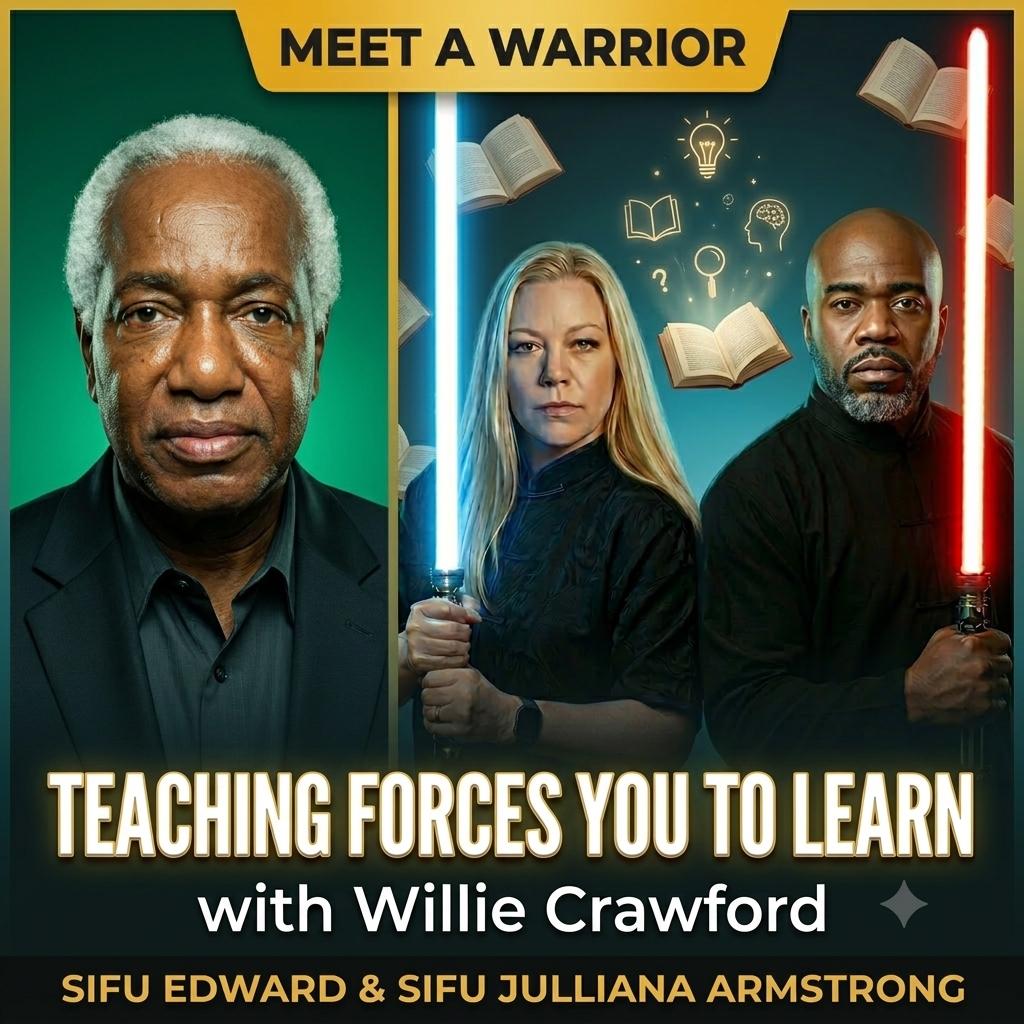
Adapted from the recorded conversation; the guest's words are verbatim. The questions are reconstructed and voiced by Sifu Edward and Sifu Julliana Armstrong.
🎥 Video podcast coming soon. The complete interview will play here once published. The full conversation is transcribed below, and the audio edition will be available on sifuarmstrong.tv.
In a new Sifu Armstrong interview, the retired Air Force pilot and forty-year martial artist explains why he spent years building a business as a “lone wolf,” and what changed the moment he found other people doing the same work.
Willie Crawford built his first online business in the cracks of an already grueling schedule: sixteen to eighteen hours a day flying C-130 aircraft, followed by whatever hours he could steal at a keyboard afterward, some nights falling asleep mid-session with the keys pressed into his hand. His conversation with Sifu Edward and Sifu Julliana Armstrong for the Warrior Intelligence Series covers that grind, and the isolation that came with it.
For years, Crawford said, he had no idea anyone else was doing similar work. Deployments kept him away from home for months at a time, and what family he had didn’t fully understand what the “part-time job on the computer” even was. That changed in 2002, when he was invited to speak at an industry seminar and discovered a room full of people building the same kind of business he’d been building alone. “That was eye-opening, because when you work alone in isolation, you feel like it’s you against the world, and then you realise it’s not,” Crawford said. “You work together, you teach each other, and it makes it easier for everyone.”
That seminar led directly to collaborations with five other speakers he met there, a turning point Crawford credits with breaking a pattern he hadn’t realized was limiting him. Isolation, he said, feels like self-reliance, but it’s actually a ceiling most people don’t recognize until someone shows them what’s on the other side of it.
Crawford’s other defining principle came from an entirely different discipline: forty years as a martial artist who also taught karate. “When you teach anything, that forces you to really learn your topic too,” he said, describing how standing in front of students (or, later, standing in front of generals and politicians during military briefings) exposed the gaps in his own understanding faster than any amount of solo study ever could.
That same military background shaped how he now builds online courses and manages his own plans. “You plan things out, you flow them out, but you don’t plan on sticking completely to the plan,” Crawford said, describing lessons learned across four wars and multiple insurgency operations. A course outline gets adjusted the moment real questions or real problems surface, because, in his experience, no plan survives first contact with an actual audience.
Underneath all of it, Crawford said, is a belief that the relationship comes before the transaction. “People buy from people, not from businesses,” he said, insisting that even email should read as though a single real person is sitting across the table.
The Armstrongs heard their own creed reflected back at them almost word for word, that transmitting a skill to someone else is what deepens a teacher’s own mastery of it, and that no warrior rises as fast alone as they do surrounded by people already reaching for the same standard.
In This Conversation
- Building a business on stolen hours between eighteen-hour flight days
- Years as a “lone wolf,” and the seminar that changed everything
- “It’s you against the world, and then you realise it’s not”
- “Teaching forces you to really learn your topic too”
- Military discipline: planning fully, then adjusting without hesitation
- Why age was never the barrier people assume it is
The Full Conversation
Sifu Edward Armstrong: Every so often a guest walks in who is practically one of our own, and Willie Crawford is exactly that. A C-130 pilot who flew through seven conflicts. A 40-year martial artist who taught karate. A man turning sixty-one who still can't wait to teach. When he said that teaching anything forces you to master it more deeply, I felt like he was quoting our own instructors back to us. I couldn't wait to talk to him.
Sifu Julliana Armstrong: And I love that he's living proof age is no barrier. He's built a life where the work fits the man, not the other way around. Forty years in the martial arts, a lifetime of discipline, and he's still adapting, still learning, still on stage. That's the Ageless Warrior in the flesh.
Our guest is Willie Crawford, a true veteran of internet marketing, and one of the most genuine and respected figures in the industry. Willie, welcome.
Willie Crawford: Thank you very much. It's my pleasure to be here.
Sifu Edward Armstrong: You've been at this since 1996, and you were flying planes at the time. How did it start?
Willie Crawford: I've been around since 1996. At the time I was in the United States Air Force, trained in economics and business in college, ready to start a business of my own even though I had six years before I'd retire from the military. It was an office job where I had access to the early internet, and I saw advertisements saying you could make money doing different things, so I just started doing them. What really made me get into internet marketing was that when I first started, I was flying a C-130 aircraft all over the world, 16 to 18 hours of crew duty a day, then land and try to work on the computer. So I needed something portable, so no matter where I was, as long as I had access to the internet, I could work on my business. That nudged me toward internet marketing. And I came across people who said what you do is build an audience, find out what they want, and offer it to them.
Sifu Julliana Armstrong: You've described the early grind honestly. What was it actually like?
Willie Crawford: It was very difficult at the very start. The standard crew duty day, you were expected to put in up to 18 hours, from when you first showed up at base operations to plan the mission. So I'd work up to 18 hours, then land, then get on the computer and put in maybe another four. Some nights I slept maybe two hours. I'd fall asleep at my keyboard and wake up, and because my hand was resting on it, the screen would be full of Zs. So it was exhausting at first.
Sifu Julliana Armstrong: Eighteen hours in the air, then four more at the keyboard, asleep on the keys. That's a level of dedication most people can't imagine, and it's the same dedication I see in a fighter who trains after a full day's work because the dream won't wait. Nobody handed you a spare hour. You built the business in the cracks of an already impossible schedule. That's not talent. That's will.
Sifu Edward Armstrong: And your first real product came from your grandmother's kitchen. Tell us.
Willie Crawford: It took about a year. At first it was figuring out what to offer. I was told, find something you know, then build an audience around it. And the only thing I really knew that I thought would be marketable was: I'd grown up on a farm in North Carolina where I learned to cook. My grandmother started teaching me at about age seven. So I put together a website all around cooking (or, as you say in the UK, cookery), and started building an audience. Around 2000, my mailing list enjoyed my recipes so much they asked if I had a cookbook. I said, "No, but if you want one I'll write one." And they said, "We'll buy it." I sold about 200 copies before I even started writing it. It was published in 2000, and it still sells to this day.
Sifu Julliana Armstrong: You're about to turn sixty-one, and you're adamant age is no barrier at all.
Willie Crawford: Yes. I've seen people as young as 14 starting online businesses, and I've seen many people in their 70s and even 80s. I used to attend a lot of seminars, and I'd sit and talk to people in their 70s and 80s, and they were very lucid. We were all sharing the same experiences, the same dreams and hopes. It was just a matter of putting all the pieces together. Anyone can do it, regardless of age.
Sifu Julliana Armstrong: That's the exact truth we built an entire path around. We have warriors in their sixties and seventies picking up the practice for the first time and building real capability, because the body and the mind respond to training at any age. The world tells people they've missed their window. You're proof, at sixty-one and forty years into the martial arts, that the window never actually closed.
Sifu Edward Armstrong: Is it easier or harder to start today, and who would you focus on if you began again?
Willie Crawford: It's easier to get started because there are more tools, more training, more people whose experience you can tap into. The problem is knowing who to listen to, because a lot of people, when they first start, do what we call "fake it until you make it." There's a lot of training out there that's nothing but theory, so you have to be very careful who you listen to. When I look back at all the people I've encountered over 24 years online, fully 80% of them are not in business online anymore. And if I started over, I'd focus on business owners. When I first went into business, I focused on teaching ordinary people to take their knowledge and create information products, and I worked with a lot of people who had no business experience and were unwilling to learn the skillset they needed. Probably 90% of them never had major success. Business owners have experience running businesses, they make tough decisions, and I enjoy working with them more.
Sifu Edward Armstrong: Walk us through how you build a course, because I hear the fingerprints of your military training all over it.
Willie Crawford: I was trained early on to record almost everything I do. People noticed I was building websites, renting them, buying and selling them, and asked me a lot of questions. So I said, why don't I do a six-week course: each week, one hour of teaching plus questions and answers, recording everything, and at the end I'll have about nine hours of material. Then I was taught: if you do a video, rip out the audio and offer that too, and transcribe it and offer the PDF. Three formats. And I don't have to prepare it all in advance. I only need the first week's material to get started, then I prepare each week in between. If questions or problems come up, I adjust. Coming from a military background, I learned you can have the most flawless plan, and as soon as you take off, things start going wrong and the plan completely changes. So you plan things out, you flow them out, but you don't plan on sticking completely to the plan. I've been through so many experiences in the military (four wars and a number of insurgency operations) that there's very little now that would shake me up more than those did.
Sifu Edward Armstrong: "No plan survives contact." Every warrior culture on earth knows it. You prepare rigorously and then you hold the plan loosely, because the fight, the flight, the launch never goes the way the plan drew it up. Rigidity gets you killed; adaptability keeps you alive. You're describing the exact mental posture we drill into a fighter: total preparation, total willingness to adjust the instant reality changes.
Sifu Julliana Armstrong: You spent years as a "lone wolf" before you found others doing what you did. What changed?
Willie Crawford: My family was supportive but didn't fully understand. They just knew I had a part-time job on the computer. And I was flying planes, often away from home for as long as three months at a time, so a lot of what I did was in isolation. I started in '96, and it wasn't until 2002 that I attended a seminar and met other people doing the same thing. Until then I was a lone wolf. I was invited to speak because someone noticed I'd written a cookbook that was doing well, and they wanted a speaker doing something other than teaching people how to make money by teaching people how to make money. They wanted someone with a real product. At that event, all the other speakers were very willing to share what they were doing, and suggested working with each other. I did projects with five of them. That was eye-opening, because when you work alone in isolation, you feel like it's you against the world, and then you realise it's not. You work together, you teach each other, and it makes it easier for everyone.
Sifu Julliana Armstrong: "It's you against the world, until you realise it's not." That's the moment a solo grinder becomes part of something. Isolation feels tough and self-reliant, but it's actually a ceiling. The training room, the circle of people all reaching higher. That's where you break through what you couldn't alone. We call ours the Shadow Council and Club Sabernet, but it's the same truth: you rise faster surrounded.
Sifu Edward Armstrong: What's your honest advice to someone starting out?
Willie Crawford: First, don't try to figure everything out on your own. Newbies tend to think they don't have money to invest in training, so they say, "I'll just watch what the successful people are doing and copy them." The thing is, they don't see everything the successful people are doing, so they're guessing and missing pieces of the puzzle. And even when they hire someone, the teacher often isn't aware of the little nuances that make a difference. So I'd advise them to get a coach. And once they decide to create their own products, outsource as many tasks as you can: it makes life easier and lets you scale so much faster. The other big mistake I see is people creating huge products over months or years and then rolling them out, without surveying the market first to confirm the market wants it. My friend Marlon Sanders teaches: come up with an idea, survey your audience, ask what they want, then create a small version and test-market it. If they don't buy it, go do something else. A lot of beginners fall in love with the idea of their product and keep trying to sell it to people who don't want it. That doesn't work.
Sifu Julliana Armstrong: I saved this for last on purpose, Willie, because it's why you feel like family to us. You're a forty-year martial artist who taught karate, and you said teaching forces you to master your topic. Tell me about that.
Willie Crawford: I do enjoy teaching in the first place. I'm a martial artist, and for a while I taught karate to students. I've got 40 years of experience in the martial arts, so I enjoyed teaching there too. And what I discovered is that when you teach anything, that forces you to really learn your topic too. I enjoy speaking on stage most of all. In the military I was forced to get on stage and explain portions of the mission even with politicians and generals in the audience, so I grew accustomed to standing up in front of people and teaching. People fear public speaking more than death, they say, but I've done it so long I love it. You have the podium power, everyone's focused on you. And whether it's on stage or a Facebook live, what matters is that it's two-way: people need to feel they know you and that you care for them. Even in email, I was trained to write as if one person, your avatar, is sitting right across the table from you. When I see emails that say "you guys" instead of "you," I know that person doesn't get it. It's human-to-human. People buy from people, not from businesses. You can find me at williecrawford.org.
Sifu Julliana Armstrong: "Teaching forces you to really learn your topic." Every Sifu on earth knows that in their bones, the moment you have to transmit a form to a student, you discover the gaps in your own understanding, and you deepen. You've been living our creed for forty years on the mat without calling it that. It's an honour to talk to a fellow teacher and a fellow martial artist.
Sifu Edward Armstrong: Willie, this has been a genuine pleasure, from one lifelong martial artist to another. Thank you.
Willie Crawford: Thank you very much.
Sifu Julliana's closing word: Willie is family, and not just because he's a forty-year martial artist. It's that he's lived every principle we teach without needing our vocabulary for it: teach and you deepen, prepare then adapt, rise faster surrounded, and age is no barrier to anything. Eighteen-hour flights and four more at the keyboard, asleep on the keys. That's the dedication of a warrior, and he's still got it at sixty-one.
Sifu Edward's closing word: He's one of us: forty years on the mat, decades in the air through seven conflicts, and still teaching at sixty-one. That's not a marketer. That's an Ageless Warrior. He knows the deepest truth of transmission: teaching forces you to master the thing more completely than doing ever did. Prepare with everything you have, hold the plan loosely, surround yourself with masters, and never believe you've aged out. We don't entertain warriors. We create them.
Willie Crawford, internet marketing veteran since 1996, retired US Air Force C-130 pilot, 40-year martial artist and karate instructor, and one of the most respected figures in the industry. williecrawford.org.
ILLUSTRATIVE RESULTS. Any revenue, enrollment, margin or retention figure in this conversation is either a documented result from one of our own operations, a figure the guest reports about their own business, or an illustrative example, never a projection of your results.
Nothing here is financial, legal or tax advice.
Stay in the Fight
This conversation is part of the Sifu Armstrong Warrior Intelligence Series: interviews with world-class performers, builders, and thinkers, filtered through the lens of the warrior's path.
Subscribe at sifuarmstrong.news for every new interview, delivered to you.
Join Club Sabernet, the member community of the whole Sifu Armstrong ecosystem, where warriors train, connect, and hold each other to the standard.
Ready to build your own floor? Find your path at sifuarmstrong.com/which-path.