Surf the Crest, Keep the Brakes: Sifu Edward & Sifu Julliana Armstrong Sit Down With Kevin Polley
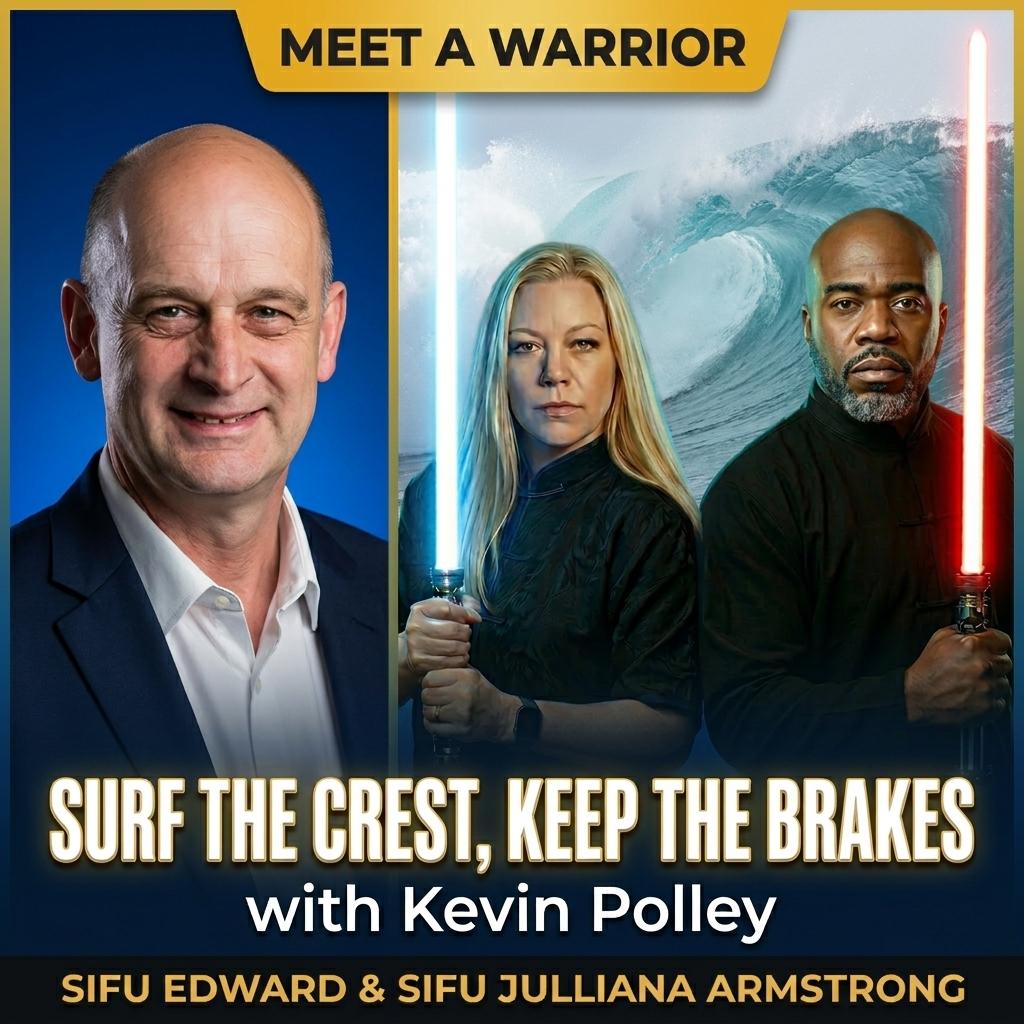
Adapted from the recorded conversation; the guest's words are verbatim. The questions are reconstructed and voiced by Sifu Edward and Sifu Julliana Armstrong.
🎥 Video podcast coming soon. The complete interview will play here once published. The full conversation is transcribed below, and the audio edition will be available on sifuarmstrong.tv.
In a new Sifu Armstrong interview, the self-hosted-email pioneer explains why he builds on ground he owns outright, and why he never lets a machine run unsupervised.
Kevin Polley has been building online since 1999, and the through-line of his career, laid out in a new Sifu Armstrong interview, is a refusal to depend on anyone who could fail him. Polley (creator of the self-hosted platforms ARP Reach and V2 Movement) joined Sifu Edward and Sifu Julliana Armstrong for the latest Warrior Intelligence Series conversation calling himself, only half-jokingly, unemployable by nature.
“The honest answer is I needed to make money because I’m totally unemployable,” Polley said of his start, tracing it back to a childhood spent setting his own price for gardening work and DJ gigs rather than waiting on an employer to name his worth.
That independent streak shaped how he approached search engines, too. While competitors asked how to get found, Polley asked a different question entirely. He dug to page 78 of the search results and found an obscure ontology years before the rest of the industry caught up, a lesson he still hands to newcomers today: “Don’t wait for the tidal wave to pass you by. Position yourself on the crest of the wave and surf it as far as you can.”
The same logic drove him to buy his email software outright rather than rent it monthly, eventually acquiring the platform and building it into V2 Movement. Owning the infrastructure, he said, means he isn’t “tied at the hip forever to an autoresponder I pay for monthly,” if one of the more than thirty companies he can route mail through develops deliverability problems, he simply resends through another.
That same caution now shapes how Polley thinks about AI. He’s building an AI-assisted copywriting tool and using the technology daily, but he’s blunt about where the human has to stay in charge. “There must always be hard brakes where a human looks at the results and makes a common sense decision,” Polley said, describing a process where AI handles a small slice of a task before a person checks the output and decides whether to proceed.
He’s equally wary of feeding AI on the internet’s accumulated noise. His advice: train it on your own first-party data (your sales, your subscribers, the interest that’s unique to your business), and treat that data carefully. His own email open rates run 40 to 60 percent, which he attributes not to any tool but to the relationships he’s nurtured with his list over decades.
Polley has also built a compliant AI use case of his own: a copywriting template based on a formula from marketer Tony Shepherd, fed into ChatGPT to draft a sales letter in about an hour. He used it to write the sales letter for his own guide to using it, a letter he says converts at 23 percent, with buyers reporting their own versions converting at 18 to 32 percent and telling him the copy actually sounds like them.
It’s a stance that echoes the discipline the Armstrongs bring to every tool used at Light Sword Training Academy: use the wave, but never let it use you.
In This Conversation
- Why Polley calls himself “totally unemployable,” and means it as a compliment
- The page-78 search discovery that put him years ahead of the industry
- Why he bought his email software outright instead of renting it
- The AI guardrail: small chunks, human checks, no full automation
- Training AI on first-party data instead of the open internet’s noise
- Where to find ARP Reach and V2 Movement
The Full Conversation
Sifu Edward Armstrong: Kevin Polley calls himself "totally unemployable." A man who's been building online since 1999 and who owns his tools instead of renting them. He runs self-hosted email software precisely so no platform can hold his business hostage. That instinct (to own your ground rather than depend on someone who can fail you or price you out) is one we live by.
Sifu Julliana Armstrong: And he thinks the way a master does. When everyone else asked "how do I get found in search engines?", he asked a completely different question ("how do search engines work?"), and dug all the way to page 78 to find the answer, years before the rest of the world caught up. And in the AI age, he gave the clearest guidance I've heard: ride the wave, but keep your hand on the brake. Never let the machine run the whole show. I couldn't wait.
Our guest is Kevin Polley, creator of ARP Reach and V2 Movement. Kevin, welcome.
Kevin Polley: Hello, wherever you are. Thanks for listening.
Sifu Edward Armstrong: Take us to the beginning, because the independent streak started young.
Kevin Polley: The honest answer is I needed to make money because I'm totally unemployable. I started in 1999 (the internet in its infancy) bought my first domain, learned HTML, put up a page trying to sell gardening services, and then realised: how do people even find this page? That led me into SEO, into building the UK module for one of the original open-source shopping carts, into hosting. But it goes back further. I'm also a coded welder, and I never liked getting up in the morning; a hangover at 8am at seventeen wasn't good. At eleven I realised my parents weren't giving me enough pocket money, and my uncle said, "Why not start a little part-time job?" That was gardening, helping older people, getting five pounds an hour when a job would pay me one. Then I became a DJ at sixteen, and the money and the freedom made it my defining moment: the freedom and flexibility to manage your own life, your own time, and set your own value. Since then it's always been, if I need something, I'm responsible for making my way in the world.
Sifu Edward Armstrong: "Set your own value." That phrase is the whole thing. Some people wait their entire lives for an employer, a market, or a gatekeeper to tell them what they're worth, and some people decide it themselves and then go prove it. At eleven you'd already worked out that helping the older folks paid five times what a "job" would, because you set the terms. "Unemployable" isn't a flaw in a person like you; it's the mark of someone built to own the ground they stand on. That's exactly the sovereignty we build everything around.
Sifu Julliana Armstrong: What makes you a builder, I think, is that you ask a different question than everyone else. Tell me about the search-engine story.
Kevin Polley: Everyone was asking "how do I get found in search engines?" I asked a different question: how do search engines work? Because my logic was, if I understand how the underlying thing works, I can work with the code and position myself higher, or find shortcuts to better results. And the answer came from page 78 of the results. I found something called GoodRelations, an ontology created by a professor at the University of Munich. It was special code that told search engines exactly what a webpage was: the beginnings of what I've since learned was machine learning. It was so effective at getting sites onto page one that six years later, when Google and the others created schema.org, they wrapped up everything I'd learned from GoodRelations into it. I was playing with it five or six years beforehand. And the first nugget I'd give anyone: don't wait for the tidal wave to pass you by. Position yourself on the crest of the wave and surf it as far as you can.
Sifu Julliana Armstrong: Two things there are pure mastery. First. "How does it work?" instead of "how do I get found?" That's first-principles thinking, and it's the difference between memorizing a trick and understanding a mechanism. The fighter who only learns moves is beaten by the one who understands why the moves work, because understanding generates a thousand moves the memorizer never had. And second. You found it on page 78. Everyone else quit at page two. The edge is so often just in digging deeper than the people who stopped where it got boring. And "surf the crest of the wave." Get on the change early, while it's still rising, before it's obvious to everyone. That's how you get years ahead.
Sifu Edward Armstrong: And you own your infrastructure rather than rent it. Walk our operators through why.
Kevin Polley: I'm a hacker, not a coder. I take a bit of code here, a bit there, and make it do what I need. That's how I built the shopping-cart module. And with email, I realised early that once someone found me, they had three choices: bookmark, leave, or buy, a 33% chance after all that effort. There had to be something better, and that was building a list. But I didn't want to pay $20 a month forever, so I found Auto Response Plus, software you buy once and install on your own server, with just a small annual fee for updates. That made common sense: when you're starting, you don't know if you'll make money every month, so owning something outright and using it forever just makes sense. I built my business around it, and when the developer stopped developing it, I'd built up a good relationship with him as a beta tester (you can never underestimate the value of a good relationship), so I asked to buy it, and in 2015 I acquired it. It became V2 Movement. And the biggest benefit of self-hosted: I can choose which of 30-plus companies sends my email. If one has deliverability problems and my open rate drops, I just resend through a different one. I'm not tied at the hip forever to an autoresponder I pay for monthly.
Sifu Edward Armstrong: "Not tied at the hip forever." That is the sovereignty principle applied to your tools, and it's the same lesson we keep hearing from the wisest guests: own your list, own your platform, own your ground. When you rent your infrastructure, someone else's outage, price hike, or policy change can hold your entire livelihood hostage. When you own it, you decide. Building your business on rented land is building on someone else's terms, and the day they change those terms, you find out who really owned it. Own the ground.
Sifu Julliana Armstrong: You're all-in on AI, and yet you're the most careful voice I've heard about it. Give our warriors the guidance.
Kevin Polley: If you're not seriously looking at AI, you're going to lose out as the years come on. It's the next big thing, like the internet in 1999. Get involved, learn the prompts. But I have serious concerns about the misconception that AI is the answer for everything. I wouldn't recommend anyone just lets AI run their business. You've got to have hard stops and human checks. Full automation is never really good, if something breaks at 100 miles an hour, it shatters everything; at 20 miles an hour, you've got time to slow down, see what went wrong, fix it. Break your process into smaller chunks: let AI run the first 10 or 20%, know exactly what result you expect, and a human looks at it and makes a common-sense decision. Is this right? Then move to the next step. And there's a garbage-in, garbage-out factor: if AI is scraping search engines full of the garbage that SEOs pumped out years ago, your answers might not be right. So if you can, train the AI on your own first-party business data: your sales, your subscribers, the interest unique to you. Treasure that data with kid gloves. I ask my daughters: if I performed brain surgery on you, would you be happy? No. If a brain surgeon did? Of course. So where's the risk? Is a 10% variance acceptable to your business or not? My own open rates run 40, 50, 60% (apparently I shouldn't get those), because I nurture the relationships. That's what makes the difference.
Sifu Julliana Armstrong: "Ride the wave, but keep your hand on the brake." That is the wisest thing anyone has said about this era. The tool is astonishing, and refusing to use it is foolish, but surrendering your judgment to it is a different kind of foolish. A machine can generate the answer; only a human who's earned the intuition can tell whether the answer is right. You break the process into stages and put a human's eyes on each one, because when it fails at full speed, it shatters. That's exactly how a good instructor uses any powerful tool, harness the force, but never take your hand off the control. And "nurture the relationships" is the human part no machine will ever replace. The care is the edge.
Sifu Edward Armstrong: You even used AI, carefully, to build a copywriting tool. And where do people find you?
Kevin Polley: One of the hardest things with a little business is writing a sales letter. You pay a copywriter five or ten grand. I thought AI should be able to help, but on its own AI copy has no personality. You can tell it's AI. So I took a copywriting formula from a great copywriter I'd met, Tony Shepherd, and built a template I could feed into ChatGPT that analyzes your product and produces a sales letter that gets results in about an hour. I used my own guide to write the sales letter for the guide, and it converts at 23%, and buyers tell me theirs convert at 18, 30, 32%, and that the copy actually sounds like them. It's not fully automated: do one bit, check it, do the next, pull them together, add manual touches. You can find the self-hosted software at arpreach.com or the current version at v2movement.com, and the AI copywriting guide at kevinpolley.com/aicopywriting.
Sifu Edward Armstrong: Kevin, this has been genuinely valuable, thank you.
Kevin Polley: It's been great. Everybody, enjoy business, make smart choices.
Sifu Julliana's closing word: Kevin thinks the way a master thinks. He asked "how does it work?" while everyone else asked "how do I get found?", and dug to page 78 while everyone else quit at page two. That's understanding the mechanism, and it beats memorizing tricks every time. Surf the crest of the wave, get ahead of the change early. And in the age of the machine, ride the wave with both hands but keep one on the brake, because the care and the judgment are the human edge no tool will ever replace.
Sifu Edward's closing word: Kevin is "unemployable" in the best sense, a man who sets his own value and owns his own ground, refusing to be tied at the hip to any platform that could fail him. Own your tools, own your list, own your infrastructure, because building on rented land means building on someone else's terms. And the tool serves the master; the master never serves the tool. Ride the wave with both hands on it, but keep your hand on the brake, a human decides. We don't entertain warriors. We create them.
Kevin Polley, digital marketer and developer since 1999; creator of the self-hosted email platforms ARP Reach (arpreach.com) and V2 Movement (v2movement.com), and founder of Mutual Advantage.
ILLUSTRATIVE RESULTS. Any revenue, enrollment, margin or retention figure in this conversation is either a documented result from one of our own operations, a figure the guest reports about their own business, or an illustrative example, never a projection of your results.
Nothing here is financial, legal or tax advice.
Stay in the Fight
This conversation is part of the Sifu Armstrong Warrior Intelligence Series: interviews with world-class performers, builders, and thinkers, filtered through the lens of the warrior's path.
Subscribe at sifuarmstrong.news for every new interview, delivered to you.
Join Club Sabernet, the member community of the whole Sifu Armstrong ecosystem, where warriors train, connect, and hold each other to the standard.
Ready to build your own floor? Find your path at sifuarmstrong.com/which-path.