Success Is on the Other Side of Fear: Sifu Edward & Sifu Julliana Armstrong Sit Down With Wayne Crowe
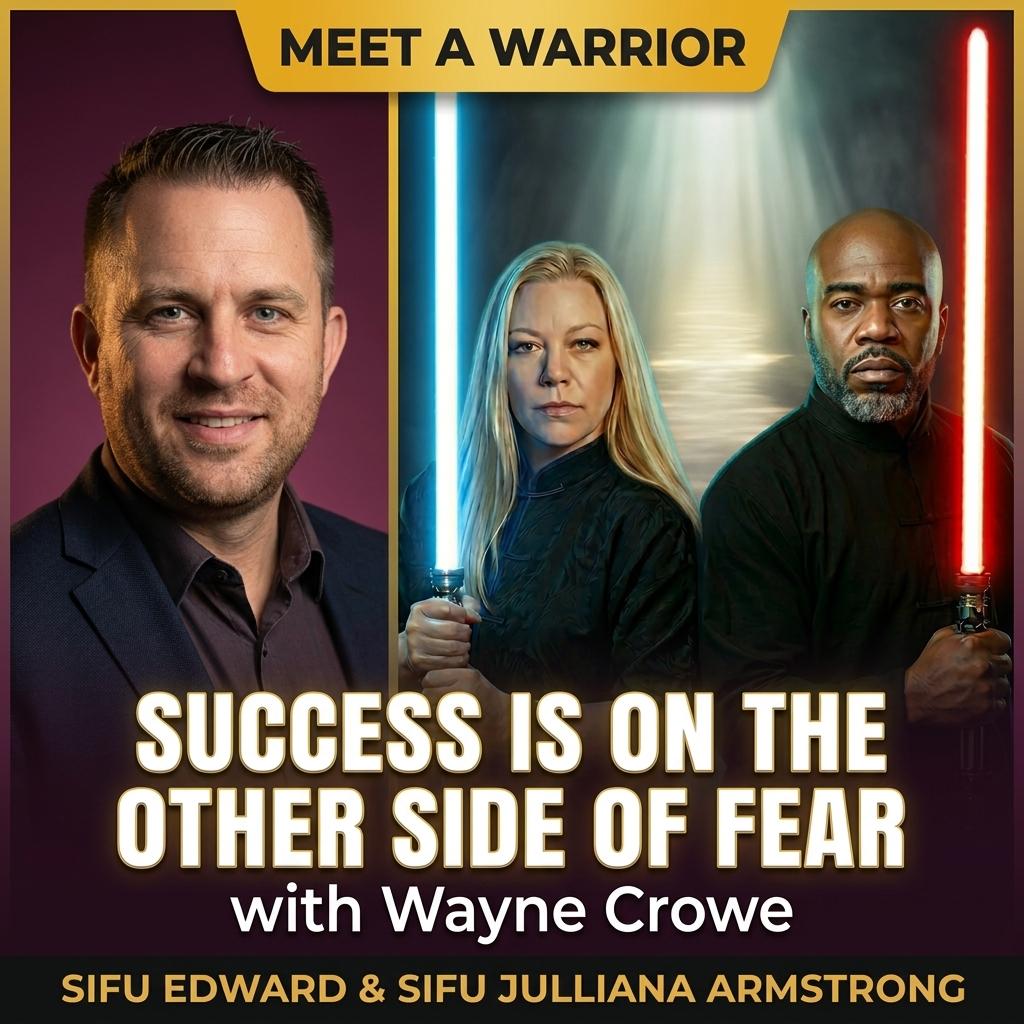
Adapted from the recorded conversation; the guest's words are verbatim. The questions are reconstructed and voiced by Sifu Edward and Sifu Julliana Armstrong.
🎥 Video podcast coming soon. The complete interview will play here once published. The full conversation is transcribed below, and the audio edition will be available on sifuarmstrong.tv.
In a new Sifu Armstrong interview, the OLSP System founder makes the case that nobody starts as the person capable of success. You become that person by walking straight at what scares you.
Wayne Crowe still works from the house he started in. His office looks out at the bedroom, now his daughter’s, where he built his first online business with £25 while grinding through rotating factory shifts he says “absolutely destroyed” him. That origin story anchored his conversation with Sifu Edward and Sifu Julliana Armstrong for the latest Warrior Intelligence Series, and it produced one of the plainest truths the series has captured about starting from nothing.
Crowe’s central claim is that beginners fail not because they lack ability, but because they haven’t yet become who the business requires. “When you start any business, especially your first, you are not the person who can be successful yet. You’ve got to learn the skills,” he said, describing how total immersion (studying what successful people actually do, not just what they say) is the only real shortcut. He was once too introverted to appear on camera or answer a cold call; he now speaks ten hours a week selling, on video, to strangers.
That transformation didn’t come from comfort. It came from repeatedly doing the thing that terrified him. “Success is on the other side of that fear,” Crowe said, describing how he forced himself onto camera, told his wife she’d “see a lot of weird stuff on Facebook” from his sales posts, and got nothing but results in return, millions of dollars from the one tactic that once scared him most.
Crowe’s patience is as notable as his nerve. He built a business that once ran 70 staff before he deliberately shrank it back down to a life he actually wanted, a “bat cave” office at the end of his garden, a team of thirty, and a focus on profit over vanity metrics. Asked how he sustained the discipline through the slow years, his answer was long-view and matter-of-fact: it didn’t matter whether success took one year or ten, because at sixty, the wait wouldn’t register, only the outcome would.
Crowe now spends his time helping newer marketers close the gap between where they start and where the established players already are, rather than relying on the affiliate networks that dominate his industry. He’s also blunt that the first skill nobody wants to sell beginners is mindset, because it can’t be packaged the way a tactic can: most people, himself included in the early days, assume they already have the right mindset until real results force them to admit otherwise. Paired with that is a confidence he says never came naturally to an introvert, only from repeated proof that the work would eventually pay off no matter how long it took.
What he’s proudest of isn’t the revenue, but the team he’s kept for years and the families he’s been able to support along the way.
It’s a story that lands the same way on the mat as it does online: nobody arrives already capable. You immerse yourself in the training until you become the person who can actually do the thing, and the fear you feel pointing at the hard part is usually pointing at exactly where the growth is waiting.
In This Conversation
- Starting an online business for £25 in a bedroom while working brutal rotating factory shifts
- Building an e-commerce business from zero to 27 staff through a partnership formed in the back of a taxi
- Why beginners aren’t yet “the person who can be successful,” and how immersion changes that
- Walking straight at the camera and the cold call until fear turned into millions
- The long view that got him through the slow years: “it won’t matter when I’m 60”
- What Crowe is proudest of after years of scaling, his team, not his revenue
The Full Conversation
Sifu Edward Armstrong: Wayne Crowe started in his daughter's bedroom with a £25 investment while working rotating factory shifts that, in his words, destroyed him, and built his way to £150,000 a month. He's a strategy-gamer turned operator who understands something most people miss: when you start, you are not yet the person who can succeed. You have to immerse yourself until you become that person. That's not a business lesson. That's the whole philosophy of the mat.
Sifu Julliana Armstrong: And he gave us the sentence I say to every scared beginner: success is on the other side of that fear. He was a total introvert who couldn't pick up a phone or go on camera, and now he speaks ten hours a week and has made millions doing the exact things that once terrified him. He walked straight at his fear, again and again, and that's the only direction that ever works.
Our guest is Wayne Crowe, UK-based marketing expert and founder of the OLSP System. Wayne, a pleasure.
Wayne Crowe: It's awesome to be on here, mate.
Sifu Edward Armstrong: Take us back to the bedroom and the factory, because that's a hard place to start from.
Wayne Crowe: I'm still in the same house I started in. I started in what's now my daughter's room, and I can see that bedroom out my office window. Back then it was tough. I worked in a factory, three rotating shifts a month: one week up at 5am till 2pm, next week 2pm to 10pm, next week 10pm to 6am. I did that for seven years and it absolutely destroyed me in the end. And the thing I hated most was working for someone else, a boss you've got no respect for, who doesn't seem to work that hard but somehow gets to tell you what to do. That drove me nuts. I've always been into strategy games, so I had that thought pattern. I wonder if I can earn money at my computer? So like a lot of people, I went to Google and typed in "how to make money online." My earliest success I'll remember the rest of my life: I was selling online, dominated Google for a search, filled the car with parcels for the post office, and afterward went to the bank and withdrew £500. I'd always been in my overdraft, so to have £500: I thought, this stuff really, really works.
Sifu Edward Armstrong: And it built from there in an unusual way, including a partnership from the back of a taxi.
Wayne Crowe: I was a bit of a slow burner, honestly. That supplier dried up, so we found the number-one bestseller on Amazon, imported it from China, and couldn't bring it in fast enough. To take this internet thing seriously, I left the factory and became a taxi driver so I could knock the days on the head one at a time. And I met a guy in the taxi who'd just shut down his e-commerce business, and we formed a partnership. I took that business from zero to 27 staff in about two years, from zero money, just through hard work. Then I started buying other businesses with zero money, because I realised how creative I was with numbers. At one point I had about 70 staff (an insane number), but I'd done this internet thing to do what I want when I want, not to have 70 staff. So I stopped all of those businesses, stepped back, and asked, "What kind of life do I actually want?" Now I run everything from a little log cabin at the end of the garden. I call it my bat cave. That was my dream. I've got an awesome team of 30-plus, we turn over £300,000 to £500,000 on a good month, and I look at profits, not figures. And I genuinely love the work. I do this for the journey it takes you on.
Sifu Julliana Armstrong: People call it risky or a scam. Your answer is about a journey, and about who you have to become. That's my whole world. Explain.
Wayne Crowe: The real key to success online is realising it's a journey you have to go on. When you start any business, especially your first, you are not the person who can be successful yet. You've got to learn the skills, and the way you learn is by completely immersing yourself. Look at the people making the profits, what actions are they taking, what mindset have they adopted? People think there's this huge risk, but look at a McDonald's franchise: you pay a million dollars for the most proven model in the world, and you can still fail. Online, you can start with almost nothing and be successful if you immerse yourself and learn as fast as you can. When I started, you'd never get me on video, and now I've done thousands. I couldn't pick up a call and speak to a stranger, and now I speak ten hours a week selling. Some people make money very quickly but fizzle out, because they don't actually know why they found it, so they can't turn it into habits. The slower burners inherently understand the business better, so they have the longevity. Once you get the skills, you can do this forever.
Sifu Julliana Armstrong: "You are not the person who can be successful yet." That is the truest thing anyone can tell a beginner, and almost nobody says it. You don't arrive a warrior. You immerse yourself in the training until you become one, and the person who starts is never the person who finishes. And I love the slow-burner point, because it's exactly what we see on the mat: the person who wins a medal too fast, without understanding how, often can't repeat it, while the one who earned every inch slowly owns it forever. Fast success you can't explain evaporates. Mastery you built rep by rep is yours for life.
Sifu Edward Armstrong: Tell our operators what you actually do, because you deliberately serve the newest people.
Wayne Crowe: My primary skill was always traffic, paid, then organic. But when you look at the internet-marketing world, it's all based on JVs and affiliates, and that takes a new person ages to build. I don't rely on any affiliates or JVs. So the way I think of what we do is we reach down and help the newer people: give them the hope and the head start they need, gain the knowledge the quickest, give them the shortcuts, instead of trying to break into that circle of established affiliates. There's always this big cavern between where you are when you start and where you want to get to, and we try to bridge that gap with our courses.
Sifu Julliana Armstrong: Your number-one tip isn't a tactic. It's mindset. And it comes with a long view I love.
Wayne Crowe: The first thing everyone needs to work on isn't sexy and is never really sold (because it can't be sold when you don't realise you need it), and that's mindset. When I started, I thought I've got the right mindset, I'm just going to work, make it happen. It wasn't until I saw a bit of success, maybe five figures a month, that I realised how important mindset really is. So don't think you already know it, like I did, start reading, start applying. And the other thing is confidence. I'm not a naturally confident person, I'm an introvert. The internet is great for introverts, it brings out the best in them. But I always knew, deep down, that I'd be successful. And the important part was: I don't care if it takes a year or ten years. When I'm 60, that ten years isn't going to matter. I could either still be in the minimum-wage factory job, or have tried, made it work, and be sitting there with my family and my dream home in Spain. So: mindset, and the confidence that no matter what, you can do it.
Sifu Julliana Armstrong: "I don't care if it takes a year or ten years, when I'm 60 it won't matter." That is the long view that separates the people who make it from the people who quit at month three. Impatience is the great destroyer of mastery. The ten years pass whether you train or not; the only question is who you are at the end of them. And mindset being the thing "you can't be sold because you don't know you need it." That's exactly why a good teacher works on a student's inner game long before they think they need it. The technique is the easy part. The mind is the whole fight.
Sifu Julliana Armstrong: Your biggest breakthrough was walking toward the thing that scared you most. Tell me.
Wayne Crowe: The biggest challenge, the thing that made the biggest difference, was going on camera. My first ever video is still in my Facebook group from years ago, and I'd hate to look at it now, but that was my biggest challenge. And I actually like challenges now. You realise that success is on the other side of that fear, as it often is. Even with family. I remember telling my wife, "You're going to see a lot of weird stuff on Facebook," because I do a lot of sales posts, and I was really scared of what friends and family would think. I started doing it, got absolutely nothing negative, and that one tactic has made me millions. And money was always the thing I felt held me back, but it's surprising, when you're stuck in a corner and you let your mind be creative, how creative you can be. If I did it again with no money, I'd do exactly the same, because that's the only way you learn that creativity.
Sifu Julliana Armstrong: "Success is on the other side of that fear," and you proved it by walking directly at the thing that terrified you, over and over, until it made you millions. That's the only move there is. Fear points, like a compass, at exactly where your growth is waiting. Most people read that signal as "stop"; the warrior reads it as "here." The camera, the phone call, the first sparring match, the terror you feel is the size of the person you're about to become. And the corner that forces creativity is a gift in disguise; comfort has never made anyone resourceful.
Sifu Edward Armstrong: When people say "it was easy for you, you had it easy," and what are you proudest of?
Wayne Crowe: I'd say just do it. If you want it bad enough, you'll find a way. There'll always be excuses (they come to you all the time), but taking action and just doing it is the only thing that decides whether you'll be successful. And what I'm most proud of is actually to do with the team. I've got members who've worked for me seven years that I'd class as very good friends, and being able to provide for their families. Same with people we've brought into our system who've quit their jobs and are looking after their families. Everyone says "I've made my millions, I'll give back." For me it's about keeping earning profits in the future so I can keep helping people. But the staff is a big one.
Sifu Edward Armstrong: "Keep earning so I can keep helping." That's the right engine. And a team who've been with you seven years, whose families you provide for, is a truer measure of a man than any revenue figure. It's the same reason I measure this federation by the warriors it raises, not the money it makes.
Sifu Edward Armstrong: What's next, and where do people find you?
Wayne Crowe: We're always scaling, not out of greed. I do this because I love it. If you don't grow, you go backwards. The goal is seven figures a month, a million dollars plus, not because of the money, just to see if we can actually do it. We get a ton of stuff wrong, but when you find the one thing that works, that's the real excitement. And one day, Spain, somewhere warm. The best place to find us is olspsystem.com: create an account and you'll join our Facebook group, which already has 125,000 members.
Sifu Edward Armstrong: Wayne, it's been an absolute pleasure. Thank you.
Wayne Crowe: Thanks very much.
Sifu Julliana's closing word: Wayne handed us two truths that live at the center of the mat. You are not yet the person who can succeed. You immerse yourself in the training until you become one, and the person who starts is never the person who finishes. And success is on the other side of fear: he walked straight at the camera, the phone, the thing that terrified him, and it made him millions. Fear is a compass pointing at your growth. The warrior reads it as "here," not "stop."
Sifu Edward's closing word: A factory worker on rotating shifts, starting in his daughter's bedroom with £25, took the long view ("when I'm 60, ten years won't matter"), and became who he needed to be. Immerse until you're transformed, hold the patient certainty that impatience can't touch, and measure your success by the families you're able to provide for, not the figure on the page. Walk toward the fear. Keep earning so you can keep helping. We don't entertain warriors. We create them.
Wayne Crowe, UK-based online marketing expert and founder of the OLSP System (olspsystem.com), with a 125,000-member community; creator of Traffic Domination and 30 Day Email Journey Hacks.
ILLUSTRATIVE RESULTS. Any revenue, enrollment, margin or retention figure in this conversation is either a documented result from one of our own operations, a figure the guest reports about their own business, or an illustrative example, never a projection of your results.
Nothing here is financial, legal or tax advice.
Stay in the Fight
This conversation is part of the Sifu Armstrong Warrior Intelligence Series: interviews with world-class performers, builders, and thinkers, filtered through the lens of the warrior's path.
Subscribe at sifuarmstrong.news for every new interview, delivered to you.
Join Club Sabernet, the member community of the whole Sifu Armstrong ecosystem, where warriors train, connect, and hold each other to the standard.
Ready to build your own floor? Find your path at sifuarmstrong.com/which-path.