Stand Straight and Push Back: Sifu Edward & Sifu Julliana Armstrong Sit Down With Anik Singal
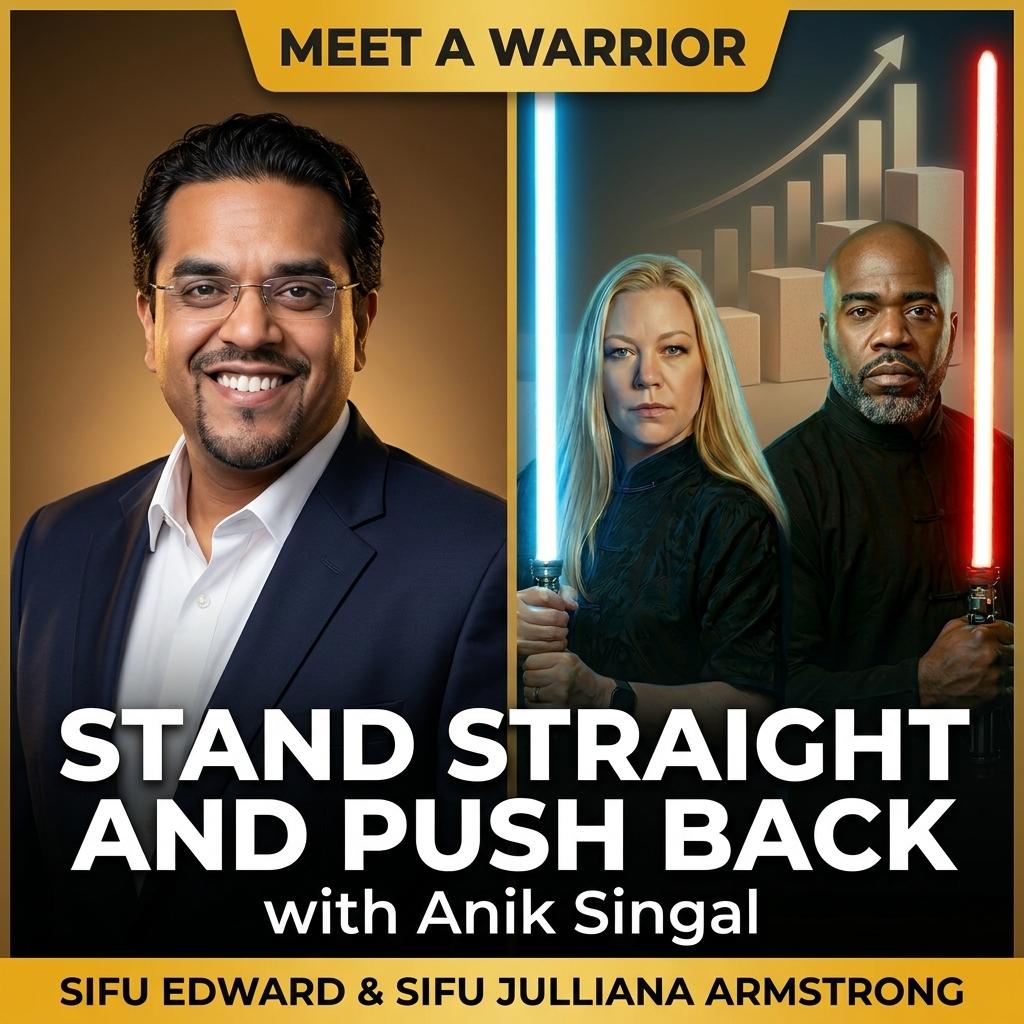
Adapted from the recorded conversation; the guest's words are verbatim. The questions are reconstructed and voiced by Sifu Edward and Sifu Julliana Armstrong.
🎥 Video podcast coming soon. The complete interview will play here once published. The full conversation is transcribed below, and the audio edition will be available on sifuarmstrong.tv.
In a new Sifu Armstrong interview, the Lurn founder describes losing a $40 million company almost overnight, and the mindset that got him back on his feet.
Anik Singal built an education company from a $100 Super Bowl pot into a projected $40 million in annual revenue, and watched it collapse within days of receiving a federal investigation notice. He told the story in full to Sifu Edward and Sifu Julliana Armstrong for the latest Warrior Intelligence Series conversation on sifuarmstrong.news.
Three weeks after his daughter was born in May 2022, Singal returned from paternity leave to a 31-page letter from the Federal Trade Commission. Within two days he’d shut down 80 percent of his publishing business and laid off most of his team, even before he was required to. The investigation dragged on for 18 months and ultimately turned, he said, on four words used in his company’s phone sales scripts. “What is your goal?” deemed an implied earnings claim. The settlement cost $2.5 million in fines on top of roughly $2.5 million in legal and staffing costs and a lost acquisition.
Singal was candid about what the ordeal actually cost him beyond the balance sheet: white hair, sleepless nights, a chronic health flare-up, and stretches of staring blankly at a wall. He refused, however, to let the setback define him. “Life doesn’t happen to you. It happens for you,” Singal said, describing the mantra a friend gave him that let him take ownership of the outcome rather than sink into what he calls the “why me” trap.
Instead of retreating, Singal did the opposite. “The worse I feel, the more value I will pour into the world,” he said, describing how he launched a free Facebook community to teach other entrepreneurs while his own company was in crisis, a decision that became the seed of his current work teaching compliant marketing.
Singal is adamant the investigation wasn’t the product of carelessness. He had a full-time paralegal reviewing every sales call before the FTC ever came calling, he said, and had spent over a million dollars on compliance safeguards over the years. “You could be doing the right things, you could be taking the right steps, you could have all the right intentions, but you could still make a mistake in the eyes of others who can then come after you,” he said.
A chance encounter inside the FTC’s own building became a turning point. A security guard recognized him and told him his free content had changed his life, a moment Singal describes as confirmation, at his lowest point, that he wasn’t the “bad person” the investigation made him feel like. He now runs the Don’t Say That podcast and book with an attorney he met during the case, teaching entrepreneurs how to market compliantly instead of learning the rules the hard way, as he did.
Singal closed with the line he says he repeats after everything he’s ever been through: “When life pushes you (which it inevitably will) stand straight, smile, and push it the heck back.”
It’s a resilience the Armstrongs recognize from their own path: the setback that could end a story can just as easily become the chapter that builds it.
In This Conversation
- From a $100 Super Bowl pot to a projected $40 million company
- The FTC letter that arrived three weeks after his daughter’s birth
- The four words that shaped an 18-month investigation
- The real cost: white hair, sleepless nights, a lost acquisition
- The security guard at FTC headquarters and the moment that changed everything
- Don’t Say That: teaching compliant marketing to the next generation of entrepreneurs
The Full Conversation
Sifu Edward Armstrong: Every warrior I've ever trained eventually meets the moment that was supposed to end them. Mine came when I walked away from the franchise I'd given years to and watched everything I thought was secure disappear. I had to decide right there whether the betrayal was the end of my story or the beginning of it. So when I found a man who built an empire, lost it almost overnight to forces he couldn't control, and chose to rebuild and teach from the ashes. I knew our community had to hear him.
Sifu Julliana Armstrong: And I'll be honest, what moved me about Anik's story isn't the success. It's the toll. As a competitor I know that the scoreboard never shows what a loss actually costs you: the sleepless nights, the self-doubt, the question of whether you're even who you thought you were. Anik talks about all of it, out loud, with nothing hidden. That kind of honesty is rarer and braver than any win.
Our guest is Anik Singal, a visionary entrepreneur and the driving force behind Lurn. His journey isn't just a tale of business success; it's a testament to resilience, learning from failure, and the relentless pursuit of dreams. Anik, welcome. It's a pleasure to chat with you.
Anik Singal: Hey, thanks for having me. I'm excited to be here. And yeah, I appreciate the time.
Sifu Edward Armstrong: I want to start at the fork in the road, because mine defined everything. There was a version of my life where I stayed on the safe, sanctioned path somebody else laid out for me, and something in me knew it would be a slow death. Tell us about the moment you realised entrepreneurship was your true calling.
Anik Singal: Oh, man. You know what? It's funny because I think there were lots of hints along the way since I was a little kid. I think I realised it thoroughly though when I was already in pre-med, I'm in college, I'm on a full scholarship. I mean, I'm on a one-way ticket to Ivy League med schools. I have my life made, and yet there I lay in bed miserable. I couldn't get out of bed every morning. And when I say I'm made, I mean I'm literally, I am going to undergrad at one of the best programmes in the country that I competed to get into. I have a full scholarship. I'm actually getting paid to go to college. I'm being recruited to go to top Ivy League med schools my freshman year of pre-med. So I'm like, I have it made, and yet I was miserable.
And so there was a moment I remember sitting back. I'm a very self-reflective person. I can reflect really well, and I think that's a skill that everyone should develop. And so I asked myself one morning when I just did not want to go to class, I said, "When was I the happiest? When have I been the happiest?" And I realised going all the way back to when I was a little kid, I was like, I misguided, I misjudged myself this whole time. I was the happiest when I was doing my own thing. I was the happiest when I was building a business or being creative and out there creating.
And so while still in pre-med, I started doing a little tinkering on little entrepreneurial projects and I just loved it. Although none of it was working, I eventually took the massive step of just leaving this made for me life all behind. I went to switch universities. I went to study business. I think it was somewhere freshman year early when I started college that I realised it. But then, I mean, you go back to when I was in third grade. And now that I realised it, there's clear signs that I was an entrepreneur as far back as I can think.
Sifu Edward Armstrong: Walking away from the "made-for-you life." I felt every word of that. And here's what nobody warns you about: the moment you leave the marked path, there is no map. You founded an entirely new martial art; there was no Google result for "how to do this." What was the initial challenge you faced when you decided this was your future?
Anik Singal: Yeah, I think the initial challenge we all face is just lack of knowledge, lack of association, lack of everything, right? You just don't know where to go, who to go to. I don't have entrepreneurs in my family at the time. I didn't know what I didn't know.
And so here I am trying to build a business. What does that mean? There's a gazillion options out there. I have no money. I'm not going to ask my parents. I don't even want to tell anybody that I'm doing this because they're all going to call me crazy. It's not like anyone believes what you believe. And so it's that lonely lack of knowing, yet you're still inspired and you want to figure it out. And then all of that piles on with the fact that you make mistake after mistake after mistake. You make error after error. So you're failing. You don't know who to ask for help, you don't want to tell anybody, yet you still believe. It's this really strange mixture of feelings. And those who survive through that and thrive through that are usually the ones... Or not usually, are the ones that succeed. Many, I believe, that have tried to become an entrepreneur, get stuck somewhere in those mixture of feelings and can't get past it, and that's where they fall apart. So that was my first biggest challenge, was just figuring out how do I carve through this massive.
Here's the thing, if you want to be a doctor, it's a pretty set straight path. Lawyer, path. Engineer, path. Plumber, path. I mean, every profession out there has a clear cut path. You can Google it and it tells you boom, boom, boom, boom, boom. Entrepreneurship does not. There is no path. And so that I think is the biggest challenge entrepreneur goes through.
Sifu Julliana Armstrong: When there's no map, the people who've walked the ground before you become everything. That's the whole reason we built a lineage into LSTA, Grand Masters and a Shadow Council so no warrior has to find the way alone. They say success leaves clues. Who did you look up to, Anik? Who were your mentors?
Anik Singal: Yeah, absolutely. I've had many mentors throughout my entire career. And I feel that mentors, you have some mentors that'll be with you forever, but you have some mentors that you'll be with you for a period of time and then you actually surpass them.
I think the person I looked up to the most was my father. Now, he's not an entrepreneur. He's a nuclear mechanical engineer. He's a brilliant man and he's way smarter than I am, but he's in a completely different line. However, here's what's really inspiring. He grew up in a village at one point that had no electricity. He used to study for his school under lampposts, street lampposts. His house had no electricity. Candles. And here's the irony, and yet he went on to, at the end of his career, he is retired now, he was the head of two nuclear power plants in the United States.
Literally the government head. So he could, at any moment notice, shut them down, turn them on, boss them around. I thought that was the most ironic thing. You think about it, as someone who grew up studying with no electricity, now overseeing and commanding the electricity that millions of people receive. I saw where he took our family single-handedly. My mom was mostly stay at home. She had a daycare at the house, but it was kind of on and off. And so my dad... And I watched what he did. I saw the opportunities he gave me. And so I always tell people that even when I do become a billionaire in my life at some point, my success and feats that I achieve will be nowhere near what my father did. I mean, he crossed far, far bigger chasms of success. So I used to look at that and just say, "It's upon me to take our family name to the next level and I need to do that."
And then of course, in business, I had great mentors at different parts. An individual who really made a deep impact in my life in the world of direct marketing and information marketing was Justin Ford, who I don't know why, saw talent in me and didn't just take me on. He insisted and fought and convinced me to let him mentor me. He's actually the brother of Mark Ford, which many people may not know is Michael Masterson, who's arguably one of the best copywriters to have ever lived. So I got the good fortune of being directly mentored and coached by the brother of the best marketer who's ever lived. So those are two people that I think I always consistently try to remember and give credit to for where I am today.
Sifu Julliana Armstrong: That image of your father studying under a streetlamp and ending up commanding the power grid. That's the warrior's arc in one life. I love that you carry it as a standard to live up to. Now, I've heard the legend that you started with just a $300 investment. Is that true?
Anik Singal: It was even less. I won $100 at a Super Bowl game. Our families would always come together at Super Bowl and we would do these guess the score contest, right? So everyone put 5, 5, 5, 5, $5 in the pot. I remember I think I put 5 or 10 in. I guessed where I scored turned into $100. That was the money I had to start my first business. I blew through it in a matter of just days.
And then obviously being in college, I had my father's credit card. So I was so optimistic and so positive that I kept things going, except now I was putting money on his credit card that I did not have. And so I blew up another $300 on top of the 100. And at that point, I stopped it and I paid him back through savings that I had. But it took me a while after that until I had my first breakthrough. But my first "business venture" online was started with $100 from a Super Bowl game, plus let's just say a $300 loan from my father, which completely collapsed, failed, didn't work. However, in the process of all of that, I learned a lot of skills that till this day serve me.
Sifu Edward Armstrong: From a hundred-dollar Super Bowl pot to a real empire, and I know more recently you went through something brutal with that empire. Before we go there, I want to honour that this is your story to tell however you choose. How comfortable are you talking about that side of things?
Anik Singal: Oh, I'm an open book, my friend. I talk about absolutely anything that's happened in my life. Never hides anything.
Sifu Edward Armstrong: Then let's walk it. I've stood in the rubble of something I built and had to decide whether to quit, so I don't ask this lightly. Tell us about Lurn, building that company, what it became, and what happened next.
Anik Singal: Yeah, so Lurn was a culmination of many companies and many ideas. I'll give you the shorter version, but I believe, if I could go back, I'm being honest with you, I don't have regrets. I love every part of my life and I love what I've done, but if I could go back... And actually it's funny, I wanted to write a book, and I think I'm going to write one, which is an interview with myself at the age of 40 is really what I want to call it, which is, I turn 40, I want to interview myself. What have I learned, right? It's meant to be ideally a book read by 20, 30 year olds.
One of the things I would talk to myself about is, pick a business idea or pick a type of business that's simple, that can scale and that 20 years of invested time can turn it into something huge, but pick something that's got a model out there. Unless you've got something truly innovative like you've invented the next iPhone or you've invented some technology like AI or whatever, if it's not that, pick a model that's simple because the business model I chose was not simple. It was very hard. It was very complicated. Of course, at the time I didn't know.
But it started simple. So it started with me selling information. I took knowledge out of my head, I put it down into some form of written and video format, and I sold it to people and I started to do very well with that. In doing that, I started to build quite an audience. I had an email list that was hyperresponsive. I could generate thousands of clicks and make hundreds of thousands, if not millions of dollars of sales of products. I would promote someone else's product as an affiliate and it would work really well and I'd make a lot of money.
So one day I had this idea, years ago, 15 plus years ago, I said, "What if I were to publish somebody else?" So instead of selling them as an affiliate, what if I brought them into my institution, to my company? Did all the work, put the course together, published it, sold it to my community, plus also went out and did what I do with other affiliates to get them to sell it, I could make a larger share. And so basically, I was becoming a distributor of a publishing house. My now skillset became the fact that I had reached distribution market. And I did very well with that. I was able to publish a couple people, make really good money and make them a lot of good money and made them into prominent names in the industry. And I did that for some time.
In the middle, I had this idea once to commoditize education. I'm all about education. I started to build this platform that was supposed to basically be this place where people can upload their education and sell it. And I wanted to take what is a Harvard level education and commoditize it. I wanted to connect, I believe in peer-to-peer education. I think remove the middle, remove the institutions. If someone's a great investor, if someone's a great rose gardener, if someone's a great whatever, connect the student direct to that person, not to teachers who just take theory.
So I started to build this platform, I don't know technology, I don't know coding. I built an office in India. I got completely blown away, millions of dollars wasted. I was shutting the whole operation down. And that very day, my now wife, at that time girlfriend, comes running up to me and says, "Have you seen this?" And she shows me Udemy. So here it was somebody else in the world in Turkey and three guys in a garage building the very company that I was trying to build. I mean, it was almost like they had a camera in my head. So it's a huge failure.
But that didn't stop me from wanting to build that. I came back and turned Lurn. That's why the name Lurn exists by the way. It's a generic name because it was supposed to be a generic educational platform. However, I lost a lot of money, went to near bankruptcy during that time, came back and decided to build a company that would be an educational platform but for entrepreneurs. So now I was really tripling down on becoming a publishing house.
Now, I'll tell you the challenge of being a publishing house. You in the direct marketing world, funnels, copy, paid ads. These require a very special skillset. This skillset is not readily available on the internet. Most people that are really good at this skillset are out there doing it for themselves. So hiring the right team was one of the hardest things I've ever done in my life. It was the biggest challenge I ever conquered. I was struggling and I was slogging and working 20-hour days. I was making great money, but I was miserable. I wasn't happy. At this point, I'm married and I'm not... It was just miserable.
2020, the business blows up post COVID and I'm making more money than I've ever made in my life and I'm miserable. So I finally decide to really pour money into hiring. I go and I hire the best of the best of the best of the best, and I work with them. And we got it. It took forever. And by early 2022, we were good. I had someone ready to step in as a CEO for me. I had my team running. We had a system down. We were scaling. In 2022 we were going to do $40 million in revenue. We were climbing and climbing.
My wife and I were expecting our first baby in April. So on April 21st, I'm also in the middle of getting acquired. I have an acquisition offer on the table. We've gone through due diligence. I'm going to have the entrepreneurial dream. April, I'll have my baby. I was hoping to be acquired by July or August. May comes, I come back to work, I decide I'm stepping down as CEO. I'm going to name my right hand as CEO. He is going to get to shepherd the company through this acquisition. Once the company gets acquired, I'm taking a year off. I'm going to be dad. And I'm going to go back, regroup, figure out what the next project is that I want to launch, and I'll get to come back a year or so.
So I get the entrepreneurial dream. My dream was to build and sell a company by the time I'm 40. I was just turning 40. I was a year before 40. I was like, "This is amazing. I did it," right? Did the company get as big as I wanted? No. Was it still going to be an amazing story? Heck, yes. All right. So it took forever to figure that out, to build a system, to be able to step down. And I'm proud of what we built till this day. Love what we did.
May, 3rd week of May, I'm back in the office for only three days from paternity leave and I get the dreaded FedEx package in the mail from the Federal Trade Commission, the FTC, which for anyone who's not in the United States, who doesn't know what that is, it's a regulatory body from the government. It's a federal government regulatory body that oversees consumer related matters, commerce basically. I was told in that letter, which was 31 pages, that the FTC would like to be closer to me for the next coming months. And that was another way of saying they wanted to investigate me. Even as I talk about it today, my heart falls to the bottom of my stomach because everything shattered that moment.
I wasn't going to get to step down as CEO anymore. I wasn't going to get acquired anymore. And here's the irony, May of 2022 was going to be a record-breaking month for us. It was 15 years of me trying to figure out how to build that type of business, the publishing company, I had just nailed it. It ended up not being a record-breaking month. Within two days of receiving that notice, I shut down 80% of my business, not because they made me, but because I'm a publishing company. So obviously the people who I publish, I'm not going to hide this from them. Even though I wasn't required to tell them, I was going to tell them. And the minute I told them, what do you think they would ask me? They'd asked me to shut down their promotions, of course. So I shut it down beforehand, 80% of my 40 million a year, what was projected to be 40 million a year company, poof, gone in a matter of seconds. And I had to lay off about 80% of my team. Within three days, my life turned upside down.
In the end, it came down to just a few things being said in the marketing that they did not like that were against the rules and it turned my entire life. I mean, it is a crazy time. And I'm telling you, what proceeded after that, the 18 months investigation, took 18 months to close it, to settle. Am I alive? Am I good? Am I more blessed than 99% of the people in the world? Yes, I'm grateful for it. But the 18 months was, as I put it, for those 18 months, and even since then, I would say I have been where hell goes when hell has been bad.
Sifu Edward Armstrong: "Where hell goes when hell has been bad." I felt that in my chest.
Sifu Julliana Armstrong: Most people would have hidden a story like that. Two of your fellow publishers got pulled into the investigation too, didn't they, that fear of contagion, everyone around you suddenly at risk?
Anik Singal: Yeah. And two of them did. Two of them did.
Sifu Julliana Armstrong: That's the part I want to sit with, because people forget there's a human inside the headline. They say, "He's a businessman, he can take it on the chin." But you're a person. How did this actually affect you, Anik, personally?
Anik Singal: Oh, man, it's hard to explain. So till this day... By the way, first of all, as a funny side note, I have PTSD in the sense of don't hand me a FedEx package or a certified letter. I just have a reaction to it. I have a repulsive reaction. Because that wasn't the only thing that happened to me. It really is crazy that when it rains, it pours because right around this time is when the interest rates hikes started happening. So my wife and I, we have all this real estate that was tenanted by this really large company, this secure 100-year-old big company conglomerate that's safe to have a debt with, they go bankrupt.
So now I have this massive debt to the banks on my head, don't know how to pay that. We have a property issue with one of our properties in Florida. We have other issues that come up left-right. We have an issue with a investment made back in 2016 and years ago that now is being looked at. It had nothing to do with us. We were just one of the investors. And so it's not a thing against us, but it's something that we need to think about and worry about. I mean, these are all being delivered to me in what? FedEx packages or certified letters.
So till this day, I see... I put my hands up, "I don't want it. Someone else open it. Tell me what it is before. Who's getting sued? What's going on?" Personally, what it does, man, is it messes you up. There's no other way to put it. I'm not going to try to sit here and sugarcoat stuff. You go through the biggest emotional rollercoaster on a daily basis. One morning you wake up and you are like, "I'm going to take over the world. This is going to be the best comeback story. And everyone's yada, yada, yada,." The next day you are like, "What's the point?" You're depressed. You don't want to do anything. "Why did this happen to me?"
I mean, if you think about it, I had a multi deca million acquisition going through, approved and done. Gone. I had a $40 million a year company. I wasn't in the weeds anymore. I was about to step down as CEO and I was going to live my life going around racing my cars and going to shooting ranges and hanging out with my kids. Gone, poof in a second. You have to take a minute to really process the speed with which that goes and the whiplash that you feel from it.
Everyone handles it differently. Listen, there have been people that have been investigated by the FTC that had a heart attack and died. There've been people that have been investigated by the FTC who committed suicide. I knew about this. I researched it. And I obviously it wasn't going to be one of them, but you can imagine the torture that it plays on owns mind.
Now people think this is because the FTC or the government comes in and they smack you around and they do this and do that. I can't speak to what the FTC and the government has done in other cases, but I can speak to mine. It was nothing like that. It was nothing like that. I got the document, they were cordial the entire time. Professional. They gave extensions and there was no threats. We weren't told we have to shut down our business. But that doesn't matter. In the end, you still have a 3,000-pound gorilla with an unlimited budget and unlimited power, and you don't know what they're going to do every morning you wake up.
Here's a crazy story. One time I walked into the office and there was an unmarked car standing outside the office. It even had that little squeakly light thing that police cars have outside the driver's side. I was thoroughly convinced it was someone from the FBI watching me. I mean, your mind starts to play tricks on you. I walked in and I tell my front desk person, I said, "Watch for that." I'm calling my lawyer. I'm calling my wife saying, "I might get taken in, pay attention." My lawyer's telling me on the phone, he's like, "What are you doing? No, there's no one there. That's not how they work." I'm like, "I'm telling you, there's someone here." Only to go and find out half an hour later it was a car bought on an impound from one of the people that services our buildings.
Your brain plays tricks on you. And this goes on for months. It's the torture. And you've got that, you're trying to save the company because you want to save the team. You're trying to make sure you spend the countless hours in discovery required to submit the documents that the government's looking for. You're trying to pay all the bills. I had just become a father. And as the 18-month process went on, we had a second child. So now I've got kids at home, I've got a wife at home. I've got these investments that are going south. I've got banks calling me. I've got the FTC to handle. I've got a business to save. I've got a business to build.
Sifu Julliana Armstrong: You were in the middle of a perfect storm, and grief, fear, and exhaustion all arriving at once is exactly when most people go under. You found a way to point yourself outward instead. For anyone listening who's thinking, "If it happened to Anik, it could happen to me." What were the red flags, and how did you climb out of that hole?
Anik Singal: This can happen to anybody, whether it is the FTC or it is some other regulatory body if you live outside the US, it could be a state government, state AG, it could be a class action lawsuit by your customers, it can be multitude of things that can completely come in and disrupt everything about your life. Now, of course, every different body has different authority.
For me, the future as I'm now living it, was carved one night. And one night it was around 8:00 or 9:00, and I was in the lows of lows. I was really feeling it. Because one of the things... And the trap that you don't want to fall into, everyone, I'm telling you right now, at any point in life, if you get to a place where you're low, trap, that's very difficult to come out of is the "Why me?" trap. If you start going through the, "Why did this happen to me? Look at so-and-so. Look at so-and-so? Look at so-and-so. Why me? Why me?", you just can't dig yourself out of that. That's a very difficult place to be. So I've refused to ever allow myself to get into it.
The very first thing I did when this whole thing happened is I took ownership, I took accountability. I don't agree with the investigation, I don't agree with the outcome. I settled due to other reasons and the need for peace. I respect the FTC in the organisation. We disagree. That's okay, we can do that. But I took ownership over it. I am where I am today because of decisions I've made, things I've done. A friend of mine told me once and it stuck with me forever. "Life doesn't happen to you. It happens for you. Anything in your life you're going through, that doesn't happen to you. It's happening for you."
And so I took this moment and I said, all right, so one night, 8:00 or 9:00, whatever, I'm sitting there, I'm at the lows of lows. I catch myself self-reflective, I know what's happening. I said, "We're not going to go down this hole. I'm not going to fall into that little pity party. So what can we do right now?" And I said, "You know what? If I don't feel good right now, the only way I think I can make myself feel better is if I make someone else feel better." So the worse I feel, the more value I will pour into the world. The worst I feel, the worst place I feel like I'm at, the more value I'm going to pour into the world.
And that's actually why I created this Facebook group called The Expert Scale Facebook community, where I thought, "If I can't scale my business right now because of where I am, I'm going to teach other people how to scale their businesses. I'm going to serve them for free. Nothing. I'm going to put good into the world." The universe has to recognise that. There is no way it doesn't have a byproduct, it doesn't have an end result. So I'm going to do more. The worse I feel, the more I do.
And that became my fighting mantra. And that led me to where I am today where I said... I remember hearing something on a podcast, I was at a gym, from Ed Mylett that changed a lot of my approach during this investigation and what I wanted to do after it. And he said, "Your best customer is the person you used to be." And I thought, "Man, there is some brilliance in that," right?
So back to your question of what were some of the things. So the FTC doesn't like when you make claims and it doesn't like when you imply the specific results that somebody else will get. Now, if you get on a 4-hour webinar about a product that you love and believe in and you start to go at it and you are selling it, I'm sorry, but I would feel most people in this world will end up saying something that could be considered as noncompliant.
Listen, you could be the best driver in the world. If I follow you around long enough, you're going to roll through a stop sign, cross a red light. You're going to do something that I can say, "Ha-ha-ha. Driving infraction." So initially the document I got had sentences and things in there from some of the webinars and things I had done. They had thoroughly looked at me. You could tell they had watched things that were old. I wasn't even using them anymore, but they still existed on the internet. So based on that, it was enough to say, "Hey, we'd like to investigate you to see what else you are doing."
Now, some rules have changed and laws have changed. It's a long explanation, but basically it's a little bit harder for them to come and collect money and fines based off of things you've said on web-based sales, what we call one to many sales. Sales pages, videos, webinars. But it's enough to open an investigation. And when they opened the investigation with me, they quickly discovered that I had a telesales operation, meaning I was having people sold on the phone one-to-one, an area where they still have a lot of governance and the ability to collect fines and money.
So my investigation quickly became more centred around the one-to-one phone sales activity. Now, the irony of this is I have spent over a million dollars in the past trying to make sure that we were fully compliant with legal fees and with checks. I had a full-time paralegal in my company before we even got investigated. Her job entirely was to listen to every sales call that led to a sale because I wanted nothing unethical and nothing unfair set to my customers. We actually had the lowest conversions on our phone than any other operation because I was so heavy on them.
However, there was one thing I did not know about. I was not told about by my attorneys, and it made it into our scripts, and that was enough. And that was what my entire case came down to, four words. "What is your goal?" That question on a one-to-one phone call is an implied earnings claim because here's how it's going to go. The person on the other hand says, "I'd like to make $10,000 a month so I can quit my job." Of course, the sales salesperson on the other side says, "Great. We could help you get there." Implied earnings claim. It's called goal setting. There's no regulations or rules written about it. Nothing anywhere says you can't do it, but they collapse it under the terms of implied earnings claims. And my entire case came down to those four words pretty much.
Now, I'm not saying if those four words had not existed, that my case would've disappeared. But I am saying based off of what my attorney has told me, is if those four words didn't exist on my sales calls, everything else about my sales calls were fine. They were clean. Because I had a very good process in place. Everything else about my sales calls was great. If those four words did not exist, the case would've been drastically different, is what I'm told from my attorneys.
So can you imagine having to process that? That your life, the sale, the year off, the freedom, the dream coming true by the time you turn 40, everything came down to four words. And I had my scripts and things reviewed by attorneys. They never got triggered. So you could be doing the right things, you could be taking the right steps, you could have all the right intentions, but you could still make a mistake in the eyes of others who can then come after you. So yeah, life can throw you lemons real fast and you can't ever prepare for everything.
Sifu Edward Armstrong: Taking ownership when the world hands you every excuse not to. That's the cleanest mark of a warrior I know. You bowed to no "why me." Help our operators understand the adversary, though: what was the FTC actually after? What was their preferred outcome?
Anik Singal: They don't really ever say. So one of the things that's interesting... And so if I answered that question, I would be inferring. I'm happy to give you a guess from my experience, but I have to say, guys, they never said any of this, and this is just me guessing.
So first of all, it's not like I get to talk to them much throughout the process. The lawyers talk to them. I got a chance to meet them once. I have a really funny story from that meeting. It's a story worth exploring. It's just irony, but it was very important to me. It was a very pivotal moment in the case from my psyche. But I got to meet them once. I got to go into the FTC and do a presentation, saw them for about an hour. Beyond that, the FTC, there's no grey there. It's black and white. You're good, you're evil. There's no middle. So as far as I was concerned, at least the way they approached us, I was evil.
However, look, there was someone else I know who got an investigative document a week before I got mine. Now, that person had done some, I don't want to be judgmental, but they had done some things that I felt made them deserving of it. I'm sure other people would sit there and say, "I've done things that made me deserving of it and it's fine." But their case was a lot more clear cut. There was a lot more fraud involved. And you know what? The FTC bulldozed through that case in six or seven months. I happen to know more about the case intimately just because I know the people behind it. And some of it is hearsay, but I trust the hearsay. At the same time, my case took 18 months. And so I do believe that with mine, they had to dig deeper. And with mine, they had to make a case. When they have an easy case and it's just there, they'll go finish and move on.
They want you to stop, is what they want you to do. I think in an ideal world, they want you gone. They want your business to stop. Do they say that? No. Am I banned or injuncted from being in the industry? No. Are some people that? Yes, some people do get banned. The individual I'm speaking about whose investigation got shut down in six, seven months and over, they're banned. They're banned from being in the industry for some time. I'm not. So there's definitely grades. I say black or white, and there's no grey, but there is grey. It comes in the way they approach you and the time and the judgement eventually they give you. But what do they want? They want reparations for the consumers. They want to collect as much money as they can back so they can give it back to the consumers. And they want you to stop doing whatever it is that they don't want you to do.
And so there's a big myth out there that people think the FTC is a money grab and that they're going out and grabbing all this money and keeping it and using it to fund the wars of the government. There's a lot of conspiracy crap out there about this. And I'm actually here, and I believed it. I actually thought the money that they take, they just keep and they hoard and go "He-he-he!" And then they use it to be more evil and go after more people. This is what I thought prior. It's not that actually at all. They give every penny of it back to your consumers. They don't keep a penny.
So they probably spent a million dollars out of their time investigating me because they had to do 18 months, plus the time they spent before they sent me that document. And those are expensive lawyers, investigators, they put multiple people on you. So I'm sure they invested a million plus dollars of their money in my process. They don't recover any of that. The money that I turned over goes straight back to the consumers. So really all they want, money back to consumers and they want you to stop doing the things that they don't like you doing.
Sifu Edward Armstrong: And none of this came with a warning you could act on. It just landed on a clean record. That ambush, after doing everything right, is the cruelest part.
Sifu Julliana Armstrong: It reminds me of being penalised on the floor for something you didn't even know was a rule. You prepared for everything you could see coming, and it didn't matter. Did this truly come out of the blue, Anik? No prior knowledge at all?
Anik Singal: Yeah. Look, I have been in business for 20 years. I have never been sued by a single customer. I've never had a state AG complaint. I've never had a merchant account problem. I've never had a chargeback problem. My BBB rating is an A. My Trustpilot was great. My customers love me. I have a $4 million facility that I'm in every single day. I show up. I've never had people come and Google me. I sit on webinars, I say, "Google me." There's very few internet marketers who've been around for 20 years or say," Google me." There's not bad stuff about me. I'm a good person. I do good things by people. I treat people well.
The only thing is that in October of 2021 apparently, there was a warning letter released, and I use quotes because I disagree with the fact that it was a warning letter, with like 700 or plus, like a thousand plus companies names on it. It had names like Amazon and Uber and Lyft and all these big companies too. And at the top of the letter, I got to see it later, I never got it. We actually have physical evidence of me never receiving the letter in the mail. But eventually when I saw it, the Lurn's name was on that. And so according to the FTC, that was like, "Hey, we warned you." But at the same time, it's a letter. It is kind of funny because at the very top, it says, "Just by having..." I'm paraphrasing, but it says something like, "Just by having your name on this letter, it doesn't mean that you're actually doing anything wrong."
So even had I received it, I don't know how I would've received it, how I would've looked at it. My assumption at that point was they took a thousand of the largest advertisers and just sent it to them. I was spending about almost a million dollars a month on paid ads, so all right, I got under the radar. I didn't think that that was a proper warning, but they say it was. And it was a letter I never received. And they say, "We sent it. That's your problem." But beyond that, no, I didn't have any... I had no issue. We had 63,000 transactions in a window and we still managed to keep a BBB rating of an A and make our customers happy. 36 minute response time, 24/7, holidays included. I had three support teams worldwide. 8, 8, 8 hour shifts running. We treated our customers like they were the... They were, not like. They were the most important thing in the company.
I built a company, I tracked the KPIs, I measured everything, and I made sure we were a strong, solid, amazing business. And I burned millions of dollars doing that. And I did it on purpose because I knew we're a heavily regulated industry and I wanted to make sure that we never got into the web of all of this. Ironically, we still did though.
Sifu Julliana Armstrong: So the fight drags on for a year and a half while you're holding a newborn, a sinking investment, and a company on life support. When the end finally came, did it come fast, and what was the real cost?
Anik Singal: No, no, it was drawn out. I think we were finally done. So we started turning over things and started working on the case by June of 2022. I think it was finally in January of 2023 that we said, "Here is all of the documents we have." So we took about six, seven months in digging a little bit more because then they came back in Feb and March, we were still giving some documents over. I think I went to see them in March. I think they delivered their official complaint letter to us sometime in March or April. We negotiated over that for a month or two. Then we got into the negotiations of the Oxford dollar amount, that took a couple of months. Then once we agreed on the dollar amount and we had something to sign, it took a couple of months. It actually took three months to get the commissioners at the FTC to sign it off on it.
So I mean, it dragged on until the end of 2023, which is why I say it took 18 months. It was not fast. It was slow. It was thorough. And in some ways I appreciate that. And in some ways it sucks, right? If I had someone come to me today and said, "Hey, I got this notice from the FTC," my advice to them would be move fast. Don't drag it. Look, once you get a CID, it's called a CID, civil investigative demand, they're guilty. The chances of them getting... They've already researched you. They have what they want. These are words for my lawyer, by the way too, I'm not making stuff up. I would just say, "Look, you're going to pay a fine. You're going to do something. Just get through it. Save yourself in legal fees."
My fine eventually was $2.5 million, which is heavily determined by your ability to pay, which is just so unfair because there are people that have done far, far worse things and gotten away with paying a $200,000 fine because they were idiots and they were broke and the guy was rewarded for it. So I have some thoughts there. But again, my opinions. I'm allowed to have opinions. They do what they need to do and they do it their way and I respect it. But there's a lot of things that go into determining how the fine was determined. A lot of people online... I saw some people, not a lot. I've been very blessed by how this was received by the industry. I've been very, very supported. But some people were like, "Oh my God, I can't believe Anik has only had $2.5 million to his name." Guys, they don't take every penny to your name. That's not how it works. There's no point in settling. Why would I settle if every dollar I have to my name disappeared? Obviously then you're incentivized to go to court.
It's a settlement, right? Both parties come to the table and agree. It's a two-way thing. But I spent about one to 1 to $1.2 million in legal fees. I spent about 1 to $1.5 million in staff cost of discovery. And I lost at least 10 to $15 million of opportunity cost, which is profit that I would've been making in the business that we had finally streamlined. And I lost a multi deca million dollar acquisition.
So for the people that look and say, "Oh my God, only $2.5 million. That not so bad, man. You've made millions. You got off easy." Let's talk about the fact that my hair was fully black before this whole thing started. And last time I got a haircut, half my hair was white. Let's talk about the fact that if you try to hand me a certified letter, I'll freak out. Let's talk about the fact that it's at least 150 nights of sleepless nights. Let's talk about the fact that sometimes even till this day, you'll see me staring at a wall blankly. Let's talk about the fact that I have a chronic health condition that flared nonstop for over a year, gained 20 plus pounds. Let's talk about the fact that...
There's just so many things that aren't talked about that I'm going to talk about in my book that I specifically say. One of the things I find the most offensive is when someone looks at me, it's such a naive and stupid comment to say, "Oh my god, $2.5 million." You just don't know. You just don't know. It's like telling someone who goes to jail for five years.
Actually, I knew someone that went to jail, and I was the dumb idiot who said this to them. He was a young guy. He went to jail when he was 20. He had to go to jail for five years. And I was interviewing him and I said, "Hey, at least it was only five years. You were out by the time you're 25. You have your whole life." And the guy just looks at me, he said it to me in the interview. He is like, "This is the dumbest thing I've ever heard." He's like, "Do you even know what that means? Do you even know what those five years were like? Do you even know what that's done to me for the rest of my life? Do you know the five years I've missed?" He's like, "I missed my girlfriend who I had been with for 10 years since I was 10 years old. I couldn't marry her. I left. I watched her marry someone else."
It was crazy to watch and to listen and then to go through this. And I'm like, people tell me, "Oh, it's just $2.5 million." I'm like, "No, it's not. It was 20 years of my life," is what I feel like, right? So yeah, it's been interesting.
Sifu Julliana Armstrong: That cost (the white hair, the sleepless nights, the staring at the wall) is the part nobody puts on the highlight reel. Nobody survives that alone. How important was the support of your family, Anik?
Anik Singal: Great question. So my wife, ugh, man, for all the men out there, find a woman like the one I have, man. Just strong as can be and was probably more riled up than me. I mean, there were times where she was like, "Bring it on. Let's go" and I'm like, "Oh, calm down, Tiger." We were about ready to settle, she's like, "Screw the settlement. Let's go all in. Let's take it to court. This is bullshit." And I'm like, "There's a whole bunch of reasons not to do that." Man. I wouldn't have been able to do it without her.
And I have people that I got chance to meet once I got my FTC notice, because you go out talking to and meeting others who have been through it. I've met two or three at least that got divorced during the time. Now, my wife was a huge part of it. Having my child, which was, it sucked so much that this happened less than a month after my... It was three weeks after my daughter was born. Actually, yeah, three to four weeks after my daughter was born. As much as that sucked, I think my daughter got me through it because I always had something to go back to that would just make me smile. Even until this day I go home at night, no matter how much I've been beat up throughout the day, when she comes running to give you a hug, it's all gone, right? Instantly melts away. We've got two baby girls now that really have helped me through.
My friend circle. I can't talk enough about my team. "Why are they still here? It's crazy. Leave. Go. This is nuts. Why are you voluntarily dealing with this bullshit, right?" When the ship is sinking, it's like, "I got to stay. You all should go." And they're like, "No." I'm like, "Please, go." "No." "I can't afford to pay you right now." "Fine." "Leave." "No." "All right." It's a burden, but it's also so humbling to just know like wow, because sometimes when you're going through this, sometimes you start to question yourself. You start to hear the things that they're saying about you, the questions they're asking, and you start to say, "Dang, am I a wolf in sheep's clothes? Am I bad? Have I been a bad human? Have I hurt people?" You start to ask yourself this stuff. And I was really getting into it. I'm a very spiritual person, and so I really believe in God and the impact of God. And throughout this whole time, there was something that happened at the FTC's headquarters that I thought was God just letting me know, "No, you are not a bad person." But my team really helped me through it, man. They're still here. Not one person left me. Not one person who I didn't unfortunately have to ask to leave me left me. And that was such a humbling thing.
My friends, my customers, the industry, I was open about it. I talked about it. Everyone's like, "Hey, what can we do to support? What can we do to get you back up? We love you. This is crap. We don't want you to go through this." The only people I never told was my parents. Until the settlement was written and I knew we were good and we were settling, I did not tell them because they just would not be able to handle it. I did not want to put them through that. What I went through for 18 months, hell no. I don't want to put them through that.
The day we had an official agreement and I was signing the settlement. I called my dad, I said, "I want to talk to you" and I told him. I stand by that decision. I think that was a good decision. Didn't tell my sister, didn't tell my family. But yeah, man, I came out of this. Unfortunately, I feel bad because a lot of people come out of things like this realising they have no support. I came out of this realising, "Damn, I'm blessed because I had so much support."
Sifu Edward Armstrong: You mentioned a moment at the FTC's own headquarters that you took as a sign from God. I'm a man of faith myself, and I believe the universe puts the right person in front of us at the lowest moment. Share that story.
Anik Singal: Till this day, every time I tell this story, I just get goosebumps. So if the person is watching, if I've reached this person, please reach out to me. Because when we met, I could not get your name and take a picture with you. I didn't think it was appropriate. But meeting you that moment was a huge thing for me and I want to be able to meet you again. I want to be able to say hi and thank you.
So when you walk into the FTC building, it's a government building, you go through the airport security to get into the main corridor. Now when you get into the main corridor, you were told the FTC building, so I guess it's multiple buildings that get to one lobby, I don't know how it works. I was too distracted at the time and thinking about my presentation to look around. It was in a beautiful building. So you walk this way and then you walk up and that will be the entrance to the FTC building. The FTC building has its own security. So the doors are locked and you have to knock on the door and then it get buzzed open.
So anyways, I was behind. I had six, seven people with me, my two lawyers. I had a team of four or five people. So I was like, "Hang on back for a second. I'm going to use the restroom. I'll meet you guys." So when I get there, they're already inside. I knocked, the door opens, I walk in and the security table is surrounded by them. All of a sudden my team made a little space and there's a head security guard sitting at the table right under the Federal Trade Commission sign. And he looks at me and he just goes, "Anik? Holy crap. I love you, man. I follow all your stuff. I've been following you for years." And he's like, "What the hell are you doing here?" And I remember being in shock. I'm looking at him and I just kind of pointed to the trade commission sign, I was like, "Well, like that." And he just goes, "Man." It was the best, most crazy feeling.
So I walk up to him. So of course my lawyer comes running, he's like, "Oh, tell me. No, no, no." Right? So we shake hands. He's like, "Man, I've been following you for years. Love your stuff." He's like, "But I've only taken your free courses. I've never bought any one of your courses, but I really feel like you've had such an impact on my life." So I got a little emotional when I talk about this story because I needed to hear that. Look, I needed to hear that at that moment, that I had made a positive impact on someone's life because I was starting to get convinced that I was a horrible human. And that was probably the hardest thing to deal with of the entire thing, right? And to hear him say that, that's all I remember. I blanked out after that.
And so I remember the attorney from the FTC who was responsible for the case, he came down, it was really awkward. We shake hands and my attorney is like, "Yeah, we got to talk to your guy here." One of my slides in my presentation was that, "Hey, we don't just only sell courses. I have free courses. I try to help. I try to help all the people all over the world, even those who can't afford it." So we're told and like, "Hey." And so the guy security guard said something to the attorney as a small thing. We got in the elevator. It's only a few floors. Weirdest, awkwardest, longest elevator ride ever. It was quiet. And the attorney from the FTC side, he just goes, "Well, that's a first." That's how he broke the silence. He said, "That's a first." And we're all like, "What?" We had kind of forgotten. We're like, "What?" My attorney's like, "What are you talking about?" He's like, "That. What happened in the lobby. Our security guard recognising one like you."
And that's all he said about it. That's all he ever said. He's like, "Oh, maybe I should go." No, he said one more thing. He's like, "Maybe I should go talk to him." We're like, "Yeah, you should." And for me, it felt like God said in the building of my accusers lives a man whose life I've influenced positively. So how can you say you're a bad person or you've done bad? I never asked myself that question after that day. I let that go. I was convinced thoroughly at that point that no, I'm not a bad person. Maybe some bad luck or made some poor decisions that led me into this place, but no, I'm not a wolf, I'm not been hurting people. I have made a positive impact. It was really, really important part. I'm really grateful that God put that person there because I needed that.
Sifu Julliana Armstrong: That's the universe handing you back your own reflection at the exact moment you'd lost it. And you turned all of that pain outward into teaching. There's so much love for you online now for exactly that. Tell us about the book and the podcast.
Anik Singal: Yeah, yeah. Thank you. And you know what? Honestly, I think that was another selfish reason I started pouring so much value into the world. The byproduct of that was to hear from people the influence and impact I was having and had. I needed that. That was the currency that kept me going. I didn't make any money during this whole time. I was losing money, burning money left and right. Literally burned millions of dollars. But the best currency I had was someone telling me, "You've helped me." That's it. Three words, "You've helped me" was the best bank deposit I could make.
Somewhere along the process, as I'm dealing with all the attorneys, one of my attorneys who I'm now business partners with on the book and on the podcast, I just never knew the extent of what I didn't know. Most people think that, "Look, getting in trouble with the FTC is all complaint driven process. You have to get a volume of complaints against you." And I didn't have a volume of complaints against me, so I was like, "I'm good. I'm not hurting people, so I won't get looked at." But that turns out not to be the case. If you're breaking the rules, you're breaking the rules, period, right?
So the rules you have to understand thoroughly. I got them kind of. And in hindsight, I looked back and I'm like, "I probably shouldn't have said that. Oh my gosh, why did I do that?" So I'm not saying like, "Oh my God, I'm completely innocent." I see some of the things and I see the perspective of the FTC. And some parts I'm like, "Okay, I get it." Some parts I disagree with. But I started to learn from this attorney, Greg, and I'm like, "Dang, man. If I don't know this in 20 years of being in the industry, there are just so many people that don't know this."
And I want those who are small right now, small, people that they call themselves small, if you're making multi six figures, less than multi six figures, a couple million, I want you to know now, learn now because you want to grow big, you want to get there. Please set the right habits from day one because it's very difficult to change them when you're five times bigger than you are today. And when you're five or six times bigger, you're definitely going to come into the radar. And you might come into the radar today.
Listen, we know about settlements and cases where the FTC has settled with someone for their watch where the settlement has been as low as $15,000. So there's a lot of people out there misinforming saying, "You're too small." You're not. The rules are the rules. The FTC does not care because they don't make any money from you. You are not paying the FTC. You're there doing consumer redress. So get that thought out of your head.
People think, "Well, the FTC wants to make millions of dollars. They're going to come after the small guys because they keep the money." They don't keep money. So whether they go after a small person, big person, they don't care, right? So I halfway through, I'm like, "No, I got to turn my mess into a message. I got to turn my message into my message. I got to get this word out. I got to teach people what I'm learning. Because if I don't know it, they definitely don't know it." And I see it all around me, my closest friends making mistakes left, right, front and back, and I'm like, "Please stop. Stop. You don't want to deal with what I dealt with. It is hell upon hell."
And so if I could help even one person stop. So that was where we decided we're going to do a podcast. I've tried to make compliance fun. So we call it Don't Say That instead of FTC Compliance Rules, because no one wants to watch that. So hey, now what I'm doing is I'm architecting. As I'm doing it, I'm architecting a compliant marketing model. Because a lot of people are like, "Well, if I can't say this, I can't say that, what the hell am I supposed to say? I'm not going to make any money." No, I'm building a business now compliantly, there is a way to do it and you can do it. You get better customers. It's a better business. It lasts you longer. It's better. Believe it or not, I'm actually really enjoying what I'm doing now.
So we have this book called Don't Say That. I have my next book already being worked on, which will be all about my compliant marketing model. We have our podcast that we do every week where we talk about different things you can and cannot do and the different things happening in the regulatory world, which I think everyone should be tuning into. We're going to be using it as an instructional place to teach you how to do things, things you might be doing right now that aren't compliant. Like, "Okay, value stacking, this package is worth $38,000." All right, let's talk about that because that's not allowed to be done, right?
Your testimonial usage, your own stories, case studies, all of this we teach. So dontsaythat.com, it has our podcast and it has our book that you can grab. We have virtual events we're going to be doing. We have live events we're going to be doing. We have an audit service that we've launched where we do a quick assessment of your marketing to give you an idea, and then we can do a full-blown audit. We have a software coming out that's fully AI powered that can monitor live your entire business, 24/7, social media posts, your ads, your copy, your sales, calls to make sure you're staying compliant. I mean, we are diving full head first into this to really help businesses all over the world. Because even if you're in Australia, Canada, whatever, you can still come into the wraps of FTC violations, state AGs, class action lawsuits. We want to help protect you against all of that.
Sifu Edward Armstrong: Turning your mess into a message so the next person doesn't bleed the way you did. That's the highest calling of any master. Anik, tell everyone once more where to find the book, the podcast, and the events.
Anik Singal: So dontsaythat.com has our podcast, has the book. compliancesummit.com, so compliancesummit.com. Well, if it's virtual or if it's in person, whatever the next one coming up, you can register your spot for the event there. And then also, if you want to learn more from the marketing side from me, where if you're like, "Man, enough about this FTC stuff on it. Teach me how to scale a business. Teach me a copywriting, teach me funnels, teach me ad buying, teach me community building," go to expertscale.com and join our Facebook group and join our email newsletter where I'm constantly every day teaching how to build businesses online. So we've got both sides. I'll teach you how to build a business and I'll teach you how to do it compliantly. Expertscale.com. Dontsaythat.com.
Sifu Edward Armstrong: It's been an absolute pleasure. I wish the subject matter could've been lighter, but thank you for sharing your knowledge, your insight, and your story, which I'm sure you're glad is behind you.
Anik Singal: Yes, I am. Hey, thank you for having me. And for those who are listening, seriously, thank you for listening. Thank you for taking this seriously enough to listen. And look, I always say one thing at the end of everything I ever say, which is, when life pushes you, which it inevitably will, stand straight, smile, and push it the heck back.
Sifu Julliana's closing word: What I'll carry from Anik is what the scoreboard never shows. He told us about the white hair, the sleepless nights, the staring at the wall, and then he told us about the security guard who reminded him who he really was. Every competitor needs that moment of being handed back their own reflection at the bottom. The loss is never the whole story. What you do at the lows of lows is.
Sifu Edward's closing word: Anik and I were forged in the same furnace. You build something with everything you have, and then it's torn away by forces that don't care how hard you worked. The "why me" trap is real, and it's a grave. He climbed out the only way a warrior can: take ownership, pour value into the world when you have the least to give, and turn the wound into a lesson for everyone behind you. "Life doesn't happen to you, it happens for you." So when life pushes you (and it will), stand straight, smile, and push it the heck back. We don't entertain warriors. We create them.
Anik Singal, entrepreneur and founder of Lurn. Now host of the Don't Say That podcast and author of the book of the same name, teaching compliant marketing to entrepreneurs worldwide. Find him at dontsaythat.com · compliancesummit.com · expertscale.com.
ILLUSTRATIVE RESULTS. Any revenue, enrollment, margin or retention figure in this conversation is either a documented result from one of our own operations, a figure the guest reports about their own business, or an illustrative example, never a projection of your results.
Nothing here is financial, legal or tax advice.
Stay in the Fight
This conversation is part of the Sifu Armstrong Warrior Intelligence Series: interviews with world-class performers, builders, and thinkers, filtered through the lens of the warrior's path.
Subscribe at sifuarmstrong.news for every new interview, delivered to you.
Join Club Sabernet, the member community of the whole Sifu Armstrong ecosystem, where warriors train, connect, and hold each other to the standard.
Ready to build your own floor? Find your path at sifuarmstrong.com/which-path.