Share What You Learned: Sifu Edward & Sifu Julliana Armstrong Sit Down With Internet Pioneer Armand Morin
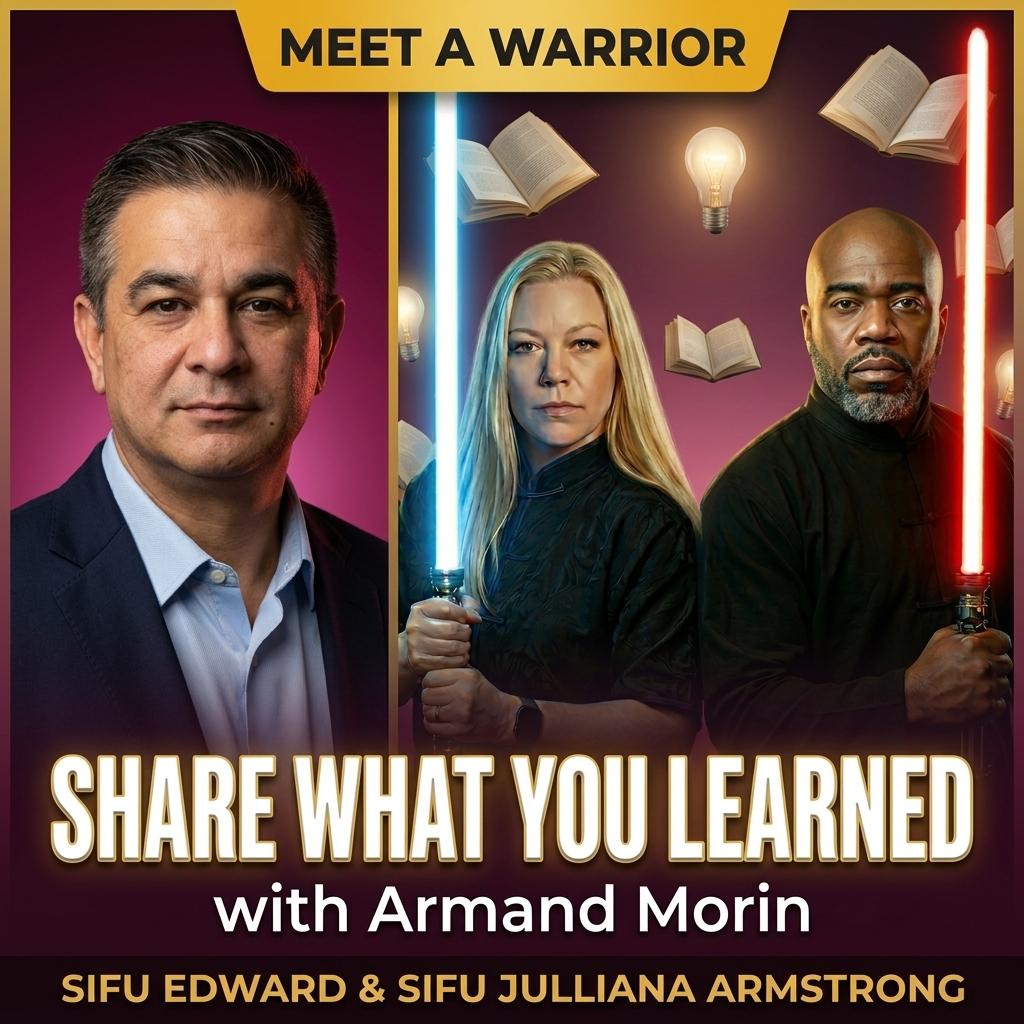
Adapted from the recorded conversation; the guest's words are verbatim. The questions are reconstructed and voiced by Sifu Edward and Sifu Julliana Armstrong.
🎥 Video podcast coming soon. The complete interview will play here once published. The full conversation is transcribed below, and the audio edition will be available on sifuarmstrong.tv.
In a new Sifu Armstrong interview, the founder of the longest-running internet coaching program in history explains how being robbed of over two million dollars became the foundation of everything he built afterward.
Armand Morin’s origin story sounds almost mythical: in 1996, with nothing but a laptop and a leftover check-printing tool, he built a $110 membership site selling nothing but a list of free bookmarks, and did $4.2 million in twelve weeks. Then his merchant account provider called. “We have to shut down your merchant account. In fact, we already did, and also by the way, we went into your bank account and took out $2.1 million,” Morin recalled them telling him, convinced his sudden success had to be a scam.
Sifu Edward Armstrong, who has his own experience of a system taking what he built, stopped Morin mid-story to name what mattered most about it: the reframe. Rather than treat the betrayal as an ending, Morin insisted “it was a great situation because that was really what started my internet marketing career,” because it forced him to solve a harder problem (how to sell without a merchant account at all), and that search led directly to his first ebook, his first software product, and eventually a business that’s still running.
Twenty-five years and over $200 million in sales later, Morin’s explanation for his own success carries none of the mystique people expect. “I figure out how to do something and then I share what I learned with other people, making their lives easier. That’s it,” he said. It’s the same principle behind Marketing University, the coaching program he’s run for nearly two decades, and behind his observation that most people undervalue the ordinary skills they already carry. “People have internet amnesia,” Morin said. “They forget everything that they’ve done in life prior to getting on the internet.”
Asked what actually explains a program surviving this long when so many competitors haven’t, Morin didn’t point to tools or tactics. He pointed to something closer to a promise kept, year after year: “It’s survived this long because of one thing and that is we actually care about the people that are with us.” Members who joined on day one, he noted, are still with him, and have upgraded along the way.
That’s the throughline worth sitting with. Morin was robbed of everything by a system that mistook his success for fraud, and instead of quitting, he built a program whose whole reputation rests on keeping every promise it makes. It’s the same standard the Armstrongs hold themselves to: the oldest, most trusted programs aren’t the ones that were never tested. They’re the ones that kept every word they gave, long after the excitement of the launch had faded.
In This Conversation
- The $4.2 million bookmark website, and the merchant account that seized half of it
- Why Morin calls being robbed “a great situation... that started my internet marketing career”
- Writing sales copy as a conversation with a person across the table
- The three pillars of Marketing University: coaching, tools, and support
- “Internet amnesia” and why everyone already has a skill worth teaching
- Where to find Armand Morin and Marketing University
The Full Conversation
Sifu Edward Armstrong: The longest-running program in any field earns that title one way: it keeps its promises long after the excitement fades. Armand Morin runs the longest-running internet coaching program in history (nearly twenty years), and he built it after being robbed of over two million dollars by a payment processor that decided his success looked too much like a scam. I've lived a version of that betrayal, so I wanted our operators to hear how he turned it into the foundation of everything.
Sifu Julliana Armstrong: And what I love is his answer to how you actually build any of this: figure out how to do one thing, then share what you learned. No secret. He was a door-to-door vacuum salesman who learned to write a sales letter by imagining a person across the table. That's craft, and craft is what I respect.
Our guest is Armand Morin, internet marketing pioneer, over $200 million in sales, and founder of Marketing University. Armand, a pleasure.
Armand Morin: Oh, thank you very much for having me. I'm excited and I think we're going to have a lot of fun today.
Sifu Edward Armstrong: You've been at this since the very beginning. How did the journey start?
Armand Morin: When I got started on the internet, it was many, many moons ago. It was back in 1996 is when I first got started and what happened was, I had just had one of my first companies created and it was a long distance company, which means that we sold long distance services to local people, home residences and businesses and things of that nature. I just sold that company for a stock in another company, which by the way, isn't always a good idea because I kept that stock and a few years later, I got a notice saying that all that stock that I sold my company for was valued at 1 cent.
Yeah. It was just a crazy, crazy experience, but it was great. It was my very first company and that first company did a $1.8 million in seven months and I was extremely excited. Of course that's the gross, that's not what I kept, of course, because basically what it turned into was only 1 cent. After that, I had a bit of time on my hands and at that time I was the technical person. I was the CEO of the company and I handled all the tech things within the company.
So when I closed down the company, I kept really two things. I kept my laptop, which back in 1996, was state-of-the-art. It had a CD player and a three and a half inch floppy disc. So it was very special, but at that same time, I also kept my desk. So those are the two things I left that company with and everything I read was about the internet and Bill Gates made a statement way back then and that was, "If your business is not on the internet, your business will be out of business."
At that time, Bill Gates was the richest man in the world and I thought, if he said this, then I must pay attention to this. So I did what everyone else did at that time. AOL was sending out these discs and I popped it into the computer and I jumped on and honestly, I didn't even know what to do. I surfed around AOL a little bit to see what it was and then someone told me later on that day that that's not the internet. That's just the AOL. So I'm confused. I said, "Well, what's the internet?" They said, "Well, you have to click little E. That little E." Of course, they were talking about Internet Explorer at the time. So I opened that up and I'm like, "Well, what do you do now?" They said, "Well, you search for things." I'm kind of flabbergasted.
I'm like, "This is never going to work. People are not going to do this. Who's going to sit around all day and just search for things on the internet?" Little did I know that that's what I basically do now all day. The fact is, is that at that time I started doing what other people are doing. I started searching around and within a few minutes, I started searching for my competitors in the previous company that I had and I discovered that they were actually selling things on the internet. Now, again, this is 1996. We have to put things in perspective. There was no Google, there wasn't Facebook, there wasn't all these social media. Social media, wasn't even a thought at all back then.
So when I discovered that someone was selling something, I just thought, well, what should I sell? Again, remember, this is actually still day one. I'm probably about two hours into my whole internet journey. So, of course I'm a pro at this point. So now what happened is I ran across this one website and this one website changed my life forever. When I went to this website was a very basic plain website and it said, "If you give me $25, I will list your website on my website and because I'm driving traffic to my website, you in turn will probably get traffic to your website." So it was like a link directory, if you will. So I thought, "Man, that is the most simple idea that anyone could possibly do and need to do something like that."
So I went around and I said, "Okay, well, what do I need? I need to make a website," and AOL at that time provided this free software called AOLpress and it promised me that within two hours, if I followed their instructions, that I would have a website and I thought, "Oh man, I can follow instructions." I'm a little naive. So I believed them. So I went to work and I followed their instructions and sure enough, two hours later, I actually had a website online. My website said this, "If you give me $25, I will put a link on my website to go to your website and because I'm going to advertise this, you should get traffic to your website." So basically, yes, I admitted, I copied basically that other person's website. The other thing that I kept from my company though, was a tiny software programme that at the time was legal where people could give you their checking information online and you could print a check that didn't require a signature on your end.
It was very interesting. So I put this website up in my ... Now again, I had everything going against me because my website address was something like this, members.aol.com/some name/some name/some other name and then you finally get to my website. So it wasn't the easiest URL in order to remember and also it wasn't on a secure server and I was asking for people's checking details on an unsecured form. So everything was going against me, but I advertised it on AOL and their classifieds and their different forums and message boards and at the end of that first week, I had in total around $8,000 in sales.
I had $25 each and I had this big stack of checks now that none of them had a signature on that I had to go to my bank and try to cash. So they didn't believe me at first, but I brought into the law that actually told them that it was true that you can do this. I had no problems from that point on, but again, this was my very first internet venture. We made $8,000 the first week and there was a lot of work that had to be done because every person that ordered, I had to add another link to their website on my website. So you can see that my website went into multiple pages and it was very crude and it was all manual. There was nothing automated about it and against all odds, it succeeded. That was my very first venture where I made money but I also knew that that wasn't going to well, be long standing as far as a business idea.
So I started looking around at other things on the internet and I started saving things. I started saving things. Different bookmarks, different websites, websites that said free internet access, free magazines, free calendar, free this, free that. I thought, "Man, all these things sound really, really cool." I had this big list of bookmarks and at that time it was about six or 700 bookmarks and I had this idea one day. That idea was basically, well, if I think these things are cool, I bet you that other people might think these things are cool too. So I said, "Well, if I could put these bookmarks in an area where people could access them, then I could charge people for it," and that's what I did.
I created a membership site. Again, back in 1996, we're still talking. I created one of the first membership sites out there and I charged people $110 to access my bookmarks. Now remember, the interesting part about this model is that I got something for free on the internet, which was a collection of links to other websites. This was just a collection of links and that's all it was. Organised and categorised and I charged people $110 in order to access this. The reason why it was $110 was at the time, my thought was, "Well, I'm going to charge them an extra 10 bucks because I don't want to pay the credit card fees."
So what happened is I marketed this and I started doing it the same way I did the other website that I had and I put on classifieds and the first day I got 10 sales. I'm like, "Man, 10 sales. That's $1,100. I'm doing pretty good at this." Then the next day, all of a sudden I had about 100 sales and I'm like, "Oh man, I just made $11,000 at this." I'm like, "This is nuts." Then by the end of the first week, I had about 1,000 sales and at the end of that first week again, 1,000 sales, $110,000 that we brought in just that one time and again, I'm kind of freaking out because ... And the reason why it went like that is because I had one thing that I thought ahead on that helped and that was, I had an affiliate programme where people could sign up and they could refer other people and people were just referring everybody to this particular piece.
Now, at that time I had advanced, I had gotten a merchant account to process my order. So I accepted credit cards. I had a legitimate website, but my website was actually only two paragraphs. It literally said the problem and then number two, it said the solution and then it had a button at the bottom that said, buy. Very, very crude but it started growing and growing, growing and at the end of 12 weeks, I had sold over 35,000. I brought in a total of $4.7 million at that point. $4.2 million, I'm sorry.
Sifu Edward Armstrong: From tiny acorns. You struck gold almost by accident. But I have a feeling it wasn't all a happy ending.
Armand Morin: I got lucky. I was in the right place at the right time and I recognised an opportunity and more importantly though, is I wasn't afraid to act upon that opportunity. I think a lot of people, they think of, well, what if this doesn't work? Well, what do you have to lose? That's really how I looked at it and I still look at things like that today. If there's not a lot of risk to it, I'm still going to take advantage of it but that also started the ... It wasn't all happy endings and let's just put it that way.
The reason I say that is because at the end of that 12 weeks, I brought in a $4.2 million and I received a phone call from my merchant account company and they said, "Mr. Morin you've just processed $4.2 million," and I'm so proud. I'm thinking, "Oh, yes I did," and what happened was the next words they said were, "Well, we have to shut down your merchant account. In fact, we already did, and also by the way, we went into your bank account and took out $2.1 million."
Sifu Edward Armstrong: They just took it? Why did they think it was a scam?
Armand Morin: Exactly. That's exactly what their thoughts were, that there was something wrong in this. Remember this was 1996 on the internet. This was one of the first major successes in this type of marketing and this type of products and digital marketing being sold. So I was really kind of an example that they were looking at and not sure what to do because their thoughts were, "Well, what if all these people refunded all at the same time? We'd be out all this money."
So what happened ... It sounds really bad and it was. I was devastated at the time. They took half of my money. Now, remember the situation. It really good. I brought in $4.2 million. They just said that they took out $2.1 million. So they took out half. Now the other side of it, that other $2.1 million, you might be thinking, "Well, how bad is it? $2.1 million can make you pretty happy still." Well, remember I also said I have an affiliate programme and that affiliate programme paid 50%. So I now have $2.1 million that one person took, I have $2.1 million I have to pay my affiliates and now I'm left with the remainder, which is you can probably do some simple math is nothing. Also when they cancel your merchant account, they put you on a blacklist that means that you can't get another merchant account.
Now here's the ... You may be thinking this is a bad, bad, bad situation, but in reality it was a great situation because that was really what started my internet marketing career because I would tell you, and I would tell anybody that that situation that I was in and I did $4.2 million in 12 weeks selling free bookmarks, hey, I was at the right place at the right time and had the right product and put it out there, but I wouldn't call it necessarily on purpose. It was by happenstance that it happened, but the next part was actually the most important part because now I had a problem. I couldn't process credit cards, but I also knew that the internet was something that was definitely working. I had two case studies under my belt.
Sifu Edward Armstrong: Stop right there, because I need our warriors to hear that reframe. You were robbed of everything by a system that couldn't understand your success, and you called it the great situation that started your career. I left a franchise that took what I'd built and told the same story to myself. The betrayal isn't the end. It's the beginning of building something that's finally, entirely yours.
Armand Morin: I knew this could work and my company at that time was on track literally to do $155 million that year if I was continuing on the pace or I didn't get shut down. So now I'm here. I know that the internet can work. I can't process any orders because I don't have a merchant account. So how do I process credit cards without a merchant account and that was my question, which led me to the search.
I kept researching and researching and researching and I found out there's, what's called a third-party merchant account, which you can use someone else's and very similar to ClickBank today. ClickBank has the merchant account, you process through them and they pay you and they take a higher fee than if you had your own merchant account. That's fine and there was a bunch of these and I found 80 of them. I thought, "Man, if I think these things are needed and I need these," and as I was doing my research, I was finding out that other people needed something like this too, because they couldn't get a merchant account because of their credit. I said, "Well, maybe I could just put this into a little tiny book. If I could put this into a little tiny book, I bet you people would buy it," and sure enough, it took me a lot longer than what it should, because I didn't know how to do it, but it took me about four months to put this together into an ebook at the time and eBooks were a lot different back then than they are today.
eBooks were basically software when they first, originally came out. They were a bunch of web pages put together in a software that you could open up offline and you didn't have to be connected to the internet. That was the definition of an eBook back then. So I went through and I found a bunch of different eBooks software, bought what I needed and put this ebook together. Put it out there for $19 and 97 cents and wrote my first sales letter for it as well too and all of a sudden, people started buying it. In fact that one ebook I sold for about 12 years and every year, it averaged just slightly under $30,000 a year.
Yeah, just that one ebook that I wrote. I think I only updated it like two or three times. That's all that was necessary. I never changed the sales letter from the first time I wrote it. It still stayed the same exact sales letter and there was a lot of lessons learned during the process but when I made that ebook, remember I said, I bought a bunch of eBook software, but none of them were exactly what I was looking for. I had this idea as I was creating this ebook out there. I said, "Man, if someone could create an ebook software that had all the positives of these six or so software that I bought and none of the negatives, I bet you they could make a million dollars." So I took the last bit of money I had. I had $5,000 in my pocket and I said, "Okay, let's find someone that can make me the software.
I don't know how to write software, but I'm sure I can find someone someplace on the internet." I found this company in Czechoslovakia that could do it and I paid them that $5,000 and I created this ebook software and it was called Ebook Generator back at the time and it turned out to be the bestselling ebook software on the whole internet. It did make a million dollars over the course of just a few years, but that also led me to other questions. People kept asking me, "Well, how do you make those graphics at the top of your website, those header graphics?" So I said, "Man, if someone could create a piece of software that would do that, then I bet you they could make a lot of money."
So I went to work and, again, now I know I could outsource and I found another company that would make me these graphics and put them into the software where people could easily put text on them. Very much like a lot of the social media type software there is today that you can do in your browser. Well, back then we could only do it in a piece of software. So I created a software called Header Generator. Then I created another one that could create PDFs without using Adobe called PDF Generator. Then I had another one that made popups. In fact, it was ... It still is even to this very day, the number one popup software that ever existed and it was called Popup Generator and there's just millions of sites that have that software on it right now.
So it went into a series of about 34 different pieces of software that I had and along the way, though, as I was marketing my software, eventually someone started asking me, "How do you market your software and what do you do? How do you write that sales letter? How do you do this and how do you do that?" So it just eventually led me to start a membership site that was just about what am I doing to marketing and to market my software and how do I make my opt-in pages and how do I do this and what do I do for traffic and all these different things. So I created a membership site way back in the early 2000s and at first it was called AM2. And the reason why it was called AM2, it was because I partnered up with a partner at that time who was Alex Mandossian. So it was Alex Mandossian and Armand Morin, AM2, squared. So that was the piece and eventually Alex, we just grew. He had different things that he wanted to do. So I bought him out and then I changed the name of it. Now it's called Marketing University.
Sifu Julliana Armstrong: You wrote that first sales letter yourself, and you've said you got stuck. I'm fascinated by craft under pressure. How did you break through, and are you still that self-critical today?
Armand Morin: Probably even more critical than I was back then, because I believe the markets are tougher today and people have seen a lot of different things, but the basic premise though is always the same. You see, when I was writing that very first sales letter way back when, I was stuck on the second paragraph for, I don't know how long. I just couldn't get past it and then for whatever reason, I thought about it from a different angle. My background prior to getting on the internet when I was from 19 to about 25 is I sold vacuum cleaners door to door. So I was in front of people and I was selling to people but I never felt it was actually sales, but when I get to that point in my sales letter, I said, "Well, what would you say," and this is the thought that I had going through my head is what would you say to someone that was sitting across the table from you in order to sell this product to them?
What would that conversation be? When I thought about it from that angle, it was very easy. It just flowed out of me. These are the things that that person's thinking. These are the things that I want to tell them about and how do I put this into a conversation in order to make it make sense in their mind and in my mind, as well too. Today it's the same scenario. When I'm writing sales copy, what I'm doing is I'm having like a commercial in my head. It's like an infomercial that's running through my head. What would that voice say in that infomercial to sell this product to somebody and what would that person want to know about in order to overcome what their needs are, and also their objections.
Sifu Edward Armstrong: Tell our operators about Marketing University itself, because the structure of it maps almost exactly onto how we license and support our Academy Commanders.
Armand Morin: Correct. Marketing university is basically everything about marketing and let me explain. The way I look at marketing is that you have basically several different areas. Number one, the first area is coaching. Coaching, knowledge and you need that in some way, shape or form. It's hard for us to look at ourselves and critique it and I think that's the best skill that you can have is that perspective, as far as looking at yourself from a third party point of view, but a lot of times you just don't have the patience or knowledge or know what is happening in the marketplace to decide what is good, what is bad. So the coaching and the training that we have, we do it different ways. Number one, I do a full seminar every single month for my marketing university members.
So I choose a topic. So let me give you an example. Last month happened to be about AliExpress is a lot of people want to know about drop shipping. I think one of the easiest things that you can do is utilise AliExpress as a drop shipper and I showed them exactly how to put together that website, choose a product, market it, advertise it and everything. It's a two day seminar that's done live every single month. So every month seminar is fully focused on just one single topic and this way, we can go in depth about 12 hours or so, roughly each and every month, just on that one topic. So that's the first part of the training is every month we do a new training. Sometimes it might be on sales letters. Sometimes it might be on webinars. Sometimes it might be on another topic, but it's a topic that I think that people need or want to know.
Then we also supplement that with our weekly training. So every Wednesday, I do a brand new training for an hour that is on something maybe that I'm doing at that current time that I'm working on. Maybe it's something that's changed recently in Google. Maybe it's a new form of advertising that I'm utilising, but it's where they can see me, see my screen, see exactly what I'm doing and let me explain it without any kind of, let's say commercial interruption at all. Throughout the whole membership site, there is no pitching or anything like that as far as me trying to force them or wanting them to buy something else. The third element that we have, depending on the level that they have at Marketing University, is that they can come to my house.
Now over the course of the pandemic, we did virtual meetings and we have been doing virtual meetings, and now we're getting ready to open it back up where people can actually fly in from all over the world. They come to my home for a training session that's about four days and we have multiple groups that come in. So they sit here and we critique their business while they're here. So each person basically comes up, let's say, on stage. What we do then is we critique their business with the whole group. So it's like a mastermind, it's live. While they're here, we feed them, we take care of them. I actually bought a shuttle bus that I actually shuttle them back and forth between hotels to my home and everything like that.
So then that's the third part of the training and that's a live part of it where they come here multiple times and depending upon again, their level there might be specific section. So for example, on my highest levels, they actually come and spend a few days after that, even for let's say another four days along with that. So they're spending eight days with me basically, the highest levels and we focus in and we do basically workshops where we might build out their actual webinars system, or we might build out their website. We might build out ... And they're doing this live with me. So they have these workshops that we do. Then the highest level of course, does that one-on-one where they can come to my house, that we spend a day together. I create their business plan for the next six months or to a year and we plan out in detail exactly what it is, and that includes their branding, their products, their marketing strategies and we get in depth and in detail where that happens.
So the first part, that's the coaching and again, based on their levels, depending on how much of that coaching that they get, number two is the tools. The tools that they need to make it happen, whether it be a website software. So for example, we made our own software that ... It's an overlay on top of WordPress, basically that we control their hosting. We have the systems. We have over 400 templates. We have different sections for marketing. It's built in with a webinar software. We have all these things. It's all under one roof. We even have our own auto responder system as well, too. So it's all under one system that we can recommend the tools inside of our platform, we have things for scripts. So you put in your name, your product and it generates an opt-in script for you or it generates a webinar script or we have another software that you put in your basic details, and it creates an outline for an eight day followup system. Again, there's many other tools, but again, the tools is what's going to make your life easier and do some of the things, at least give you a headstart on some of the things that you need to do, but number three is also the most important part.
You can have the tools, you can have the coaching, but number three is also the support aspect and this is where I think many, many programmes fail is they don't have any interaction. So in my programme, depending on the level that they're at, they can have unlimited email access to me directly, which means that they send in their ... It goes through a ticket system and let me explain. Every day at 11:30, I actually answer everyone's questions in the last 24 hours. My team, someone reads off the questions or sends me the questions, and then I verbally give them the answer and then they send it back to everybody and it happens every day. We've been doing this for so many years. So it just works out well that I can answer all these different questions from a lot of different people, very, very quickly and very, very easily and it's my personal input.
It's not going through a coach. It's not going through some intermediary that's changing my words or changing my meaning in some way. So the access to that is key and then of course, if they have other questions about the programmes or how to do something, then sometimes questions that like that would be deferred to someone on my team that could easily answer those questions as well too. Then the other part to that, along with the support is during normal times we do different events and it might be, as an example, a cruise where it's just a private cruise just for the people that are in my programme. So I don't open it up to the public or anything. We go on this cruise together, we have a lot of fun and we get to relax. There's times where we do a little bit of training, a little bit of talking. This way, people can ride out the cruise. That works out well, but it's just a complete system and we've been doing this for so long now. Again, I believe now would be, oh, just, just, just pretty close to 20 years. I think it's about 19 years at this point.
That we've been doing this and it's change over time where I think some things are necessary. In fact, even right now, literally as we speak, I'm redoing our members area again, to make it easier where we can have tracking of our different courses, where people can see how far they've gone into each course. We're also taking our monthly trainings and we're having them transcribed now. So those 12 hours are also going to be transcribed or you'll see the video up on top, but then the transcription of the whole video will be underneath and we just want to make things easiest as possible for this and yeah, our programme, it's not the least expensive in the world, and it's not the most expensive either, but it's survived this long because of one thing and that is we actually care about the people that are with us and I have people that have been with me from literally day one. And not only have they been with me, but they've upgraded along the way.
Sifu Edward Armstrong: "It survived this long because we actually care about the people." That's not a marketing line. It's the load-bearing wall. Coaching, tools, and support, held up by genuine care. Change three words and you've described our federation.
Sifu Julliana Armstrong: You still roll up your sleeves after all these years. What would you say to someone starting out today is it harder now, or easier?
Armand Morin: I would tell anyone, people think that marketing today is difficult, but in reality, it's the easiest thing that you could possibly do in order to get started. You don't need hardly any of the things that we needed in the past. I think they're easier to do today than ever before. I think webinars are probably the biggest key to anyone's success in today's day and age simply because you can come up with an idea. Let's just give you an example. I could have an idea of something that someone might want, typically information that I might know how to do. Then what I would do is simply create a webinar on it. I could go to a system and it doesn't matter what webinar software you use, but let's just say that we used ... Well, in fact, let's make it even easier.
Let's not even use a webinar software. We could just go to Facebook now and do a Facebook presentation, do a Facebook meeting and that could be our tool that we would use in order to get people to see what our message is all about and actually do a presentation to them. That would be a very simple way to do it. Then you could use simply a PayPal link for people to buy and really within a couple of hours, you could have people purchasing your product or idea or access to a course that you might do sometime in the future. So, it's very simple for people to get started and with Marketing University, we make it easy for people. We have basic levels from the very low, from $97 all the way up to the very high end levels, which is $25,000 for personal coaching, where you come to my house and spend a whole day with me and all the different things in between.
So there's five different levels that we have in Marketing University and yeah, of course I'm biassed. There's no doubt, but also at the same time, I'm not only biassed, but I guess I would call it an educated biassed because I've seen the things that other people have out there. As an example, there was a course done by someone recently that I saw and they were selling it for a significant price. It was $997, and they were going to teach you about social media and driving traffic to your website and all these other things and they gave you the outline, which was great. It was a fairly good sales letter, but the one thing when I'm looking through this and I'm looking through the bullet points, this is what you're going to learn about social media, why you need to do it and the outline and how to create a social media calendar and all these things are great, except the one thing that they never told you how to do is actually how to do it.
It was an overview. It wasn't showing you how to do it. For example, when your traffic, you can tell me, "You should do a YouTube ads, you should do YouTube banner ads. You should do pre-roll ads on YouTube. You should do six second ads on YouTube." Okay. Well, that's great. How do I do that? And that's exactly where we pick up. If I tell you that we're going to talk about Google ads, I literally log into my Google ads. I actually create an ad right in front of you, showing you step by step of how to do it and that's why it works is because there is no question. That's why ... It's not that I want to do a 12 hour course every month. Trust me, I don't. But at the same time, what we are doing during the 12 hours is we're going into the details that other programmes just don't do. They don't explain the details. They don't explain, well, why should I click that? Why should I not click that? What I learned a long time ago was that if people understand the why behind what they're doing, they're more likely to do it.
So if I can explain to them that, and they can actually see it in real time and me spending real money in doing this, they can actually see it. So another example I did a training that we have in our members area on viral marketing and it was viral videos on Facebook. We've all seen these videos that have gotten hundreds of thousands, if not millions of views. So I'm like, "Oh man, how did they do that?" So I went ahead and prior to the training, I actually created my own viral video, utilising tools and free tools on the internet. I put together a viral video, put it up online. We got, I believe it was 200,000 views. I'm like, "Oh man, this is awesome. Let me do a class on what I did and show people how I did it." I did it and then what we did is we put that one up and that one got almost 500,000 views. So they can see real results as opposed to hearsay.
Yeah, because you just need to see what's working in the real world because so many times I ... Right now, currently this is my 25th year that I've been full-time online. I've seen things come, I've seen things go and I've seen what works and what doesn't work. So my point of view has narrowed along the way, but I'm still open to new ideas. I'm still open to changes as far as how I do things. If someone can show me a much better way. So when I see a lot of times sales letters that promise the sky, promise the moon and they're just doing a disservice to the people that are actually out there. People are paying you a certain amount of money and sometimes that money that they're paying you is in some cases might be their last dollar.
Sifu Julliana Armstrong: Twenty-five years, and you've watched a lot of people come and go while you're still standing. What is the actual secret to longevity?
Armand Morin: The longevity of this is, it's very simple is if you ... It's a series of promises and what I mean by that is that I promise to show you this or teach you this for this amount of money. So it's a promise and an agreement and if I hold up my promise to you then, and you get results from what I do then you're going to come back and you're going to work with me again in the future at some point.
Sifu Julliana Armstrong: You keep coming back to something I love, that everybody already has a skill worth selling. Say more, because I think that's the whole thing.
Armand Morin: Very much so. Very much so. It's easier, but it's easier because it all still relies on your basics. It's having that problem or finding a problem that someone needs an answer to in some way, and it doesn't have to be a big problem. I think that's the part that a lot of people misunderstand is they're thinking that it has to be a big problem that they have to solve when in reality, it's something simple. For example, I saw a programme the other day and it was very inexpensive. It was less than $20 and it was about utilising PowerPoint and, hey, I've got literally 1,000 presentations on my computer in PowerPoint. I'm like, "Oh, I'm a PowerPoint pro. I know how to do PowerPoint." So I read the sales letter and this woman was showing me all these different things that she could do in PowerPoint. I'm like, "How do we do that? I want to know that. I want to know this," and at the end it was like, I don't know. Like I said, it was just a few bucks. So I'm like, "Yeah, count me in. I'll buy this any day of the week."
It was a skill that she learned how to do and then she simply is teaching other people. That's what I tell everyone, there is no secret to my success. My success is very simple is I figure out how to do something and then I share what I learned with other people making their lives easier. That's it. That's the only thing that I do and if you follow that premise of doing that, there's skills that we've all have acquired throughout our whole lives, and you might take them for granted and think that everyone knows how to do this, but the reality is they don't. If you go to Udemy as an example, Udemy has a lot of different courses that are there, but when you sort the courses into what has sold the most, it's shocking because what sold the most and what sold the most courses is Excel.
How do utilise Excel? Hey, I know two functions in Excel and that's it. I can paste things into a table and I can sort it. That's it. I'm done. I know and it's like this cheap course, but they've sold like 300,000 copies. Some ridiculous amount and it's just that following that same principle. It's like, what do you know? Because what people have is internet amnesia. They forget everything that they've done in life prior to getting on the internet. I don't know why, because there's so many skills that people have, whether it be learning how to work with people, what they've done in their jobs, in their prior, what they're currently doing in their jobs and people want to know how to do that.
If you can show people a certain aspect of that, it doesn't have to be this full comprehensive course. It could be something simple and therefore with the usage of screen recorders today, like Camtasia, I use Camtasia for everything, but there's a lot of other ones that are cheaper and free that you can use and it's just the screen recorder. So all I have to do is turn on a screen recorder, show you how I did this. Let me show it to you visually and let me verbally walk you through how to do that. That's the best product creation that you could possibly do and it's the quickest and the fastest and you can make a 30 minute video, a 40 minute video and sell that for anywhere between $20 to $50 and people will be happy to pay for it.
So once you learn how to do something, it's just simple to share it with other people and then you make another little tiny video of just a couple of bullet points on a PowerPoint slide that tells people what you're going to learn if you purchase this programme and now you have a product that people could buy. So it can be done literally in just a few hours throughout the day. I've done seminars all over the world and part of the seminars that I've been doing recently has been proving this exact point. So I start my seminar with telling everyone in the audience, saying, "Hey I have nothing up my sleeve. What we're going to do is we're going to talk about a topic, something that I know, and what I'm going to do is I'm going to create a product right in front of you. It's going to be a 30 to 40 minute product. Then what we're going to do is once I have that product and I'm going to create a sales letter and I'm going to put it up online, and the thing is, is I'm going to create the product, create the sales letter, put it up online, add the payment processing to it and start marketing it within 90 minutes."
Now the great part is, is that as I'm creating this product, as I'm doing all this, I'm explaining what I did, how I'm doing it. So they see this done in 90 minutes, but the cool part is at the seminar is that all the money that I make by selling that product over the course of those two or three days, I actually give away to somebody in the audience. So someone will walk home with 10,000, $12,000 over the course of a couple of days and it's fun. It's fun and people see it and it just kind of drives the point home and we make a game out of it a little bit.
Sifu Edward Armstrong: Last one from me. If you were starting today, knowing everything you know is there anything you'd do differently?
Armand Morin: Yeah. I probably wouldn't have made software in the beginning to start off with. The reason why is software has the most customer service associated with it. It's the support aspect. I managed to go through it and I came out fine on the other end, but if I was to advise someone from the very beginning, instead of making a piece of software, I would certainly advise anyone to just simply create an information product to start off with. I did in the very beginning, but then I started going into software almost immediately after that. Today I would just do a course in teaching you how to make a PDF.
Sifu Edward Armstrong: Armand, it's been amazing. Where can people find you and everything you build?
Armand Morin: Sure, absolutely. The most simple way to find out about me and what I'm doing is a few simply go to armandmorin.com, A-R-M-A-N-D-M-O-R-I-N.com. You'll see exactly what I'm doing there and about Marketing University, you could simply go to marketinguniversity.com and check it out. In fact, we do something that a lot of people don't do is, you can try it out for 14 days, see if you like it or not and if you don't like it, then that's fine. We can part ways and if you like it just do nothing and become one of our members.
Sifu Edward Armstrong: Armand, thank you for being so generous with your time and your knowledge. A genuine pleasure.
Armand Morin: Sounds great. Thank you.
Sifu Julliana's closing word: I keep coming back to "internet amnesia," the way people forget everything they already know the moment they try something new. Every beginner I meet on the mat does the same thing, convinced they bring nothing. But you've all lived, worked, struggled, learned. Armand's whole empire is one sentence: figure out one thing, then share it. You already have the thing. Stop forgetting it.
Sifu Edward's closing word: Armand was robbed of over two million dollars by a system that mistook his success for a crime, and he called it the best thing that ever happened to him. I know that road. And here's why his program has outlasted everyone's: coaching, tools, and support, all resting on genuine care, and every promise kept. The oldest academy standing isn't the one that never got robbed. It's the one that kept every promise it ever made. We don't entertain warriors. We create them.
Armand Morin, internet marketing pioneer with over $200 million in sales, software developer (Ebook Generator, Popup Generator, and 30+ more), and founder of Marketing University, the longest-running internet coaching program in history. armandmorin.com / marketinguniversity.com.
ILLUSTRATIVE RESULTS. Any revenue, enrollment, margin or retention figure in this conversation is either a documented result from one of our own operations, a figure the guest reports about their own business, or an illustrative example, never a projection of your results.
Nothing here is financial, legal or tax advice.
Stay in the Fight
This conversation is part of the Sifu Armstrong Warrior Intelligence Series: interviews with world-class performers, builders, and thinkers, filtered through the lens of the warrior's path.
Subscribe at sifuarmstrong.news for every new interview, delivered to you.
Join Club Sabernet, the member community of the whole Sifu Armstrong ecosystem, where warriors train, connect, and hold each other to the standard.
Ready to build your own floor? Find your path at sifuarmstrong.com/which-path.