Run the Other Way: Sifu Edward & Sifu Julliana Armstrong Sit Down With 3D Mail's Travis Lee
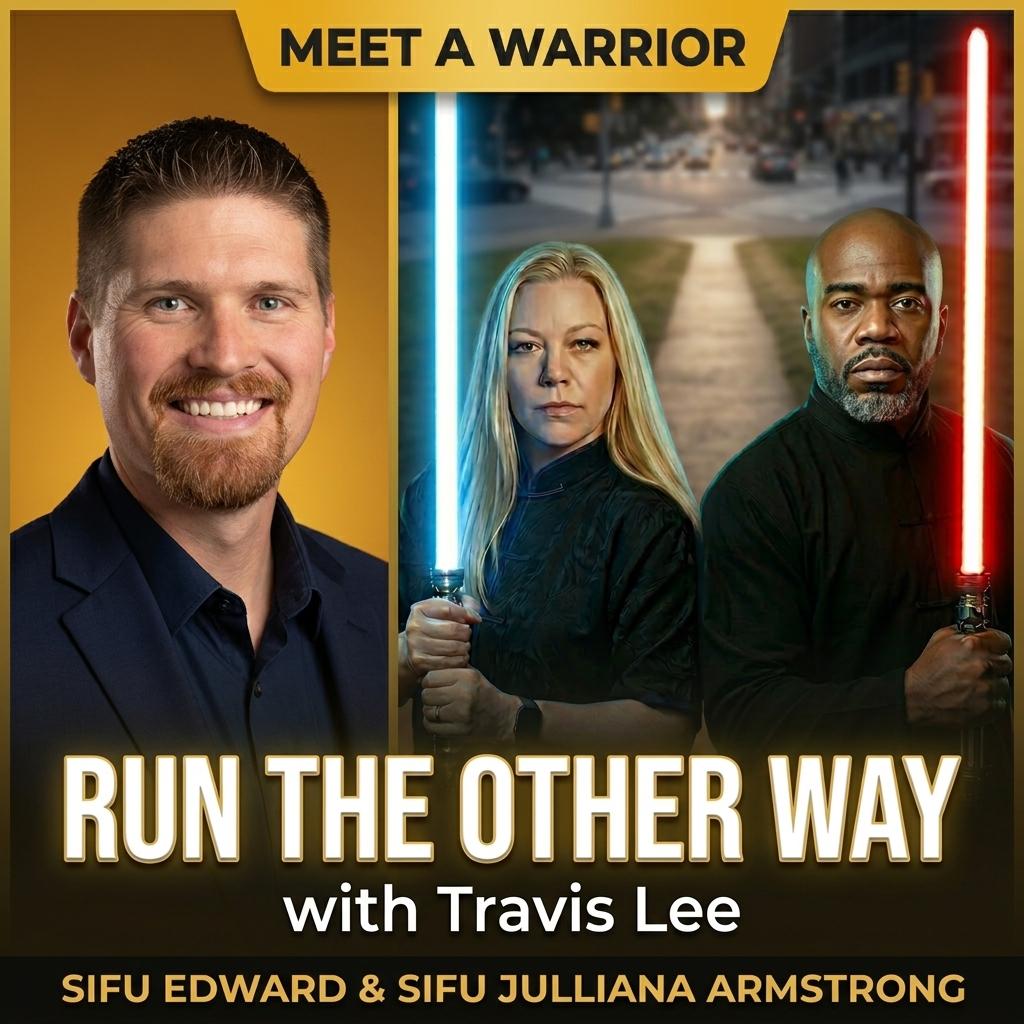
Adapted from the recorded conversation; the guest's words are verbatim. The questions are reconstructed and voiced by Sifu Edward and Sifu Julliana Armstrong.
🎥 Video podcast coming soon. The complete interview will play here once published. The full conversation is transcribed below, and the audio edition will be available on sifuarmstrong.tv.
In a new Sifu Armstrong interview, the 3D Mail Results co-founder makes the case that while everyone crowds the digital feed, the real opportunity sits in an actual mailbox.
While most marketers chase the same crowded digital ground, Travis Lee has spent his career mailing bank bags, fake express envelopes, and rubber-footed novelties to get a message opened. The co-founder of 3D Mail Results joined Sifu Edward and Sifu Julliana Armstrong for the latest Warrior Intelligence Series conversation on sifuarmstrong.news, laying out why physical mail still outperforms a crowded inbox.
Lee’s business began with his father’s wholesale distribution company in the early 1990s, when a first direct-mail piece pulled a 25 percent response rate, a number Lee still calls “obscene.” What started as a marketing tactic became a full business built on a simple contrarian instinct. “When everyone else is running one direction, maybe it’s time to start running the other direction,” Lee said, noting that pay-per-click costs have climbed from 25-cent clicks to $15 and $25 clicks while the mailbox stays comparatively uncontested.
The numbers back him up, Lee said: 80 percent of people report looking forward to checking their mailbox, 66 percent of direct mail gets opened, and a mailed piece has an average shelf life of 17 days compared to roughly two seconds for an email.
Lee described a recent campaign for a real estate coach named Carlos, who mailed 300 vinyl bank bags (the kind retailers use to carry cash to the bank) to a list of low-dollar buyers he wanted to graduate into a $20,000-to-$30,000 coaching program. The tactic drove a 6 percent response rate before a single sale closed. “The hardest thing we have in marketing today is getting our message heard, watched, paid attention to,” Lee said. “We go through all this trouble to ensure that the thing gets opened, because if none of them get opened, we cannot have a response.”
Lee also emphasized that a winning campaign isn’t measured by response rate alone but by return on investment, a campaign with a fraction-of-a-percent response rate can still deliver a five- or six-to-one return if the right person converts. For operators just starting out, he pointed to reactivation campaigns as the cheapest entry point: reaching people already on a list (like a dentist’s patients who’ve missed their six-month appointment) who only need a nudge to come back.
Lee’s company has since layered digital onto the physical mailer with a program he calls Direct Mail 2.0, uploading a mailing list to Google, Facebook, and Instagram so recipients start seeing matching digital ads before the physical piece even arrives, with personal QR codes that let his team track exactly when each recipient engages.
For businesses targeting other businesses, Lee said, data has become remarkably precise: lists can be built by SIC or NAICS code, company size, employee count, or sales volume, letting a mailer target an exact profile down to the individual vehicle fleet size of a prospect.
It’s a lesson the Armstrongs took directly to heart, not just for reaching future operators, but for the warriors who trained with them once and drifted away, who a letter, not an algorithm, might be what finally calls them back.
In This Conversation
- The 25 percent response rate that turned a side tactic into a business
- Why Lee tells operators to “run the other direction” from the crowded digital feed
- The vinyl bank bag campaign and its 6 percent response rate
- Response rate vs. return on investment: what actually measures a win
- Reactivation campaigns as the cheapest way to start
- How precise B2B and consumer mailing lists can get
The Full Conversation
Sifu Edward Armstrong: The operators I most want to reach (the gym owners, the dojo masters, the school builders ready to become Academy Commanders), don't live in a feed. They live in the real world, behind a counter, with a mailbox. And the warriors who once trained with us and drifted away aren't gone; they're just waiting to be called back. Both of those are problems physical mail solves better than anything digital, which is why I sat down with one of the most creative direct-mail minds alive.
Sifu Julliana Armstrong: And I love his core instinct, because it's pure warrior strategy: when everyone is stampeding one direction, look hard at running the other way. While the whole world fights over the same crowded digital ground, he wins the empty battlefield of the mailbox. That contrarian nerve is exactly what it took to found a brand-new martial art nobody was asking for.
Our guest is Travis Lee, co-founder of 3D Mail Results, who has revolutionised how businesses use direct mail in a digital age, driving remarkable engagement and response. Travis, great to have you.
Travis Lee: Wonderful to be here. Thanks for the invite and looking forward to sharing some direct mail expertise with some of our listeners.
Sifu Edward Armstrong: Tell us how 3D Mail Results began. I have a feeling there's a good origin in there.
Travis Lee: It's an interesting story, fairly instructive. I started this business with my father in 2008, 2009. My father had this business, American Retail Supply, a wholesale distribution company serving mainly small retail stores, the bike shop on Main Street type of client. It was very much sales-force-driven; you'd have what we affectionately call the foot soldiers walking up and down the street, knocking on doors and working the phones. He discovered this guy named Dan Kennedy, who I'm sure you're familiar with, renowned marketing expert. This was back in 1991, '92, and Dan said, "If you can figure out how to get direct mail to work in your business, it can revolutionise it. It can be a force multiplier."
His first direct mail piece, he gets a 25% response rate, which is obscene. That is absurd. No one should expect that. And so now he's hooked. Then that evolved into sending what we now call 3D mail. We set these little tiny rubber feet in the mail, or we send a message in a bottle in the mail, and it evolved into this thing that was way more than just paper and ink and envelopes.
Fast-forward to 2007 or so. For years people kept coming to us saying, "Where are you getting your ideas?" Our answer was always, we go to the dollar store and we walk up and down the aisles until we have inspiration, and then we run to the clerk and say, I need 5,000 of this little trinket. It became evident that people didn't want to do that, and because of our expertise as a wholesale distribution company, could we just buy these things and wholesale distribute them? We went to a mastermind meeting and said, we're thinking about starting this new division. We could have left that meeting with thousands of dollars in orders right then and there. Since then, we've completely sold the other business, gone whole hog into direct mail, and now we do everything from the wholesale distribution of the products to printing and mailing and stuffing and postage. It was: we use this thing with great success. How can we turn it into a full-fledged business?
Sifu Julliana Armstrong: Direct mail in a digital world sounds backwards to most people, which is exactly why I suspect it works. Make the case.
Travis Lee: That's a great question. The biggest reason to send it is, while everybody's running over here, you should at least look around and say, should I be running over there? When everyone else is running one direction, maybe it's time to start running the other direction. Dan Kennedy, my mentor, says the masses are usually wrong. And frankly, there's just less competition in the mailbox right now. When pay-per-click first came out, you'd get 25-cent clicks; pretty soon those are $15 and $25 clicks.
I've got some stats here from the United States Postal Service. If you think direct mail is dead, take a look. 80% of people say they look forward to seeing what they get in their mailbox every day. Do you think 80% of people enjoy checking their email? 73% of US consumers prefer direct mail for communication because it allows them to read it at their own convenience. 66% of direct mail is opened, nowhere close to my email open rate. And here's a giant one: direct mail has an average shelf life of 17 days compared to two seconds for email. If you send a package, that thing is going to sit on the coffee table, the kitchen table, the office desk.
Think about pizza. Have you ever seen a social media ad, stopped, printed it out and stuck it on the refrigerator so you remember to use the coupon? Compare that to a direct mail piece, that thing goes up on the refrigerator, and now you've got a visual representation of the thing you want on a Friday night when the kids are screaming. That's the competition, the stick-around effect, and the fact that people enjoy getting it. Even millennials, even those younger, are creeping back into that analogue world.
Sifu Edward Armstrong: "Run the other way" is the maverick's creed, and a physical thing in the hand is undeniable, the same way nothing replaces a real saber in your grip. Walk us through a campaign that worked, because I want our operators to see the creativity.
Travis Lee: I'll give you a very recent example. A client named Carlos. He coaches realtors, and he sells a coaching programme that's anywhere from 20 to $30,000. He had a list of low-dollar buyers already: people who'd bought a $3 to $7 ebook, a $47 course, a $97 challenge, but none coming anywhere close to a 20-to-30-thousand-dollar price point. He decided, I want to get them to graduate up to this next thing. So he decided to send out a little bank bag, an actual vinyl bank bag, the kind a retail store takes to the bank with cash inside. We mail it directly: postage on the outside, mailing label on the outside. When this vinyl bank bag shows up, what's the first thing they think? Money. Of course they're going to open it.
Here's why we go through all this trouble. The hardest thing we have in marketing today is getting our message heard, watched, paid attention to. We go through all this trouble to ensure that the thing gets opened, because if none of them get opened, we cannot have a response. He had about a 6% response rate, sent 300, had seven or eight reply. He's extremely confident at least two of those will buy. If one buys, his ROI is about six to one. I'd call this a conversion campaign, converting low buyers into high buyers. Direct mail can work wherever in your funnel people may be falling out; it works as that stick point so they don't fall out.
Sifu Julliana Armstrong: The bank bag that whispers "money's inside" so they have to open it. That's the whole battle, attention. How do you actually measure whether a campaign won, and what's this idea of putting people in a silo?
Travis Lee: Ultimately, all we're really worried about is return on investment. If we spend a dollar and make two, how many times can we spend that dollar? Response rate is what everyone concentrates on, but it's just a leading indicator. If Carlos only got one response and that person bought, his response rate would be one third of 1% (which sounds bad), but his ROI would be five or six to one, which is great. So you've got response rate, conversion rate, and ultimately ROI. We track with dedicated phone lines, QR codes, dedicated landing pages.
And here's the key: Carlos didn't do the direct mail in a vacuum. He took those 300 buyers and, when they got the direct mail, they stopped getting all the other communication from him. They got the mail, then emails about the mail, then outbound phone calls about the offer. We put them in this silo where all they're seeing is this one offer. That's important, especially if you've got 17 offers going off at once and this one gets lost in the shuffle. Segregate them, put them in a silo so they only experience this one thing right now across all the media we have to touch them with.
Sifu Edward Armstrong: "Put them in a silo, one offer at a time." That's the discipline of focus we preach in everything; a warrior who chases every technique masters none. Now, the operators I most want to reach are martial-arts school owners. For someone starting from zero, can you actually get the right mailing addresses?
Travis Lee: Yeah, there absolutely is a way. I'll speak from the US perspective. Data in the United States is extremely easy to get. Privacy is dead. Most websites you visit, most products you purchase, most warranties you register. That's now being sold. We can get very, very tight specific mailing lists. For consumers, we can get new home buyers, new movers, new mortgage borrowers, new parents, new marriages, new divorces: by age, income, whether they own their home, whether they have kids. There are like 3,000 data points.
On the B2B side, we can track them by SIC code or NAICS code, the code the federal government gives you for the type of business you are. We can target by the specific business type, by their size, by employee count or sales volume. Let's say you're an auto mechanic who does fleets; we can find all the HVAC companies with five or more service vehicles. That's the tip of the iceberg. We had a financial planner who wanted people approaching retirement age with a federal investment account; we got that list because as they retire those funds become fungible. That's how deep you can get. If you needed left-handed golfers who only golf on a Tuesday afternoon, it's probably an available list.
Sifu Edward Armstrong: So I could put a creative, attention-grabbing package directly into the hands of every dojo and gym owner in a region who fits the profile of a future Academy Commander. That's a recruiting weapon. And it pairs with what Craig Simpson told us on this platform. You both came up under Dan Kennedy, both swear by the mailbox.
Sifu Julliana Armstrong: It does. And I want to ask about the warriors who already trained with us and drifted away, because direct mail seems built for exactly that. For the operator on the fence about the cost, where would you tell them to start?
Travis Lee: The very first thing I tell people is, just like with Carlos, you should be able to squeeze something out of an existing mailing list you already have. One of the campaigns I love if you're starting out is a client reactivation campaign. Let's use a dentist, because everyone goes to the dentist. You're supposed to go every six months. If you hit month seven, you're lost, you're inactive. We've got to reactivate you. Every dentist who has a list of patients who've hit month seven without being in the chair should be sending a reactivation campaign to get them back. Those are the campaigns where, even if you're not all that big, you can squeeze more juice out, get them back in the fold, and put yourself in a Carlos position where you only need a half a percent or 1% response rate to be profitable. You don't need a 9% response rate.
You really have three costs to consider: the mailing list (purchase or rental), the creative pieces, and getting the message out: printing, stuffing, mailing. We always start with the mailing list. It is at least 50% of the battle. What we send, how, when, and the offers we make are all dictated by who's receiving it.
Sifu Julliana Armstrong: A reactivation campaign is exactly what I'd run for the warriors who stopped coming to the mat: month seven, the student who vanished, the one who thinks we forgot them. That's not a lost cause; that's a letter waiting to be sent. For the operator who's inspired but doesn't know what to physically send, give us a couple of ideas.
Travis Lee: Let's go back to our new-mover example, the average new mover spends twice as much on home improvements as a non-mover. What if you just sent one of our little fake express envelopes? If you're not watching the video, they're made to look like a FedEx or USPS priority envelope, but they're not. They say "rapid delivery, urgent letter, deliver immediately," with fun colours. Imagine that showing up in your mailbox. It's a very low-cost way to send something different, unique, that cuts the clutter. I wish we could just send a number 10 envelope with a stamp and a printed address, because that's cheapest, but people won't look at it. We've got others that say "air mail" with a red, white and blue pattern. Those are the types of things that are different and unique, that don't break the bank, that your recipient very likely hasn't seen: thus the curiosity factor, thus we open it, and now we've got a shot.
Sifu Edward Armstrong: Travis, what's next for 3D Mail Results, and where should people go?
Travis Lee: We've started a new programme, about 14 months in, which is relatively new in the direct mail world. Direct mail hasn't changed a whole lot in over a hundred years. We're calling it Direct Mail 2.0. You can send mail to a list and then also, on a one-to-one basis, serve them ads online. We take a list, mail it, upload it to Google, Facebook, and Instagram, and get a one-to-one match so we can serve them ads as well. So the day we send mail is the day they start seeing our digital ads. Now we're warming them up for several days before the mail arrives, and the mail arrives with the same messaging, the same images, the same offer they're seeing online. We even have personal QR codes, where every person on the list gets a unique code, so we know exactly when Tom or Harry scans it, and we can follow up.
The best place to start is the website, 3dmailresults.com, the number 3, the letter D, M-A-I-L-R-E-S-U-L-T-S dot com. There's a free book there, completely free, not "free but give us a credit card." It's called How to Explode Your Advertising Results. Get that book; it's a great primer. And there are contact forms in there if you've got more personalised questions.
Sifu Edward Armstrong: Travis, this has been excellent. Thank you for sharing your insights.
Travis Lee: No problem.
Sifu Julliana's closing word: The line I'm taking is the reactivation campaign, the dentist's month-seven patient, the warrior who stopped showing up. We treat those people like they quit us. They didn't. The warrior who stopped showing up didn't quit you. He's waiting to be called back, and most of the time nobody ever sends the letter. Send the letter. A community isn't just who's on the mat tonight; it's everyone who ever was.
Sifu Edward's closing word: Travis gave us two weapons. One: when the whole world stampedes toward the crowded digital ground, run for the empty mailbox, the maverick's instinct that built this whole art. Two: put something undeniable into the hands of the exact operators and dojo owners we want as Academy Commanders, and into the mailboxes of the warriors who drifted away. Attention is the whole battle, and a thing you can hold beats a thing that vanishes in two seconds. Get it opened, make the offer, and never let a single warrior fall silently through the cracks. We don't entertain warriors. We create them.
Travis Lee, co-founder of 3D Mail Results, specialists in attention-grabbing "lumpy" direct mail. Free book and examples at 3dmailresults.com.
ILLUSTRATIVE RESULTS. Any revenue, enrollment, margin or retention figure in this conversation is either a documented result from one of our own operations, a figure the guest reports about their own business, or an illustrative example, never a projection of your results.
Nothing here is financial, legal or tax advice.
Stay in the Fight
This conversation is part of the Sifu Armstrong Warrior Intelligence Series: interviews with world-class performers, builders, and thinkers, filtered through the lens of the warrior's path.
Subscribe at sifuarmstrong.news for every new interview, delivered to you.
Join Club Sabernet, the member community of the whole Sifu Armstrong ecosystem, where warriors train, connect, and hold each other to the standard.
Ready to build your own floor? Find your path at sifuarmstrong.com/which-path.