Rented Land: Sifu Edward & Sifu Julliana Armstrong Sit Down With List-Building Master Travis Ketchum
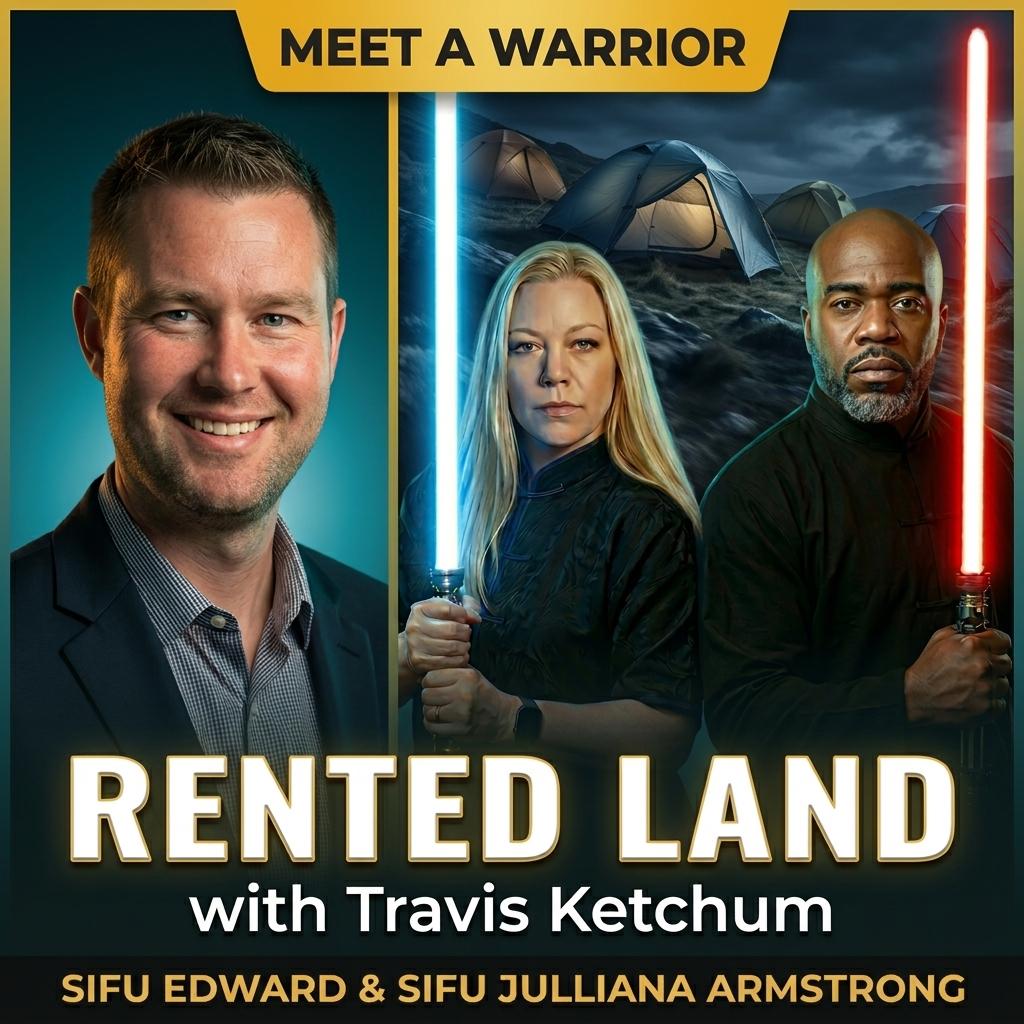
Adapted from the recorded conversation; the guest's words are verbatim. The questions are reconstructed and voiced by Sifu Edward and Sifu Julliana Armstrong.
🎥 Video podcast coming soon. The complete interview will play here once published. The full conversation is transcribed below, and the audio edition will be available on sifuarmstrong.tv.
In a new Sifu Armstrong interview, the Campaign Refinery and Contest Domination founder explains why a website and an email list remain the only two assets a business actually owns.
Travis Ketchum’s first product was financed on a credit card the same week he lost his income: fired from a client relationship and locked, the very next day, into an eighteen-month apartment lease with no way to pay for it. That pressure, he told Sifu Edward and Sifu Julliana Armstrong on the latest Warrior Intelligence Series, is what forced him to build something that was finally his own.
Ketchum had been building an audience for someone else (a best-selling author he worked for, filling her events and affiliate program) before realizing he’d simply swapped one job for another. He set out to build his own list fast, landed on the idea of a contest, and built a minimal WordPress plugin that generated 2,000 leads in a week after years of blogging had produced only a few hundred. That plugin became Contest Domination. He credits keeping the first version stripped down to its bare essentials (no members area at all in the earliest release) as the discipline that let him launch on a shoestring instead of the tens of thousands a fully built product would have cost.
The mechanism, Ketchum explains, was rethinking how sharing gets rewarded. Older contest tools handed out points for simply posting to social media, regardless of whether it produced a single new lead. Ketchum’s version paid out only when a share actually converted a new entrant, a small shift that sometimes tripled total leads, because it rewarded a real referral instead of an empty gesture.
That same instinct for rewarding real behavior over hollow metrics carried into his second company, Campaign Refinery, built after years of fighting email deliverability problems with tools like Infusionsoft. Ketchum discovered that inbox placement increasingly comes down to one signal: whether subscribers actually engage. “Engagement tends to be the currency,” he said, describing gamified tools that reward subscribers with points for opening and clicking, training a list to behave in ways that get rewarded with better inbox placement.
Ketchum is unmoved by predictions that privacy features like Apple’s Mail Privacy Protection spell the end of email marketing. Opens were never a perfect measure, he argues, and the businesses that build real relationships and write content people actually want will keep winning regardless of what analytics can or can’t measure. His bottom line, learned back in 2011 and unchanged since: “A website and an email list are the only two assets you really own. Everything else is rented land.”
He’s also candid about what it took to hold onto that belief through the leanest stretch, a girlfriend, now his wife, who stuck with the decision even as her own father questioned what quitting a stable job would do to Ketchum’s future. Ketchum calls the willingness to ride out both the euphoric wins and the genuine setbacks the real dividing line between entrepreneurs who make it and those who don’t, and says the discipline of trimming a product down to only what’s essential (rather than chasing every feature) is what made the whole thing survivable in the first place.
In This Conversation
- Financing a first product on a credit card the same week he lost his income and signed a lease
- Realizing he’d built an audience for someone else’s business, not his own
- The contest mechanic that rewards real referrals instead of empty shares, and sometimes triples lead counts
- Why “engagement tends to be the currency” for landing in the inbox instead of spam
- Running two very different companies, one mature, one a constantly moving target
- The line that’s guided him since 2011: everything but your own list and website is rented land
The Full Conversation
Sifu Edward Armstrong: There's a moment that separates the people who build empires from the people who build someone else's empire, the day you realise the audience you're growing belongs to a master who isn't you. I lived it inside a franchise, and walking away to grow my own people was the hardest, best decision of my life. Our guest had the same realisation, and he's spent a decade since teaching businesses how to build and truly own their audience.
Sifu Julliana Armstrong: And he did it with his back flat against the wall, fired and locked into the longest lease of his life on the same day, financing his first product on a credit card. As a competitor I respect that more than any easy success, because pressure is where you find out who you actually are. Pressure makes diamonds, like he says, and this conversation is full of them.
Our guest is Travis Ketchum, CEO of Campaign Refinery and Contest Domination, who's spent the past decade helping tens of thousands of businesses build bigger email lists filled with qualified leads. Travis, welcome.
Travis Ketchum: Oh, wonderful being here. Thanks for having me on.
Sifu Edward Armstrong: Take us back to where the entrepreneurial fire started, and especially to the moment you realised you were building for the wrong person.
Travis Ketchum: Sure. I've always been interested in entrepreneurship in general, right. I'd go a little bit further back, the car washing and lawn mowing and paper routes. I was always hustling to make something happen, right. I always had this dream of having my own thing. That's always been in the periphery, right. Technically, my first legitimate business, you had to be 18 to have that, be here in the United States, was actually started in high school. I remember having to get past the school filter and do all these things and apply for a business licence. It was actually a drop shipping business on eBay and was drop shipping laptops all over the place and building high-end game machines. That was where I got my taste of money, the value of your own business and the leveraged ability of a business to generate revenue.
In fact, in just a couple months, I went from basically a broke 18 year old to being able to pay for at least the first full year of college, room and board, the whole deal. That was a really eye-opening experience. Once I got through school, got the normal job, hated it, quit right after nine months and went and worked for a best-selling author and speaker, filling her events live in-person events, filling her affiliate programme, all that stuff. But I realised I'd been building a list and building assets for someone who wasn't me. Right. I had basically replaced one job for another and that's when I thought, "Okay. I need to build my own list as fast as possible. What's the best way to do that?" A contest is what came to mind, but I didn't like any of the contest solutions that were out there.
I went and dabbled around and tried to find some developers and had some false starts and errors and wrong alleyways and all that stuff. But eventually, I did get this little WordPress plugin idea that worked and it followed my very simple, minimal viable product vision of what it should look like. I had been blogging on the side for years and it only collected a couple 100 leads over about four years. Then I ran this contest and I generated 2000 leads in a week. That to me was the aha moment that A, this works and B, you know what, software is kind of fun. That's what kicked things off and got me down the path of being really, I guess a software entrepreneur.
I know just enough to be dangerous, to go break things, but not enough to actually build it myself. When I was at school, even though I went to school for marketing in a minor international business, I've always been technically minded because I was building computers and nerdy in that regard. When I was at school, I actually self-trained myself to build enterprise IT. By the time I started as basic help desk, like "Hey, my Outlook doesn't work." To by the time I left, I built, it was a $14 million server system for the school. I worked my way up that way. I have some technical jobs and I know enough about database structures and that stuff to at least know what to ask for from a developer, but not enough to go build it myself, right. But I can investigate technologies and weigh their pros and cons. I leave that up to the people I hire, because they're experts in that space.
Sifu Julliana Armstrong: "I'd been building a list for someone who wasn't me," that line is the whole reason warriors eventually stop fighting for someone else's flag and raise their own. But the way you raised yours was brutal: tell us about the wall you had your back against, and the steps you took anyway.
Travis Ketchum: In the early days, that was the case. Yeah. I mean, now obviously I hire people full-time, but in the early days it was actually a pretty big risk because when I was creating that first version, that client, that best-selling author and speaker I was working for, we basically had a difference of opinion. They told me to take a hike and I was like, "Well, I just signed an 18 month lease with my then girlfriend, now wife." It was literally the next day she wanted to part ways. I was like, "Oh no, I just signed the longest lease of my life for more money than I'd ever paid for a place to live and I have no income now." Like, great. I actually financed that first version on a credit card. I had no idea it was going to work out. I figured if it really went to heck in a handbasket, I could go down to the Apple store and start slinging iPhones to people or something. I could figure out how to make it work, but yeah, just hire people outsource in the beginning and eventually hire them full-time now.
Well, being under pressure is definitely a good way to do it, right. Having a big rental check to stroke. I still had a car payment at the time. I had student loans, the whole deal, right. Pressure makes diamonds sometimes, right. Then, basically what I did is I tried to really trim down the scope. I think a lot of people, when they get the software and this still happens to me sometimes still, I have to rein myself back in, but you get what's called feature creep, right. It's like, the first thing is deciding what does it really absolutely have to have? It won't work without it. What does that feature list look like? Everything else is version 2, or version 1.1, at least. For me, that literally meant, I didn't even have a members area in the beginning.
My delivery was an AWeber autoresponder with a link to an Amazon S3 file that was unprotected on the first version. Right. Then I knew I needed enough sell, but I didn't know how to do that. Instead of saying, "Oh, let's make a bunch of crazy features." I said, "Well, I could sell a different licence to the product." I knew just enough to go in and literally rename the file to a different zip and rename it, so when you installed it, it said, "Business licence." But it was actually the same software. I wasn't trying to scam people, but it's like, "This one has our blessing to use with clients, and this one is for individual use." But it, simplify, simplify, simplify, and once you can really trim it down, I think you'll find that 90% of a software thing. You're like, "Well, that's a nice to have, but what do I have to have, to make it work?" If you can really be disciplined in that, you can take what would otherwise cost tens of thousands, hundreds of thousands, millions of dollars and all of a sudden you're five figures instead of a lot more.
That was really the discipline I think that was required to get it to going. Then it's getting traffic and sales, right. I had a couple friends with some small email lists, but it's a lot easier to go to the medium size players than the big dogs and just get them to send it to a couple thousand people and see if it bites. Even those first few thousand people, we sold 100 copies or something, which wasn't insane, but it was enough to show that it had legs. Then at that point, I could take that little bit of data and go and get a big launch partner and actually do a proper launch. That's where we sold tens of thousands of copies in a week.
Sifu Edward Armstrong: Fired and locked into a lease on the same day, financing the comeback on a credit card. I felt that in my own bones rebuilding from nothing. And the discipline of stripping it down to only what's essential is exactly how we built our curriculum and our operator platform: simple enough to actually work. You signed that lease with your then-girlfriend, now wife. How important was that support system through the ups and downs?
Travis Ketchum: Yeah. I mean, if you ask her, she said she was maybe a little bit naive at the time, but she was even like... We started dating when I actually had the regular job, right. Before, I even had gone and worked for the client, and I think we were on month two or three or something of dating when I made the decision pretty unilaterally to quit my job and go down this path, basically a contract worker. I remember sitting down at dinner with her and her family and her dad, who's been a doctor his entire career, just like, "How's this going to affect your CV?" He has softened on how he remembers that event. But at the time I'm thinking he's probably like, "Who's this scrub trying to date my daughter, doesn't even have a job, gave up his benefits, his retirement accounts, all that stuff. What an idiot."
It definitely was [the best decision]. The only reason you hear a little bit of hesitation there is because it's not for the faint of heart. There's been some significant challenges and some euphoric wins, but that's the journey I think of an entrepreneur and being willing to ride that up and down game is the make or break attribute I think of entrepreneurs that can make it to the other side. Because it's easy to get yourself in a pickle, but the challenge comes in having the mental stamina and the support system, friends, family, colleagues, et cetera, to not only back yourself out, but to turn pickles into good pivots that end up being long-term wins for the business.
Sifu Julliana Armstrong: "Ride the up and down game." That's competition life exactly; the euphoric win and the gut-punch loss live on the same street. Let's get into the engine. For anyone who's never met Contest Domination, why is running a contest such a powerful way to build a list?
Travis Ketchum: Yeah. What made contest special and what made it so effective for me at the time is twofold. One is contest just plain, if you don't even talk about the back end yet, just the front end conversion of a contest tends to be a lot higher than say, get this free report. Because you can make the prize a lot more attractive, even if there's only a chance they're going to get it. It becomes more enticing and more of an incentive for someone to actually give up their information and they're willing to give up more specific details. Usually, if someone enters a contest, they might be willing to give you their zip code. Maybe their phone number, so they can be contacted if they win. They may even give you some specific interest or pain point answers on the way in, so an example that I like to give, one of our clients over the years was promoting a gym, right. On that entrance, it was like, get access to a personal trainer.
Then it would say, what are you most interested in? Cardio, spin class, strength training, that kind of thing, which tees up your sales team perfectly because now they just told you what their pain point is. Whereas, if someone had just opted in for a workout at home PDF, you're more zoomed out on what their real needs are. The second component about contest that makes them special is the virality on the back end and where you can incentivize them to then share that front end offer with their friends. That's where you get your viral lifts or your viral coefficient. Not only are you a much higher conversion rate on the front end, but then you get this additional lift on the back end, and sometimes you can actually generate more leads than you send in direct traffic. If you send 1000 people to the page, you might actually end up with more than 1000 leads because of all the sharing and stuff that they do with their friends on the back end. That's what makes contest this really special way to build a list.
Sifu Edward Armstrong: That virality is exactly the dream for Club Sabernet, warriors recruiting warriors because they want their friends in the fight beside them. How did you discover the mechanism that made it actually work?
Travis Ketchum: Well, we had run some contests for that client that I was working for, but at the time I didn't like the way that the incentives were set up. You have to remember it's been a while since they did that first version, right. That was back in, I actually launched it in 2012, started building it at the end of 2011. Back in 2011, most contest tools, they had a high fronting conversion, but then on the back end for sharing, it was like, "You get five points if you share it on Twitter, five points if you share it on Facebook, five points if you email it to somebody." Right. It was this unilateral even incentive system. It didn't have any correlation to how many new leads actually opted into the contest as a result of the share. The concept that I was going for at the time, which has now become, I'm not trying to beat my own drum here, but has become the standard in contest is that the sharing mechanism should have a direct correlation to actual referrals.
Our concept at the time was, you don't get any points just for sharing. You get 10 points when someone actually opts in. It incentivizes them to share on a real Twitter account instead of a throwaway Twitter account. It incentivizes them to actually maybe have a Facebook Messenger conversation with their brother or cousin about the cool contest, because you're trying to entice them to enter because it's going to help your chances to win. That flipping of its head went from, "Oh, you get a five or 10% bump on the back end." Sometimes tripling your overall leads. That was the big paradigm shift that I think needed to happen in contests. If you look around at other contest tools, everyone else seems to agree.
Sifu Julliana Armstrong: I love that you reward the real referral, not the empty gesture. That's the difference between a warrior who actually brings someone to the mat and one who just clicks "share." So what do people put up as prizes? And what's the mistake to avoid?
Travis Ketchum: I mean, the biggest mistake people make is trying to give away an iPad or a gift card or something, because it doesn't do anything to pre-qualify the user for what you actually do and sell. You need to make sure it's correlated to your core business. I said the example of a gym membership, right. If they gave away an iPad, that might actually be a couch potato that wants to watch Netflix, right. But by giving away time with a personal trainer, it's people who are looking for a transformational outcome, those are a lot better prospects for a gym type scenario, right. That makes a big difference. You just got to think about what's the pain point, what's the mechanism that can get them across that bridge? That's what'll get them there.
And for anybody interested, we certainly have contestdomination.com. We've got some free information there as well. We even have a PDF. It's the contest funnel formula. Honestly, if you Google contest funnel formula, you'll find the link to go grab that. But that's basically breaks down what a good contest funnel looks like, what the attributes are or how the mechanisms work. Some good prize incentives, as well as some case studies to help give you some ideas about how that works, what good prizes look like and actually snapshots from the dashboard, what their analytics look like once they're all done.
Sifu Julliana Armstrong: "Give away time with a personal trainer, not an iPad." That's the whole philosophy of how we recruit. We don't want the couch potato chasing a freebie; we want the person hungry for the transformation. Contests get them on the list, but then what? That's where Campaign Refinery comes in.
Travis Ketchum: Yeah. This has been the biggest personal challenge, I guess business challenge, but thing that I've personally invested my heart and soul into is trying to fix email because like I mentioned, I was really a simpleton when it comes to email in the early days, right. I did the normal path most people, they start with the MailChimp or AWeber or ConvertKit or something, right. Then I jumped over to Infusionsoft, thinking it was the World War II warship that was going to get me where I needed to be. In the early 2010s, they have the market cornered in a lot of ways. What I found was two things. One is that automation and tagging is amazing. Okay. The ability to flexibly manage your audience is great.
But the challenge I ran into using tools like Infusionsoft, and then as you can imagine with Contest Domination, having tens of thousands of customers using all the different ESPs, there was a recurring issue that I was having and it seemed like a lot of our customers were having as well, which was that as you grow your list, you become problem aware of deliverability. Because once you start getting a bigger list, clicking send does not equal hitting the inbox. Right. I didn't know at the time and my customers certainly didn't know how to be a good email citizen in such a way that more email actually hit the inbox so that you get the maximum open rate, the maximum click rate, and thus the maximum return.
We knew even from, in hindsight, the fraction of results we were getting that email was not even close to anything else in terms of being so amazing on ROI. Even with getting a fraction of the deliverability that we needed to, it was still blowing away every other channel in terms of what it delivered for us, in terms of conversion, revenue, relationship building, all of those things. The issue was, there was technical problems about how the email got there and then there was an educational problem for how we managed our list, for keeping it clean and optimising our sender reputation and the ability for email to hit the inbox. I went on this basically long winding road by figuring out what are all the rules of email, because a lot of them actually turns out are pretty counterintuitive. They're not exactly what it says on the tin.
We started building a system from scratch that we could actually control that would make a lot more of that success more automatic, even if you didn't know what the rules were. For example, most people as they start to scale up, start to learn that list hygiene is a very important piece. I don't just mean removing the unsubscribed, that is important. But I mean, checking your list, using a cleaner to remove undeliverable, email addresses, spam traps, bot addresses, disposable emails, roll accounts, right. There's so many potential hazards living in your list right now, if you don't do hygiene, that it's a problem. With our email system, we said, "Okay, let's just make that automatic, high quality and requires zero thought." When you import a list or a lead gets added through any mechanism possible into a Campaign Refinery account, we automatically check before the first email is ever sent if it's a undeliverable spam trap, disposable bot account, roll account, et cetera, so that you're protected by default and we will recheck anyone who passes that cleaner and is still subscribed down the road so that every time you click send, that list has been sparkling clean through a good service that you did not have to think about.
Then we said, "Okay. Now that we've learned more about what it takes to hit the inbox and how to be a good sender, how do we give ourselves and our customers tools that will maximise deliverability in other ways?" What we learned is engagement is key. This shouldn't be shocking, because we all went through this with Facebook and we've gone through it with insert social media platform here, YouTube, whatever, that engagement tends to be the currency. When you realise that Gmail and Yahoo and Microsoft are basically having to weed-whack through billions and billions and billions and billions of emails every day, and that most of them are junk, engagement tends to be one of those metrics that they use to decide if your email goes to the inbox, the promo tab, or God forbid, the spam folder.
We've built some tools that help you, not only say, "Okay, I want to send the email to people who have already opened in the last 30 days or so," but we actually also built tools to encourage engagement, right. Just like how we talked about in contests, the core concept back in contest domination was, let's tie the incentive to actually get in the referral, because that was what was important in that scenario. In email, the important piece is getting them to engage. Taking some of that contest theory and gamification and whatnot in the back of our minds and saying, "How can we apply this to email?" We actually built what I believe is basically the first of its kind, email engagement gamification. What it is, is you can actually give your subscribers points when they open, when they click, and soon when they reply to your emails, three things that Google loves and will reward you for in spades in terms of where your email lands, and you can automatically set up rewards.
If someone hits 100 points or 500 points or a thousand points or whatever, you can use the cool automation tools that automatically deliver those rewards. What you're doing is you're training your list to engage with you as a sender in a way that is unlike any of your competitors. When you do that, you get treated unlike any of your competitors with much, much better placement. That philosophy between hygiene and automation and gamification is what led us to consistently deliver almost unbelievable results for customers, because our average customer doubles the open and click rate of their email list compared to the email platform they're on right now, simply by plugging and playing in our off-the-shelf tools.
I was deep into Infusionsoft and it was consistently having errors where it wasn't doing what it was designed to do, even though it was set up correctly because I paid their team to do it at an Infusionsoft sanctioned event that had Infusionsoft employees that I paid $10,000 at an event to make happen. More than 50% of the time, it would erratically fail. When I would go to support, the most support I could get was, "Here's a link to our developer forums. Good luck." It's like, "Well then, how do I become a good emailer? Show me the way. I'm happy to follow the rules. I just don't know what the rules are." When that was the core issue, at first I said, "Okay. Let's see if we can build something for ourselves first." In our case, it more than four X'd the emails' results that we had, the opens and clicks. We have some customers, we have as much as 25 X'd. We know the process works, but that was what really kicked us down that road.
Sifu Edward Armstrong: Rewarding the people who keep showing up. That's the heartbeat of the warrior's path. We honour the student who turns up for the unglamorous reps, and you built a system that does exactly that for an audience. You run two very different businesses now. How do you hold both?
Travis Ketchum: Yeah. I mean, thankfully once we got Contest Domination to a good place, that business pretty much is just, it's in drive, it's moving forward, but it does not take a significant portion of my time. It's been very good to me over the years, but Contest hit a ceiling in some ways. The market in general at this point is a race to the bottom. It still does a great job. It still continues to pump out leads at a consistent basis. But in general, I think it's at a pretty mature place where it can hang out for a while.
Campaign Refinery is a whole different beast. Email is a constantly moving target. There's always new ways that the algorithms are handling and all the different ISPs do differently, right. Google is always changing how they're doing, way more frequently on email than even they do on SEO updates. Some of our emailers that we pull on are pretty significant. Some of them as an organisation send a billion emails a month, right. We have multiple that are sending hundreds of millions of emails a month and we bite off a piece of that traffic. When you talk about sending at that level, at that volume, it's really a beast. Now, we do have a lot of people that were basically Travis in 2011 that have hundreds, or maybe 1000 or 2000 subscribers. I find enjoying helping those people too.
I try to appreciate each for what they are. That doesn't necessarily need to be a huge overlap or whatever. Sometimes it's nice to switch gears in my brain too, the same way that working at your desk for eight hours, getting up and going for just a walk around the block can be refreshing. Sometimes just changing the problem set that you're working on for a minute, not only feels good, then when you come back to the harder problem or just the different problem, you're able to look at it through a fresh lens.
Sifu Julliana Armstrong: Switching the problem set to come back sharper. That's cross-training, plain and simple; we send strikers to grapple so they return to striking with new eyes. Now, the giants are squeezing email, Apple and Google both. Does that make your life harder, and what does it mean for the rest of us?
Travis Ketchum: It can. It's interesting. I'd basically develop a thesis on a marketing problem and then I go and try to test it. The interesting thing about the Apple thing specifically, what you're referring to for those who aren't aware, it's called Mail Privacy Protection. It came out as part as iOS 15, iPadOS 15 and macOS. Basically, if people open up Apple Mail and if they opt into what's called Mail Privacy Protection, what the system does is it will basically cache emails on your local device when the device is plugged in on WiFi. What that looks like to the email provider is, you get an open rate one time, that's when the device is plugged in on WiFi and not actually when the user opens it, or if they ever open it. But it does tell you that it hit the inbox, at least as opposed to the spam because they don't do that to spam.
I have a differing philosophy than a lot of my competitors in this space. My initial knee-jerk reaction was similar to theirs, which is, "This is the open rate apocalypse." Right. But the reality is in my opinion, starkly different than that. Really that opens are still useful. They're just a rough measuring stick, more rough than they had been before. Because they've never been perfect. The guidelines from all the major ISPs basically say, "Please send to people who've recently engaged." They're basically begging you as senders in their text, plain as day. It's a little funny that Apple actually makes it hard to tell who's actually engaged or not, but that's a whole different hour long talk for a different day.
But there is a war on email to a certain extent. I think at a certain point it'll probably pull back a little bit, but even if it doesn't, that's okay, because what it's going to mean is a couple things. One is, real relationships are going to matter even more than they've mattered in the past. The concept of a generic abstract "email brand" sending out a bunch of generic, low quality, high volume offers and content, that's not going to fly. In the future, that's not going to fly because even if they removed pretty much all of the analytics from email, if you write compelling, creative, and you actually write things that make people care about you as a sender, you're going to win and email will continue to be an amazing ROI, even if you could never tell your numbers. Because if you can build a relationship and send content and you know that they get it, even if you can't read who got it and who didn't, that's going to be the most powerful asset a business can have outside of their own website. Because a website and an email list are the only two assets you really own. Everything else is rented land.
I knew that all the way back in 2011, which is why I wanted to build that email list, because I knew your website and your email list in 2011 were the only digital assets you had. The same is true in 2020, 2022, 2030. I don't see that changing significantly. Your customer list, which right now is basically email, maybe SMS and your website. That's all you have. Focusing on, how do I make it compelling? How do I add value? How do I build rapport? Even if my analytics don't reflect the engagement level, if you're being compelling, you're going to convince people to buy and you're going to get conversations and interactions and transactions as a result of that, period. That's been the story since the beginning of humanity talking to each other. It's not going to change in the future.
Sifu Edward Armstrong: "Everything else is rented land." We just heard Terry Dean preach that exact gospel, and it's why we'll never build the warrior nation on borrowed ground, Club Sabernet and our own platforms are the land we own. Travis, where should people go to find the tools and to find you?
Travis Ketchum: Anybody interested in Campaign Refinery, it's campaignrefinery.com. We actually have a PDF there as well, which is called the Inbox Formula. For those people that are struggling or are frustrated and tired of landing in spam or the promo tab or whatever, we have our best practises guide and there's a couple little weird tricks in there that you would never expect in a million years make a difference on deliverability, but they absolutely do. Check it out. It's a free PDF, to help people take that first step towards being a better email citizen, like I was trying to do so many years ago.
And for anybody who wants to find me personally, they can shoot me an email if they want, travis@campaignrefinery.com, but I'm on pretty much all the social platforms that you can imagine. Twitter is actually a fun place for me, personally. @TravisKetchum is a good way if you have a quick deliverability question or you want to know the best place to get fish and chips on Orcas Island or it could be as weird as you want it to be. I'll do my best to get you an answer.
Sifu Edward Armstrong: It's been an absolute pleasure. Thank you so much for your time today, Travis.
Travis Ketchum: Thanks so much. It's been a real pleasure.
Sifu Julliana's closing word: Travis built an empire with his back against a wall, financing it on a credit card the day he lost his income, and the through-line of everything he taught us is engagement. Reward the people who actually show up, not the ones who make the empty gesture. That's the truest thing I know about building a team: you don't chase the couch potato chasing a freebie, you build for the warrior hungry for the transformation, and you honour them every time they engage.
Sifu Edward's closing word: Two lessons I'm carving into the wall. First: everything that isn't yours is rented land, so we build the warrior nation on Club Sabernet and our own platforms, never on borrowed ground that an algorithm can repossess. Second: build on land you own, and reward the warriors who keep showing up. The right prize attracts the committed and repels the tourist; the right system honours engagement over noise. That's how a list becomes a community, and a community becomes a movement. We don't entertain warriors. We create them.
Travis Ketchum, CEO of Campaign Refinery and Contest Domination. Free guides: the Contest Funnel Formula (contestdomination.com) and the Inbox Formula (campaignrefinery.com). Find him on Twitter/X @TravisKetchum.
ILLUSTRATIVE RESULTS. Any revenue, enrollment, margin or retention figure in this conversation is either a documented result from one of our own operations, a figure the guest reports about their own business, or an illustrative example, never a projection of your results.
Nothing here is financial, legal or tax advice.
Stay in the Fight
This conversation is part of the Sifu Armstrong Warrior Intelligence Series: interviews with world-class performers, builders, and thinkers, filtered through the lens of the warrior's path.
Subscribe at sifuarmstrong.news for every new interview, delivered to you.
Join Club Sabernet, the member community of the whole Sifu Armstrong ecosystem, where warriors train, connect, and hold each other to the standard.
Ready to build your own floor? Find your path at sifuarmstrong.com/which-path.