The Physical Touch: Sifu Edward & Sifu Julliana Armstrong Sit Down With Direct-Mail Master Craig Simpson
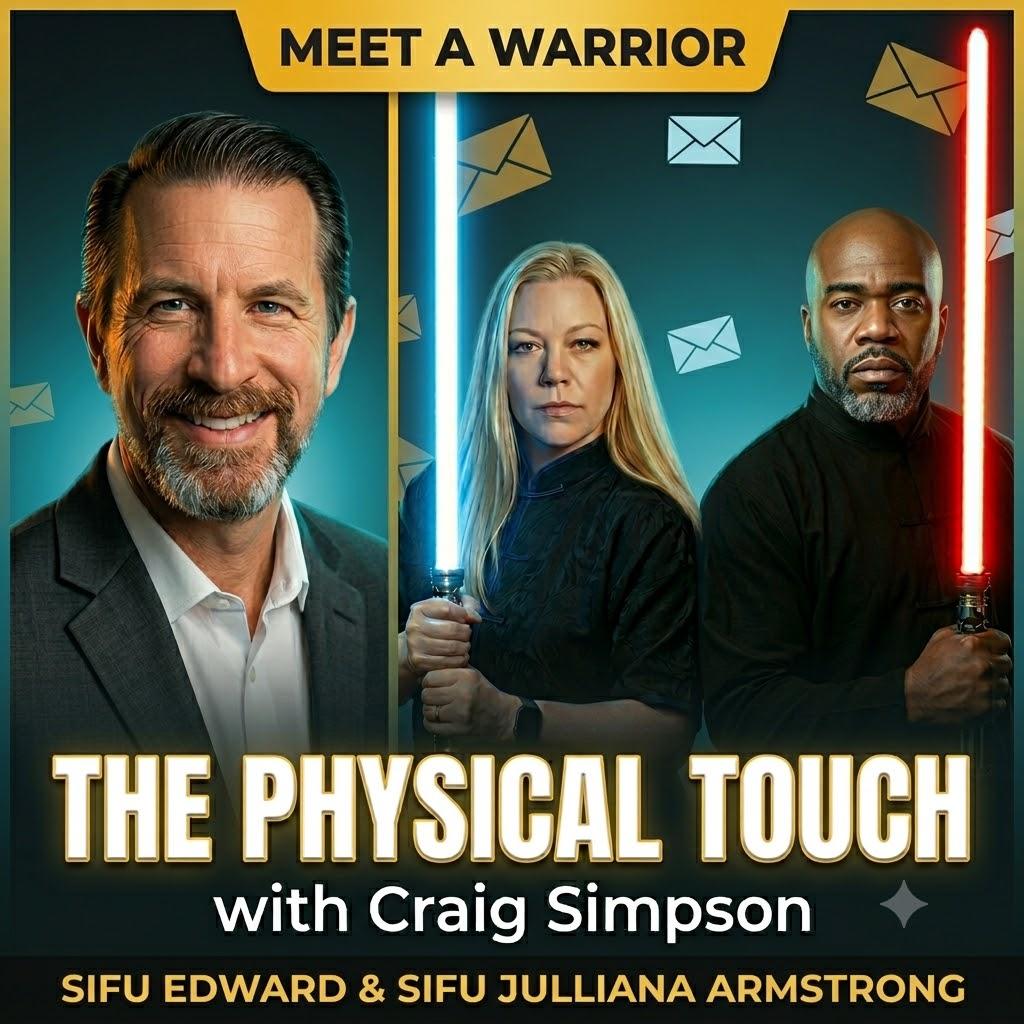
Adapted from the recorded conversation; the guest's words are verbatim. The questions are reconstructed and voiced by Sifu Edward and Sifu Julliana Armstrong.
🎥 Video podcast coming soon. The complete interview will play here once published. The full conversation is transcribed below, and the audio edition will be available on sifuarmstrong.tv.
In a new Sifu Armstrong interview, a marketer who has sent over 300 million pieces of mail makes the case that the most expensive channel often buys the most loyal customer.
Craig Simpson didn’t start in an office. He started building fake rock-climbing holds in his backyard because he couldn’t afford the real ones. That origin story, and the direct-mail career it launched, brought him to Sifu Edward and Sifu Julliana Armstrong for the latest Warrior Intelligence Series conversation.
Simpson, a direct marketing expert trained alongside Bill Glazer and Dan Kennedy, and sender of more than 300 million pieces of mail, opened with the flop that started everything. “My first mailing was a complete bomb. I got zero calls, zero orders,” he said. He kept adjusting until those homemade rocks sold in the thousands, and the lesson became the foundation of his whole career: test, fail, tweak, repeat.
What makes direct mail work, in Simpson’s telling, is the one thing digital channels can’t replicate. “It’s the one media where the prospect has a physical thing in their hand that they’re forced to do something with,” he said, unlike an email or an ad, which can vanish with the tap of a button. That physical friction costs more to create, and Simpson doesn’t pretend otherwise: postage, printing, and lists all add up, which is why he insists operators go all in rather than test halfheartedly. “You’ve got to be all in with it,” he said. “You’ve really got to make sure your I’s are dotted and your T’s are crossed.”
The payoff, he argues, shows up downstream. In a study comparing 150,000 buyers who purchased the same product through TV, online, and direct mail, Simpson found the mail-acquired customers were worth roughly four times as much over 18 months as the online buyers. “Direct mail brings in the customers that have the highest customer lifetime value,” he said, a finding he sees repeated “over and over again.”
Simpson’s core-response demographic still skews 40 to 75, though he notes younger buyers are starting to respond well precisely because mail feels unusual to them now. His advice to anyone starting a first campaign: begin with a proven offer, find the list of people most likely to want it, and don’t assume the cheapest channel is the smartest one.
He’s also candid about scale and craft. Some campaigns run as small as 250 pieces, others in the hundreds of thousands, printed and stuffed by outside facilities rather than by hand. And length isn’t fixed by any formula. He’s written 80-page consumer letters for a $1,500 solar generator, but keeps business-to-business mail to a page or two, because those readers are busy and just need a reason to ask for more information.
The through-line of the conversation (that the harder, costlier path to a customer tends to produce the more committed one) is a principle the Armstrongs recognize from their own world. The warriors who go the distance rarely walk in through the easiest door; they’re the ones who had to work a little to get there in the first place.
In This Conversation
- The backyard climbing wall and the mailing that bombed
- What direct marketing actually is, and why it forces a response
- The cost of mail versus the competition-free mailbox
- A 150,000-buyer study: direct mail’s 4x customer lifetime value
- Who responds best, and why younger buyers are starting to, too
- Building an omnichannel campaign around the physical piece
The Full Conversation
Sifu Edward Armstrong: A lot of operators chase the cheapest, fastest way to reach people, and wonder why the people they reach never commit. The dojo owners and gym builders I most want to reach for our Academy Commander ranks don't live in a Facebook feed; they live in the real world, behind a counter, with a mailbox. So when I found a man who has sent over 300 million pieces of physical mail and studied exactly what makes someone act, I knew our operators needed his playbook.
Sifu Julliana Armstrong: And what won me over is how he started. He built a climbing wall in his own backyard and made the holds by hand because he couldn't afford to buy them. That's a warrior's origin. No money, no permission, just grit and relentless testing until it worked. The man understands the physical world, and on the mat we know nothing replaces the physical.
Our guest is Craig Simpson, a direct marketing expert trained alongside legends like Bill Glazer and Dan Kennedy, who has now sent over 300 million pieces of direct mail and analysed exactly what works and what doesn't. Craig, it's lovely to meet you.
Craig Simpson: Thank you. I'm glad to be with you and chat with you today.
Sifu Julliana Armstrong: I have to start with the fake rocks, because it's the most warrior thing I've heard all week. You wanted something, couldn't buy it, so you built it. Take us back to how you got started.
Craig Simpson: Yeah. So, I got started in direct mail marketing in a really unique way. The first thing I actually sold through the mail was fake rock climbing holds. I had built this climbing wall in my backyard and I wanted to bolt on these holds, but I didn't have any money for them. And so, I ended up making these fake rock climbing holds on my own. And everyone loved them. They said, "You should start selling them."
So, I did my first mail campaign, which was a complete flop. Nobody responded. But I kept trying and testing. And I eventually sold over 4,000 rocks, fake rocks, through the mail, for the rock climbing industry. And that got my start into direct mail marketing.
I was just out of high school. I was only 19 years old. I think I was working at a gas station, or something, on the side. And I was an entrepreneur. I got started real early, and it turned into a full business. And it led me into direct mail marketing for a big publishing industry and everything else. But that was my start, selling fake rocks through the mail.
My first mailing was a complete bomb. I got zero calls, zero orders. But I learned some things, and I tweaked and I changed. And eventually, obviously, became a success because I sold thousands of them. But there was a lot that I learned in every campaign, and I didn't know anything. I just knew back then that I had heard direct mail worked, and so I just had to start tweaking and testing things until I found something that worked well.
Sifu Julliana Armstrong: "A complete bomb… but I learned, I tweaked, I changed." That's a kata. You don't land the form the first time. You run it, fail, adjust, run it again. For anyone who's never heard the term, explain what direct marketing actually is and why it's such a powerful way to drive people to take action.
Craig Simpson: Sure. So, direct marketing is basically sending out an advertising message to somebody and then asking them to respond. And when they respond, that's kind of that engagement. There's a lot of marketing, say, like a billboard, where it's just promoting something. And you look at the billboard, you remember the name on the billboard, but it's not asking you to take the next step.
Direct marketing, we're asking the prospects to do something, to call, to go online, to make some kind of commitment by responding. And that's what we consider direct marketing.
It is one of the best ways to get traffic to a website. So, what I specialise in is direct mail, direct marketing, and that's sending things through the physical mailbox. And what I love about it, it's the one media where the prospect has a physical thing in their hand that they're forced to do something with.
So, we show up in their mailbox and they take it to their counter or their coffee table or their desk, and they have to decide whether to keep it, read it, toss it, whatever they want to do. But it forces them to make a decision. Whereas with email or TV or radio, you can push a button and those ads disappear. They're gone instantly. It's easy to get rid of them. With the mail, they physically have to do something with it, and that's what I love about it.
So, when it comes to, hey, even though it's this physical piece, we can drive people to an online website to register for something, to go get more information. And it's a great tool for driving people online.
Sifu Julliana Armstrong: "A physical thing in their hand they're forced to do something with." That's the whole truth of our art. You can watch a thousand videos, but until a saber is actually in your grip, nothing happens. A lot of operators flinch at direct mail, though, because email feels free. Talk us through that. The cost, the barrier to entry, and whether the payoff is worth the effort.
Craig Simpson: Yeah. There is a cost to direct mail marketing. It's not something where you can just quickly test something and hope it works, because there's all this cost involved. I mean, there's postage and there's printing, and there's lists, and there's all these things that go into it.
So, you really have to strategize and come up with your best message, and solution, and offer you can, it's not something you just want to do halfway. You've got to be all in with it. You've really got to make sure your I's are dotted and your T's are crossed.
Let's think about this. So, if you were to take a step back and look at how many emails you receive every day, it may be a hundred. Some people, it may be more. Some people, it may be a little bit less, but that's a lot of emails to wade through every day.
With direct mail, think about how many personal letters you get in the mail every day. If you can make your letter or your piece look like an invitation or a letter, you don't make it look like a sales thing piece necessarily. If you have something that you can put in the mailbox that looks different, and we're only talking about a few pieces of mail in there. Maybe you have 10 other things in there, maybe it's five, you have a better opportunity to grab the prospect's attention.
There's less traffic around it, right? There's not as much business you're competing with because your mailbox is empty, and then you've got that whole physical touch thing again. So, it does take a lot more effort to get into the mail, but the response usually outweighs that, because you don't have the competition that you do, say, in the email inbox.
Sifu Edward Armstrong: "You've got to be all in with it." That's the only way we let anyone step on the mat, and the only way I'd let an operator run a campaign with the academy's name on it. Here's the objection I hear from every new Academy Commander, though: "I don't have a list." How do you reach the right people (say, the gym owners and school operators I'd want) when you're starting from zero?
Craig Simpson: Sure. Yeah. So if you don't have your own list, which a lot of businesses don't, there's a couple different ways, and it all depends on who you're marketing to. Let's say you have a joint cream that helps out with aches and pains in your joints, and you want to sell your product to consumers who buy that kind of thing. Well, there are list brokers out there who will help you find those lists, and then you're able to rent them. And then you can rent those names, basically physical names and addresses, that you can mail your offer to, promoting, say, joint cream.
And in that case, we'd want to find people who have bought similar products or services. Because if they've already bought something from someone else, there's a good chance that that's something they're interested in. It's a need or a desire. And so, if you make an offer to them, there's a chance that they may buy from you as well, because they've got this ache and pain they're trying to get rid of.
So, you can work with what's called a list broker. And basically, a list broker is a lot like a real estate broker. They can show you any list available on the market, just like a real estate broker can show you any house on the market. And then, if you choose to proceed with renting that list, or buying that house, those brokers facilitate the deal. Well, that's the way it works with list, is it's a very simple process.
One other way to find lists, if you don't want to go through a broker, is let's say you work in a very small field, a niche field. Let's say, you're only marketing to podiatrist. Well, you can go on the internet and you can find lists of podiatrists or you can find associations. You could call and see if you can rent their list. There's lots of different ways to find names of prospects to mail to.
And once you sell to them once, it doesn't stop, right? You should be making other products and services available to them. And once they've purchased from you, you've got your own list that you're working with, and you want to rework that list and use it over and over again to sell them other products and services.
Sifu Julliana Armstrong: Over 300 million pieces of mail, that number is staggering. Has it climbed even higher since? And please tell me you don't lick all those stamps yourself.
Craig Simpson: Oh yeah, of course. I send out hundreds of mailings every year, and the mailings can be as small as 250 pieces all the way up to hundreds of thousands of pieces.
Yes, I do. Yeah, I mean, work with, obviously, there's printers who will print the pieces for you. And there's mailing facilities that will insert those envelopes and seal them and stamp them and address them. And a lot of the stuff can be automated for you, if it's a bigger mailing. If you're only mailing a few hundred pieces, then sometimes it's worth just doing it all in-house.
Sifu Edward Armstrong: For the operator about to attempt their very first campaign. What's your advice as they start out?
Craig Simpson: Well, I think the thing is you want to, if possible, start with a proven offer, something that you've marketed before or tested somewhere. And you have some kind of proof of concept that what you're selling, that there is a market who wants to buy what you're selling. If you're going out to the marketplace with a brand-new product and nobody's bought it and you're not sure if it's going to work or not, that kind of thing could be really difficult to sell. Because you don't know, is it the direct mail that's going to work or not work? Or is it the offer?
So ideally, I like to start with something that's already proven. And then from there, you start finding out, okay, who are my most likely best customers? Who are the people who are most likely to buy your product? And you find those lists, and then you write a sales message that would motivate those people to purchase that product or service.
Sifu Edward Armstrong: Start with something proven. That's why we built the entire federation on the 9 Forms, a curriculum already tested on real warriors, before we ever scaled it. The other buzzword everyone's chasing is omnichannel. How does direct mail fit into that?
Craig Simpson: There's a lot of different ways that, I mean, so let me just take a step back on this. What I love to do, I mean, obviously the best type of marketing we can do is if we can hit customers in multiple media at a similar or same time.
So if I have my choice, I would love to be able to take a list of people and send a direct mail piece to them. And then, time it, around the time that mail piece arrives, I would love to send them a series of emails. And around the time those emails arrive, and the direct mail piece arrives, I would love to re-target them on Facebook, right?
I mean, around the same time, if I've got their phone numbers, I'd love to give them a phone call. I mean, the more we can do that's congruent with the same message, just different media, the more response you're going to get. Sometimes, not all those medias are available for the same people and you're not able to do them at the same time. But if possible, it's worth it.
Sifu Edward Armstrong: That's exactly how we think about the ecosystem, the same warrior message hitting through sifuarmstrong.news, sifuarmstrong.tv, the community, and yes, the mailbox. Now the question every operator counting pennies asks: cost-wise and performance-wise, how does direct mail compare to YouTube or Facebook?
Craig Simpson: Yeah. I think cost-wise, so here's what I found. Direct mail, out of all those media, is probably going to be the most expensive media. But what I've found is direct mail brings in the customers that have the highest customer lifetime value.
So, I've done a study where I took 150,000 buyers. 50,000 of them came in through direct mail, 50,000 came online, and 50,000 came through TV. They all bought the same product and service, and they all bought it over 18 months. So, everything is congruent across what they bought, when they bought. The only difference is how we marketed to them.
The TV buyers, the lifetime value was twice as high as the online buyers. And the direct mail buyers were twice as high as what the TV buyers were.
So for example, I can't remember the exact numbers here, but it was something like the online buyers had an average customer lifetime value of $250, and the TV buyers had an average lifetime value of 500, and the direct mail buyers had an average lifetime value of a thousand.
And so, I see that type of thing over and over again. So, yes, it costs more to go out and find these people. But in the end, they're a better customer and they spend more money.
Sifu Edward Armstrong: Four times the lifetime value from the harder, costlier channel.
Sifu Julliana Armstrong: That tracks with everything I know about commitment. The warrior who has to work to get through the door values what's on the other side. Which makes me curious about who responds, because people say the young have lost the art of the letter. What demographics give you the best response, Craig?
Craig Simpson: Yeah. I mean, my core type group of age group, that I like to go after, is 55 to 75. Really great response. But I also do well in the 40 to 55 market as well. So, I would say, anyone from 40 to 75 is a great market to go to.
However, more and more studies are coming out where marketing to the younger generation is actually working really well. And part of it is it's unique and different. It's something that they're not used to. And so, all the online media is just hitting them from all sides. And so, there are some companies that have had some great success mailing to those in their 20s and 30s using direct mail.
So, I think we'll see the tide turn here, and direct mail marketing will be used more and more, I think, to the younger generation.
Sifu Julliana Armstrong: Fifty-five to seventy-five being your strongest responders is music to us. That's exactly the Ageless Warrior we built the Dragon Cane path for, and reaching them where they actually are matters. Let me ask about the craft itself: with mail you can't ramble forever like an email. How do you handle length and copy?
Craig Simpson: It depends on the market. So, I've gone to consumers and I've mailed them an 80-page sales letter before, selling a solar generator. And it was a $1,500 item. Well, that's not exactly a short piece, right?
But sometimes, you have to create the case. Right now, I'm working on a sales letter with a copywriter for a financial offer. It's going to be 20 to 24 pages, because we have to tell a story. We have to agitate the pain, we have to provide a solution, we have to give the evidence that supports the solution, you know? It's going to be a longer piece.
Now, when I'm mailing to, say, dentist or to business owners, I keep it usually short. It's usually a one or two-page letter, because I've got to be to the point. They're busy, and I'm just trying to get them to respond for more information.
So in the business to business sector, I'll do one or two pages with the goal of just getting them to request free information. In the consumer market, I can usually directly sell a product, if the product is less than a hundred dollars. I can write a longer sales letter and I can get them to route two, purchase the product, call up on the phone, or go online, pull out a credit card, spend money and get them to buy. But those letters are a little bit longer.
And there's not necessarily a formula. Every niche and offer is a little bit different, so there's not like a exact formula we can use that's going to work for everything. It's got to be tweaked a little bit based on what it is you're selling, what your goal is.
If a client comes to me and they have a $500 product for consumers, and they say, "This is what I want to sell," that path is going to be a little bit different than the guy who's got a $37 product that they want to sell. The more expensive it is, we have to take a little bit different approach. And a lot of times, that approach for something like, say, $500 is we've got to get a step in between when they purchase and just getting them to respond, because we've got to develop the relationship before they're willing to spend that kind of money.
Sifu Edward Armstrong: "Develop the relationship before they're willing to spend that kind of money." That's the whole arc of turning a curious visitor into a committed warrior. You don't just teach this, you train others in it. Tell us about your services and where people can find them.
Craig Simpson: Yes. Thank you for asking. So people go to my website and I've got all sorts of blog posts on there with, I don't know, probably a hundred different articles on direct mail marketing. And it's at my website, which is simpson-direct.com.
So, there's great education at simpson-direct.com. I also have a course on there, which is basically the A to Z on how to put together a direct mail campaign. And then, there's also a contact form. If someone has questions, or wants coaching, or wants me to manage their campaigns, they can reach out to me and I can help with all those things.
Sifu Edward Armstrong: It's been a fascinating conversation. Thank you so much for taking us into your world, Craig. We really appreciate it.
Craig Simpson: All right. Thank you.
Sifu Julliana's closing word: I keep coming back to the kid who built a climbing wall and carved the holds by hand because he had no money, and whose first mailing was a total bomb. He didn't quit; he tweaked and ran it again until 4,000 rocks went out the door. That's the only way anyone ever masters anything, on the mat or in the mailbox: fail, adjust, repeat. And the lesson that the people who work hardest to reach you become your most loyal? Every warrior who's ever earned their place already knows it in their body.
Sifu Edward's closing word: Craig confirmed something I've staked the federation on: the warriors who commit the deepest rarely arrive through the cheapest door. A physical thing in the hand, a real relationship built before the ask, a message that respects the person enough to be all-in. That's how you reach the operators and the Ageless Warriors who'll actually go the distance with you. Don't always chase the free click. Sometimes the costliest path delivers the most committed warrior. We don't entertain warriors. We create them.
Craig Simpson, direct marketing expert trained alongside Bill Glazer and Dan Kennedy; sender of 300+ million pieces of direct mail. Education, courses, and campaign management at simpson-direct.com.
ILLUSTRATIVE RESULTS. Any revenue, enrollment, margin or retention figure in this conversation is either a documented result from one of our own operations, a figure the guest reports about their own business, or an illustrative example, never a projection of your results.
Nothing here is financial, legal or tax advice.
Stay in the Fight
This conversation is part of the Sifu Armstrong Warrior Intelligence Series: interviews with world-class performers, builders, and thinkers, filtered through the lens of the warrior's path.
Subscribe at sifuarmstrong.news for every new interview, delivered to you.
Join Club Sabernet, the member community of the whole Sifu Armstrong ecosystem, where warriors train, connect, and hold each other to the standard.
Ready to build your own floor? Find your path at sifuarmstrong.com/which-path.