Make It Happen: Sifu Edward & Sifu Julliana Armstrong Sit Down With Internet Business School's Simon Coulson
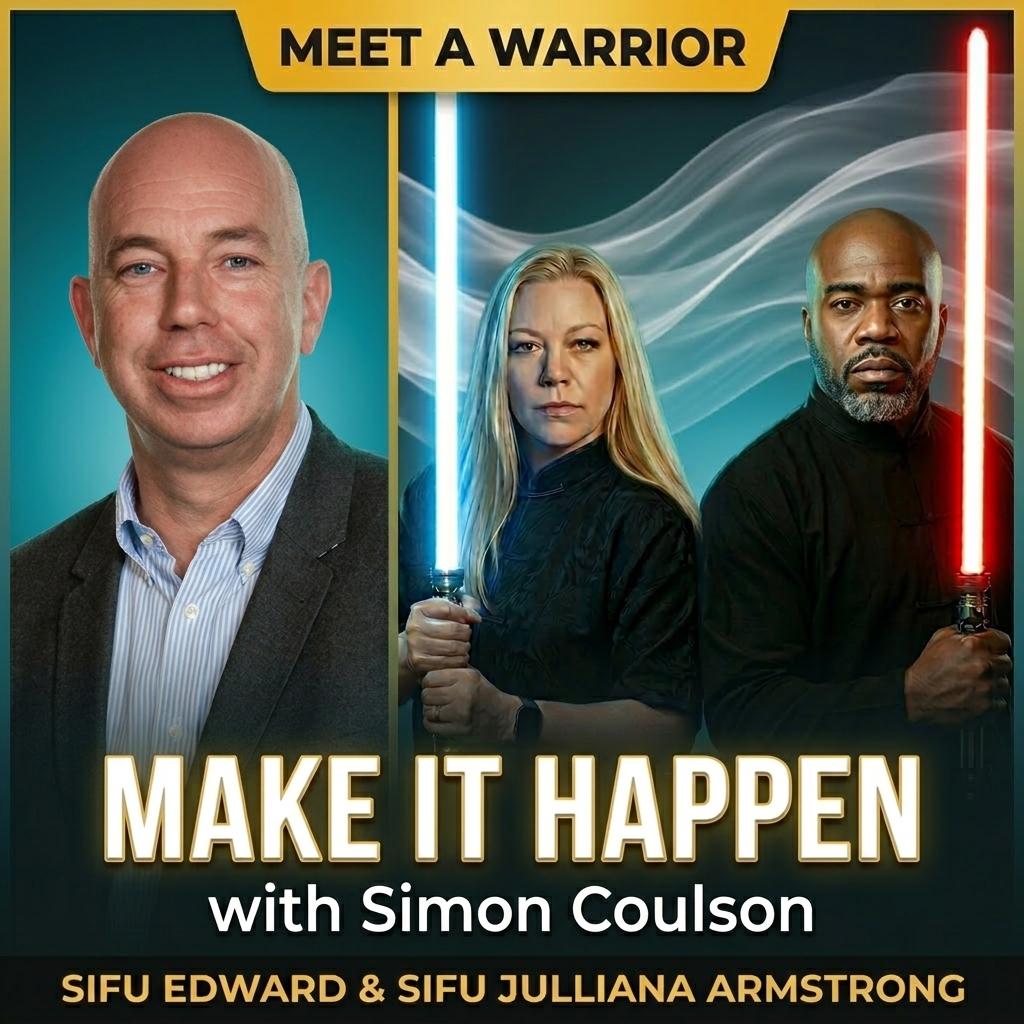
Adapted from the recorded conversation; the guest's words are verbatim. The questions are reconstructed and voiced by Sifu Edward and Sifu Julliana Armstrong.
🎥 Video podcast coming soon. The complete interview will play here once published. The full conversation is transcribed below, and the audio edition will be available on sifuarmstrong.tv.
In a new Sifu Armstrong interview, a UK entrepreneur traces how physical exhaustion, a Coldplay tribute band, and a repeatable formula added up to more than five seven-figure businesses.
Simon Coulson’s turning point didn’t arrive as a business decision. It arrived as his body shutting down on a train station escalator. He joined Sifu Edward and Sifu Julliana Armstrong for the latest Warrior Intelligence Series conversation to describe the collapse that ended his corporate career.
Coulson, founder of Internet Business School and The Songwriting Academy, and builder of five separate seven-figure businesses totaling more than £30 million in sales was commuting four hours a day when he blacked out and woke up on the floor at King’s Cross. Doctors called it exhaustion. “I’m 32 years old and I’m burnt out effectively,” he remembers thinking. “This isn’t for me. This clearly is not going to last.”
Around the same time, his pub covers band rebranded itself as a Coldplay tribute act (“Coolplay”), and the name change alone reshaped the economics overnight. That rebrand became his first real lesson in positioning, before he’d even left his job.
The business that followed started small and honest. Coulson wrote an information guide about buying property in Bulgaria (a country he’d invested in but, by his own account, never actually visited) built entirely from research anyone could do for free online. What he was really selling, he realized, was time. Customers, he said, “could give me £20 pounds and save 100 hours at their life, going looking for all that information”: proof, in his words, that “they were buying the time saving as much as the information in it itself.” He repeated the formula 34 times across different countries, then taught it to friends, a firefighter bandmate, and eventually thousands of students through Internet Business School.
Coulson hit his own long-stated goal of retiring at 50, and now spends much of his time writing and recording music instead of running his companies day to day. Reflecting on the farmhouse he once bought as a near-ruin, restored, and eventually sold off, he offered the line that stayed with the Armstrongs most: “I look at life as chapters.” He described pouring himself fully into each season of a project or business, and then, without regret, letting it become the next one.
That formula eventually grew into an information-publishing empire covering everything from business-startup guides to career guides to a franchise-review membership site, and Coulson traveled internationally: Sydney, Malaysia, South Africa, the U.S., to speak and train on internet marketing, even while keeping the bulk of his customer base in the UK and pricing in pounds rather than following the industry’s dollar-first instinct.
The Armstrongs saw in Coulson’s path a version of a decision they’d made themselves: walking away from a system that was quietly costing too much, then building something of their own, one repeatable formula at a time.
In This Conversation
- Collapsing from exhaustion on the King’s Cross escalator at 32
- The Coldplay tribute band rebrand that 20x’d the income overnight
- Selling time, not just information: the Bulgaria property guide
- Teaching the same formula to friends, family, and a firefighter bandmate
- Five seven-figure businesses and retiring, on schedule, at 50
- “I look at life as chapters”: restoring, and letting go of, a farmhouse
The Full Conversation
Sifu Edward Armstrong: The single most important decision I ever made was walking away from a system that was quietly killing me, leaving a franchise with my name on someone else's door to build my own. When I found a man who literally collapsed from exhaustion on his commute, walked away from a fourteen-year corporate career, and turned one repeatable formula into five seven-figure businesses, I knew our operators had to hear how he did it.
Sifu Julliana Armstrong: And he did it while fronting a Coldplay tribute band and eventually performing his own song on the stage of the O2 Arena. That's a performer's heart, and I wanted to talk to the part of him that had to stand up under those lights and deliver.
Our guest is Simon Coulson, one of the UK's most successful online entrepreneurs, founder of Internet Business School, and the man behind more than £30 million in sales across five separate seven-figure businesses. Simon, great to connect.
Simon Coulson: Great to be here.
Sifu Edward Armstrong: I know something about the moment you decide the ladder isn't worth the climb. For you, stepping away from the corporate world must have been terrifying, and I understand your body actually forced the decision.
Simon Coulson: Yeah, it was. But everybody at the time thought I was a bit mad, but the background to it was I'd been working in Central London. I lived in Kent, and I'd been working there for 14 years, as you said, and it was a two-hour commute, door to door, just to get to work, and a two-hour commute home. So I was travelling for four hours a day, and there was overtime available, so I'd been working extra hours. Things came to a head one day when I was actually travelling home from work at King's Cross Station. I remember getting on the escalator, and then the next thing I remember I was standing on the escalator, then I remember just waking up and I was lying on the floor at the bottom of the escalator with what felt like 100s people stepping over me. And eventually, one of them was kind enough to lean down and say, "You all right, mate?" I just about managed to go, "No."
I was just trying to work out what the hell I was doing, how I was there. I was thinking, have I had a heart attack? Have I been mugged? Have I had a stroke? What's happening? So it was all very dramatic. They called me an ambulance, they put an ECG on me, and everything, and found everything was fine. No one had mugged me. They just concluded that I was suffering from exhaustion, and my body had just shut down, you've just been doing too much. So the diagnosis was go see your doctor tomorrow, in the days when you could still see a doctor and get signed off for a week. Basically just do a week of complete rest and let your body recharge, because it's just telling me you're overdoing it.
And that was a massive turning point for me because it just meant, I thought, hold on a minute. I'm 32 years old and I'm burnt out effectively. Retirement age is 67, so I've got 35 years to go, and I'm burnt out after 14. This isn't for me. This clearly is not going to last. So I started weighing up my options and thinking about what else I could do. And a couple of fortuitous things happened really around the same time as well. Ironically, one was BT announced a redundancy scheme and said they were looking for volunteers to go. So I'd get a few months' money if I volunteered to go, which I thought would give me a buffer to find my way doing something else.
And the other thing that happened was I'd been playing in a pub covers band for years, and we'd recently just changed that band to be a Coldplay tribute band, because Coldplay were just coming to the fore and being very popular. We were doing a couple of Coldplay songs in a set and I just had this crazy idea on the way back from a Coldplay gig at Brighton Centre. I said, "Why don't we just become a Coldplay tribute band rather than just being another pub covers function band?" And the guys went with the idea. So it was really the first listening business of rebranding, which was change the name of the band to something close to Coldplay, which we settled on Coolplay.
Sifu Edward Armstrong: Stop there, because that's a positioning lesson our whole federation is built on.
Simon Coulson: And basically, we'd started doing gigs as a Coldplay tribute band and found that just that rebranded exercise had actually given us a 20 fold increase in income, because we used to go out for 100 quid a gig, and suddenly we could earn £2,000 a gig. So all these things happened at once. It's like, well, hold on. I've got this other little job here on a Friday and Saturday night with a band where I can get 500 quid each, a gig, so do that two nights a week, that's a grand a week. That's more than BT are paying me anyway. And if I volunteer to go from BT now they're going to give me a few grand to leave, and I can't keep doing this BT thing anyway because it's killing me, so let's just take this leap of faith.
So I literally left, didn't have a clue what I was going to do. I actually remember on my last day of employment, on the way home I popped into a news agents and they had a book on one of those little revolving things by the checkout, and it was called The Beermat Entrepreneur. I thought, I better buy this. I better start figuring out what I'm going to do, because I had this vague idea that I might start my own business. So the plan was look for a local job, start my own business, and in the meantime the music will keep me going. So that was how it all started really.
Sifu Julliana Armstrong: I have to ask the most important question of the interview: in Coolplay, what do you play?
Simon Coulson: I am Chris Martin, so I did the piano and all the singing.
Sifu Julliana Armstrong: That doesn't surprise me at all, and I love that your first instinct as a band was the rebrand, not the talent. Where did the name land?
Simon Coulson: Slightly larger. In fact, when we started the band, because we were a little bit older than them, we were bouncing around ideas and my original suggestion was Old Play, but we thought that that'd be selling ourselves short and probably wouldn't get many gigs booked, so we settled for Coolplay.
Sifu Edward Armstrong: So you left, you read the book, and then you found a seminar that promised to make you a millionaire in a day. What happened, and would you call it the turning point?
Simon Coulson: Oh, very quickly. Within a couple of days I'd read that, and that got me thinking a little bit. Then what happened next was I saw an advert for a seminar which claimed to teach you, in one day, how to become a millionaire. And the thing that caught my eye was there was a guarantee, and it said, "If by lunchtime you don't believe that you can become a millionaire by completing this training, you can leave for a full refund." So I thought, well, it's a pretty bold guarantee. So I must admit, I booked a ticket to this one day workshop, and when I went in with the mindset of, I am going home at lunchtime. I've just come here to see what's going on, but I'm sure you can't become a millionaire, and you can't learn how to do it in a day, so I will be going home at lunchtime.
But the guy running the workshop did something very smart. Firstly, in the morning he told us all about the business model, and it all made sense. It seemed very plausible. But then, just before lunch, he passed round his bank statement for that week showing that he had over £1 million in his current bank account. And it's like, wow. This is social proof if ever you needed it. And it was perhaps more valid for me than other people, because for two reasons, one is I'd actually left school at 16 and gone to work at a bank. I worked at Lloyd's Bank in Woolage for a couple of months before I decided that it was very boring, and I was going back to school to do some A-levels.
But when I was at the bank, in those days all the statements for the business accounts actually used to be distributed by the branch. So they would come to the branch and then we would've to post them out from the branch. So I had seen literally thousands and thousands of business bank statements. I was firstly amazed when I worked at a bank that most of them started with a minus number, and it amazed me how many businesses actually are running in overdraft, for cash flow reasons. And none of them had anything like more than, I think, the biggest bank statement I've ever seen for a business was 150 grand or something. It was a positive balance. So seeing someone who was a solo entrepreneur, with over a million quid, really got my attention. And at that point, when he passed that around, I'm like, I'm going to stay for the whole day.
So the workshop was all about information products. The guy had actually made a fortune from selling educational, in those days, mostly DVDs and cd roms. And I think, possibly when he got started, audio cassettes, which ironically are coming back again now, aren't they? But he seemed to have done really well with that. And I think the key takeaways were here are products that you can sell that have pretty much got a 99% profit margin. To duplicate a DVD would cost about £1, but you could sell it for £100 a disc. You could sell a set of 10 DVDs on some topic. He was selling them for £995, so there's a 99% profit margin. I was just thinking, God, I've been working for this big company called BT that ran on a 4% gross profit margin, and by the time it netted down it was under 1%. It was the complete opposite of what I knew about a business. So I just thought, you know what? I'm going to have a go at one of these information products.
But what I didn't have was much capital to invest in purchasing. What this guy had done is he purchased resale rights, licences, to products that other people had already created. So I figured that what I'd do is I'll have a go creating my own information product from scratch. Rather than licence someone else's product I'll make one. So one of the things I've done with my redundancy money from BT was I'd bought a property, but unfortunately the only place in the world I could afford to buy a property was Bulgaria, because in those days you could buy a detached house in Bulgaria for under £5,000. So I bought this house in Bulgaria, and on a bit of a whim I just decided, well, it's about to join the European Union. Everyone's saying the property market's going to go up. Let's just write an information product all about investing in Bulgaria, because I was an expert, I'd bought one property. I'd actually bought one property, not even visiting the country. And actually, to this day, I've still never visited the country. So I've never even seen the house that I bought because it all became a bit irrelevant over the years.
But what I learned was, and even more so these days with AI and ChatGPT and things, but even then, pretty much any topic you want to know about, you can just use Google and find the answer. So that first information product, everything in it I found for free on the internet. Really all I was doing was repackaging information that was out there. And really what people were buying was the time saving, because I spent about 100 hours of research to put this thing together, which means that anybody else could have found exactly the same information for about 100 hours of research time, or they could give me £20 pounds and save 100 hours at their life, going looking for all that information. So really they were buying the time saving as much as the information in it itself.
Sifu Julliana Armstrong: When you released that first guide (the clunky website, the PayPal link) what were you actually expecting?
Simon Coulson: I really didn't know what it was going to do, and I didn't really know what I was doing. I mean, I look back at that first website and it was appalling. I made it myself in something called Microsoft Front Page, which was a bit like Word for websites in the early days. It was a very clunky webpage editor, and I didn't understand copywriting or anything, so there was no sexy sales copy. It was just like, would you like to buy a property in Bulgaria? I've got a guide that'll tell you how. Here's the content. Chapter 1 covers this. Chapter 2 covers that. Chapter 10 covers this. It's £19.95, click here to buy. And it was a link to my personal PayPal account, and that was it.
But I then tried a few things to get the website found, managed more by luck than judgement to get it on the first page of Google, and then suddenly it started working. And within a couple of days I was selling 20 copies of this guide a day for £19.95. So I basically had made this £400 a day cash machine at my first attempt, and that really set me off. It's like, right, this is great. Let's do another one. So then I very quickly created the Croatia Property Guide, and just rinse and repeat the same formula. And then did Slovenia, Slovakia, Romania, Turkey, Italy. Just basically did 34 of these property investment guides, just basically repeating the same formula. Just researching the hell out of everything there was to know about property investment in a country, making a guide on it, making a simple webpage, providing the webpage, on to the next one.
Sifu Edward Armstrong: That leap from one guide to an empire is the part I most want our operators to hear, because you didn't just scale yourself, you taught the formula to other people. Take us from there to five seven-figure businesses.
Simon Coulson: So basically what happened next was, so starting from that point I built an information publishing empire, I guess, if you like. And primarily, they were how to guides, so how to start a business, or obviously those ones, how to invest in property. So I did lots of business startup guides on how to start a cleaning business, a B&B, a coffee shop, a catering business.
So the next chunk of things actually, what I actually did was I looked around at people that I knew, friends, family, old work colleagues, and thought, okay, I've got a formula here of you can take knowledge about any subjects and I can turn it into money. I know how to make a simple website, get some traffic to the website. So who do I know that's got a skill that I can work with them, I can get them to brain dump all they know, make the product, I'll market it, and we'll share the profits. So the next few literally came from that. So I had a friend whose brother was an electrician, so we did guides on electrical rules and regulations. I had a friend who ran a cleaning business, so we did a guide on how to set up a cleaning business. I knew someone that opened a coffee shop, so we did a guide on how you open a coffee shop.
So basically leveraging that extended network of contacts was where those next ideas came from. And then I thought, okay. Then I ran out of friends, basically. So then it was a case of, okay, let's look at this from the other end of the spectrum. What is it that people are looking for that no one's done a guide on yet? So I started looking at popular topics. So I did something on speed dating, because there were a lot of interest in speed dating, and no one had really written a guide on hints and tips for top speed dating strategies. I did a thing on how to become a plumber, because I'd seen an article in the newspapers that we had a big shortage of plumbers in the U.K. So I thought, okay, there must be a demand for plumbing education if we've got a big shortage of plumbers, so let's make a guide on how to become a plumber.
So that's how the next few ones came along. Then actually the drummer in my band, a guy called Rick, he was a firefighter at the time. He saw that I was making loads of money from the internet and would be picking my brains in the band bus on the way to gigs. And he was asking about what I did. I said, look, just come around and I'll show you. So he came around. In half a day I just taught hin the basic business model, which was, okay, firstly, you need a topic, a subject. Well, you are a firefighter so let's start with that, how to be a firefighter. Then you need a simple website. I showed him how to make a simple website using this front page software. Gave me a copy of one of my websites as a starting point. And then you need some traffic, and I taught him some basic things about how I was getting traffic. And fair play to him, he went off and he made his first product how to become a firefighter.
That started selling well, so then he came back and said, "What do I do now?" I said, "Do the same as I did. Rinse and repeat." So then he did how to become a police officer, a paramedic, an airline pilot, a train driver. And I actually built that business with him. So we'd sell career guides in that business, and we're still doing that today. So we've got over a hundred different career guides. So they're all about getting a specific job rather than starting your own business, which is what a lot of my early ones were. This is more about how do you get employment in a certain vocation in life.
So that was one of the things that came along next. Then I started a membership site for reviews of business opportunities and franchises. So I realised that when I left BT some of my colleagues at BT left at the same time. They invested their money into business opportunities, into franchisees quite often, and sometimes it didn't work out well. Well, I thought wouldn't it be good if there was a place where you could go and read independent reviews and feedback of some of these business schemes before you invest in them? So I created a website called Business Opportunity Review, which is basically a membership site that had hundreds and hundreds of independent reviews from the public. A bit like, I guess, Trustpilot or Checkatrade, but for the franchise industry.
So that was the next business that came along. Then I got into selling physical products and started websites selling physical products that were being drop shipped as an affiliate. Then I started affiliate marketing, and then I created an online lottery business. Then I created a business, like a music training business, teaching people all about songwriting and music production and the music business. So yeah, that's it briefly, how I ended up where I'm now.
Sifu Julliana Armstrong: It sounds like you never stop, but you also told us you hit a life goal. What does the life look like now?
Simon Coulson: Well, I actually hit the big 50 two years ago, so my plan in life was always to retire at 50, which I've done. I mean, I like to be entrepreneur, I can't not do anything. All the businesses have got managers in, so I don't do anything day to day. I just need a little strategy call with each manager, each week, really. So pretty much my foot's off the gas now, and really the last couple of years I've just been making lots of music. I've written and recorded, well, recorded five albums, two of which are cover albums so I didn't write those, but the three original albums and two cover albums. I've just been having lots of fun, making lots of music for the last couple of years, and doing a bit of property investment development as well, with the fruits from the internet businesses.
Sifu Julliana Armstrong: I heard a rumour I have to confirm, that you bought the actual farm from the TV show The Darling Buds of May. Is that true?
Simon Coulson: That's right, yeah. So that is funny. So I lived not far from there. I always loved that TV show when it came on TV, and I ended up, when I became successful in 2007, I think it was, I actually bought a barn conversion about two miles away from the farm where they filmed the TV show, Darling Buds of May. It's a lovely house in the Kent countryside. And I didn't know until I moved down there, but there was every year, the farm actually opened for one day a year for a classic car show. And that had been happening since the TV series was on in the early 90s, and the car show got bigger and bigger.
So I went along to this car show one year and it was a great day out, but I was really saddened by the state of the farm, literally the main farmhouse, all the windows were rotting, hadn't been painted for, I don't know, 20 or 30 years. The little place to fall was just falling down, and all the outbuildings were dilapidated and collapsing. I remember consciously saying to myself as I was walking around there, if this place ever comes up for sale I'm so going to buy it. Anyway, wind the clock forward a few years, about five years, and low and behold, I'm watching the news, local TV news, and it comes up on the news, "The farm used for the Darling Buds of May TV show is on the market." I'm like, oh my God, I've got to have it.
So I went along and viewed it, and of course it had got even worse because another five years had gone by and it had just got even more dilapidated. It was the middle of winter, so it wasn't a great time to go and see it. But literally all the grounds were flooded. In fact, there was basically an old farmhouse then and some old barns. One of the barns was literally a few 100 years old, just had a mud floor, and that was falling down. There was an oast house, but the ground floor was about six inches underwater because there was a crack in the back wall and the garden was all water logged. Basically water was just flowing in the crack in the back wall and flowing out the front door into the stable yard. So it was a real state, but nevertheless I put a bid in and was the successful bidder on it.
So suddenly I've bought a farm with the intention of developing it and restoring the buildings, but never having done property development before. So what a place to start developing a whole farm at once, which is a very nice project. So that was great fun. So I bought that, set about getting planning permission to convert the buildings initially to holiday let, so my plan was to actually run it as a holiday centre. And then there was a barn that I used as a training room, and actually did training courses down there for my internet business, school business, and my songwriting academy business.
Then as I got all the building converted I licenced it for a wedding venue as well, and ran it as a wedding venue for a number of years. And ultimately wanted to develop it further and actually put in a purpose built training centre there and make it a management training centre where people could come down and do residential training courses. But unfortunately, the local council initially very supportive of that, and then did a complete about turn and said that they wouldn't support any further development in the countryside, which sits me with a little bit of a white elephant because the farm and all the cottages and everything were great made to September, but nobody wanted to go on holiday in the middle of the Kent countryside in the winter.
So almost to call their bluff, I said to the council, well, if you're not going to support me putting in anything that means there's an attraction to come here in the winter, like a training centre where people would come in the winter because it's a residential training venue, the alternative would be to make it separate residential houses. Would you support that? And they said, "Yes, we would." So I actually split it then into five separate houses, each with a pass a land, because the whole thing was set in 35 acres of grounds. And actually sold it off as five separate houses, which in some ways was a bit sad because it was a bit of a loss to Kent of a great tourist attraction. But I philosophically look at life as chapters, and it was a great almost 10 years of my life there, buying it as a wreck, restoring it, seeing lots of people have what hopefully was the happiest day of their life, getting married there. Lots of people having great holidays there. But unfortunately now it's separate residential houses, and I've moved off to another farm now.
Sifu Julliana Armstrong: "I look at life as chapters." That's the healthiest thing a competitor can learn. You pour everything into a season, you honour it, and then you let it become the next one.
Sifu Edward Armstrong: You're called one of the UK's most successful entrepreneurs, and interestingly, you built that mostly on a home market, and you price in pounds when the whole industry screams "charge in dollars." Talk about that choice.
Simon Coulson: To be honest, what I've sold is pretty much U.K., just in a professional capacity, as a speaker and a trainer on internet marketing. I've actually spoken at seminars and events in Sydney, in Malaysia, in South Africa, in America. So I've travelled internationally to speak and train about internet marketing, and my music academy business has got a fairly global customer base. But the other businesses, to be honest, pretty much 90% of the customers are U.K. So I've made the success pretty much with a U.K. customer base.
Yeah, well I guess there's a bit of a counter to that actually. Certainly if I'm in the U.K. and I'm looking at buying a product, if I see it's priced in Dollars I'm going to assume it's an American company and it might not apply as well. I think, for things, especially things like the career guides where it's How To Join The U.K. Police Force, if we priced it in dollars I think people would think, oh, is this how to get in the American Police Force? Is it relevant? So there's probably an element of it's worked in my favour, I guess. But flip side is probably true. I mean, a shopping cart now on an Internet Business School which sells a bit internationally, does clever dynamic stuff. So when you look at the page it'll price in your currency, based on your IP address, so it'll change the currency accordingly. So you can do clever things like that, I guess, to manage that.
Sifu Edward Armstrong: You mentioned Internet Business School, which came out of the same instinct that drives our Academy Commanders: people saw what you'd built and asked you to teach them. Tell us about it.
Simon Coulson: Yeah. So Internet Business School is my training company, which teaches internet marketing, which I set up after getting lots of people asking me to show them how to make money online, because I showed a few friends, like Rick, the fireman I mentioned earlier, how to make money online, and they started making money. So then it spiralled that lots of people that I hadn't spoken to since I left school suddenly came out of the woodwork and were going, "Could you teach me? Could you teach me?" So I set up Internet Business School to share what I was figuring out for myself really, and learning about internet marketing, with other people. Then after getting asked to speak at a few seminars, it seemed that the logical thing to have a training brand, that there was something I could sell when I got a speaking gig about being an entrepreneur, an online business. Obviously, there was a central call to action there saying, "If you want to learn more, check out internetbusinessschool.com." We've got about 50 different courses there on digital marketing, every aspect of digital marketing really.
Sifu Julliana Armstrong: Now the story I most want to hear. You're known for stage presence, and your debut of an original song was at one of London's biggest venues. How on earth did that happen?
Simon Coulson: Yeah. So I'd been asked to speak at a entrepreneur seminar, which was happening at the London O2 Arena. So I'd done a couple of big ones before that. I've done Brighton Centre in Borehamwood. So I've done a audience of 3,500 and 4,000, but it was another step up. But I was like, yeah, okay. Yeah, I can do that. So I was all prepared for that, and then I just thought, this just feels like a golden opportunity. Every band's dream is to play the London O2 Arena. So I said to the organiser of the event, "Is there any chance that I could perhaps do a song in the middle of my speech?" He was like, "What are you talking about? This is a business conference." I'm like, "Yeah, but I think it'll be different. It'd be a bit of a pattern interrupted. It'd just be interesting and be memorable." And he was like, "No."
I said, well, what if I paid for whatever it costs for extra technicians, sound engineers, whatever? The kit, I've got the kit, we can get all the kit provided. Couldn't we do it then? So I tried taking away any reason why we could say no, and eventually, reluctantly, he said, "Oh, all right then." So he agreed, and then we're, okay, well, the obvious thing to do actually would be a Coldplay cover, because we're a Coldplay tribute band because I didn't have any original songs at this point. But we then started looking into it because the event was being filmed and then going to be sold on DVD, the sum of money was pretty astronomical, like north of £100,000 to licence one Coldplay song to perform at this event. So it's like, okay, that's not going to fly. Let's try another band then.
So let's try something else. And we tried a Take That song, and that has got five separate artists, I think with five separate publishers. So we never even got a price in time as the event was looming. So it's like, Christ, the only way around this, I've got him to agree that I can perform, but I haven't got a blimming song. I'm going to have to write one. So I wrote a song called Make It Happen, which was a autobiographical song about turn your dreams into action. Just like me you can make it happen. All about that moment of my dream was playing the O2 Arena, and here I am on stage singing you this song about making it happen. So yeah, my first performance of the original song was on stage at the London O2 Arena, and it got a standing innovation, so it went down all right.
Sifu Julliana Armstrong: You wrote your own anthem because the licence was too expensive, and it got a standing ovation. That's the whole thing right there.
Sifu Edward Armstrong: For the aspiring songwriters and the aspiring entrepreneurs reading this. Where should they go to find you and your work?
Simon Coulson: Sure. So the songwriting side is thesongwritingacademy.co.uk. You can learn all about us there. Internet Business school is just internetbusinessschool.com, and that's the training company that I've got. And I've got a personal site, simoncoulson.com, S-I-M-O-N-C-O-U-L-S-O-N.com. And if anybody fancies watching the video of that infamous O2 performance, if you just put my name, Simon Coulson and O2 into YouTube, you'll find a video of that performance at the O2 Arena, of that song, which will be quite entertaining, I'm sure.
Sifu Edward Armstrong: Simon, it's been a genuine pleasure, an incredible story, and congratulations on every bit of it. Long may it continue, even in semi-retirement.
Simon Coulson: No probs. Great. Talk to you soon. Cheers. Bye-Bye.
Sifu Julliana's closing word: Two things from Simon will stay with me. "I look at life as chapters," the grace to pour everything into a season and then let it go. And the O2 story: the licence was too expensive, so he wrote his own anthem and brought the house down. That's what you do when the door's locked. You don't borrow someone else's song. You write your own.
Sifu Edward's closing word: Simon collapsed on an escalator at thirty-two and used it as the exit door, the same way leaving the franchise became the start of everything for me. Then he found one repeatable formula and, crucially, taught it to a firefighter in his band. That's the Academy Commander model in a nutshell: master a system, then transmit it. Every operator's first product is a rotting farmhouse. You buy the wreck, and you restore it into something people build a life around. We don't entertain warriors. We create them.
Simon Coulson, founder of Internet Business School (internetbusinessschool.com) and The Songwriting Academy (thesongwritingacademy.co.uk); builder of five seven-figure online businesses and £30M+ in sales. Personal site: simoncoulson.com. Frontman of Coldplay tribute band Coolplay.
ILLUSTRATIVE RESULTS. Any revenue, enrollment, margin or retention figure in this conversation is either a documented result from one of our own operations, a figure the guest reports about their own business, or an illustrative example, never a projection of your results.
Nothing here is financial, legal or tax advice.
Stay in the Fight
This conversation is part of the Sifu Armstrong Warrior Intelligence Series: interviews with world-class performers, builders, and thinkers, filtered through the lens of the warrior's path.
Subscribe at sifuarmstrong.news for every new interview, delivered to you.
Join Club Sabernet, the member community of the whole Sifu Armstrong ecosystem, where warriors train, connect, and hold each other to the standard.
Ready to build your own floor? Find your path at sifuarmstrong.com/which-path.