Known vs. Iconic: Sifu Edward & Sifu Julliana Armstrong Sit Down With Icon Builder David T. Fagan
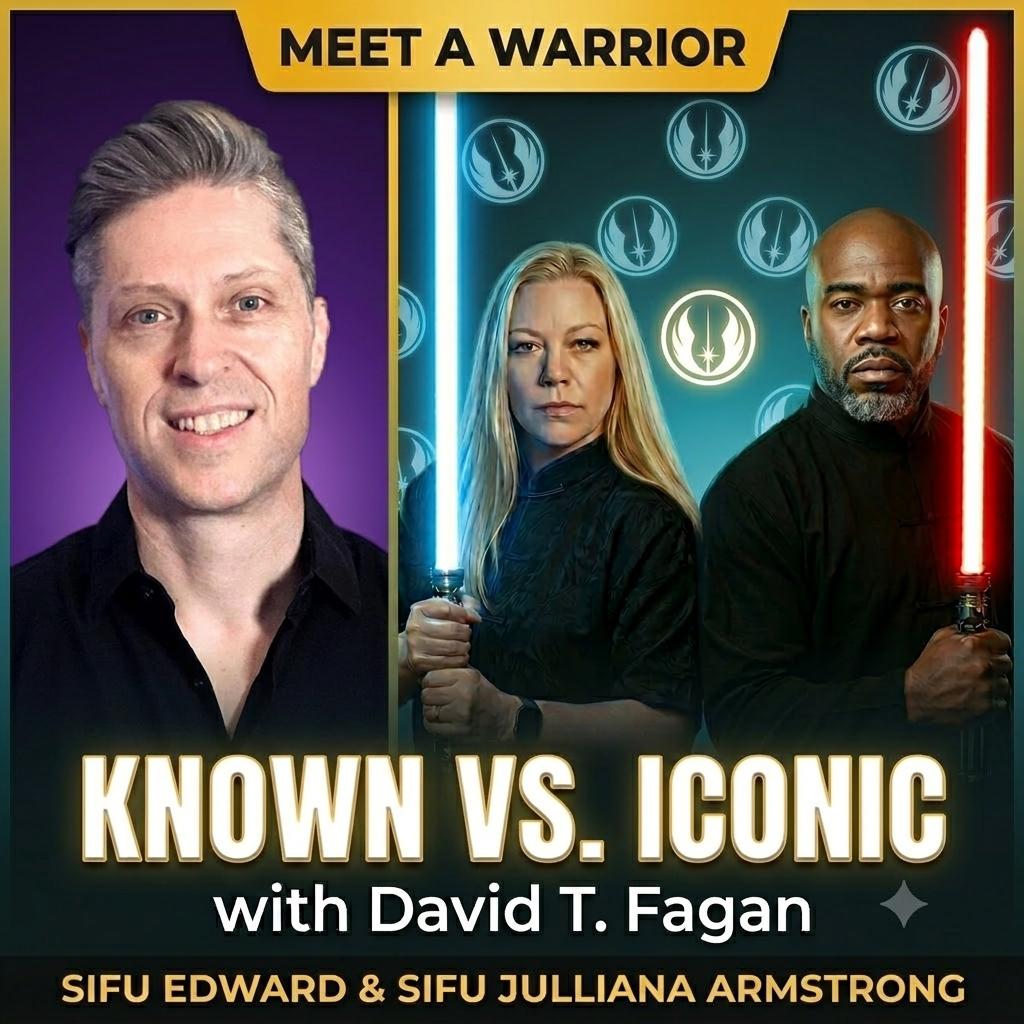
Adapted from the recorded conversation; the guest's words are verbatim. The questions are reconstructed and voiced by Sifu Edward and Sifu Julliana Armstrong.
🎥 Video podcast coming soon. The complete interview will play here once published. The full conversation is transcribed below, and the audio edition will be available on sifuarmstrong.tv.
In a new Sifu Armstrong interview, the former CEO of Gorilla Marketing explains why being good is never enough, and why intention, not accident, builds an icon.
David T. Fagan spent two decades in mortgage banking answering one silent question every prospect asks. “Why you?” before he built an entire career teaching others to answer it. The founder of the Icon Builder and former CEO of Gorilla Marketing joined Sifu Edward and Sifu Julliana Armstrong for the latest Warrior Intelligence Series conversation on sifuarmstrong.news.
Fagan calls the belief that good work alone gets noticed the “Humility Myth,” the idea that if you’re simply decent and skilled, recognition will arrive on its own. It won’t, he argues. “We could not be the world’s best kept secret,” Fagan said, describing the moment he realized that authority has to be built on purpose, not left to chance.
That realization came out of necessity. Looking young and lacking a college degree while overseeing nine bank branches, Fagan had to learn how to “attract and enroll” people who might otherwise dismiss him. He watched reality television reshape culture in the mid-2000s and noticed people were drawn to real, flawed individuals rather than faceless companies, a shift he says can be built deliberately through books, speaking, media placements, awards, and testimonials, not left to accident.
Fagan is equally blunt about the resistance he still runs into. Many people, he said, are “culturally opposed” to putting themselves forward, fearing exposure the way Australians describe “tall poppy syndrome,” the impulse to cut down anyone who stands out. He’s made peace with that friction, pointing to examples like unconventional campaigns (his team once mailed watermelons with a sticker reading “for more green in your business”) as proof that standing out on purpose beats waiting to be discovered.
At the center of his advice is a simple audit: take inventory of real accomplishments (media features, testimonials, endorsements, a published book), because those become the answer to “why you?” instead of a vague hope. He measures success less by follower counts than by loyalty. “A fanatic is someone who can’t stop talking about you and won’t change the subject. We want those kinds of people,” Fagan said.
Fagan also cautioned against the flip side of the trend he helped popularize. “We’ve probably swung too far where influencers... have a lot of pull and power,” he said, describing a market correction toward questioning what expertise actually backs a following, separating people doing real, deep work from those simply repeating a formula they picked up secondhand.
His formula for building that following is deceptively simple: give, serve, and share. Helping people, consistently and visibly, is what turns an audience into fans, and eventually, he says, into the kind of recognized authority a business or an individual actually needs.
It’s a lesson that lines up with why the Armstrongs built Light Sword Training Academy the way they did: standing up and naming the standard is not vanity. It’s how the right people find the art worth finding.
In This Conversation
- The “Humility Myth,” why being good isn’t enough to be found
- Why the individual, not the company, earns trust in a post-reality-TV world
- Tall poppy syndrome and the resistance to standing out
- The watermelon campaign and the case for unconventional attention
- Turning real accomplishments into the answer to “why you?”
- Give, serve, share: Fagan’s formula for building fans, not just followers
The Full Conversation
Sifu Edward Armstrong: Martial arts culture taught me to bow my head. Keep quiet, let the work speak, never put yourself above the art. It's a beautiful code on the mat, and it nearly buried Light Sword Training Academy in the cradle. Because the truth is, the world doesn't beat a path to the best-kept secret. If light sword is ever going to stand on the World Games stage, somebody has to be willing to stand up and say this is the standard, this is the art, this is the name. There's a difference between being known and being iconic, and my guest today has built a career on that exact distinction.
Sifu Julliana Armstrong: And from my corner, stepping onto a world-level competition floor, you learn very fast that performance alone doesn't get you remembered. The way you carry the brand of who you are, your presence, the story behind you, matters. I've watched equally skilled competitors become household names in their sport while others remain invisible. That gap isn't talent. It's the work David does. This conversation is for every warrior who's too good to stay unknown.
I'm excited to welcome today's guest, David Fagan, the visionary behind the Icon Builder. As a former CEO of Gorilla Marketing, which sold over 23 million books worldwide, David has a storied history of elevating brands and individuals to iconic status. At the helm of the Icon Builder, he's now focused on crafting the image and market presence of tomorrow's leaders. David, welcome.
David T Fagan: Thank you. Thank you. That's a great introduction. I think I want you to do all my introductions moving forward here.
Sifu Edward Armstrong: When I walked away from the franchise I trained under and started building my own art from nothing, I genuinely believed that if I was simply good enough (disciplined enough, skilled enough, decent enough to my students), the recognition would just arrive. It didn't. I had to learn to answer the question every prospect was silently asking me. So take us back. Tell us a little about the journey that led you to create the Icon Builder.
David T Fagan: Oh, absolutely. For years, I was in a whole different industry, had a whole different life. I don't talk about it a lot because of trading brand confusion, but I very quickly realized the power of what is now referred to as authority marketing. 20 years ago, it was maybe just being called, being bold, maybe being a little egocentric, but I started to kind of form this belief that I called the Humility Myth, that a matter of fact, I included it in several of my books, including the book Cracking the Icon Code, and the Humility Myth is this idea that, if we're just a good person and we live a nice life and we treat people well, that everything's just going to work out and we're going to be successful. Well, that is the Humility Myth, and that is not necessarily the case, and it's a very fast way to have very skinny kids.
What I learned is we could not be the world's best kept secret and we did need to say, "Why us?" There is this question that everybody is asking themselves out there, either consciously or subconsciously, and it's, "Why should I hire you? Why should I work with you instead of somebody else or something else?" And so from that belief system came Icon Business Development, which became Icon Builder and Icon Builder Media and Cracking the Icon Code and Icon Bootcamp, and so on and so forth. So that's kind of how it all got started is just really learning the power behind different ways to put yourself out there and become somewhat of a celebrity expert.
Sifu Julliana Armstrong: "The Humility Myth." As someone who competes publicly (who walks out onto a floor where everyone is watching), I had to learn that confidence isn't arrogance. It's preparation made visible. And I had to get comfortable with the question "why you?" too, whether it's in front of judges or in front of a camera. Where did you come from before all of this, David? What's your background?
David T Fagan: So more than 20 years ago, I was in the mortgage business, the banking business, the real estate business, late nineties, early 2000s, right out of school there was a very big boom going on, one of the first booms in my lifetime, if you will. And so I was involved in that quite a bit. I oversaw nine different bank branches before too long as it pertained to real estate and lending. And so I was very much required to speak, to train, to attract referral partners, people that would refer business in the real estate industry and other industries.
And I realized that I looked very young. I probably still look kind of young, but I mean back then I looked like I was 13 years old. I did not have a college education. So I realized early on like, "How do I get these people to listen to me? What does it take to get somebody to not just persuade, but attract and enroll?" And so I had to get clever at how to quote certain kinds of people and how to read certain kinds of things and earn certain types of accomplishments, to ultimately impact, persuade, influence, have credibility, get exposure, these types of things.
Sifu Edward Armstrong: That word "enroll" is the one I keep coming back to. On the mat, anybody can teach a technique, but getting a person to commit to the warrior's path, to walk in the door and stay, that's the real art. It's also exactly the challenge I put in front of every Academy Commander we license: don't just be competent, become the one people in your town can't ignore. So speak to that directly. How would you encourage somebody to become an icon?
David T Fagan: Well, back in the 2000s, this is really when reality television started to takeoff. And so one of the other things that helped form my belief, as well as other people's beliefs, is that the individual consumer, the individual person, period, we became less enamored and interested in the company, that you can't really hug a building. And so even though a person could be flawed, we found ourselves as an individual and as a society drawn to people and their flaws as long as they were real, as long as they were authentic, as long as they were honest. And we started understanding that you could even screw up if you said you were sorry. This is even kind of when the anti-hero started to take off more and more in just everyday culture. And it was really from that, that it wasn't really like me putting out this belief, it was more of me being an observer of what was going on around me, that this was really becoming a thing.
And people started having a following, a following on YouTube, 2007, 2008, you see social media, things like Facebook, LinkedIn come out, people starting to have a following in these places. And this was really before the word even influencer came around, but it was something that I noticed and caught onto pretty early and started observing, too, that this wasn't necessarily an accidental thing. Somebody could very purposefully write books and speak on stages and serve in certain positions and put themselves out there in these ways, winning awards, serving on boards, getting testimonials, client testimonials, getting celebrity endorsements. And all these things started to become something that I formulated as the way to crack the icon code, and not to just be like an icon in the world, but you could be an icon in your industry, in your geographical area, and that people were doing it all over the place. And it didn't have to be this accidental thing, but you could become very intentional about this process.
Sifu Julliana Armstrong: "You can't hug a building." That's the whole thing. And I've seen it work in competition culture too. The athletes who build a following, who become the face people root for, it's never just the medals. It's them. Were you surprised by how people embraced this notion when you first released your book and started talking publicly about it?
David T Fagan: I really wasn't too shocked by it. I was obviously more surprised by the people who didn't get it because there are a lot of people out there still to this day, but especially back then, they were like, "I don't need to be a celebrity. Matter of fact, I don't really want to be on TV. I don't want to be on stage." And I started doing news and media. I started doing a radio show. I had a cable TV show which further heightened my own icon status. And that got me touring places. And what was even more fascinating is I would go to places like Australia and they have something there, which maybe you're aware of, but they call it the tall poppy syndrome. And the tall poppy syndrome is those little things that have the flowers, and in the US we like to pick them, and you make a wish. You just blow the poppies away and they float away.
Well, in Australia, that's the best thing. It's like you really start to pop yourself up. People start to pump you up and maybe hero worship you a little bit, and you really put yourself out there and it really leaves you exposed for the winds to come along and just blow you and all your works away. So I was probably more surprised by the people that weren't just against it, but were culturally opposed to it. It was like in their DNA to be scared, fearful, like, "Do I really want myself to be promoted as an individual?" I like the idea to hide behind a company or a team or to play it safe sort of tucked down. So I was probably more surprised by that and having to fight that humility myth that developed in people and evolved in people.
Sifu Edward Armstrong: The tall poppy syndrome is alive and well in the martial arts world too, the moment you raise your head and claim the standard, there's always someone ready to swing the scythe. I've made peace with that; you can't lead a movement from the safe crouch. And it helps to point to the ones who've done it. When I look at a Richard Branson, the man is so much larger than the Virgin logo he could lose the company tomorrow and still be an icon. Do you find those examples have helped your cause, giving you living proof of what becoming an icon actually does?
David T Fagan: Yeah, absolutely. I mean, it has absolutely helped a lot of people. And as always, there's that pendulum, the law of the pendulum. We've probably swung too far where influencers or people that are dubbed influencers have a lot of pull and power, and now we're kind of going, "What's your expertise? What really is your acclaim to fame, so to speak?" And the idea of fake it till you make it, maybe has allowed a lot of fakers in the world. And so we've seen the pendulum come maybe a little bit back where hopefully it should be where now people are saying, "Okay, good for you. You have a following, but what is really your expertise here?" And for us to maybe challenge that a little bit, "What have you really accomplished?" And there's nothing wrong with that, and I think we do need to do that as a society, but I think if anything, some of us have gotten frustrated with, "Hey, there's a lot of us that feel like we've earned that icon status, that authority status, that celebrity expertise."
While maybe there's some other people who worked the formula, they cracked the code, but there's really not a lot of depth. Maybe they're just sort of regurgitating the shallow end of the pool. They went to one Tony Robbins event and now all of a sudden they're an expert and it gets difficult, right? Because who are we to challenge some of these people? Maybe they fake it till they make it, but they do in fact make it, right? So it becomes tough to separate the real people doing the real work that have real value and the people that are maybe just a little bit synthetic or plastic or don't have a lot of depth to them. Right?
Sifu Julliana Armstrong: That pendulum resonates deeply from the competition world. There are people who look the part (great uniform, great presence), and then there are people who have actually trained. The governing body we've built at LSTA is our answer to the fake. Real combat forms, real sanctioning, real credentials. So staying real and current across platforms. How do you adapt your strategies so they don't go stale?
David T Fagan: Well, technology is a massive part of that. Technology has just been driving us all faster and faster and faster, and there's a ton of pros to it, but there's some to it as well, right? There's an upside to it, but there's a downside as well. But technology, I mean, like I said, in the mid to late 2000s, it was really places like YouTube, Twitter, Facebook, LinkedIn, and then all of a sudden we saw a lot of things pop up that aren't really here anymore. Things like Flicker, even Pinterest is kind of barely hanging around. I don't know if you remember, but Google+ had its own platform, that was really supposed to be a big deal. A couple of years ago, Clubhouse, that was all the rage. Clubhouse, that was going to change us. So social media platforms, I mean, TikTok didn't even exist more than a handful of years ago.
Now it's probably the 800 pound gorilla, the 1,000 pound gorilla out there. So you really have to stay up to date with social media and you really have to pick your vehicles because you can't really ride in all of them. I probably didn't get on Instagram as fast as I should have, and that's been amazing. But I held back on Clubhouse and I'm glad I did because to me it didn't do as much. Email was really big for a long time. It's still big for if you know what you're doing, so you got to do a little bit of everything, but at the same time, you got to pick the technology and the platforms and the ways to communicate with your base that you really want to be on the cutting edge, the bleeding edge, if you will, and you can't do them all, right?
You got to do all of them to a certain point, then you got to pick a few of them to do really well. So for us to evolve in all these industries, we've had to say, "Okay, we're really going to stay in this and learn this and read about this and study this and experiment." Experimenting is so important with what we do, constantly experimenting in our own business and then based on what works, telling our clients, "Okay, here's how we've perfected some things on Amazon and the publishing world," and that's always changing. And then, "Hey, here's what we're doing in Facebook or Facebook groups or LinkedIn, and Twitter's become X, videos are getting shorter, now they're getting longer, now they're getting shorter again, let's get out of direct mail. You know what? Everybody left direct mail. Let's get back into direct mail because there's no competition there anymore."
So I was involved in Gorilla Marketing, the former CEO of Gorilla Marketing, the only CEO ever of Gorilla Marketing, and Gorilla Marketing is all about the unconventional way to reach conventional goals in lead generation and attracting and enrolling people, but it's all about the unconventional. Well, what was once unconventional becomes conventional, and what was once conventional sometimes then becomes unconventional. If you're out there sending things in the mail, you're a gorilla marketer right now, you're like, "Wow, that's crazy. You're sending something in the mail?" Yet, 15 years ago, everything was sent in the mail. That was, how do you create the lumpy mail? How do you put something in there? We were mailing watermelons. We'd put a sticker on a watermelon and we would say, "For more green in your business, give us a call." We were just trying to think of crazy cool, outside of the box ways to get to people's attention, and there were gatekeepers like, "Okay, how do we get past the secretary? Well, if we mail them a watermelon, that's got to stand out, right?"
I mean, you don't hear of anything like that anymore. Nowadays, if you did that, it's come full circle back to like, "Okay, that's kind of clever. That's kind of gorilla, right?" So a big part of our business nowadays is understanding the trends, understanding technology, playing around and experimenting. It's fun and a little bit stressful at the same time.
Sifu Edward Armstrong: Mailing a watermelon, pure warrior thinking: refuse to fight on the crowded ground. Founding an entirely new martial art was my watermelon. Everybody said get in line with the established arts; I built something the gatekeepers had no box for. With all these low-cost tools now, would you say it's easier or harder today than when you started?
David T Fagan: Wow, that is a tough one. I mean, I would say it's easier to get into, I would say it's more difficult to really break through. If you want to get into this nowadays and say, put on an event, because of Zoom, because of Facebook Live, because of all these Streamyard and all these technology platforms, it's very easy. It used to be you wanted to put on an event, you're going to go to a hotel, you're maybe getting food. There was just more real costs involved, at least it felt like it. Nowadays, same thing, too, getting into it not only is fairly easy, but it's also hard to get people out of the business. It used to be somebody went bankrupt and they're like, "Okay, I'm out. I got to go do something else." Nowadays, you live at home with family members, you have no cost, and that person that really isn't being successful, they can hang out in the back corner forever and you don't really know. Are they making $5? Are they making $500,000? We really just don't know.
So I would say it's easier to get into it, but as like a lot of industries, probably 10 or 20% are doing 80 or 90% of the business. So there's a lot of internet marketers, there's a lot of speakers, there's a lot of authors of books. I mean, everyone's got a book now, that are probably just barely getting by really in some ways. So very easy to get into it, much more difficult to really have a decent path for you and really break through and have something significant.
Sifu Edward Armstrong: That gap between getting in and breaking through is where mastery lives, same as on the mat. I've found that the breakthrough usually comes from the company you keep; warriors are forged in the right room. Tell us about your Trailblazer Summit, because that kind of reach doesn't happen by accident.
David T Fagan: We've got a bunch of events. Probably the one that's most exciting is some of these event broadcasts we do with major media partners, big city newspapers, TV networks. The next one is called The Trailblazer Summit, and that's in June, June 18th through the 20th. It's an online broadcast. It goes out through a lot of social media platforms, different types of TV platforms, but it's all about different pioneers, trailblazers, disruptors of the past and present. Mark Victor Hansen, Dennis Waitley, The Psychology of Success, John Grey, Men Are From Mars, Women Are From Venus, Jeff Olson, The Slight Edge. I mean, the list goes on and on. John Demartini, really just cool people that you would know that were really trailblazers out there, but also people that are like first female SWAT team or FBI negotiator, people in the coffee industry, water recycling, food forest for food sustainability, people in the social justice world.
So excited about some of these mainstream events that have mainstream media with not just people from say, the success industry, but from people that have been disruptors and pioneers of all kinds of industries coming into play. So that's at trailblazerevent.com. You can find out more about that and you could view that from anywhere in the world. And I think when the world shut down a few years back, everyone got very international and we definitely were on the cutting edge of that. And when we broadcast things, we broadcast like United Nation, 160 plus countries, 162 countries, 190 countries sometimes. So that's very fun and exciting.
Sifu Julliana Armstrong: Broadcasting to 190 countries. That's the reach we're chasing with sifuarmstrong.tv and the Global Alliance Tour, taking light sword across borders so a warrior in another hemisphere can find their tribe. Tell us more about what the Trailblazer Summit actually does for the people who get on that stage with you.
David T Fagan: Yeah, absolutely. One of the things that maybe drives my team a little bit crazy, but I'm really following the market trends, and it's interesting, the market trend used to be you would develop this well-branded event, and once it's this well-branded event, everybody wanted to come back to it because they kind of knew what to expect. But nowadays in the marketplace, people really want the new thing, the next thing. And so some of these events we've done in the past, they're great, but I sometimes lose interest in them because I feel the crowd or the audience losing interest in them, and I'm excited about bringing up some of the great legends of industries and areas, but I want to mix in that person that maybe nobody knows about that's really out there changing the world, and that's a lot of fun for me to have these people come to me and be like, "David, you just had me published in this big city newspaper and I just got a letter from somebody saying, 'You changed my life,' or, 'You saved my life.'"
Like, "David, I didn't know that these people were out there and I've been doing all this work and now I just got this letter that I made this impact, and it just made all my years of pain and discomfort and, all worthwhile because now I found my people, I found my audience, I found my tribe, I found my community. They're in tears coming to me because of my work. Now I'm in tears coming to you for bringing me to the world," and that's probably one of the most rewarding things that a publisher or a publicist like me, an agent like me can have. We really do run talent management agency in the world of publishing, publicity, and production, so when we find that talent, that expert and bring them to the world and they start changing it, it's a lot of fun. And so I'm always looking for different platforms, events, channels, networks that I can expose people to.
Sifu Edward Armstrong: "I found my tribe." That's the whole reason Club Sabernet exists. And it makes me think of the partnership behind all of this, because I know firsthand that you don't build something this big alone. I build alongside Julliana. She's on the competition floor while I hold the infrastructure together, and we both carry the brand.
Sifu Julliana Armstrong: And I want to jump in here, because David, I understand you work closely with your wife on the agency. Tell us about that, because being in business with the person you love is its own kind of martial art.
David T Fagan: She's amazing. She's editor in chief of Top Talent Magazine. She's just really good with people. One of the things we do is these international keynote tours, we've been to Kenya three times in the last year, year and a half, speaking at universities, and she's always really quick at picking up basic of any language, so she'll stand up in front of these university students, thousands of these students, and just start speaking Swahili to them. She comes from the pageant world. She had different Miss California titles, so she just does really well on camera, really well on stage, really well with people, and so it makes it a lot of fun. People see me do this and they think, "Oh, David, he's got to be this extrovert that just loves being out there with all these people." That is not the case. I'm the guy that speaks and then afterwards goes up to their hotel room and orders room service.
You say to me like, David, here's 200 people that all want to meet you. Just walk through and just shake hands and say hi to all of them, and just tell them about yourself." I'm not horrified of that, but that's not a good time to me. My wife, Isabelle, on the other hand, it's like, "Absolutely." She's a life of the party, let's do karaoke. We go on these cruise ships like the marketer's cruise, and I like to hang out in small groups of people and talk to people and everything, but I'm in bed by 11:00, 12:00. That's late for me. I'm getting up, going to the gym. She's in the hot tub. She's doing deals at the bar. People are like, "I don't even see you guys together on the ship." It's like, "Well, our lifestyle sometimes, or the way we do business is a little bit different." She's the big time socializer life of the party.
I'm more of the, let's have a very on purpose business meeting and have an agenda, and I'm very intentional, right? I'm not transactional. I'm very relationship based as well, but I'm more intentional in that way. She's more like, "Let's just go have some fun, see what happens."
Sifu Julliana Armstrong: That balance is the strongest partnership there is.
Sifu Edward Armstrong: For the Operator-Builders reading this (the ones quietly dreaming of becoming the recognised authority in their own city) what are your top tips for building toward iconic status?
David T Fagan: That's really good. I would really sit down and take inventory of your accomplishments. We have a list of 15 accomplishments really to focus on. Video testimonials, celebrity endorsements, being featured in the media, speaking on stage, publishing a bestselling book. The list goes on and on, but to get really intentional about those accomplishments, those accomplishments should become your bio. They should become your answer to the question, "Why you? Why should I work with you instead of somebody else? Something else? Why you instead of nothing at all? Right? I could just sit here and do nothing. Why should I make an investment of time, money, and resources into what you're doing?" The answer to that is really those accomplishments, so get out there and give, serve, and share. Those three words are very important in the beginning, and will continue to be important. How do you very strategically give, serve, and share? If you want more fans, fan is short for fanatic.
Winston Churchill has a pretty good quote about that. Fanatic is someone who can't stop talking about you and won't change the subject, and we want those kinds of people who just can't shut up about us. So you got to give, serve, and share, and when you do that in the right way, helping other people get to where you want to be, that's a kind of a Zig Ziglar quote, another legend. In order for you to get to where you want to be, you have to help a lot of other people get to where they want to be. So give, serve, share. That's how you're going to get fans. Icons have fans, celebrity experts have fans, and you give, serve, and share. So by that, you can get testimonials, you can get endorsements, you'll get opportunities to serve people in places. Those things can become accomplishments that you can share with people and start to win people over.
It's how you can develop a following. If you want to have more people subscribing to you. I'll tell people really focus on how you make people feel. In my book Word Genius, I tell people there are seven feelings that will really help people move forward, and so stop focusing on the numbers and the analytics, and start focusing more on how do you make somebody feel? They need to feel like you are the authority. They need to feel like there's a perception of value to what you do. They need to feel like there is a sense of urgency. There's seven of those feelings. I'm not going to give them all, they're in the book Word Genius, but there are some early things that anybody can do to give, serve, and share, create that following, create those feelings, and inadvertently, whether you realize it or not, you're going to start to become the authority in something. You're going to start to become the celebrity and expert in something. You're going to start to have a little bit of icon status in your industry when you're out there becoming that super connector.
Sifu Julliana Armstrong: "Give, serve, and share." That's the warrior code wearing a marketer's clothes. Where can warriors find you to learn more?
David T Fagan: My website right here is davidtfagan.com. There's a place they can even book a very short interview with us, but really more of the company is toptagency.com, and at toptagency.com you'll see a lot of the books we've published for people, you'll see an example of a lot of the media we've gotten clients in. There's a lot of frequently asked questions and answers of the organization. So personal, maybe a little bit more davidtfagan.com, more of the company and organization, toptagency.com. Those are two websites, but I'm not hard to find. If you Google me, I'm probably going to come up in a lot of different places.
Sifu Edward Armstrong: David T. Fagan, thank you so much for your time. It's been an absolute pleasure, and we wish you all the best with your next event in June.
David T Fagan: Yeah, thank you my friend.
Sifu Julliana's closing word: What landed hardest for me was the section on how you make people feel, the seven feelings. That's the science behind what every competitor who's ever had a fan base already knew instinctively. It's not your record. It's whether people feel something when your name comes up. Give, serve, and share with intention and the feeling takes care of itself.
Sifu Edward's closing word: David put words to the quiet battle every founder fights, the Humility Myth, the belief that being good is enough. It isn't. Being good gets you known. Being intentional makes you iconic. He's right that the antidote to a world of fakers is depth: real accomplishments, real expertise, the receipts to answer "Why you?" without flinching. That's why we don't chase followers. We forge a federation, a governing body, a true combat curriculum, and a name that stands behind every one of them. Give, serve, share, and stay the realest one in the room long enough, and the icon status takes care of itself. We don't entertain warriors. We create them, and we're not afraid to stand up and say so.
David T. Fagan: founder of the Icon Builder, former CEO of Gorilla Marketing, and author of Cracking the Icon Code and Word Genius. Find him at davidtfagan.com · toptagency.com · The Trailblazer Summit at trailblazerevent.com.
ILLUSTRATIVE RESULTS. Any revenue, enrollment, margin or retention figure in this conversation is either a documented result from one of our own operations, a figure the guest reports about their own business, or an illustrative example, never a projection of your results.
Nothing here is financial, legal or tax advice.
Stay in the Fight
This conversation is part of the Sifu Armstrong Warrior Intelligence Series: interviews with world-class performers, builders, and thinkers, filtered through the lens of the warrior's path.
Subscribe at sifuarmstrong.news for every new interview, delivered to you.
Join Club Sabernet, the member community of the whole Sifu Armstrong ecosystem, where warriors train, connect, and hold each other to the standard.
Ready to build your own floor? Find your path at sifuarmstrong.com/which-path.