It's the Operator, Not the Tool: Sifu Edward & Sifu Julliana Armstrong Sit Down With Omar Martin
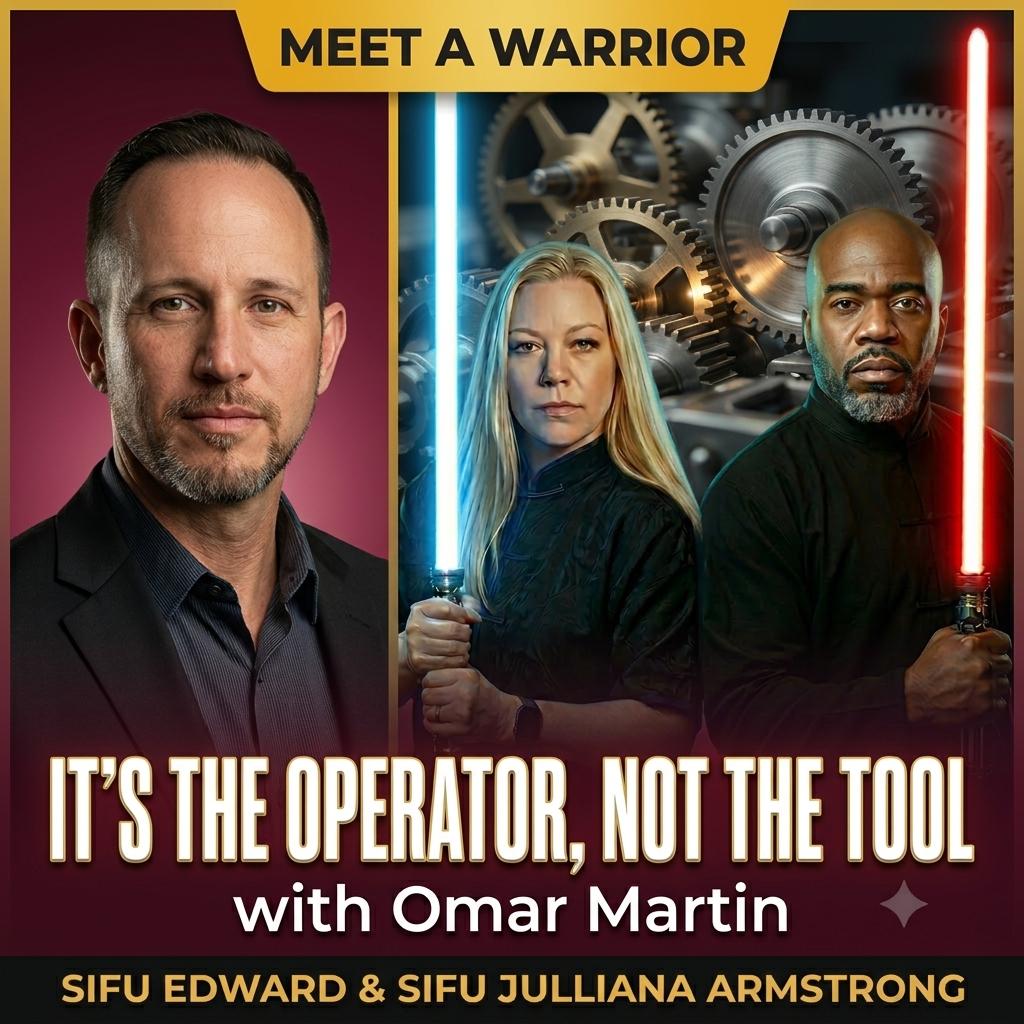
Adapted from the recorded conversation; the guest's words are verbatim. The questions are reconstructed and voiced by Sifu Edward and Sifu Julliana Armstrong.
🎥 Video podcast coming soon. The complete interview will play here once published. The full conversation is transcribed below, and the audio edition will be available on sifuarmstrong.tv.
In a new Sifu Armstrong interview, the former New York City paramedic and September 11th survivor explains why five failed launches mattered less than who was running them.
A former New York City paramedic who lost his partner and 343 fellow first responders on September 11th says the tool never mattered, only the person using it. Omar Martin, co-founder of Higher Level Strategies, joined Sifu Edward and Sifu Julliana Armstrong for the latest Warrior Intelligence Series conversation.
Martin left medicine after 9/11, rebuilt his life from nearly nothing in Florida, and eventually found his way into online marketing after mistakenly typing a search query into eBay instead of Google. What followed was total commitment to a mentor’s coaching program, even when money was tight. “I’m going to be your best, most successful student ever,” he told his coach at the time. “I’m going to get better at this than you.”
That commitment paid off, but not before five consecutive product launches failed outright. It was the sixth that finally worked, generating roughly $450,000 in sales. Looking back on the whole arc, Martin is unambiguous about what actually drove the result. “It doesn’t come down to the tool, it comes down to the operator,” he said, noting his business generated $1.7 million in a single year using nothing more exotic than WordPress and OptimizePress. “It comes down to who’s using it and what you’re doing.”
Martin credited his wife and business partner, Melinda, as central to the company’s growth. She runs Higher Level Strategies today as CEO while he focuses on the creative side. “She lets me soar while keeping me grounded,” he said.
He was equally direct about the order operations should actually happen in for anyone starting out. “You don’t get a business because you build a list,” Martin said. “You get a list because you built a business.”
It’s a lesson that fits neatly into the warrior’s path the Armstrongs teach: no piece of equipment builds a warrior, only the hours put in by the person holding it.
In This Conversation
- Leaving medicine after surviving September 11th
- Total commitment to a mentor, and the promise that came true
- Five failed launches before the sixth one worked
- “It’s the operator, not the tool,” building $1.7 million on WordPress
- The partnership behind Higher Level Strategies: visionary and integrator
- Where to find Higher Level Strategies
The Full Conversation
Sifu Julliana Armstrong: Some stories carry a weight you feel immediately, and Omar Martin's is one. He was a New York City paramedic who lost his partner Dave and 343 firefighter brothers and sisters on September 11th. Dave had a dream (to build a gym, a whole health and fitness center), and it died with him that day. Omar walked away from medicine to build a life that honoured that, and I wanted to sit with the reckoning that started it all.
Sifu Edward Armstrong: And here's a beautiful thread. We sat with John Thornhill earlier in this series, and John named Omar as his most successful student ever. Now we get the other half of that story: the man who told his mentor "tell me what to do and I'll do it," and then did it, all the way to a seven-figure company built with his wife. He also gave us a line I'd carve into every academy wall: it's not the tool, it's the operator.
Our guest is Omar Martin, co-founder, with his wife Melinda, of Higher Level Strategies. Omar, a real pleasure.
Omar Martin: Thank you very much. I appreciate you having me on.
Sifu Julliana Armstrong: Take us to the beginning, because it starts with the worst day.
Omar Martin: My formal education was in medicine. I graduated medical school in 1996 and worked for the New York City Fire Department as a paramedic. I loved what I did, but I wasn't happy. It's the type of work that takes a special individual. I worked in one of the busiest 911 systems on the planet, going from the worst moment in one person's life to the next worst moment, over and over, and it's a very unappreciated job, a moving target for a low wage. But the straw that broke the camel's back was September 11th. I wasn't on duty when it happened, which in a way makes it even harder. It wasn't just my partner Dave that died. It was 343 brothers and sisters from the Fire Department. So I reevaluated things, and that was the event that made me decide I'm never going back to medicine. I'm going to find ways of helping people, of making this planet a little bit better than I found it, but outside of risking my life physically every day.
So I had to put my pride and my education in my back pocket. I came to Florida from New York with about 200 bucks in my pocket, didn't know where I'd stay, pretty much all my possessions in the trunk of my car. I picked up a newspaper, picked an ad, and went on a job interview. I was interviewed by this beautiful woman, and honestly the job was door-to-door sales, it was horrible, I didn't want to come back, but she was a very beautiful woman, so I got the job, and I ended up marrying her. That's my beautiful wife, Melinda, who is the CEO of our company today. And Dave. He was very physically fit, very athletic, and his dream was to own a gym, to build a whole health and fitness center. All of that died that day with him. In many ways it was a springboard for me to want to do something else.
Sifu Julliana Armstrong: Thank you for carrying Dave's name into this, Omar. There's something sacred about surviving a loss like that and deciding to build in response to it. His dream was a place to make people stronger and healthier, and you went and built a life dedicated to making people better, just through a different door. That's how a warrior honours the fallen: not by stopping, but by carrying forward what they can't. The wound became your mission.
Sifu Edward Armstrong: And then came the mentor. We spoke with John Thornhill, who told us about the student who said "just tell me what to do." That was you.
Omar Martin: John and I have become the best of friends. If it wasn't for John. I'm not saying I wouldn't have found something, because I'd decided long ago I was going to be successful and help others, but John just happened to be in the path. And the way we met, the stars aligned. By 2007, Melinda and I had done the door-to-door thing, been homeless for a while as squatters, then tried corporate America, bought a house, and went broke like everybody else, up to our eyeballs in debt. Trying to put together money for Christmas, I turned to eBay to sell a garage full of junk. It wasn't working. We spent more on shipping than we made. So I decided to search "how do I become a PowerSeller?", and fate intervened when I accidentally typed that into the eBay search bar instead of Google. What popped up was a book, The 90 Day PowerSeller Challenge, by John Thornhill. I bought it for $12, got a download link, and in that moment I thought, "Wait. I just got a link for a book. I've got to learn how to sell links like this guy, because I won't have to ship anything." I never even read the book. The next day I got an email from John selling me something else, and I was introduced to this whole subculture of marketing, and I said, "This is it."
Eventually John came out with a coaching program, and that's when it got heavy, because I was still broke. We didn't have the money for it. But I took money out of the bank even though we'd be late on the rent. I brought Melinda into the room and said, "Honey, this is John Thornhill," and when I told her the cost, she said, "Are you crazy? We don't even have that for rent." I said, "We're already going to be late. We might as well be really late." She said, "If you're going to do it, do it." That was one of the best decisions of our life. And to John I said, "I'm going to be your best, most successful student ever. I'm going to get better at this than you." Thirteen years later, we're the best of friends. He has a drawer of his own clothes in our guest room, we've been actual business partners, and we've helped thousands of people together.
Sifu Edward Armstrong: "Tell me what to do and I'll do it. I'm going to be your best student ever." That total commitment to the master is the fastest path there is. And John didn't just teach you. You two became partners and lifted thousands together. That's the whole arc of a great teacher and a great student: the transmission goes both ways, and eventually you build side by side. It's an honour to have both halves of that story on this series.
Sifu Julliana Armstrong: The moment I most want to talk about is Melinda backing you when you had nothing. There's a deep truth in how you describe it.
Omar Martin: A lot of people ask about the husband-and-wife dynamic, and a lot of them have a confrontational spouse or struggle to get support. Someone once said to me on a webinar, "Omar, I wish you could talk to my wife, if you talked to her, she'd know this is legit and I can make money." And I was about to say "bring her on," but then I stopped and said, "There's nothing I can say to her. I don't have to prove to your wife that making money online is legit. You have to prove to your wife that you're legit." Because with Melinda, anything could've been on that computer screen. It could've been a website for Tiger Woods and I could've said "I'm going to be a multi-million-dollar golfer." It didn't matter. I'd already been homeless with Melinda, already started from scratch with her. She knew what I was about, that I was a determined person, and she supported who I am as a man. It wasn't the path or the product. It was the determination and the connection. So people struggling to get their spouse's support need to get to the root of it, because it's not likely the business. There's something deeper there.
Sifu Julliana Armstrong: "You don't have to prove making money online is legit. You have to prove that you're legit." That is one of the wisest things anyone has said on this show, and it's true far beyond marriage. People spend their lives trying to prove the thing is credible, when what's really being questioned is whether they are. Melinda didn't back a business plan. She backed a man she'd already seen survive rock bottom without breaking. Earn that kind of trust, and people will follow you into anything.
Sifu Julliana Armstrong: And now you build together. She's the CEO. Tell me how that partnership actually works, because Edward and I know something about it.
Omar Martin: She is the boss, the CEO on paper and in real life. She steers the ship. Initially she was skeptical about her own role, and she watched from the sidelines for the first 18 months, which is how long it took me to get it going. Once she saw the money coming in consistently, I convinced her to leave her job. And what would've been an 18-month learning curve for me was just the beginning for her, very quickly she was correcting me, fixing things I was doing wrong. Melinda and I have very different strengths. Where I lack in organisation, scheduling, operations, logistics (the stuff that's really important when you grow a business), she excels. In the beginning when it's just you, it's about discipline: don't get distracted watching cat videos for three hours when you should be building your website. But Melinda took what I started and turned it into a company with employees and multiple profit streams. About four or five years in it became obvious she should steer the ship, not me. I'm the creative guy, the visionary; she's the integrator. She lets me soar while keeping me grounded.
Sifu Julliana Armstrong: "She lets me soar while keeping me grounded." That's the whole thing, and it's exactly how Edward and I build this federation. He's the founder, the face, the vision, and there's a mountain of work I do to keep it standing that no spotlight ever reaches. The visionary and the integrator, the one who soars and the one who anchors. Neither wins alone. The strongest thing you can build isn't a business. It's a partnership where each person is fully what the other is not.
Sifu Julliana Armstrong: You've said medicine built a wall in you. Talk about that, and how leaving changed your circle.
Omar Martin: In EMS, we create a wall, a persona, to deal with what we see every day. Generally, we're bitter people. It's a personality you build to cope with constant trauma and loss. If you don't build that wall and become that cold person, you take everything to heart and you can't perform the way you need to. The friends I met online, in the business world (people like John Thornhill), it's a completely different type of person. And when I left medicine, it shocked my parents, Cuban immigrants. I was the first in our family to graduate college, let alone medical school, a big source of pride. As for friends, when I wasn't doing well, nobody was trying to give me financial advice or help. But when I started making money, suddenly everybody had advice on how I should spend it. People ask if success changed me. I don't think my money changed me. I think it changed the people around me. A lot of the friendships from my past were holding me back, negative influences, and I became immersed in the new relationships from our online business.
Sifu Edward Armstrong: You've done many six-figure launches with a group you called the Affiliate Jedi. And you say the tool doesn't matter. The operator does. Explain that.
Omar Martin: We started by creating our own digital products and tools (plugins, systems), just so we could operate better as a company. And those tools we built for ourselves ended up becoming products we'd launch. We teamed up with a group we called the Affiliate Jedi (David Nicholson, John Thornhill, Michael Cheney, about seven of us), and we'd collaborate on calls, support one another's launches, sometimes line them up. I don't see enough of that nowadays, people forming alliances and building their businesses together. It's so much easier when you support each other and hold each other accountable. At the end of the day, we could argue about whether you should use WordPress or ClickFunnels, but what really makes the difference is you. The choices you make and the actions you take every day, not the tools. We did $1.7 million last year using WordPress and OptimizePress. If you asked whether we'd have made more with a different tool, no, because it doesn't come down to the tool, it comes down to the operator. It comes down to who's using it and what you're doing. The relationship building and the strategizing are much more responsible for your success than whether you use this particular gizmo.
Sifu Edward Armstrong: "It comes down to the operator." That is the deepest truth in the whole martial world, and you just said it in marketing language. Beginners obsess over the equipment (the best saber, the best gi, the newest technique) as if the gear will do the work. It won't. The saber doesn't make the warrior. And I love the Affiliate Jedi, a circle of masters lifting each other, holding each other accountable. That's a Shadow Council. Nobody great rises alone.
Sifu Edward Armstrong: If you were starting today, what would you do differently?
Omar Martin: I'd focus on creating content right from the beginning: tons of valuable, unconditional content, given with no condition to sign up. I'd build a tribe by providing unconditional value first, assembling an audience, containing it in a digital stadium. Creating the barrel of fish I'm going to shoot my offers into later. A lot of people rush to build a list and create products. Building a list is important, but a list is a byproduct of having a business. It's a byproduct of having an audience. It doesn't happen the other way around. You don't get a business because you build a list; you get a list because you built a business. If you focus on creating value and injecting it into an audience, inevitably you'll have a list of customers as a result. And I'd focus as quickly as possible on recurring income, instead of throwing myself into the perpetual feast-or-famine of launches. Because most businesses fail from lack of capital, not lack of ideas or traffic. The quicker you create recurring revenue, the quicker you alleviate that.
Sifu Edward Armstrong: And I understand the recurring-income wisdom came from getting bloodied. Your first five launches were rough.
Omar Martin: My first five product launches made me nothing. In fact I went backwards. My first launch, I made zero sales other than my own test sale, because I didn't understand you needed affiliates. I thought "field of dreams, build it and they'll come." Nobody came. The second, I recruited affiliates but decided to give away a big expensive camera as a prize, and I didn't make enough to justify it, so I went backwards again. The third, I approved anybody and everybody as an affiliate with no requirements, and I opened myself to fraud: fraudulent affiliates laundering money through my launch, to the tune of $20-something thousand, and I almost lost my PayPal account. I went through all these things the hard way. It wasn't until the sixth (Internet Selling for Newbies) that everything I'd learned came together. We did around $450,000 in sales, and Melinda and I put $180,000 in the bank. More money than either of us had ever saved. And the best part was a $39 recurring membership as a bump offer. We put 1,300 people into it, banking $30,000 a month. A lot of people come online, buy a coaching product, watch a free video, and then scream about why they're not making millions in a month. They create false expectations, often from deceptive claims on sales pages. Anything of value takes a significant investment of time and money. You can't give up because you hit pitfalls, and there'll be no shortage. The person who wins at this game is the one most open to change and most willing to adapt, because the internet is constantly changing.
Sifu Julliana Armstrong: You've said you've removed money from the equation of your life. What does a person do with that freedom?
Omar Martin: Something happens when you get to that position. You start looking at "what else can I do? How else can I help people? There's got to be more to it." I've become much more involved in my church, and it's inspiring us to create a platform for churches to do online ministry: the skills we've used for years, webinars and things, that people at churches know nothing about. And we're building a product called Convert Tools, a platform where people can use the hundreds of products we've created as their own to generate their leads and funnels. We're diversifying to adapt to the current internet, and finding ways to add a little more to the planet than just making money. You can find us at higherlevelstrategies.com.
Sifu Edward Armstrong: Omar, this has been a genuine honour, and please send our thanks to Melinda. Thank you.
Omar Martin: Thank you very much. I appreciate it.
Sifu Julliana's closing word: Omar survived a loss most of us can't imagine and answered it by building. Dave dreamed of a place to make people stronger; Omar built a life making people better. And the wisdom he handed us is enormous: you don't prove the thing is legit, you prove that you are; a list is a byproduct of a business; and the strongest thing you'll ever build is a partnership where one soars and the other anchors. He turned the worst day into a mission. That's a warrior.
Sifu Edward's closing word: Two things from Omar will stay with our operators. "It's the operator, not the tool." The saber doesn't make the warrior; ten thousand hours of the warrior make the saber. And the Affiliate Jedi, a circle of masters lifting each other, because nobody great rises alone. He gave total commitment to a mentor, built side by side with his partner, and refused to quit through five failures to reach the sixth. It was always the operator. We don't entertain warriors. We create them.
Omar Martin, co-founder, with his wife Melinda, of Higher Level Strategies (higherlevelstrategies.com); former NYC Fire Department paramedic and 9/11 survivor. John Thornhill's most successful student.
ILLUSTRATIVE RESULTS. Any revenue, enrollment, margin or retention figure in this conversation is either a documented result from one of our own operations, a figure the guest reports about their own business, or an illustrative example, never a projection of your results.
Nothing here is financial, legal or tax advice.
Stay in the Fight
This conversation is part of the Sifu Armstrong Warrior Intelligence Series: interviews with world-class performers, builders, and thinkers, filtered through the lens of the warrior's path.
Subscribe at sifuarmstrong.news for every new interview, delivered to you.
Join Club Sabernet, the member community of the whole Sifu Armstrong ecosystem, where warriors train, connect, and hold each other to the standard.
Ready to build your own floor? Find your path at sifuarmstrong.com/which-path.