If You're Not Moving Forward, You're Going Backwards: Sifu Edward & Sifu Julliana Armstrong Sit Down With Kevin Fahey
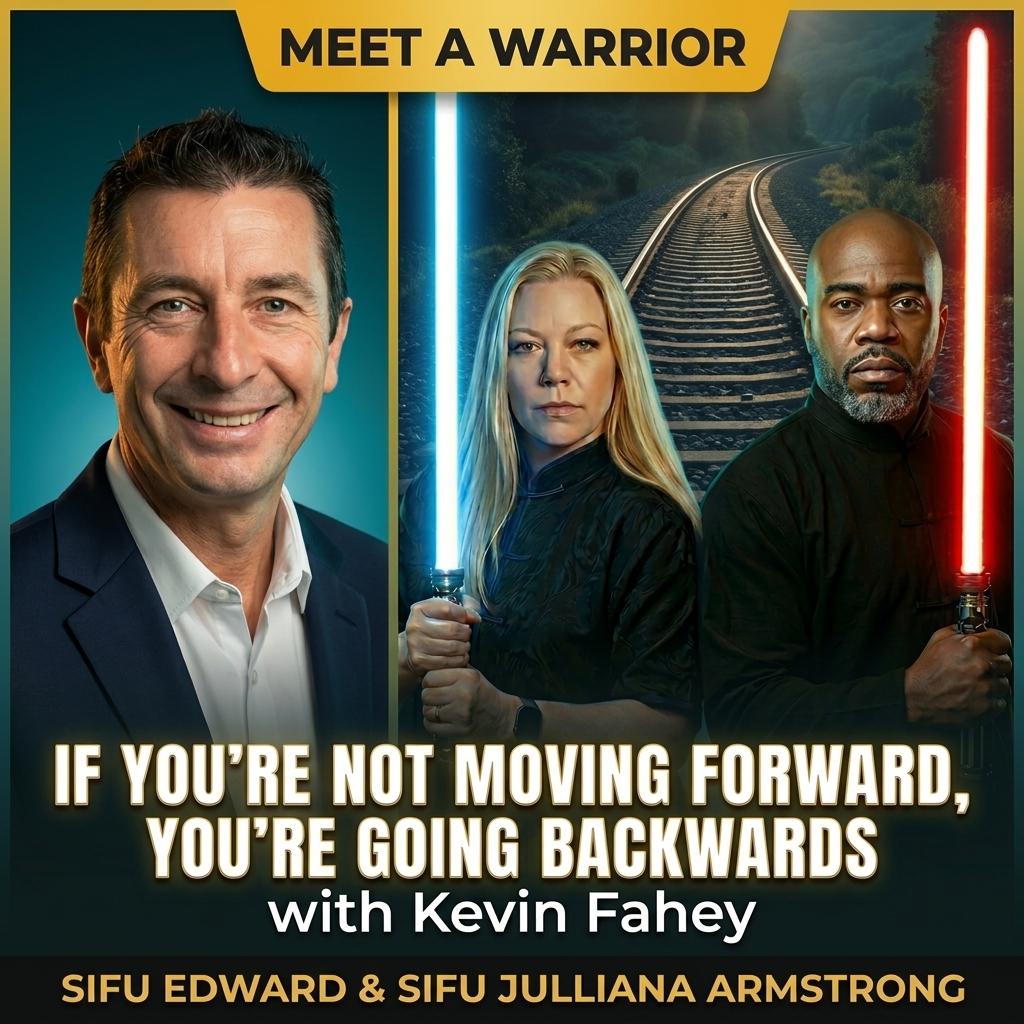
Adapted from the recorded conversation; the guest's words are verbatim. The questions are reconstructed and voiced by Sifu Edward and Sifu Julliana Armstrong.
🎥 Video podcast coming soon. The complete interview will play here once published. The full conversation is transcribed below, and the audio edition will be available on sifuarmstrong.tv.
In a new Sifu Armstrong interview, the Mallorca-based marketer explains why he chose slow, unglamorous, month-over-month growth over the boom-and-bust launch cycle.
Most internet marketers who hit a million dollars in their first year either keep growing or disappear. Information marketer Kevin Fahey has spent thirteen years doing neither: building slow, steady, month-over-month growth instead of chasing the quick spike. He joined Sifu Edward and Sifu Julliana Armstrong for the latest Warrior Intelligence Series conversation.
Fahey, who moved from Ireland to Mallorca at 18 and started his online business while working bar shifts until 2 a.m., said the shift from short-term list-building to long-term value came from a simple realization about longevity. “My mentality is I want to be around in 20, 30, 40 years time doing the exact same thing,” he said, “and your reputation is important.”
That long view, he said, shapes how he thinks about luck versus effort. “If you rely on luck, you’re going to be left disappointed a lot of the time,” Fahey said. “My mentality would be, I need to work as hard as possible to make this work. If it doesn’t work, I need to approach it from a different angle.”
Fahey was equally blunt about comfort as a threat to growth. Financial security, he said, once cost him focus, until he watched a padded bank account nearly disappear. “Someone said, 'If you’re not moving forward, you’re going backwards. There’s no such thing as standing still,'” he recalled. “And it’s very, very true.”
The lifestyle outsiders imagine (cocktails on a Mediterranean beach), isn’t the reality, he said. These days it’s early mornings, delegated tasks, and time in the garden with his two young daughters. “It’s a mix of things,” he said of what actually drives him now. “I love creating products, communicating with my email list, doing live training webinars because of the interaction, seeing the impact it can have on people’s lives.”
It’s the same discipline the Armstrongs build into the warrior’s path: the work that lasts isn’t the one heroic launch, but the steady, unglamorous choice to keep moving forward every month.
In This Conversation
- Thirteen years of steady growth instead of a boom-and-bust launch
- Why reputation, not just revenue, drives Fahey’s long-term thinking
- Rejecting luck: “adjust and attack from a different angle”
- The wake-up call that came from watching his savings disappear
- Trading the beach fantasy for family life and delegated work
- Where to find Fahey’s work at kevinfahey.net
The Full Conversation
Sifu Edward Armstrong: The internet marketing world is full of people who make a million dollars in a year and then vanish. Kevin Fahey did the opposite: thirteen years of steady, unglamorous, month-over-month growth, built on a decision most people never make: to choose reputation and value over the quick extraction. When I found a man whose whole philosophy is "I want to still be doing this in forty years," I knew our operators (who I'm asking to build something that outlasts them) had to hear him.
Sifu Julliana Armstrong: And I loved that he traded the cocktails-on-the-beach fantasy for a real life: two little girls, a garden, showing up at six in the morning to grind out the work nobody else will do. That's the athlete's truth. The lifestyle isn't the goal. The discipline is the whole thing.
Our guest is Kevin Fahey, one of the most prolific information marketers online, originally from Kildare, Ireland, now living in Mallorca. Kevin, welcome.
Kevin Fahey: Cheers.
Sifu Edward Armstrong: Take us to the beginning, the bar work, the struggle, and how you built something that's still growing thirteen years later.
Kevin Fahey: So basically I moved to Majorca when I was 18 years old and I started working in bars and disco bars for around five years. To make a long story short, I realised that working in the tourist industry was probably not the best way to have a secure life. We only had work and income for six months of the year. We used to make good money in six months, but come January or February, when we'd been out of work for three months, the money begins to run out. So I've always been looking for ways to make extra money, and I turned to internet marketing. For the first six months, I really, really struggled. My girlfriend at the time and our friends were saying, "Why is Kevin spending 12 to 16 hours a day sitting in front of the computer and he might only make $50 a week?" A lot of people can relate to that.
Six months later, my online business was generating around $2,000 a month. During that summer, I took up another job paying around $1,800 a month. I used to work in the bar from 4:00 PM until around 2:00 AM. I'd go home at 2:00 AM, work on the computer until maybe six o'clock in the morning, sleep, wake up around noon, work two or three hours, and head back to my job. And that was a requirement to get my online business generating more than my nine-to-five. The next month, October, the business was generating $3,000. The next month $4,000, $5,000. In January, up to $10,000. In March, up to around $16,000. That was 13 years ago, in 2007. Since then, my business has increased at a steady rate every single month. I know a lot of marketers make a million dollars in their first year, and some continue to grow and some just disappear. But I'm very happy with our consistency. It's just steadily increasing. Our highest month was around $63,000, and for the past few years we've been between $30,000 and $50,000 per month.
For the first three years, I spent a lot of time building my email list. Back then we used solo ads. Every month I was investing between $5,000 and $10,000 into traffic, and I ended up building a list of over 261,000 subscribers. But then the ass fell out of the industry: around 2013/2014 there were hundreds of people selling solo ads, and subscribers were getting 200, 300, 400 emails every day. Our click-through rate was less than 1%. A lot of people left the industry. What I focused on then was: rather than just buying and selling email addresses, I thought, there has to be more value if you want to actually grow. My mentality is I want to be around in 20, 30, 40 years time doing the exact same thing, selling information marketing products, and your reputation is important. So I switched my business model to providing more value and more quality all the way through, actually creating products that solve solutions.
Sifu Edward Armstrong: Stop there. "I want to be around in forty years, and your reputation is important." That is the founder's mindset, and it's the opposite of how most people play. I'm not building a federation for this quarter. I'm building something my students' students will inherit. The moment you decide to still be here in forty years, you start making completely different decisions.
Sifu Julliana Armstrong: You live in Mallorca, so I have to ask the fantasy question. Is it cocktails on the beach all day?
Kevin Fahey: It's changed a lot over the years. 10, 12 years ago, we used to get home at six o'clock in the morning. As we got older, we used to get home around three, and now I've got a four-year-old daughter and a one-year-old daughter, so things have completely changed. We're usually in bed by midnight. On a normal day, sometimes I have eight hours of work and no problem putting in the hours. Other days I might only have 20 minutes. I'm not really a person to lie on the couch all day. When my friends are available, we'd head out for a round of golf, get out in the boat, do a little fishing. I've gone into gardening as a hobby, which is really cool. It gets me away from the office. I bought a house four years ago and I like to do a lot of DIY myself. With living in Majorca, do we spend all day by the beach sipping cocktails? Unfortunately not. We might've done a lot of it in the early years, but it's something we got sick of, and now it's more of a family life to be honest.
Sifu Edward Armstrong: What's your actual favourite part of this work, and how do you protect it from the parts you hate?
Kevin Fahey: It's a mix of things. I love creating products, communicating with my email list, doing live training webinars because of the interaction, seeing the impact it can have on people's lives. I really believe if you don't enjoy doing something, you're not going to be successful at it. But there are a lot of parts of this business which are not enjoyable, and I think it's so important to have a team. I'll give a quick example. Yesterday morning between eight and half-eight, I talked to my content writer, my copywriter, and my graphic designer, three painstaking jobs. I also talked to my main VA who manages our support desk. So I talked to four people and gave them four painstaking jobs: create content, create a sales page, create graphics, republish these pages. That would have taken me three or four weeks. I would not have enjoyed any of it. I wouldn't have been earning. So I had a big smile on my face because I could see exactly how my business is set up. We can just delegate all of these tasks. And I spent four or five hours yesterday in the garden because of that. So learn how to outsource and make the business enjoyable for you.
Sifu Julliana Armstrong: So much of what you do helps other people build. That must be deeply satisfying.
Kevin Fahey: It's really, really satisfying. I've been online for 13 years. I started when I was 22. There's people that started when they were 16, 17, 18, people that started at 30 struggling in their job. And now 10 years later, I look at their lifestyle. They've got married, got kids, bought a house. Some went along and bought Lamborghinis, whatever it may be. But to be able to witness that and know that you were part of that journey, that you helped that person at some stage, maybe getting them off the ground or taking their business to the next level, that is extremely satisfying. That is one of the best parts of this business, because you know you're actually helping people, and it pushes you forward more and more.
Sifu Julliana Armstrong: Two things I want to press on, how much luck plays a part, and how hard you actually push yourself. Because I suspect your answer sounds like a competitor's.
Kevin Fahey: Honestly, if you rely on luck, you're going to be left disappointed a lot of the time. A lot of people say, "I just need a little bit of luck to make this work." My mentality would be, "I need to work as hard as possible to make this work. If it doesn't work, I need to approach it from a different angle." We've been hit with roadblocks. You're always going to have hiccups, bad luck, unfortunate things. So when you have bad luck, what do you do? Do you roll up, go home and quit? Or do you adjust, go back, attack it from a different angle, and actually overcome the problem? If anyone else can achieve it, you can too.
And I push myself pretty hard. When I've got 30 emails that must be written for a follow-up series, some people might say, "I can space this out over three or four days." I'd be like, "I'm just going to get up at six o'clock in the morning and I'm not going to leave the computer for six, eight, ten hours until those emails are written." When there's work to be done, just do the work. Because it's a requirement. No one's going to hand you your first million dollars. Nobody's going to build the funnels for you. Nobody's going to do the research for you. So you've got to push yourself if you want to make things work.
Sifu Julliana Armstrong: "When you have bad luck, do you quit or do you adjust?" That's the entire mental game of competition in one sentence. The floor is never fair, the draw is never fair, your body on the day is never fair. Champions don't pray for luck. They adjust and attack from a different angle. And then they get up at six and do the reps nobody's watching.
Sifu Edward Armstrong: What keeps you focused, and you said something interesting, that being comfortable is actually dangerous.
Kevin Fahey: What helps me stay focused is really simple. I use a daily planner, a Google document with the date at the top. I plan everything I have to do throughout the week, then break it down day by day. Today I've got around five things on my to-do list, planned the night before. I've got the sheet open at all times: that's done, next, that's done. Once I get to the bottom, I'm finished for the day. And financially. We're comfortable, and I think that's a very dangerous thing. I've worked with students who were financially comfortable, so there was no motivation to push themselves. So what keeps me focused now is buying investment properties. Once I have one, I say, "It's time to buy another." I've something to focus on. Because this happened to me six or seven years ago. We were not focused, we did not have a plan, and I watched my bank account go from around $50,000 in savings down to around $5,000 in the space of a few months. It was a massive wake-up call that I must always have a business plan moving forward to the next level. Someone said, "If you're not moving forward, you're going backwards. There's no such thing as standing still." And it's very, very true.
Sifu Edward Armstrong: That's a law of the mat too. Comfort is where mastery goes to die. The black belt who stops setting the next goal starts sliding backward without even noticing. A warrior always has a next form to master, a next mountain, not out of greed, but because standing still is the one thing that will actually kill you.
Sifu Edward Armstrong: Who's your hero, and how has the industry changed since you started?
Kevin Fahey: My heroes? I wouldn't say I have a massive amount. I'm not big on celebrities. My hero, when I really think about it, would probably be my father. He taught me everything about business. We come from a family business background, from hard work and ethics. So he would be my hero in that sense. And the industry has changed massively in 13 years, but the fundamentals of marketing are still the exact same: free lead generation page, upsells, downsells, membership sites. Not much has changed there. But it's a lot easier now technically, page builders like ClickFunnels let you set up a page in 15 minutes with no experience. Traffic is more expensive but more available and better targeted. And 13 years ago there were far fewer people selling information products, and it was so easy to make sales, when I look back at some of my old sales pages I think, "Did that actually sell? It's really bad." Now customers are a lot smarter, there's a lot more competition. So to stand out, you have to put in your A-game every time: have everything looking good, the best quality, the best design. That's one of the biggest changes.
Sifu Julliana Armstrong: For someone just starting out. What's your advice?
Kevin Fahey: Find someone you admire, someone successful you'd like to follow. You look at exactly what their business model is, their offers, their emails, their connections, and you try to apply a lot of what they're doing to your own business. People call it funnel hacking now. I've been doing it for 12 or 13 years. At the very beginning I used to buy a lot of internet marketing products on ClickBank just so I could see the upsell page, the downsell page, all the follow-up emails. I'd model that and learn from it. To this day I do the same. I did a promotion on ClickBank six months ago and studied their checkout page, follow-up emails, order bumps, discount codes, everything that made the offer look really sexy and converted really well. Then I applied the exact same things to my own offers. So if you're just starting out, stop looking for shiny objects, find someone you respect, find a business model you like, and try to replicate what they're doing as much as possible.
And what's next for me? Our business has been consistently growing for 13 years doing pretty much the same thing, so I'm not going to make massive changes. If it's not broke, don't try to fix it. I know I could add high-ticket coaching and reseller programs to make another $50,000 a month, and I could do that at any time. But right now I'm just happy the way business is running. It's not stressful, a lot is outsourced, it's steadily growing, and we've got members to keep happy every month. That's my number one priority.
Kevin Fahey: If you want to find out more about me, you can go to kevinfahey.net.
Sifu Edward Armstrong: Kevin, thank you so much for your time. I've really enjoyed this.
Kevin Fahey: Absolute pleasure. I hope you got a lot of content from it. Cheers.
Sifu Julliana's closing word: Kevin traded the beach-and-cocktails fantasy for a real life, the six a.m. grind, the two little girls, the garden. And his line on luck is the truest thing a competitor can learn: you don't pray for a fair floor, you adjust and attack from a different angle. The lifestyle was never the prize. The discipline underneath it is the whole thing, and it's the part almost nobody wants.
Sifu Edward's closing word: Kevin gave us the founder's whole creed: I want to still be doing this in forty years, and my reputation is what carries me there. The flashy ones burn hot and vanish, the warrior who wins is the one still standing in thirty years, because he chose value over extraction and never let comfort stop him from climbing the next mountain. If you're not moving forward, you're going backwards. Keep building. We don't entertain warriors. We create them.
Kevin Fahey, prolific information marketer from Kildare, Ireland, based in Mallorca. More at kevinfahey.net.
ILLUSTRATIVE RESULTS. Any revenue, enrollment, margin or retention figure in this conversation is either a documented result from one of our own operations, a figure the guest reports about their own business, or an illustrative example, never a projection of your results.
Nothing here is financial, legal or tax advice.
Stay in the Fight
This conversation is part of the Sifu Armstrong Warrior Intelligence Series: interviews with world-class performers, builders, and thinkers, filtered through the lens of the warrior's path.
Subscribe at sifuarmstrong.news for every new interview, delivered to you.
Join Club Sabernet, the member community of the whole Sifu Armstrong ecosystem, where warriors train, connect, and hold each other to the standard.
Ready to build your own floor? Find your path at sifuarmstrong.com/which-path.