How You Train Them Is How They Treat You: Sifu Edward & Sifu Julliana Armstrong Sit Down With Email Legend Matt Bacak
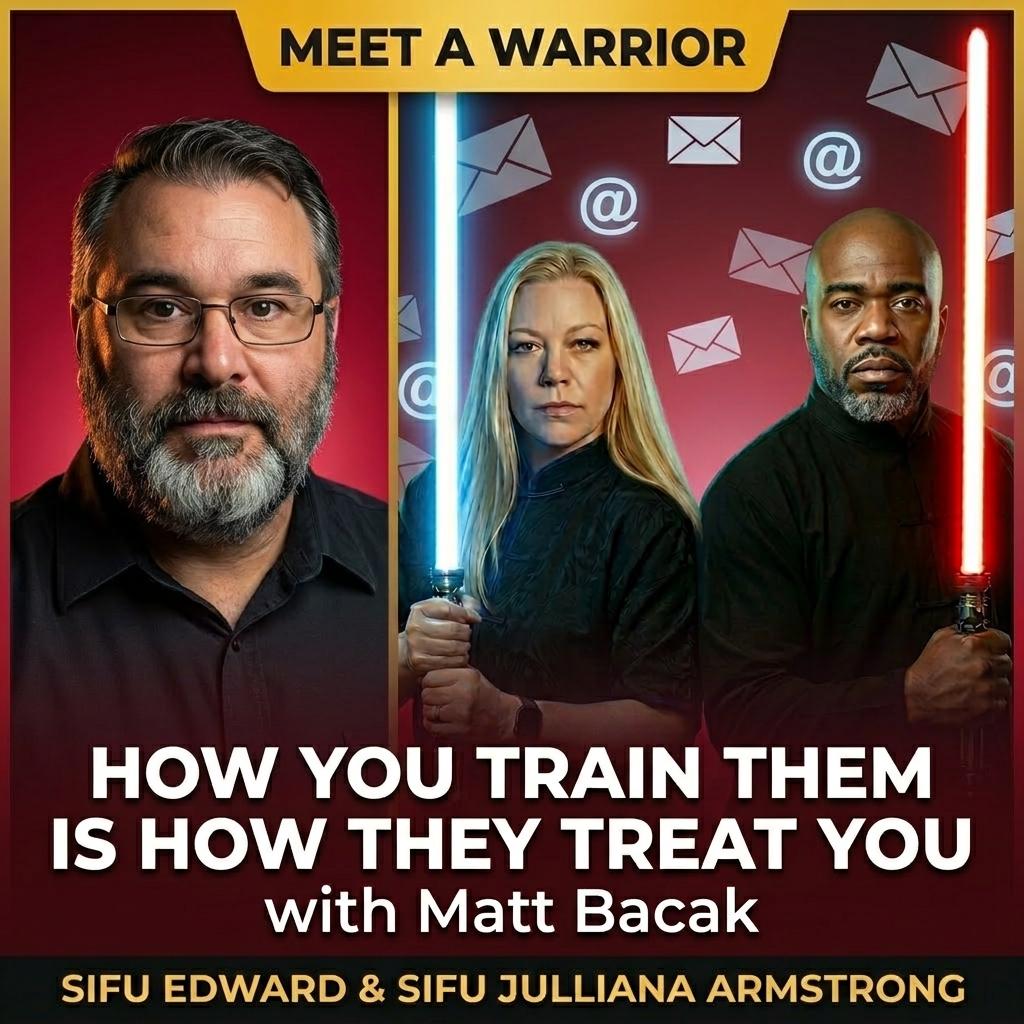
Adapted from the recorded conversation; the guest's words are verbatim. The questions are reconstructed and voiced by Sifu Edward and Sifu Julliana Armstrong.
🎥 Video podcast coming soon. The complete interview will play here once published. The full conversation is transcribed below, and the audio edition will be available on sifuarmstrong.tv.
In a new Sifu Armstrong interview, the email marketing veteran argues that the habits set in the first message of any relationship are the habits that last, and that detachment, not talent, is what makes a twenty-five-year career possible.
Matt Bacak has built multiple millions of dollars from email lists, lost most of it once, and rebuilt from nothing, a “recycle,” as he calls it, that reshaped how he thinks about every relationship a business has with its audience. His conversation with Sifu Edward and Sifu Julliana Armstrong for the Warrior Intelligence Series returns again and again to a single governing idea.
“How you train your list at the beginning is how they’re going to treat you in the end,” Bacak said. He means it literally: if a business gives things away for free from day one, that’s the relationship it has signed up for. If it mails every Wednesday, it had better mail every Wednesday, because the moment expectations set early get broken, trust erodes with them. The same logic, he said, applies to email frequency, pricing, and the promise made in the very first message someone receives.
That discipline around testing, Bacak explained, was forged during the hardest stretch of his career, when he was rebuilding his business from scratch with nothing but credit cards and a willingness to measure everything. Out of that period came a habit he now treats as non-negotiable: test daily, and never assume you already know the answer. “If you don’t do anything, you’re never going to make anything happen anyway,” he said. “So you’ve got to do something, whether it’s right or wrong, because even if you’re wrong, a lot of times just by doing, you’re still right.”
The flip side of constant testing, Bacak said, is refusing to fall in love with any single result. Pages get rewritten, offers get killed, and campaigns that felt certain to work sometimes don’t. “Don’t get emotionally attached to it,” he said. “You can get emotionally attached to people, but you don’t get emotionally attached to pages. A page is a page.” It’s a distinction he’s arrived at after roughly 8,000 email split tests, enough repetition to know that what he expects to win and what actually wins are frequently two different things.
He’s also blunt about timing. The moment someone opts in or buys is the moment they’re most engaged, and letting that window close costs more than most businesses realize. “When a buyer’s in heat, a buyer’s in heat,” he said, a line delivered half as a joke and half as an operating principle for exactly when to make the next offer.
The Armstrongs drew the comparison directly to how a student is handled in their first month on the mat: the standard set at the door is the standard that holds for the rest of a person’s training, because habits formed early are rarely undone later.
It’s a lesson that applies well beyond email lists, the way any relationship opens tends to be the way it’s lived out for good.
In This Conversation
- “How you train your list at the beginning is how they’re going to treat you in the end”
- The dark period that turned Bacak into “the king of testing”
- Why doing something beats waiting to be certain
- “A page is a page,” the discipline of staying emotionally detached
- Subscriber expiration dates and the cost of letting momentum go cold
- The Listbuilding Club and what still trips up beginners
The Full Conversation
Sifu Edward Armstrong: There's a line Matt Bacak said in this conversation that I would carve over the door of every academy: how you train your list at the beginning is how they're going to treat you in the end. He was talking about email subscribers. He might as well have been talking about students. When I found a man who built multi-millions on that single principle (and rebuilt it all from scratch after losing everything), I knew our operators had to hear him.
Sifu Julliana Armstrong: And what I connected with is that he treats it all as a game against himself. He tests every single day, refuses to get emotionally attached to anything he's built, and does it because he genuinely loves it. That's the athlete's relationship with the craft, the daily rep, the detachment, the joy underneath the discipline.
Our guest is Matt Bacak, one of the most respected email marketers alive, from Atlanta, Georgia. Matt, thanks for being here.
Matt Bacak: Hey, thanks for having me.
Sifu Edward Armstrong: Take the clock back. What were you doing before you became an internet marketer, and what pulled you online?
Matt Bacak: I'd have to go back more than a few years. But what I did before, I was pretty much doing it in college. Back then I was doing sales. I had my own company, I'd been running my own company since I was a kid. When I got started, we called it the information superhighway. Everything we know today wasn't existing. Maybe AOL, if that's even around. But before, initially, I was just a kid that wanted to make a lot of money, really in my dorm room.
So I was going out knocking on doors and trying to get people to buy stuff, and it was a pain in the butt. So instead of me chasing people down, I figured I wanted people to just come to me. That was the big thing. "If I could just get people to come to me instead of me chasing them down, that would be a great scenario." And that caused me to start looking at this internet thing. I sold cassettes, information, on cassette tapes, on VHS tapes. That was before the DVD, and now DVDs are going obsolete too. But I was selling other people's information, not my own. Actually it was Kiyosaki stuff, right when he was getting started. I sold the books, I sold hard stuff.
Sifu Edward Armstrong: Everyone says the money is in the list. But you draw a sharp distinction about what kind of list. Walk our operators through it.
Matt Bacak: I think there's really two ways. One, giving somebody an ethical bribe or something for free is always a great way to get people on your list. But this newer choice is a better choice, I believe, for everybody: instead of giving something away for free, you might want to create it and make it a lower ticket product and have people opt in with their credit card, so you can actually build a buyers list. And that's going to be the best list you can ever build. You could build 100,000 people from giving stuff away for free, or you can get a thousand people that bought something from you, even if it's a dollar. That's going to be so much better than the 10,000. Realise all subscribers aren't equal, but the best buyers you can ever get are the ones that opt in with their credit card.
The more I started utilising data, the more I realised the power of somebody opting in with a credit card is so much bigger than somebody just looking, because you get tyre kickers, plate lickers. Somebody that gave you their credit card has bare commitment, but you also have more backup to say, "Hey, look, you bought this." Buying is a good gate, a good hurdle people can jump over to prove that one, they're interested, and two, it's going to make your list more powerful and more responsive than anything else you could do. And now it's just according to how you want to price that. Something of high quality, high value, because the first impression is the most important thing. If you deliver something that they paid $7 for that's worth 500 or a hundred dollars, they're like, "Oh my gosh, imagine what they're going to give me when I give them more money."
Sifu Julliana Armstrong: You said something that stopped me, that the way you treat people at the very start sets the entire relationship. That's exactly how it works with a new student. Say more.
Matt Bacak: The loyalty and the trust factor, that's a big thing. The biggest thing is, when somebody comes in, especially the first time they meet you, people talk about building rapport, and that's great, but the best way to build the best rapport is to build trust. The best way to build a relationship is do what the heck you say you're going to do, and do it better. Under promise and over deliver. You're going to build so much more trust.
The other thing, I made millions, multi-millions from email. Everybody's like, "Oh, once somebody signs up, send out these relationship things." It's a good idea. But the point is, how you train your list at the beginning is how they're going to treat you in the end. If you train them that you give them free stuff, that's how the relationship started. But if they came in with, "Hey, I give you some money, you're going to give me something great," then they're going to always give you money to get something great. Same with email frequency. The most important thing is the decision you make at the beginning of the relationship. If you're going to send emails every single day, then you better do it from the beginning. If you train people you're going to mail every Wednesday and you miss a Wednesday, they're going to get upset with you. If you change your behaviour after they've been trained a certain way, it could cause issues.
Sifu Julliana Armstrong: "How you train them at the beginning is how they treat you in the end." That's the whole first belt. The habits, the standard, the discipline you set in a student's first month. That's who they are as a warrior forever. You cannot bolt it on later.
Sifu Edward Armstrong: You also talk about subscribers expiring, and the opportunity cost of waiting. That's a discipline most people miss.
Matt Bacak: There's such a thing as opportunity cost, and subscribers expire. Depending on the market, if you're building a list of people looking for a quick fix, I tell people, "Look for bleeding necks." Somebody with a bleeding neck gets it fixed, they don't need you anymore, so they go away. Every market has an expiration date. In the internet marketing space, we have three months. That's all we have a lot of times. After three months those subscribers start dropping off. So if we know we only have a 30, 60, or 90 day window, if we let it lapse too long, there's huge opportunity cost. Every day we don't mail is a day we miss out on money. Just like a hotel, if the room doesn't get full that night, they missed out, there's no way to go backwards to get that income.
Here's a third point people don't realise. The moment somebody signs up is the moment they're the hottest. The moment somebody buys from you is the moment they're the hottest. I always jokingly say, "When a buyer's in heat, a buyer's in heat." So get them when they're in heat. If you let that window disappear, you may never get it back. That's why the first message is the most important message of everything. Even in your first message, if you promise someone an X widget, give them X widget, but then in the P.S., "Hey, by the way, people who download this also buy this." I stole that trick from Amazon. You're providing both things. You're here to give them something free, but you're also here to make money. At that moment they are looking for that email, they're hot, they're hungry, ready to go. If you let it get cold, you're losing out on an opportunity.
Sifu Julliana Armstrong: You're called the king of testing, but you told us that came out of a dark time. What happened?
Matt Bacak: Well, the persuasion is one thing, testing is another. Early on I realised that people making more money than me had three things: they were better copywriters or storytellers, they had big ticket items, and they had continuity. And the one commonality was they all had email lists. So I studied copywriters. I studied them hard, I still do. I will never stop learning that skill, because it's the one thing. You could take everything away from me, I can just write some copy, I can write my way out. There's an old saying with The Beatles, "Hey, let's write ourselves a new swimming pool." I could write myself a new plane. I've done it before.
But the testing came at a different time. I've been doing this 22, 25 years. Halfway through, things aren't always rosy. It was a down where I went through some stuff and pretty much everything kind of disappeared. I don't want to get into that story, but I started from scratch. I call it the recycle. And in the middle of recycling my business, I was at a point where I didn't have money, well, I had credit, I had credit cards. And I said, "How am I going to squeeze as much as I can out of this?" There was only so much money I had to get traffic, only so much traffic I could get to the page. So I started testing, and I saw there was a radical difference. I looked back on the 12 years before and said, "If I had only done this 12 years ago, I'd be in a much better place." So I tested and tested and tested, and it became a habit. Now I test every single day. If I don't test, I feel weird. The difference between 1% and 10%, between 10% and 30%, is really big. I've got one page right now doing about 89%. People are usually happy with 30%. The max is 100%, and I know I'll never get there, but I always aim for it.
Sifu Julliana Armstrong: And you've said the biggest mistake people make is getting emotionally attached to what they've built. That's a deeply martial idea.
Matt Bacak: Don't get emotionally attached to it. You can get emotionally attached to people, but you don't get emotionally attached to pages. A page is a page. It could be erased, removed, changed. The moment people make the biggest mistakes in their career (and their bank account will show this) is the moment they're emotionally attached to something they've created. Because through all my testing (I've done over 8,000 email split test rounds), what I think will work, doesn't, and what I think won't work, does. It's so counterintuitive. But here's the one thing I also learned from split testing: if you don't do anything, you're never going to make anything happen anyway. So you've got to do something, whether it's right or wrong, because even if you're wrong, a lot of times just by doing, you're still right.
Sifu Edward Armstrong: Tell us about the Listbuilding Club, and answer the question everyone asks: can someone still start today and win?
Matt Bacak: I do have a Listbuilding Club, it's over at Facebook, a private group. You'd search for the Listbuilding Club. I go in every single week and do a live video. Right now we have over 20,000 people in there. It moves from newbies all the way up to the most advanced, and people are there to help each other. That was the goal of the community, provide value to each other so they can all grow their list. The only rule: if it doesn't have to do with email marketing or list building, it doesn't belong there.
And can you still do it? I think it's more possible than when I started. When I started there was no such thing as an affiliate program, no autoresponders, no opt-in page, no Facebook, no Twitter, no YouTube, nothing. We had to get really creative. Yes, some of us were early, but the tools, the success stories, the models we can model today are so much better. I remember early, if you made $10,000 a month, people were like, "Oh my God, amazing." Today I'm seeing people just starting out going from nothing to making millions in a really short period, because people like me have paved the path and said, "Here's what to do, just follow and model this." With the tools and the leverage we have today, there's an unlimited amount of opportunity for everybody.
Sifu Julliana Armstrong: You've reached a level where most people would retire. Why do you keep going?
Matt Bacak: I don't really work. I love this stuff. I love marketing, everything about it. I didn't come to that conclusion until a couple years ago. We had our 20-something year high school reunion, and somebody posted a picture of a newsletter from high school where all the seniors submitted their favourite class. And I wrote: marketing. I didn't even know that back then, but I fell in love with marketing way back then. Marketing is a piece of psychology and also math, and the math doesn't have to be calculus. Did this make me more money than this? What number is bigger? That's the answer. When I'm testing, it's a game to me. Every day I'm playing a new game with myself to see if I can beat myself. I don't care if I make a mistake, because I know in the end I'm going to win.
But there's another side to it, being able to watch others grow. People are going through my stuff, and the coolest thing happening for me right now is people sending gifts. Somebody sent me a $400 juicer, "Thank you for everything." Somebody sent me an astronaut pen because they know I write letters to my high end clients. But I don't care about the gifts. What I do care about is that the things I'm doing are changing people's lives, and that matters a lot to me. Seeing the raving reviews coming back because I'm just opening up and sharing my data, sharing what I know to be true at this moment. That's really cool.
Sifu Edward Armstrong: Last one. What's the single biggest thing that trips up a beginner?
Matt Bacak: A couple popped in my head. One, they're overthinking and not following instruction. "Oh, I think I'm smarter than them." No, follow instruction and just do it. I hate to say this, but the more educated somebody is, the more they're looking for the reasons why things won't work, instead of having faith and saying, "Hey, this will work, I'm going to do whatever it takes to make it happen." That other type of person comes in with a high school dropout attitude. You tell them, "Dig up behind that tree right there and you'll find a pot of gold," and they'll just go dig up behind that tree. The educated one, you say "dig behind that tree," and they'll run over somewhere else. And you're like, "It's right there behind the thing." So it's following instruction and having faith. I think that's huge.
Sifu Edward Armstrong: Matt, this has been fantastic, thank you for your time and for passing on so much.
Matt Bacak: Oh yeah. Thanks for having me.
Sifu Julliana's closing word: Two things I'm taking to the mat. First, "don't get emotionally attached to the page," the warrior who clings to a technique that isn't working loses the fight. Detach, test, adjust. And second, that he does it all as a game against himself, for the love of it. That's the secret nobody tells you: the champions who last aren't grinding, they're playing. He rebuilt from nothing (the "recycle"), and turned the daily test into a joy. That's how you stay in it for twenty-five years.
Sifu Edward's closing word: Matt gave us the truest coaching line I've heard all year, and he didn't even know it: how you train them at the beginning is how they treat you in the end. That is the entire first belt. How you train a warrior on day one is how they'll fight for the rest of their life. Set the standard at the door. Do what you say, over-deliver, and demand they follow the form and have faith before they improvise. We don't entertain warriors. We create them.
Matt Bacak. Email marketing authority from Atlanta, Georgia; founder of the Listbuilding Club and the EPC Institute. Search "Listbuilding Club" on Facebook.
ILLUSTRATIVE RESULTS. Any revenue, enrollment, margin or retention figure in this conversation is either a documented result from one of our own operations, a figure the guest reports about their own business, or an illustrative example, never a projection of your results.
Nothing here is financial, legal or tax advice.
Stay in the Fight
This conversation is part of the Sifu Armstrong Warrior Intelligence Series: interviews with world-class performers, builders, and thinkers, filtered through the lens of the warrior's path.
Subscribe at sifuarmstrong.news for every new interview, delivered to you.
Join Club Sabernet, the member community of the whole Sifu Armstrong ecosystem, where warriors train, connect, and hold each other to the standard.
Ready to build your own floor? Find your path at sifuarmstrong.com/which-path.