Help the Ones Who Help: Sifu Edward & Sifu Julliana Armstrong Sit Down With HighLevel's Shaun Clark
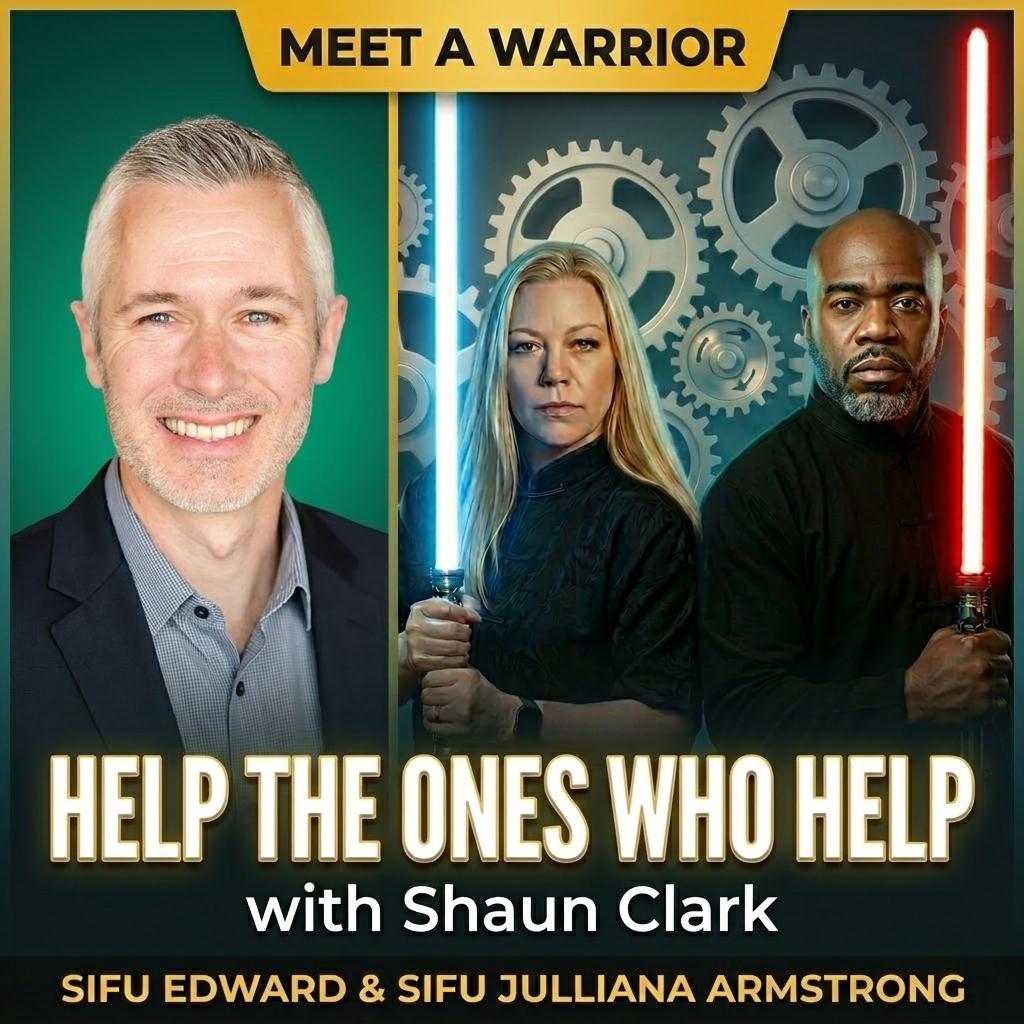
Adapted from the recorded conversation; the guest's words are verbatim. The questions are reconstructed and voiced by Sifu Edward and Sifu Julliana Armstrong.
🎥 Video podcast coming soon. The complete interview will play here once published. The full conversation is transcribed below, and the audio edition will be available on sifuarmstrong.tv.
In a new Sifu Armstrong interview, the co-founder of HighLevel explains how a failed direct-to-small-business pitch became the insight behind the world’s second-largest sales and marketing platform.
Shaun Clark and his co-founders originally built HighLevel to sell straight to small businesses, and kept hearing the same confusing objection. Small business owners loved the product and never used it. He explained the pivot that followed to Sifu Edward and Sifu Julliana Armstrong in the latest Warrior Intelligence Series conversation.
The insight that changed everything, Clark said, was realizing the tool itself wasn’t the customer’s real need. “If you really want to help the small business, you need to help the people helping the small business,” Clark said, the agencies who actually implement and run the systems on a small business’s behalf. HighLevel stopped selling to end users entirely and rebuilt itself around agencies, letting them white-label the platform so a fired agency could still keep the software relationship rather than losing everything at once.
Clark is blunt about why he refuses to ask small business owners to also become marketers. “You can be the best plumber in town... and by the way, you can be a genius software marketer on the side. It’s just a ridiculous notion,” he said, arguing that stacking two masteries onto one person is a recipe for burning out your best people.
Clark is also unwilling to compete with the agencies he serves. “We don’t have a sales team that’s out trying to sell against your customers like other people do. We just don’t have those dynamics,” he said, describing the company’s refusal to sell directly to the small businesses agencies represent.
That philosophy extends to how HighLevel builds new features. Rather than leading with what the company thinks agencies need, Clark says the roadmap follows a public ideas board where customers vote directly on what gets built next, a democratic process he calls central to keeping the platform useful rather than merely clever. Certification for implementation partners works the same way: exams are proctored live specifically so nobody can fake the credential.
Even the company’s approach to new capabilities like AI follows the same discipline. Rather than pushing untested tools onto agencies, Clark described building AI agents meant to handle missed calls and chats for local businesses, the ordinary moments, he said, where a missed call is “never people calling asking about the weather, they’re calling to buy stuff.” Clark credits his third co-founder, Robin Alex, with first showing him the model firsthand as an agency owner with 80 clients and ten employees in Dallas: “If you really truly want to help people, you’ve got to help the people helping the small businesses.”
It’s the same principle the Armstrongs apply to their own network of academy licensees: free the master to master, and give the operator the machine that runs everything else.
In This Conversation
- Why selling directly to small businesses failed before the agency pivot
- The white-label model that keeps agencies from losing everything when they’re fired
- “A ridiculous notion”: why a great craftsperson shouldn’t also have to be a marketer
- Building the product roadmap from a customer-voted ideas board
- Live-proctored certification exams so credentials can’t be faked
- Where to find HighLevel’s YouTube channel and certified partner directory
The Full Conversation
Sifu Edward Armstrong: The single hardest lesson in building a federation is this: you don't scale a movement by reaching every student yourself. You scale it by empowering the people who reach the students. That's the entire theory behind our Academy Commanders. So when I found a man who built the second-largest sales and marketing platform on earth on the exact same insight (help the people who help the little guy), I knew our operators had to hear how he did it.
Sifu Julliana Armstrong: And what I respect is his humility about the craft. He's blunt that a brilliant tradesperson shouldn't have to also become a genius marketer. That's two different masteries. On the mat it's the same: a phenomenal fighter isn't automatically a phenomenal academy owner. The genius of Shaun's model is that it lets the craftsperson stay a craftsperson. That's a gift.
Our guest is Shaun Clark, co-founder of HighLevel, the platform that revolutionised how agencies handle marketing automation and client relationships. Shaun, it's great to meet you.
Shaun Clark: Yeah, likewise. Thanks for having me here.
Sifu Edward Armstrong: Share the founding story, and the vision that drives it. I have a feeling it rhymes with how I had to think about building LSTA beyond myself.
Shaun Clark: Sure, yeah. Myself and my co-founders, we've always wanted to help small businesses and early on we probably like a lot of people started to build a product in a way that we felt like would help small businesses the best. And we very quickly found that a lot of the small businesses we talked to, they would sort of say weird things to us. So they would sort of say, "Oh, this looks great, but we just don't have time to implement it." And that was a very confusing statement initially because we didn't understand how we could build something someone would think would help them but wouldn't bother to want to use it. But I guess all of us know that if we go to the gym more often, we'll probably be healthier, and yet we still don't do it. So it's definitely a human thing. But what we were lucky in is that early on we discovered that if you really want to help the small business, you need to help the people helping the small business and those turn out to be the agencies.
And so we pivoted our product very early on and said, "We're not going to sell to small businesses at all, because really at the end of the day, they need the outcomes of the tools, but they are not going to be the users of the tools." And so we focused on helping enable agencies to take these tools out to market, and we created a business model around it where they can make money. And honestly, that is the whole business that we're in today, which is we really make tools for professionals and we work hard to help those people do the best they can on behalf of their clients. So we're now finally helping the small businesses at a very large scale, but doing so I think in a much better way than we originally started.
Sifu Julliana Armstrong: For anyone who hasn't come across the platform (and you've said most people haven't, by design) what is HighLevel, and what's the magic of the white-label model that keeps agencies from getting fired?
Shaun Clark: Yeah, I mean we're now the second-largest sales and marketing platform in the world, but the reason why most people don't come across us is again, back to the agency concept. One of the things that we saw early on was a lot of agencies would buy tools off the shelf and or tell their clients to go buy them, and then they would pour their heart and soul into these tools to make them work, and then the client would wake up one day and fire them for it. And what we discovered was going on here is that because the tool was cheaper generally, and because the small business had no idea what really went into making it work, they had this illusion that somehow the tool was doing all the work. And so early on we allowed our customers to white label our products specifically to get away from this idea.
And we always thought, well, worst case scenario, if they do decide to fire you, at least you can continue to sell them the platform. And now that's significantly evolved now and we've realised that that actually makes a lot more money for agencies than selling services ever did and it's radically more scalable than services. But all that to say, it certainly helped the agencies retain their clients. But today it also makes it so that if you are staring right at us, you might not even know that we're there. But if you think about any sales and marketing platform on planet Earth, we have every single one of those tools all in one spot. And because we're sort of agency-focused, we also have it broken out, we call it multi-tenant enabled. But the simple idea is that as an agency you can move seamlessly in and out between hundreds or thousands of clients' accounts if that's what you have. And the clients can also log in, but they're only going to see their accounts.
Massive, because again, it really spoke to the need that we saw in the market, which is agencies were not getting the respect that they deserved for the work that they were doing. And honestly, the other really sad part was that when they would lose the customer, the platform that the agency had brought forward would retain them because software is incredibly sticky. And we thought that was entirely unfair. And so now agencies are able to white label and resell the platform. And what we've done is we've turned agencies into de facto software companies and given them the same margins the software companies were enjoying before. Either way, it's radically changed the game for them because they have almost no churn and they have super high margins on the software side.
Sifu Edward Armstrong: That "turn the agency into a de facto software company and give them the margins" is precisely our Academy Commander licensing model. The operator runs a certified academy under our system and keeps the upside, instead of being a disposable middleman. And I love that you refuse to compete with your own customers. Talk about that "agency or bust" commitment.
Shaun Clark: Well, for us, it's agency or bust, and so we don't have cross-channel conflict like other people do. We don't have a sales team that's out trying to sell against your customers like other people do. We just don't have those dynamics. We really do believe this narrative that agencies make the difference between success and failure of the end customer, and we would never want to get in the middle of that. And so as a result, white labelling is important, but it's not the only thing here. You need to really believe the story. It's not like a trick you can pull.
And I think if you've been an agency for any length of time, you've lost a client to some software company who pretended to be your friend. And I think the difference between us is that we have no desire to go out and sell directly to SMBs. We think it's a defeatist concept because again, I think you're kind of lying to people. You're saying, "Oh, hey, you can be the best plumber in town and stay up to date on all the latest plumbing technology, which there is and know how to instal it and all these other things. And by the way, you can be a genius software marketer on the side." It's just a ridiculous notion for us.
Sifu Edward Armstrong: Stop there, because that's the whole thing.
Sifu Julliana Armstrong: It really is. We'd never ask a phenomenal fighter to also be a phenomenal accountant, marketer, and software admin. That's how you lose great teachers. You let the master master, and you hand them the machine that runs the rest. Shaun, take us back to your own path. How did you end up building this?
Shaun Clark: Sure. Yeah. So I'm a software engineer by trade, not a very good one, I'll be frank. But I like it. And I had a SaaS company before that was in the invoicing space that I kind of built off my kitchen table and was like an add-on to Xero and QuickBooks and gave me an opportunity to really meet a lot of the small businesses that we're now serving through agencies and get a perspective on what their needs were. And so I built along with my original co-founder, Varun, who's still with us today, my CTO, the original version of HighLevel. And then once we got large enough to kick me out, they kicked me out. Now the product is even better and the rest is history.
I'm based in Eugene, Oregon but the company is based ... I guess theoretically we're based in Dallas, Texas. But that's just because my other co-founder had an office. So it was either my house, my CTO's house in Qatar or our third co-founder's office in Dallas. And we just thought that looked more legit, but there's no one in that office these days. So we have 1,800 employees worldwide in every manner of country. We've been remote since inception and continue to be remote to this day.
Sifu Edward Armstrong: I have to ask the question I'd ask any teacher: do you train in your own art? Do you use your own platform, and how does that keep it honest?
Shaun Clark: Of course, our entire company uses the platform. I use it every day, 100%. I think a couple of crazy people have advanced the theory that you don't need to, but I just shut that down because that's nonsense. If you don't use your own product, I mean, what's the point?
Although I won't go as far as to say ... I mean, there's certainly things that I've noticed over time that I feel like have been meaningful to fix, but I'll be very careful to say that the driver of our product is our customer, not me. We really feel like we are in service of the agencies that we work with. They are the experts, they know how to build a product, and our mission is to just get behind them and do what they're asking us to do, which is why we have a public ideas list where our customers can vote on what it is that they want to see next. And our product teams literally pull from that ideas list. My favourite thing to do, and probably my biggest job, is I do the release videos, which are every day now, which is amazing.
But what my biggest thrill is to say is like, "Hey, this new feature or this new change or this new enhancement has come out. And oh, by the way, it's because of this idea on the ideas board that you all voted up and the team delivered." I did two of those this morning already, and I'm thrilled because it shows a beautiful ... The way this works, which is our customers asked for this, they tell us based on a democratic process what's more important or less important. And our job is just to deliver those things and they'll take it from there.
Sifu Julliana Armstrong: A democratic ideas board where the operators decide what gets built. That's how a real federation should listen to the people on the front line. Let's talk about where it's going. AI is the word on everyone's lips. What are you building?
Shaun Clark: Sure. Yeah. So I mean, like everybody, I think AI is our big focus of the year, but I would say the difference for us is we try to follow, not lead. And I bet very few people will say that, but again, when you have customers that are so smart and such experts in what they do, you'd be foolish to otherwise. And so I think with AI, what's really important to us is that what are the products that agencies can deploy on behalf of their customers that actually create value, and make those customers money, but also help make the agencies money? And so for us, that is inbound voice AI and all of the conversational AI across all the channels. So WhatsApp, SMS, webchat, et cetera.
So really we think of that in terms of an AI agent system. So really for us, it's about, "Hey, look, you're serving a plumber, a doctor, a lawyer, or a tattoo shop, whatever. Here's the AI agent for them that you can put in place that can pick up calls that they miss, that can pick up chats that they miss, can do back and forth SMS with their clients and achieve certain outcomes, which is the most important thing."
And so the easiest way to think about this is your front desk receptionist. The number of small businesses that miss calls every single day, huge. And those calls are never people calling asking about the weather, they're calling to buy stuff. And so if you simply convert a couple of those calls every month to a booked appointment, that's just magic for every small business. So really for us, it's about helping agencies compartmentalise those for each of the industries that they're working with, getting those deployed and helping them continue to push those out. So that's a big focus of our year.
Sifu Julliana Armstrong: The missed call that was actually someone ready to commit, every academy owner knows that pain, the prospective warrior who reached out and never got an answer. Using AI to make sure no one who reaches for the door gets ignored. That's the technology serving the human moment, not replacing it.
Sifu Edward Armstrong: Exactly, fill the room, never fake it. Now, you mentioned a certified partner program. For the operator who wants in, how do they find the right person to help, and what's the bar to be certified?
Shaun Clark: I mean, well, we have a directory now of great folks, directory.HighLevel.com, of people who can help you implement it. But the question really I think is however you do it, how do you find somebody who can help make that happen for you? And if you go to our YouTube channel, which is always the best place to learn everything about us because we have interviews with some amazing people, it's just incredible how fortunate we are just talking about their expertise for free. But connecting with someone who you feel like can make that happen for you, because a great small business owner is awesome at a craft. And what you don't want to do as a great craftsperson is stray too far from that craft because that's what makes you great.
Now you need visibility, you need people to know you're great at that, and that's what great marketers do. And so it's really just about finding somebody who you feel like can help you implement that. And again, that's why we have our certified partner programme now at that directory site because we feel like it's kind of fun because we proctor all the exams live so you can't cheat. So the people on there actually know what they're talking about, and we're constantly releasing ... As we release new feature sets, we also go in and create courses around this and testing around this, and they have to actually redo a new proctor exam for every single one of them. I laugh because it's one of those things where they'll complain about it, but then as soon as they pass it, they're like, "Yes." And it holds a lot more value for them and for the people that they serve. So it's really cool.
Sifu Edward Armstrong: Live-proctored exams so no one can fake the certification. That's exactly the standard we hold our Academy Commanders to. A credential only means something if it can't be cheated. Now, how fast did the platform take off once you found the right customer?
Shaun Clark: Well, I mean, once we got our act together, initially we sold directly to small businesses. And we found the issue there of people saying, "We love the platform but we don't have the time." But once we figured that out, I would say in the first six months, we bootstrapped the company. Since inception, we've been profitable. So it was fairly early on.
But again, I think it was all about finding the right customer and really focusing on that customer to the detriment of all else, really saying, "Hey, look, if you're not an agency, please don't call me. We're not interested in you." Because we really understood, and actually to be fair, our third co-founder, Robin Alex is really who changed our world here. He was the agency owner who came into our lives and really opened the door here. But he showed us that if you really truly want to help people, you've got to help the people helping the small businesses. And at the time, he was an agency owner with 80 clients and 10 employees in Dallas, Texas. So he really helped show us that method and model. And then of course, subsequently introduced us to everyone. He had built a Rolodex over 10, 20 years of being in the business. So he did an amazing job to help us. But what we did is try to take that opportunity and say, "Look, this is the right answer. Let's go all in." And that's what we did.
Sifu Julliana Armstrong: Robin Alex, that name came up when we sat down with super-connector Charles Byrd, who'd just done a fireside chat with him. The web of these builders really is small. And I love that the right mentor walking through the door changed everything for you. A lot of our listeners have probably used HighLevel without even knowing it, haven't they?
Shaun Clark: I mean, I will tell you, I was researching a product yesterday, and I came across a HighLevel customer. They're in the sauna business apparently. They were at their local sauna store, and they use HighLevel. So we are very much everywhere now, which is so cool. But to be very fair, that has very little to do with us and has everything to do with the agencies that we serve because again, that sauna store is being served by an agency who knows to put that chat widget on their website, which is how I discovered them. So it's pretty cool because I know that when those leads come in, there's a lot more behind that, and all of that's being built out by that agency. But also that agency, unlike other software companies, is actually charging a recurring monthly fee for that software. So they're also benefiting from it from a business perspective, which I think is the best part.
Sifu Edward Armstrong: You've built an all-in-one platform. When a new idea comes, do you spin up a separate product, or fold it in? And for the agency owner who wants to learn more, where should they go?
Shaun Clark: Well, we do that all the time. We take the latter, not the former. So we're constantly looking, and we think of it kind of like the Costco model. So the customer comes in the door to buy the thing that we sell, and then we just ask them all the time, "What else do you do? What else do you buy?" And then we just stock the store with whatever else they buy. So maybe we didn't have tyres to start with or wine, but now we sell tyres and wine and people love us for it. So if they say, "Oh, I love everything you guys do, but I buy this other thing from this other person." If we see enough people doing that, we just add that feature to the platform. So 100%.
The YouTube channel, every time, because that's really where ... Our website is one page. People are shocked to find that to this day, we're still just a one-page website, but let me give you a piece of advice. It works. But the YouTube channel has all the content, all the features, all the interviews with all the amazing experts that we get a chance to deal with. So definitely check out the YouTube channel.
Sifu Edward Armstrong: Congratulations on the incredible success in such a short time, Shaun. We look forward to watching HighLevel grow. Thank you for your time today.
Shaun Clark: Thank you so much for having me. It's great to be here.
Sifu Julliana's closing word: The line I'm keeping is the plumber who's also somehow supposed to be a genius software marketer, "a ridiculous notion." We make the same mistake in martial arts all the time: we take a gifted fighter, hand them a business they were never trained to run, and watch them drown. Let the master master. Build the machine that carries the rest. That's not coddling. It's how you keep your best people doing their best work.
Sifu Edward's closing word: Shaun built the second-largest platform on earth on one refusal: he will not compete with the people he serves. That's the covenant we make with every Academy Commander. We win when you win, never at your expense. Empower the ones who help the warriors. Give the operator the margins, the system, and a certification that can't be faked, then get out of their way. Free the master to master. Give the operator the machine. We don't entertain warriors. We create them.
Shaun Clark, co-founder of HighLevel, the second-largest sales and marketing platform in the world, built agency-first and white-label. Best place to learn: the HighLevel YouTube channel; implementers at directory.HighLevel.com.
ILLUSTRATIVE RESULTS. Any revenue, enrollment, margin or retention figure in this conversation is either a documented result from one of our own operations, a figure the guest reports about their own business, or an illustrative example, never a projection of your results.
Nothing here is financial, legal or tax advice.
Stay in the Fight
This conversation is part of the Sifu Armstrong Warrior Intelligence Series: interviews with world-class performers, builders, and thinkers, filtered through the lens of the warrior's path.
Subscribe at sifuarmstrong.news for every new interview, delivered to you.
Join Club Sabernet, the member community of the whole Sifu Armstrong ecosystem, where warriors train, connect, and hold each other to the standard.
Ready to build your own floor? Find your path at sifuarmstrong.com/which-path.