Good Is the Enemy of Great: Sifu Edward & Sifu Julliana Armstrong Sit Down With Mike Filsaime
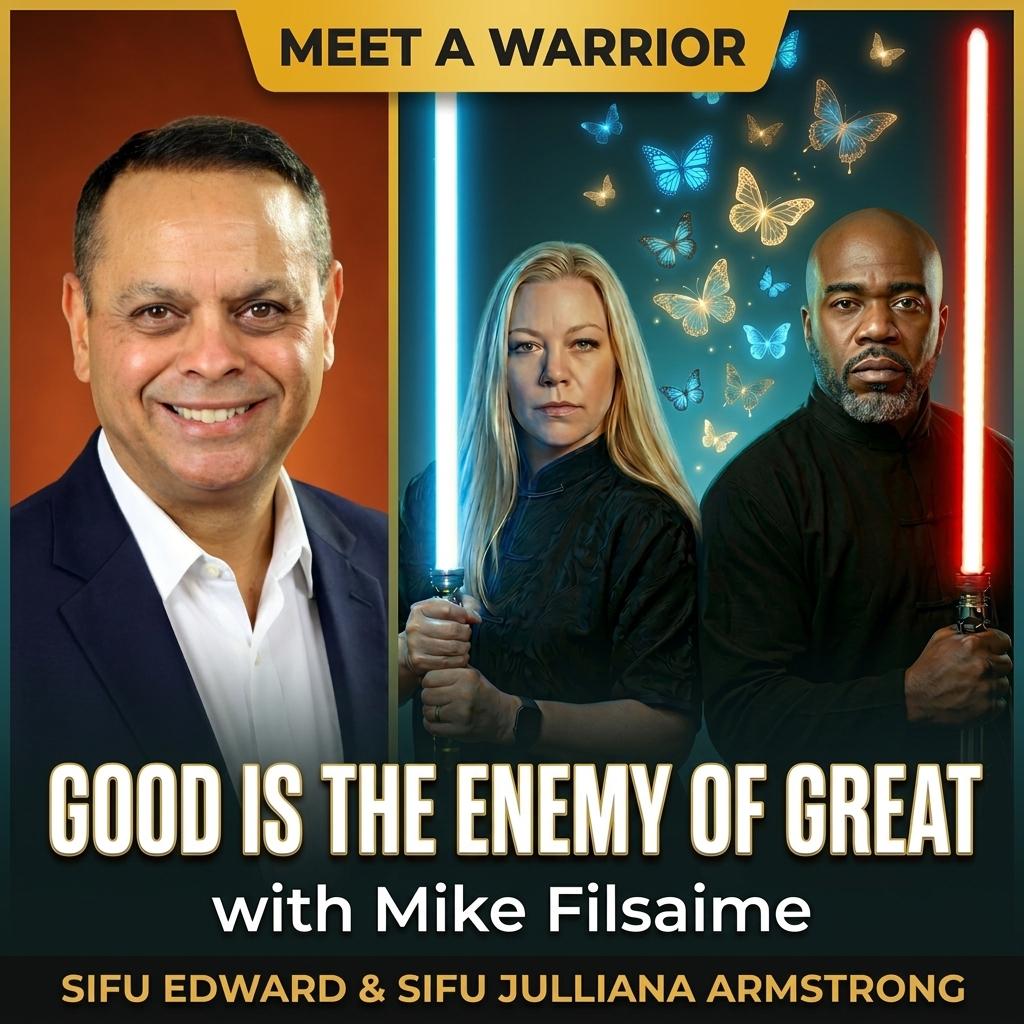
Adapted from the recorded conversation; the guest's words are verbatim. The questions are reconstructed and voiced by Sifu Edward and Sifu Julliana Armstrong.
🎥 Video podcast coming soon. The complete interview will play here once published. The full conversation is transcribed below, and the audio edition will be available on sifuarmstrong.tv.
In a new Sifu Armstrong interview, the GrooveDigital co-founder and Butterfly Marketing creator makes the case that settling for “good” is the real risk, and that surviving your own success matters more than the next launch.
He built more million-dollar software launches than almost anyone in his field, and he says none of it means anything if you’re not healthy enough to live it. That’s the reckoning at the center of a new conversation between Mike Filsaime, digital marketer and co-founder of GrooveDigital, and Sifu Edward and Sifu Julliana Armstrong for the latest Warrior Intelligence Series installment.
Filsaime, creator of Butterfly Marketing and a co-founder behind WebinarJam and Kartra, traced his drive back to a book that reframed how he saw ambition itself. “The first six words of that book are: good is the enemy of great,” he said, recalling Jim Collins’s Good to Great. “There is something great in us. For us to be good at anything is really a disservice to what our true potential is.”
That competitive fire, he said, runs back to a wrestling career that ended one match short of an undefeated season, a loss he says still haunts him decades later. It’s the same drive that carried him through building, and eventually losing creative control of, the company he founded. “I felt like Steve Jobs,” he said of being pushed out as visionary of what became Kartra.
But the turning point Filsaime returned to most wasn’t professional at all. After losing friends and watching his own health slide (high blood pressure, a smoker’s habit, a grandfather who died young), he said the question became impossible to avoid: “What the hell does all this mean if I’m not around to live it?”
Since then, he said, he’s quit smoking, taken up daily walks, and reordered what actually matters. “Take what’s good about your life and put it into your health, and your relationships,” he said. “It’s good to be able to do something that you like and know that money is a byproduct of that.”
It’s a reckoning that lines up with the warrior’s path the Armstrongs teach: chase your true potential, but stay alive and well enough to enjoy what you build.
In This Conversation
- Why “good is the enemy of great” became Filsaime’s operating philosophy
- The wrestling loss that still haunts him decades later
- Building Butterfly Marketing, WebinarJam, and Kartra
- Losing creative control of his own company, and the Steve Jobs comparison
- The health wake-up call that reordered his priorities
- Where to find Filsaime’s current work at GrooveDigital
The Full Conversation
Sifu Edward Armstrong: Every so often you meet a builder whose whole life is a lesson in the thing we teach: that greatness is a refusal to settle for good. Mike Filsaime has launched more million-dollar products than perhaps anyone alive. But what our operators need to hear isn't the scoreboard. It's the driver underneath it. A boy who hid his heritage to fit in, a wrestler haunted by a single loss, a founder who got pushed out of his own company, and a man who finally realised that none of it means anything if you're not healthy enough to live it.
Sifu Julliana Armstrong: The moment he described going 18-and-0 and then getting pinned in the very last match of his career (and how it still haunts him decades later), I knew this was a competitor's soul. I've lived inside that exact ache. I wanted to talk to the fire, and to the peace he finally found.
Our guest is Mike Filsaime, digital marketer, author, software developer, and co-founder of GrooveDigital, the man behind Butterfly Marketing, WebinarJam, Kartra, and more. Mike, an honour.
Mike Filsaime: Probably the best intro I've ever gotten, what a true professional. So happy to be here, excited to give out some great content.
Sifu Julliana Armstrong: Was becoming number one always the ambition? Because I sense the drive comes from somewhere deep.
Mike Filsaime: Wow, I think I have to be completely transparent here. I've never been asked that question. When you meet me I'm probably the guy that when people finally meet me, especially in person, they'll say, "What a nice guy. What an easygoing guy, very unselfish." I'm kind of laid back, but boy, deep inside, there is a driver of me that wants to be number one, at everything I do. I was the type of guy that when we would play foosball in my office, I would win nine out of 10 games. I used to sing the Cranberries song when I would start doing the comeback on somebody, I'd start singing, "I'm in your head, I'm in your head," and I'd score another goal. I would relish kind of the way Michael Jordan did in winning a game. And when I'd lose, I'd put this big smile and go, "You got me, high five," and I would go into my office and grab a pillow and scream "Fuck!" Make sure nobody heard it. But yeah.
There's a competitive nature to me. I think part of it comes from wanting to fit in and wanting to prove. My dad and my mom were born in Haiti. People have this pride of their culture. To be Italian, "kiss me I'm Irish," to be Puerto Rican, Jamaican. And then to be Haitian, not when I grew up. I was born 1967. I'm in high school in ninth and 10th grade, and this virus comes out called the AIDS virus. This thing, if you're old enough to remember it, it scared the hell out of people. When people didn't know if you can get it by touching someone, by looking at someone. My dad was a very well respected person in the automotive industry, and he went for an interview one day. It was a Mercedes Benz dealership and they're loving him. All of a sudden one lady goes, "Haiti. Isn't that where AIDS comes from?" Everyone's face just went pale. And so my dad lied, and said, "Oh no, my parents were from Haiti." My dad came home and told me and my brother, "Right now with the AIDS virus, do not tell people that you're from Haiti." Then believe it or not, I started hearing things from my friends, like their parents weren't allowed to play with me anymore. I'd be like, "What's going on?" "It's because your family has AIDS." I'm talking 10th grade. So I had to hide from who I was.
We had this thing that we would say we were French Canadian, or Martinique. When you would ask me, it was like this thing that you knew you were a fraud, talk about imposter syndrome. Because if you look at me, I could pass for a Dominican, a Puerto Rican, a Mexican, an Iranian, a Persian, Middle Eastern, a Hawaiian, or a Filipino. People would say, "Mike, you have a very interesting look, do you mind if I ask where you're from?" As soon as I started seeing that question, I would start sweating. I'd want to get off of it very quick, because I didn't know if they knew something different. So I think that created something inside of me that wanted to fit in on a deep level. I wrestled in high school. I wasn't the best wrestler in practice, but I worked really hard. There was always this guy, Mike Dell-Poehler, the varsity guy, and I was the junior varsity guy. We used to have these things called wrestle-offs, because the best man wrestles on Friday night. There was none of this participation trophy stuff. Back then you earned your spot. I'd walk up there very shy, play it very coy, then as soon as we would go in, I would blast and I beat this kid every single week, and he'd beat me up in practice. I wrestled my high school year I went 18-0-1. When I was 18-0, I had never been pinned. The very last match that I had, this kid taps the handshake thing, and about two and a half seconds in I was blinded by him doing a fireman's carry, his arm and bicep right into my crotch, pretty much nearly knocked me out.
I got up and I said to my coach, "What happened?" He goes, "You got fucking pinned, that's what happened." It was my last match of my wrestling career. Telling that story today completely haunts me that I was 18-0 and I got pinned in the last one. Being on a wrestling team, there was some brotherhood that was going on there. To walk off in "disgrace," those things lived with me. So yes, there's this competitive thing inside of me. I get motivated by seeing other people's marketing. I say, "That's some magic that they're doing right there. How can I apply that to the outcomes that I want to achieve?" There's a book by Jim Collins called Good to Great. The first six words of that book are: good is the enemy of great. I remember looking at that, and it took me about two minutes to turn the page. Basically what it means is your higher power, godly universe, put us out here with a potential. Isn't it a beautiful thing, to strive towards potential in everything we do: in our faith, our relationships, our health, our fitness, our finances, our kids? There is something great in us. For us to be good at anything is really a disservice to what our true potential is, and that's what I took from it, and I found that to be profound.
Sifu Julliana Armstrong: Eighteen and oh, and the one loss is the one you can still feel. Every real competitor carries that scar, and it's not weakness, it's the exact thing that never lets you settle. "Good is the enemy of great" is the truest sentence I've heard on this show. We put it on the wall.
Sifu Edward Armstrong: Who formed you? Every master was shaped by someone standing at the front of the room.
Mike Filsaime: The one and only, my dad. There is my dad and there's nobody else. My character, my dad. He's a legend of a man, a hero to me and everybody in my family. He came from the spare-the-rod-spoil-the-child school. He never hit me with his hand, he would use the belt. But it was never out of rage, never uncontrolled. It was a discipline thing. He had this weird thing, when we'd get in trouble, it was "on your knees" in the corner of the room for 30 minutes, hands folded. What would happen when I'd get off? I would go to my dad and say, "Dad, I'm sorry." He would say, "Come here, sit next to your dad," and we'd watch TV together. My dad taught me a couple of things. His attitude was a reward system. If I wanted a bike, my dad created a contract. I had to mow the lawn six times, never be late. He'd literally have me sign these things and put them on the refrigerator. Everything was tied into performance. He would call me "top shelf." Even today, he calls me top shelf.
His belief was: you're not better than anybody and nobody's better than you, but you can do anything you put your mind to. He'd come in from the car dealership at 11 o'clock at night, wake me up: "Kik, come keep your dad company." He'd be there with his crackers and cheese giving me lessons: "Let me tell you something about the way the Italians negotiate. Don't ever ask them to sign anything until you shake their hands. These people are people of pride, and they will tell you, 'I've given you my word. My word is more important than anything on a pen.'" He literally gave me life lessons about cultures and different things. He was an entrepreneur, and he instilled in me being an entrepreneur. He'd say, "You need to do every job in the dealership, Mike. You should be the porter for a day, you should clean cars." He had this expression: "You need to inspect what you expect." You need an understanding of everything down to its core level if you're ever going to manage it. My dad is the person that formed me.
Sifu Edward Armstrong: "Inspect what you expect," and "you're not better than anybody, and nobody's better than you." Your father was teaching you the warrior's code before either of you called it that. Humility and standard, in the same breath.
Sifu Julliana Armstrong: How do your parents feel about all you've built, and I sense your mom and dad shaped you very differently.
Mike Filsaime: My dad is so proud. He sent me a text the other day talking about how proud he is and how he talks to people about what I do. If you know my dad, I have to warn you. He's a talker. He'll trap you in a corner and start talking to you about the French Revolution and health and all these things. My mom, on the other hand, gave me a completely different upbringing. I won the presidential physical fitness award all six years, it meant the world to me. I was the fastest kid in the school. When I got the award, I came home and left it on the kitchen counter, went out to play, came back and it was gone. "Mom, where's my presidential physical fitness award?" "I don't know what you're talking about. If it was that important to you, you wouldn't have left it there." Guess where I found it? A certificate signed by Jimmy Carter, in the garbage with spaghetti sauce on it.
That was my mom. She'd clean my room. I had the Thurman Munson card from the New York Yankees, unwrapped, worth a lot. Gone, just thrown out. "Well you shouldn't leave them under your bed." You lose a dog, you lose a cat, not much to shed a tear. Her answer to everything was, "Ours is not to question why, ours is to do or die." "You live and learn. Tomorrow's another day." My mother, you couldn't rattle the woman. She'd tell me, "Mike, stop complaining about things that can be replaced." She never ever said "I love you" up until just recently. I would put the phone on mute and say to Michelle, "Watch this, we're getting off the phone." "All right, mom. Have a good day. I love you." "Okay, bye-bye." And I'd say, "See that? She can't say it." About a year ago, I did one of those things, and she said, "Love you too." I almost broke down in tears. Now she's saying it more. My mom was the best mom anybody could ask for. She was just different than my dad, very matter of fact. It didn't matter if you won or lost.
Sifu Edward Armstrong: Take us to the beginning of the entrepreneurial road, because you were building things long before the internet.
Mike Filsaime: Let's talk about what my parents expected from me. There was never anything like, "You need to become a lawyer, you need to become a doctor." Having said that, my dad's dream was to have me and my brother own a car dealership with him. Where did the entrepreneurial spirit come from? It's either in my DNA or my dad groomed me, because I was an entrepreneur in high school. I was a terrible student when it came to reading comprehension. Those tests are there to fool you. But where I excelled tremendously was math. I was the smartest kid in my class when it came to math. What I found tedious and boring was homework. When I understood something, I knew it in my core, and I did not like to do something 400 times.
In 1982 my friend Mike Batusio across the street had this keyboard thing (a Commodore VIC-20), and he's writing a computer program, hits run and it goes. I'm like, "Oh my god, he literally just programmed that, and I can understand what he did." I immediately gravitated toward that: a Commodore 64, the Commodore 128, the IBM XT. I became a self-taught programmer, and very difficult back then. By the time they're teaching it in school, they send Mr. Weston, a math teacher, over to Stony Brook University to take a crash course. Two weeks into class he says, "I'm giving you an extra credit exam, due before the Christmas holiday. I want you to put in Roman numerals and output the decimal answer." This is not easy, when is an I not added to the previous number but subtracted from the number coming to it? I go in, I learn about this thing called a mid string, I break down every character, I create an algorithm, and I'm up till 3:00, 4:00 in the morning. Finally I crack it.
I get to the school at 7:00 AM, my hands shaking. I walk into class (this is week two of school, the day after he announces the bonus), with 17 pages of printed stuff. "Mr. Weston, here you go." "What's this?" "That's the extra credit." Man, am I waiting for him to give me a hug. He barely looks at it. "Where did you get this from?" There's no internet back then, no GitHub. In his mind, "Who's this uncle you know at the university?" "I made it. I've been up all night." "That's not possible." "Explain to me the code." I did. He looks at me, "Huh." Still not fully believing me, and he puts an A on it and walks away. Very defeating feeling, but completely redeemed as the year went on, because he'd get stuck on a bubble sort and literally say, "Mike, what am I doing wrong?" He learned to respect me. He said, "Mike, you need to become a computer engineer." Back then I didn't get it. There's no such thing as iPhone apps.
However, my dad played the lottery: the same numbers every week, and he never checked his tickets, they'd just stack up. We used to joke we might be millionaires and never know it. I said, "What a great project." I wrote a computer program that stored my dad's numbers on a disc, and every week: "Dad, you ready? Here's the numbers." I realised every state was different, and I figured out the rules for all the states. There was a magazine called Lottery Players Magazine, and I called to place a classified ad for my software. The guy gets on the phone: "Whoa, whoa, wait a minute. Are you telling me you have a computerised program that will check the numbers for all 50 states?" Back in 1986 this was revolutionary. "Where are you?" "Long Island." "I'm in Cherry Hill, New Jersey, can you drive out here?" "I don't even have a driver's license, my dad can take me." He offered me $35,000 for the software, but since it was written on a Commodore and had to be rewritten for an IBM, he offered $25,000. My dad said, "Take it." I sold him the source code, and I instantly got the bug of being an entrepreneur.
I bought Russ Whitney's real estate courses, went door to door on biweekly mortgages. I became the junkie buying things from Don Lapre. I was chasing the dream. I got married young, dropped out of college, and got into the car business. That's where I learned how to become a salesman. I was in that 14 years, and I was a piece of crap for 11, then got hired into the largest privately held automotive group in the country, and moved up the ladder: sales manager, finance director, general sales manager, general manager. I ran the largest Toyota dealership in the Northeast region and the second largest Hyundai dealership in the United States. My competitors did 70 cars a month, we were doing 500. I learned everything about building trust: urgency, scarcity, authority. Then when this internet came out, when I read the sales letter from Frank Kern telling you that you could sell a digital product and take money from PayPal and it'll be in your bank account overnight, my head exploded. There weren't gurus back then, there were hacks, and I was one of them, but I said, "Oh my god, I think I'm born for this. I'm not a career guy." When I put my first product online, and it was online for three days, all of a sudden I looked at AOL and it said, "Notification of payment received, item number one, $19.95." My heart literally started pounding. I said to myself, there is something that I did, that I created, that somebody wanted, and I wrote the words that made them want it. Create a product people want, find out where those people are, and create a compelling message. 14 months later, I quit the car business.
Sifu Julliana Armstrong: I noticed something, in this whole story, you never once said you were motivated by money. What was it, really?
Mike Filsaime: If you notice, I never said I was motivated by money. Not anywhere in this first 40 minutes. For me, going back to being accepted. I love the fact that somebody wanted a product, that I was accepted. That was validation to me. I was seeking validation. When they bought it, it was validation. I'm customer-focused for validation, without a doubt. Number two, I love the task of creating it, and the message, and the marketing, the creativity of writing a sales letter. I have everything I want. I drive a Honda Accord. I have one car. I've been to every country possibly in the world. I've had a Corvette Z06, a Hummer, a Nissan GTR, a Mercedes. I was the 41st civilian to jump out of a HALO dive at 32,000 feet with Yanik Silver. I've done the zero gravity dives, flown MiG jets. I've done everything you'd think you want to do when you make money, and then I realised, no, what I really like is to have a purpose and be an entrepreneur, and drive my fully loaded Honda Accord. I thought being wealthy was about that when I was young. Now it's more about being healthy and living long enough, and being able to put some money in the bank and leave a legacy.
Sifu Edward Armstrong: For those who never came across it. What was Butterfly Marketing, and why did it define you?
Mike Filsaime: I saw a young kid named Mike Chen launch a site called Instant Buzz, a browser plugin that put an ad bar on your browser, a free advertising network. Every time you refresh a page, you get a tenth of a credit; refer somebody and you get credit for everyone they refer, ten levels deep. A traffic exchange. My first product was called Don't Touch My Ads. You download software, and when you stop typing, an ad shows on your desktop like a screensaver. If the ad shows, you get a tenth of a credit. When you signed up for free, there was a one-time offer that would give you 5,000 ad credits for $97, one time, "if you pass on this, you will never see this again." If I'm going to give credit to the person who invented the one-time offer, it was Mark Joyner. I launched Don't Touch My Ads and modelled this one-time offer. I get 5,000 members my very first day. It converted at 20%. The most money I'd ever made in a month was maybe $5,000. I made 19 grand in a day. This is 2003. In the next five days I made more than I made an entire year in the car business. My AOL inbox was sounding like a Jiffy Pop popcorn machine, every one of those a $19 payment.
Butterfly Marketing comes from this original premise, taken to steroids. The premise is: give something away for free, have an upsell. When they sign up, instantly make them an affiliate for that product. To do that, they need an account, so when they sign up you ask for their name, email, and a password. In 2005, 2006, creating an account that makes them an affiliate, the technology didn't exist, so I created it. You give something away for free, they create an account, you show them the upsell, and then they land on the access page. You say: "Thank you for requesting my free report. You may have noticed there was an upsell. Now, below the download, do you see there's an affiliate link? I've already signed you up for my affiliate program. By giving this away to five people, one out of five will buy. That $47 will be a $25 commission to you." I called this the do-the-math stack: "If you tell 10 people, you'll make $50. If you tell 100 people, you'll make $500. If you tell 1,000 people, $5,000." I've stacked a bunch of promotion tools that already have your affiliate link: pre-written emails, banners, a signature, a blog review.
The secret magic driver said: "One last thing. Your affiliate percentage, if you didn't buy the upsell, it's 25%, but if you did buy the upsell, we've automatically upgraded you to 75%. If you didn't buy the upsell and you know you could make some money, you might want to click 'upgrade me now.'" This increased the upsell conversion rate, and it turned every customer into an advertising department, old school it's called word of mouth, then viral marketing. Butterfly Marketing was software that created an affiliate in an instant, gave them a page and their links, upgraded their commissions. It was the most successful software of its kind, bar none. I did a million dollars in five days, $575,000 in one day. It put me on the map. I always say this: there have been 11 human beings to walk on the moon, all Americans. The first two were Neil Armstrong and Buzz Aldrin. Can you name another? Most people can't. John Reese was the first guy to do a million dollars in a day, August 4th, 2004, before that nobody had done more than $70,000 in a day. He wrote a report: "One man, one product, one million dollars, one day." He said, "I believe this is a milestone like Roger Bannister breaking the four-minute mile." You can look it up: John Reese released that report on August 31st, 2004, and the domain name Butterfly Marketing was registered on August 31st, 2004. I almost choked up. That report was so inspiring. He gave me the formula for a million-dollar launch, and I said, I'm going to create software that lets people replicate it. It took me 18 months to become Buzz Aldrin. The second person to do a million-dollar launch. I became one of the Beatles. John Reese was John Lennon, and I became Paul McCartney.
Sifu Edward Armstrong: And GrooveFunnels is where all of that lives now?
Mike Filsaime: Yes. I'm now writing a book called Butterfly Marketing, and doing the biggest case study on it the world has ever seen. GrooveFunnels is a brand, not an app, an entire platform filled with apps. GroovePages, the world's best landing page and funnel builder. GrooveSell for your digital products and affiliates. GrooveMail for email marketing. GrooveMember, GrooveVideo, GrooveBlog, GrooveDesk, GrooveSurvey, GrooveQuiz. It's got everything to help you leave every other platform out there, including WordPress, all rolled into one. We've given GrooveSell away for free. Go to groovesell.com and you'll never have to give us a credit card. Why? It's the butterfly model. The catch is I've got an upsell into the entire suite, but if you're happy using ClickFunnels and ActiveCampaign, go use that. We give you all the tools, the banners, the reviews, the email swipes, one-click post to Facebook, Twitter, Instagram, Pinterest. We incentivize you to refer people, and we lock that person with a parent-child relationship in our database, locked in for life. We do a two-tier program. You get paid on anybody they bring in too. This is classic Butterfly Marketing, baked in.
Sifu Edward Armstrong: Here's what I most want to understand, Mike. You already built Kartra and WebinarJam. Why start over with Groove? And I sense there's a hard story in that answer.
Mike Filsaime: There's nobody online that's even come close to launching more million-dollar brands than I have: on average 2.5 per year since 2004. The mistake I made was that all of these were different brands that took my focus away, and I was working with different partners. GrooveFunnels is a compilation of my whole body of work (Evergreen Business System, WebinarJam, Kartra, Butterfly Marketing), all incorporated into one platform. But here's what was hard. I started this all-in-one journey in 2011 with Deal Guardian, which morphed into Kartra. This was my company with Hector. My former partner, Andy Jenkins, has passed away, so I'm going to try to stick to the overarching facts. Andy wanted to be an educator; I wanted to do software. He said, "You've got to choose your partner," and I said, "Why don't you come take this journey with us?" Andy came into the company and took over a third of it. I had a third and Hector had a third. And the dynamic changed. I went from being the visionary CEO of a software company to an equal third partner (no longer a CEO, no longer the visionary), with a person with a very strong personality. In the world of development and entrepreneurship, there's an expression: money likes speed. Andy and I had too much respect for each other; we were getting too much information, nobody just saying "this is how we're going to do it." Andy's personality started taking over. He started running it more as his company and I became more of an employee in it. It no longer became fun for me. We came to an agreement that one of us would leave.
I decided to take the buyout. The most polite way I can say it is: mommy and daddy got a divorce, and they kept the kids. Then a very tragic thing happened. I had my two-year non-compete, and while that happened, Andy got cancer and passed away. Now his wife Sarah and Hector are running the company. But for me, I felt like Steve Jobs. I had a passion for this thing, and one day I find myself out of my own company. These things happen in business as they happen in marriages. Right now, with the Steve Jobs metaphor, I'm at NeXT Computer. Steve went on to found NeXT, and they ended up getting bought out by Apple. Frankly, I'm the visionary of these ideas. These were my ideas, and I left the soul of that company. I just wasn't happy anymore. I needed to move on, wait my turn, and now I'm with a company where I've got partners that excel in their things: Matt Serralta, Matt Naus, John Cornetta, and myself. They've seen me come up. They know I'm a software visionary. They give me their input, but they let me drive the car. That's why we're able to do the incredible things we're doing very quickly.
Sifu Edward Armstrong: Stop there, Mike, because you just told my story in a different costume. To go from the visionary of the thing you built to an employee inside it, and then to walk out and start over with only your name and your ideas. I left a franchise the same way. It is a kind of grief. And it's also the doorway. NeXT is where the real work begins. (And I have to smile, John Cornetta sat with us on this very series; the band's getting back together.)
Sifu Julliana Armstrong: This whole journey sounds like self-development as much as software. And you mentioned health. Tell me about the wake-up call.
Mike Filsaime: Let me wrap up with a metaphor. I'm a big fan of Better Call Saul. Last night's episode has Kim, who quits the law firm where she's making half a million a year (a really good job), and she just quits, to do pro bono work. Jimmy says, "What are you doing? You made a ridiculous choice." And she says, "I did what was right in my heart." That was what was happening to me. When everybody was telling me I'm making a mistake, this is going to be a big company, just sit out and maintain your shares. I said, "I don't feel happy in what I do." Sometimes we make decisions and they're the wrong decisions; hindsight will tell us. But I want to do things that make me happy, and things that are fulfilling to my customers. And here's what fulfilled feels like. I've quit smoking. I used to forget my phone downstairs, and the fear of having to go back up the stairs. I couldn't go up and down stairs twice without hearing my heart. My grandfather died at 49 of a heart attack. I'm going to be 53 this year. I started having these feelings of, I've effed up in my life. I was a frigging smoker who thought the chickens were never going to come home to roost, and I've got high blood pressure. I've lost Andy. I've lost my friend Sean Wander. I've seen friends die. And I think that I'm special. I'm just not.
I'm an out-of-shape guy. What the hell does all this shit mean if I'm not around to live it? I've quit smoking. I do a daily walk, even if it's pouring rain, come hell or high water. I remember the first three days I'd say to Michelle, "Babe, slow down, why are you walking so fast?" She goes, "I'm not, babe, I'm just walking." It was just me being embarrassed that I was getting leg cramps from walking. I couldn't do a one-hour walk. Now, six months later, we race (let's jog the last half mile), and I'm feeling fit and lighter, my skin complexion looking good. John Cornetta bought me this green shake mix, and I drink a green shake every day for breakfast, no longer the eggs and bacon. I'm not perfect by any means, but I quit smoking. I'm loving these new things like biohacking that say, "If you live long enough, you might live long enough to the next stage where we can extend life another 20 or 30 years." I came really close to tempting fate, thinking I could outsurvive this thing while watching people around me die. I'm in a place right now where I've never been more happy in my life, and good is the enemy of great. Take what's good about your life and put it into your health, and your relationships. It's good to be able to do something that you like and know that money is a byproduct of that.
Sifu Edward Armstrong: Mike, this has been a gift. Where can people find you?
Mike Filsaime: Best thing to do is go to groovedigitalfb.com. Our Facebook group is open to everybody, and we give free trainings every Tuesday and Thursday. Or if you want the free software so you can sell your products without giving us a credit card, just go to groovesell.com and start using it.
Sifu Edward Armstrong: Mike Filsaime, thank you so much for your time, and your honesty. It's been an absolute pleasure.
Mike Filsaime: Same here. Thank you very much.
Sifu Julliana's closing word: I will carry the boy who hid where he was from, and the wrestler who went 18-and-0 and can still feel the one that got away. That ache isn't a flaw. It's the engine. But the thing that moved me most was the end: a man who did the HALO dive and flew the MiG jets realising none of it counts if you can't climb your own stairs. He found the fight, and then he found the reason to stay alive for it. That's the whole warrior's arc.
Sifu Edward's closing word: Mike lost his company the way I lost a franchise (as the visionary reduced to a passenger in his own creation), and he walked out with nothing but his name and his ideas and built it all again. That's the rebuild we honour. And his father gave him our code before either knew it: you're not better than anybody, and nobody's better than you. The competitor's fire builds the empire. The warrior's peace is what lets you keep it, and lets you live long enough to enjoy it. Good is the enemy of great. We don't entertain warriors. We create them.
Mike Filsaime, digital marketer, author, software developer, and co-founder of GrooveDigital; creator of Butterfly Marketing, WebinarJam, EverWebinar, and Kartra. groovedigitalfb.com / groovesell.com.
ILLUSTRATIVE RESULTS. Any revenue, enrollment, margin or retention figure in this conversation is either a documented result from one of our own operations, a figure the guest reports about their own business, or an illustrative example, never a projection of your results.
Nothing here is financial, legal or tax advice.
Stay in the Fight
This conversation is part of the Sifu Armstrong Warrior Intelligence Series: interviews with world-class performers, builders, and thinkers, filtered through the lens of the warrior's path.
Subscribe at sifuarmstrong.news for every new interview, delivered to you.
Join Club Sabernet, the member community of the whole Sifu Armstrong ecosystem, where warriors train, connect, and hold each other to the standard.
Ready to build your own floor? Find your path at sifuarmstrong.com/which-path.