Giving Up Isn't an Option: Sifu Edward & Sifu Julliana Armstrong Sit Down With BrightFlame Books' Rob Cuesta
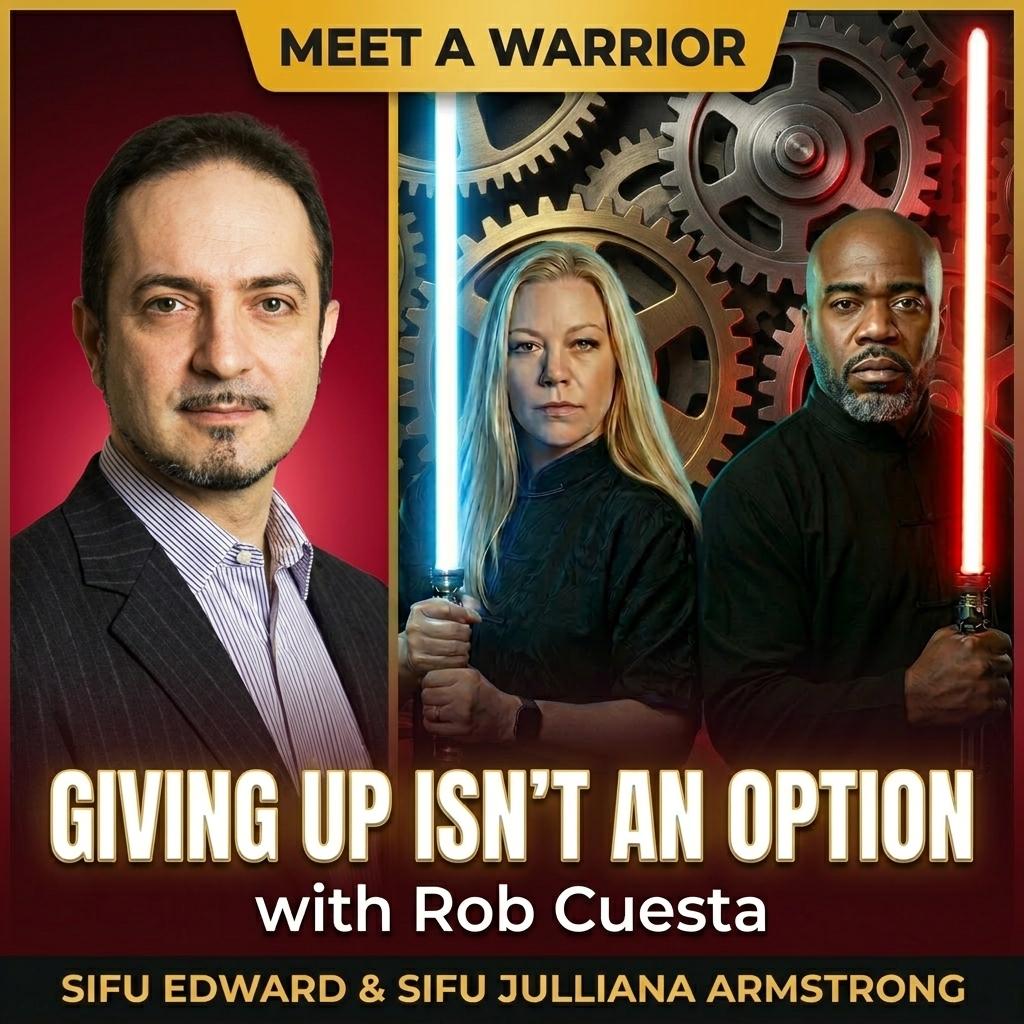
Adapted from the recorded conversation; the guest's words are verbatim. The questions are reconstructed and voiced by Sifu Edward and Sifu Julliana Armstrong.
🎥 Video podcast coming soon. The complete interview will play here once published. The full conversation is transcribed below, and the audio edition will be available on sifuarmstrong.tv.
In a new Sifu Armstrong interview, the authority-positioning publisher explains how a book can make someone the only person a prospect will call, and how he rebuilt his business from collapse three times over eighteen years.
Rob Cuesta walked out of a $140,000-a-year consulting job in 2002 convinced the world would beat a path to his door. It didn’t. His conversation with Sifu Edward and Sifu Julliana Armstrong for the Warrior Intelligence Series traces three separate collapses over the following two decades, and the single refusal that carried him through all of them.
“Giving up isn’t an option,” Cuesta said, describing what he settled on after two days of being furious at himself and the market during his lowest point in 2005. That anger, he said, wasn’t the problem. It was what he did at the end of it that mattered: he sat down and set an actual revenue goal for the first time, and came within a few thousand dollars of hitting it inside a single year.
The idea that eventually became his company, BrightFlame Books, grew out of a pattern Cuesta noticed working directly with clients: the ones who had written a book were consistently outperforming the ones who hadn’t, and the ones without one kept promising to get around to it. So Cuesta built a process to write it for them: planning the marketing campaign first, then using an interview-based process to turn a client’s spoken expertise into a finished book, because, as he put it, most experts “can talk for hours about it” even when they can’t easily write it down.
The clearest proof of what a finished book can do, Cuesta said, came from a client whose entire board of directors showed up to a meeting each holding a copy of one of his books, because the CEO had required everyone to read it before Cuesta even walked in the room. The client’s opening request became the thesis of Cuesta’s whole business: “We want you to turn us into the natural expert in our industry.” Since Cuesta had coined that exact phrase in the book itself, there was no one else the client could plausibly call.
That same client had spent three years failing to get a response from a major hotel chain, until a copy of the book went out and drew a reply within a week. Cuesta doesn’t oversell what a well-placed book can do quietly. “The book is a door-knocker-downer,” he said. “It’s a battering ram.”
None of it, Cuesta is careful to note, followed anything like a plan. “If you want to make God laugh, show him your business plan,” he said of his first attempt at self-employment, a lesson he only fully absorbed after nearly losing everything twice more.
The Armstrongs connected Cuesta’s positioning philosophy to their own approach to the Sifu Armstrong name: not simply being one voice among many, but becoming the definition a field is measured against.
It’s a principle that outlasts any single industry, the person who writes the definition is the one nobody else can compete with.
In This Conversation
- Walking away from a six-figure job and losing nearly everything, twice more
- “Giving up isn’t an option,” the two days of anger that preceded every turnaround
- How BrightFlame Books turns spoken expertise into a finished book
- The board meeting where every director already owned a copy
- “The book is a door-knocker-downer. It’s a battering ram.”
- Co-authoring the Outrageous Campaigns books with Bill Glazer
The Full Conversation
Sifu Edward Armstrong: Rob Cuesta builds the single most powerful positioning tool a master can have, a book that makes you the natural expert in your field, the one nobody else can compete with. That's the entire game we play for the Sifu Armstrong name: not to be one of many, but to be the definition. And he's ridden a riches-to-rags-to-riches rollercoaster three times over eighteen years, which is why I trust what he says about authority. He's earned it the hard way.
Sifu Julliana Armstrong: And the sentence that stopped me is the one he's proudest of: giving up isn't an option. Three collapses, and every time he sat in the wreckage, got mad, set a goal, and turned it around. That's not luck. That's a competitor's refusal to accept the scoreboard as final. I wanted to talk to that fire.
Our guest is Rob Cuesta, founder of BrightFlame Books, and co-author with Bill Glazer, who joined us earlier in this series. Rob, welcome.
Rob Cuesta: Hello. Great to speak with you.
Sifu Edward Armstrong: Your CV is impressive, so take us back to how it actually started, mistakes included.
Rob Cuesta: Back in 1997 I caught the coaching bug, when coaching was an industry that had barely started. I was working for one of the big consulting firms in London. A few years later I decided coaching was the way ahead, and I'd set out on my own, with that impressive CV, of course the world would be my oyster and everybody would beat a path to my door. In 2002, I walked out of what was then a $140,000-a-year job, not realising I had just become a $14,000-a-year coach. Because predictably, nobody knew who I was, and nobody wanted to hire me. That was how I got started: by making the mistake a lot of entrepreneurs make, which is not thinking about what my market was going to be, or what I was going to offer. I just took a great idea that I thought the world needed and went out to offer it. The only reason I can say it was $14,000 a year is because in the first year I made about three times that, and in the following two years I made virtually nothing.
I always say, if you want to make God laugh, show him your business plan, but I hadn't even gotten to the point of having a business plan. I'd decided one day I'd had enough and I was going to set the world on fire. Instead of tapering in, doing some work on the side and building it up, I went cold turkey. I literally walked into my boss's office and said, "I quit." It was a sobering lesson.
Sifu Julliana Armstrong: Then came what you call your "Lost Days." Tell me about the bottom, and the turn.
Rob Cuesta: By the beginning of 2005, I realised I've got no clients, no money, and I was very rapidly heading towards bankruptcy. I spent two days being mad at the world, mad at my prospective clients for not hiring me, mad at myself for being so stupid. At the end of those two days, I sat down and did something I should have done in the first place: I actually set some goals. The first goal I set was that by the end of the year I'd be making 100,000 Sterling, about $160,000 US at the time. I made it to about $96,000, so I fell $4,000 short, but I let myself off. I'd gotten close to the intent. I'd managed to turn it around in a single year.
Sifu Julliana Armstrong: Two days mad at the world, and then you sat down and set a goal. That's the whole turn right there. The anger is allowed (you feel it, you let it burn), but the champion is the one who, at the end of it, stops blaming the floor and starts naming the target. Rock bottom isn't the end of the story. It's the two days before you decide who you're going to be.
Sifu Edward Armstrong: And what actually pulled you out, because I sense it was partnerships.
Rob Cuesta: Quite by chance, I started doing joint ventures. That literally saved the business, and saved me. The first JV wasn't successful. I dialled into a teleconference from a hotel in Newcastle on a ridiculously expensive international line, hadn't thought about the call-to-action, threw one together at the end, and it netted me about $100, which didn't even cover the phone call. So I went back to the drawing board, set up another JV with a partner that was a better match (personal branding, ironically), and that got me to a few thousand. Then what got me to the $100,000 mark was finding one partner that was perfectly aligned, with the right offer for their audience. They were desperately in need of what I was offering. That one partnership turned into almost a six-figure business. Finding the right partners and alliances can be the difference between having a very expensive hobby and a viable, successful business.
Sifu Julliana Armstrong: But it wasn't a straight line up, 2008 nearly took you back to rags. How did you recover faster the second time?
Rob Cuesta: By 2008 I'd built a very successful one-man business, coaching senior partners in big firms, travelling the world. Then in October 2008, the world collapsed. I was literally packing to fly to New York to coach a client when I got a call: "The market has collapsed, don't bother getting on the plane." Riches, to rags, to riches, and now facing rags again. But this time it didn't take three and a half years to figure out what to do. My gut reaction was joint ventures again, and they helped. But the other thing I did (which I hadn't before) was join a Mastermind group. I suddenly realised, I need other smart people around me. Some would think it insane, spending $10,000, $15,000, $25,000 to be in a room with other people when your clients are disappearing. But I needed to be around people whose businesses were successful, and learn from them. By the end of 2009, I'd got the business back up to $200,000 and beyond. And around 2010, people who hadn't recovered from the crash started asking, "How did you do that? Can you teach me?"
Sifu Julliana Armstrong: Spending your last money to sit in a room with better people. That's one of the smartest things you said. When you're losing, the instinct is to isolate and grind harder alone. The wiser move is to surround yourself with people already standing where you want to stand. That's what a real training room is: not comfort, but the pressure and the proof of people who've already done it. You don't rise alone.
Sifu Edward Armstrong: That led to BrightFlame Books. What's the core insight, and the process?
Rob Cuesta: I ended up running a business I didn't much enjoy, managing website developers and copywriters, checking boxes on a spreadsheet. I'm a strategist and a thinker; I love writing and presenting, not project plans. So in 2014, when we moved to Canada, I asked myself: if I don't like the business I'm running, what business do I want to run? The very first thing we told our clients was that they needed a book, and there was a big difference between the clients who'd written one and the ones who hadn't. The ones who had were going great guns; the ones who hadn't didn't have that success. The problem was, if you just tell someone "a book is really useful, you need to write one," the chances are you'll see them two years later and they still won't have written it. So I thought: I like writing, I know the value of a book as a marketing tool, and I know how to build campaigns around one. Let's take the hassle away and just write the book for them. That became BrightFlame Books.
The process starts with planning the whole marketing campaign first. What do we want the customer to do after they've read the book, how are they going to get it, and what content will make them take that action? Then we hand off to a ghostwriter, because most people struggle to write about what they do, but they can talk for hours about it. That's what they do all day. So we use an interview-based process, a few hundred questions that become an interview guide, and the writer's job is to turn that conversation into a book. We're not doing 20-page extended sales letters. We create 120- to 160-page books that look worthy of a major publisher, that I call a "sales meeting in a box." Then our designers make it look professionally published, and the capstone is a bestseller launch that creates buzz.
Sifu Edward Armstrong: Give our warriors the story that proves what a book actually does, because I think it's about becoming the one and only.
Rob Cuesta: I always tell the story of the world's shortest sales meeting. A prospective client had read one of my books on Amazon and invited me in. I drove to London expecting to meet one person, and found their entire Board of Directors, every one of them with a copy of the book in front of them, because the CEO had bought a copy for each and made them read it. As we started, he said, "We want you to turn us into the natural expert in our industry." Now, "the natural expert" is a term I'd created in that book. So I knew two things instantly: first, there's only one person in the world who could make them the natural expert, because I'd literally written the book about it. They couldn't call anyone else. And second, if they'd made everyone read my book, all their objections were already handled, and this wasn't a sales meeting, it was a kick-off meeting. At the end they just said, "Send us a note with your fee."
That same client wanted to work with big hotel chains but couldn't get through the door. One chain they'd been trying to reach for three years, no returned calls, emails, or letters. We wrote the book and launched an outrageous multi-step campaign starting with it. About a week after the book went out, an email came back: "I've read your book, we need to talk." Three years of nothing; a book, and within a week they're coming to us. Another chain's gatekeeper actually emailed to say, "You sent your book to the wrong person, I've forwarded it to the assistant to our Operations Director, they'll call you to set up a meeting." When was the last time a gatekeeper went out of their way to make sure your sales brochure reached the right person? A sales letter ends up in the trash. The book is a door-knocker-downer. It's a battering ram.
Sifu Edward Armstrong: "You wrote the definition, so you're the only one they can call." That is exactly the game we play for the Sifu Armstrong name. A book positions you as the natural expert, the one nobody else can compete with, because you wrote the definition. That's how you become the GOAT of your field on paper, and a battering ram that opens doors no cold call ever could.
Sifu Edward Armstrong: You co-wrote the Outrageous books with Bill Glazer, who sat with us earlier. How did that come about, and what's next?
Rob Cuesta: I was referred to Bill by a well-known marketer, Mike Hanicks. After Bill had a stroke, he took it easy, then decided he wanted to write a book and asked Mike who to talk to. Mike said, "Talk to Rob Cuesta." I got a text: "Do you know who Bill Glazer is?" I said, "Of course. He's the G of GKIC." "Would you like to work with him?" I edited my response down to something publishable, but it was effectively, "Yes, of course." We hit it off immediately, and now it's our fourth year working together. I helped him write the first volume of Outrageous Campaigns, which became a live event, then a virtual summit that became volume two, 42 campaigns from marketers like Ryan Deiss, Yanik Silver, Nick James, Marisa Murgatroyd. And we launched a membership with Bill's daughter Mara.
What's next, a live event with Bill and Mara, a Mastermind (because the years I've been in a Mastermind have always been my most successful), and a group book retreat, where we basically lock you in a room and don't let you out until you've written your book, because if we send you away, I know the chances of you finishing are slim.
Sifu Julliana Armstrong: After eighteen years and all those rollercoasters. What are you most proud of?
Rob Cuesta: Still being in business, 18 years in. We hear all the statistics about how many businesses collapse in the first year and the first five. Despite the rollercoaster, I've never let it get in the way. Whatever the world has thrown at me, I've always thought, this is what I want to be doing. I can either give up on what I want, or I can keep going. Giving up isn't an option. And the other thing is the books. Even now I look through them and it's almost like somebody else wrote them. I still find stuff I've forgotten. They have pride of placement on my bookshelf, because I'm incredibly proud of them, and of the team I've built. You can find us at OutrageousMarketersLive.com and BrightFlameBooks.com.
Sifu Edward Armstrong: Rob, thank you so much. I've really enjoyed this, and good luck with all of it.
Rob Cuesta: Thank you for taking the time.
Sifu Julliana's closing word: Three collapses, and the thing Rob's proudest of is that he never quit. "Giving up isn't an option." That's not a motivational poster, it's the actual decision he made in the wreckage, three separate times, after two days of being mad at the world. Feel the anger, then set the target. And surround yourself with people already standing where you want to stand. That's how you turn a rollercoaster into a career.
Sifu Edward's closing word: Rob makes people the natural expert of their field, the one and only, the definition nobody else can compete with. That is precisely the game we play for the Sifu Armstrong name, and it's why a book matters to a federation: it's a battering ram that opens doors no cold call ever will, and it positions you as the GOAT on paper. Become the definition. Surround yourself with masters. And whatever collapses, refuse the exit. We don't entertain warriors. We create them.
Rob Cuesta, founder of BrightFlame Books (brightflamebooks.com), authority-positioning publisher; co-author with Bill Glazer of the "Outrageous" campaign books. Live event at OutrageousMarketersLive.com.
ILLUSTRATIVE RESULTS. Any revenue, enrollment, margin or retention figure in this conversation is either a documented result from one of our own operations, a figure the guest reports about their own business, or an illustrative example, never a projection of your results.
Nothing here is financial, legal or tax advice.
Stay in the Fight
This conversation is part of the Sifu Armstrong Warrior Intelligence Series: interviews with world-class performers, builders, and thinkers, filtered through the lens of the warrior's path.
Subscribe at sifuarmstrong.news for every new interview, delivered to you.
Join Club Sabernet, the member community of the whole Sifu Armstrong ecosystem, where warriors train, connect, and hold each other to the standard.
Ready to build your own floor? Find your path at sifuarmstrong.com/which-path.