Get a Coach: Sifu Edward & Sifu Julliana Armstrong Sit Down With PLR Pioneer Jimmy D Brown
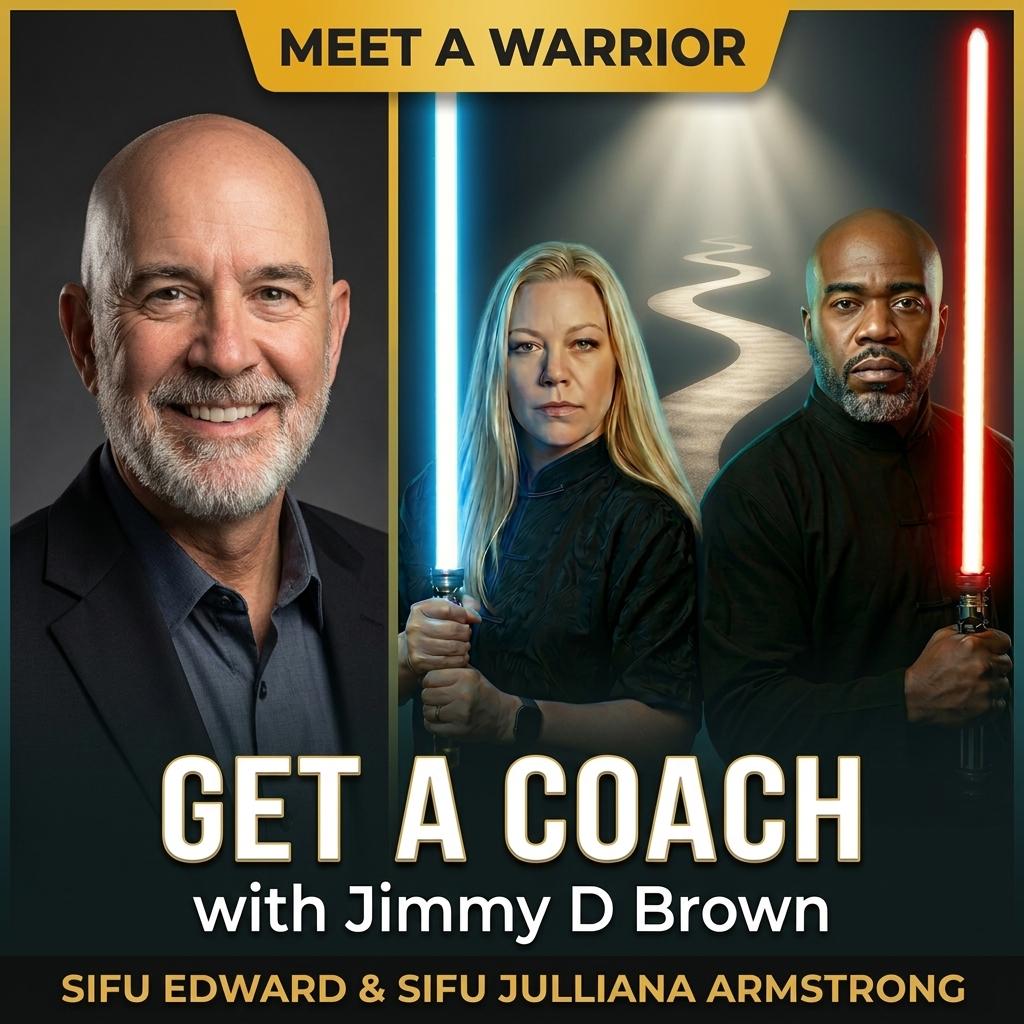
Adapted from the recorded conversation; the guest's words are verbatim. The questions are reconstructed and voiced by Sifu Edward and Sifu Julliana Armstrong.
🎥 Video podcast coming soon. The complete interview will play here once published. The full conversation is transcribed below, and the audio edition will be available on sifuarmstrong.tv.
In a new Sifu Armstrong interview, the man who coined the term PLR explains why a Walmart parking lot breakdown taught him more about mentorship than any book ever could.
Jimmy D Brown built the licensing model (private label rights, or PLR) that now lets one person’s expertise be edited and resold by thousands of others. But in a new Sifu Armstrong interview with Sifu Edward and Sifu Julliana Armstrong for the latest Warrior Intelligence Series conversation, the lesson he returned to again and again wasn’t about content. It was about coaching.
Brown traces his start to the late 1990s, when a failed referral scheme through an early online bank led him to launch profitsvault.com in 2000. By 2003 he was running a monthly membership site, and when he handed members fully editable “products in the rough,” the format took off. Working with Ryan Deiss to launch the first PLR membership site, Nicheology, the pair sold out 1,500 memberships at $29.97 a month almost immediately.
Brown credits one operating principle above all others for the longevity that followed: “Rather than trying to be good at many things, be great at a few things,” he said, describing a discipline of mastering one offer before diversifying, a habit that kept his residual income steady even when broader online sales slowed after the September 11 attacks.
He’s equally insistent on quality, recalling an early purchase (a list of “20 ways to make money on eBay” with no real instruction behind it) that left him feeling deceived and shaped his entire approach to what he sells. That standard extends to how he evaluates PLR buyers' own mistakes: buying cheap, bulk content that needs total rewrites, and buying content they never actually use.
Brown also credits knowing his own limits as much as knowing his market. For 24 years he’s stuck to topics he knows deeply rather than chasing every trend. “I don’t sell products about SEO because I don’t know much about it,” he said. “I sell a lot about digital publishing and content creation, because I know those very well.”
But the story Brown chose to leave the Armstrongs with was personal, not professional. Training for his first marathon, he hit a wall no book or downloaded plan could get him past. “I called my wife one day from a Walmart parking lot while I’d been out on a run and said, 'Come get me. I’m quitting, and I’m never running a marathon,'” Brown said. A coach, a nutritionist, and a physical therapist later, he’s now run 106 full and ultra marathons, including six 100-mile races.
The lesson he draws from that is the one he wants every entrepreneur to hear. “Information will only take you so far,” Brown said. “Having someone else in your life who has already succeeded in what you want to do will take you the rest of the way.” He put it more simply still: “You don’t get off the couch and run a marathon the next day.”
It’s the exact case the Armstrongs make for the role of a Sifu. A book can hand you the map, but only someone who has already walked the trail can watch your stride and correct it.
In This Conversation
- How a failed referral scheme led to inventing the PLR licensing model
- “Be great at a few things,” the discipline behind two decades of residual income
- The eBay ebook that taught Brown never to let a customer feel deceived
- The most common mistakes buyers make with PLR content
- The Walmart parking lot breakdown that led Brown to 106 marathons
- Why information alone never finishes what a coach can
The Full Conversation
Sifu Edward Armstrong: After twenty-four years and a hundred and six marathons, Jimmy D Brown offered the single most important sentence any student of any craft can hear: information will only take you so far, someone who has already walked the path takes you the rest of the way. That is the entire reason a Sifu exists. So when I found the man who literally invented the content-licensing model that lets one master's knowledge reach thousands, and who then insisted you still can't skip having a coach, I knew our warriors had to hear him.
Sifu Julliana Armstrong: And he's an ultra-marathoner, a hundred and six full marathons, six of them a hundred miles. He knows in his own legs the thing I know on the mat: you don't get off the couch and run a marathon the next day. You make progress and you persevere, and somewhere in there, a coach makes all the difference. I couldn't wait to talk to him.
Our guest is Jimmy D Brown, a genuine pioneer of internet marketing, the man who coined the term PLR, and creator of Earncome and Nicheology. Jimmy, welcome.
Jimmy D Brown: Well, thanks very much for having me. Really, I'm the one who's honoured to be a part of your podcast here.
Sifu Edward Armstrong: Take us to the beginning, how you got in, and how you came to invent an entire licensing model.
Jimmy D Brown: So back in the late '90s, I first came online to buy some sports cards for a collectible shop that I owned, and I started getting these spam emails about making money online. I had always loved writing, and the thought of creating a digital information product sounded appealing. I liked the idea of doing the work once and getting paid over and over. I stumbled upon a website called X.com, which was actually owned by Elon Musk, although no one knew who he was back then. It was an online bank that gave new customers $25 to open a free account, and $25 for every customer you referred. So I wrote a little ebook I sold for $12.95, showing people ways to make money online, one of which could earn them $25 over and over. People would buy the ebook, click through to X.com through my referral link, and I'd earn $25 in commission. Over and over. I thought I was set up for life. But then X.com merged with another company, changed its name to PayPal, and decided they weren't going to do the $25 referrals anymore. So not only could I not get the commissions, I could no longer sell my ebook because it was no longer valid. I was basically out of business. But I saw the potential for selling information products to a global audience from home, and I launched profitsvault.com in August 2000.
Toward the beginning of 2003, I started a monthly membership site where I created a new ebook every month, and members received master resale rights. But keeping up with a new ebook every month became a challenge. I'd hired a ghostwriter to create a few niche eBooks in markets I was unfamiliar with, but I never did anything with those. So one month I released them to members in a fully editable document with a licence to edit and use them as if they'd written the content themselves. These "products in the rough," as I called them, were a huge hit. I was down in Austin working with Ryan Deiss, and I told him I was onto something. We decided to open a monthly membership site with these editable niche products. We called it Nicheology. And as we were writing the sales letter, Ryan turned to me and said, "What do we call these things?" And I said, "I guess we should call them private label licences." So we launched the first ever PLR membership site, and very quickly sold out 1,500 memberships at 29.97 per month. PLR, as I envisioned it, started there.
Sifu Edward Armstrong: I have to smile, because you invented the exact mechanism that lets one person's expertise be carried and adapted by thousands, which is precisely the problem a federation exists to solve. Capture the master's knowledge in a form other people can make their own. You built the business model of transmission itself.
Sifu Edward Armstrong: What were the pivotal early lessons? Because I sense the PayPal collapse taught you something you never forgot.
Jimmy D Brown: One of the biggest things was making that first $12.95, because I realised right then, this thing works. It wasn't much money, but it proved my system worked. And one of the lessons that served me really well is this: rather than trying to be good at many things, be great at a few things. I'm a big believer in mastering one thing before starting a second thing. Make it work, make it work better, make it as good as it can be, and then you make something else work. It's important to make something else work, because I learned that lesson from X.com. You don't want to count on one thing as your only thing. Don't put all your eggs in one basket. So when you master something, diversify after that. When you have multiple streams of income, if one dries up, it won't ruin you while you find a way to replace it. Back in 2001, after the terrorist attacks, a lot of online sales slowed because people weren't spending on digital goods. But I was okay, because I had a monthly membership site. My residual income was still coming in like clockwork. I was able to continue supporting my young family during incredibly difficult times.
Sifu Edward Armstrong: You set a standard for quality in an industry flooded with junk. Why does that matter so much to you, and what do people get wrong?
Jimmy D Brown: When I was just getting started, I bought an information product that promised 20 ways to make money on eBay, and it was literally: "Make money on eBay by selling video games. Make money on eBay by selling jewellery." Twenty sentences in a list, and that was it, no explanation, no help of any kind. I felt deceived. I promised myself I'd never let any of my customers feel disappointed or deceived. If someone is going to pay me, I want to deliver something of value in exchange. My goal isn't just to make money, but to make a difference in the lives of my customers. I try to live by the Golden Rule: treat others like I want to be treated. So when someone spends $97 with me, I don't want them to feel like they got $27 worth of value. I want them to feel like they got $497 worth of value. Quick solutions and inferior products will make a sale, but they won't keep people coming back.
The biggest mistakes people make buying PLR tie right into that. First, buying low-quality PLR, people mistakenly think value means low cost or bulk packages, and buyers end up having to do massive rewrites or scrap the content. So vet your providers, pay more to get better stuff, test samples. The other equally big mistake is not using the PLR you buy. I have a friend with probably $50,000 worth of PLR gathering cyberdust. Why? Not having the willpower to say "I don't need this right now," and not having a plan for using what you have. Be an intentional shopper, not an impulsive buyer. Let me say that again: be an intentional shopper, not an impulsive buyer. Identify your current needs, then buy a specific piece you can plug in and use immediately.
Sifu Julliana Armstrong: You said something I want to sit with, that creating great work comes down to knowing your market and knowing yourself. That second one is the harder one.
Jimmy D Brown: A couple of really important things: know my market and know myself. First, I strive to know what my market wants and needs. These are the people I'm here to serve. Think of it in terms of a map: where are they now, and where do they want to go? So often it's a process of helping them get unstuck somewhere along the way. But that only happens when I take the time to get to know them. I ask questions, monitor customer service tickets, look at feedback, conduct surveys. And second, I have to know myself. For the past 24 years, I've stuck to topics that I know a lot about and areas I have a lot of experience in. I don't try to help people with things I feel unqualified to help with. I don't sell products about SEO because I don't know much about it. I sell a lot about digital publishing and content creation, because I know those very well. If you stick to the things you're gifted at and knowledgeable of and experienced in, that are helpful to the audience you serve, then you're way more likely to be successful.
Sifu Julliana Armstrong: "Know yourself" is the oldest instruction in every martial tradition, and it's the one people skip. Playing to a strength you don't actually have will get you hurt on the mat and in business. The masters I admire aren't the ones who can do everything. They're the ones who know exactly what they are, and pour everything into that.
Sifu Julliana Armstrong: Who helped you along the way, and I heard there's a regret in there too, about the relationships you let lapse.
Jimmy D Brown: In 24 years there have been so many people I've learned from. But a couple were instrumental in getting me started in the year 2000 when I was a complete unknown. I contacted everyone who had a platform back then, and most ignored me, because nobody knew who I was. But Phil Wiley and Frank Guerin took the time to look at my offer, were impressed, and promoted me to their lists. Those early subscribers became customers who became affiliates, and it snowballed into a six-figure income my first full year. I'm forever indebted to those two guys. And I have to mention Ryan Deiss. He was barely out of college, so incredibly smart, always smarter than I was. He'd come to our house to stay, work and play, and I'd go to his. A lot of what we did together took my business from six figures to multiple millions.
And if I could give one piece of advice to my younger self, it would be: spend more time building joint venture relationships. Back in my early days, affiliates really drove my business, and every partnership was lucrative, my affiliate manager Nicole Dean did an excellent job. But when my business got to about $50,000 a month, for reasons I don't even remember now, I just stopped investing in all that. A lot of it was the season of life. I spent a lot of time with my family travelling, then ten years in pastoral ministry. Other people came along, and those affiliates started working elsewhere, and a lot of them became really successful with their own products, which I was happy to see. But instead of recruiting new partners, I just did my own thing. And I do regret that a bit, not just because it would've meant more money for all of us, but because I've had some good friendships that I would've liked to see blossom into great friendships.
Sifu Julliana Armstrong: For someone just starting out. What's the honest truth?
Jimmy D Brown: Have the right expectations going in. It's going to take some work, it's going to take some time. If someone tells you it's quick and easy, you probably shouldn't let them be a voice in your life when it comes to your business. While there are rare occasions of overnight success, for most people that just isn't going to happen, no matter how talented or motivated or resourceful you are. So be in this for the long haul, not some quick strike. Set reasonable, reachable income goals, a plan with actionable steps, and a timeline. You really can do it, but you're going to have to do it. You're going to have to make it happen by being smart and intentional and disciplined and enduring, until you get there. To sum it up: remember you're just starting out. You don't get off the couch and run a marathon the next day. You don't apply for a job at McDonald's and run the corporation the next day. But every day you make it a little further and a little higher than the day before. Make progress and persevere.
Sifu Julliana Armstrong: "You don't get off the couch and run a marathon the next day." Coming from a man who's run a hundred and six of them, that's the whole truth of the training path. The white belt wants the black belt tomorrow. But mastery is just an unbroken line of ordinary days, each one a little further than the last. Progress and perseverance. There is no other road.
Sifu Julliana Armstrong: And then the thing you'd tell anyone at any stage. Get a coach. You have a running story about that I have to hear.
Jimmy D Brown: I'd say get a coach or a mentor, especially in areas of weakness or where you get stuck. Let me share a non-business story. As of right now, I've run 106 full marathons or ultra marathons, including six different 100-mile races. When I first started running 5Ks, I figured things out on my own. But when I started training for my first marathon (26.2 miles), I really, really struggled. I bought a book, I looked at an online plan, and I just couldn't do it. I called my wife one day from a Walmart parking lot while I'd been out on a run and said, "Come get me. I'm quitting, and I'm never running a marathon." Well, in time I found a coach and a nutritionist and a physical therapist, and they told me all the things I hadn't been told in the books. They made it personal for me. They showed me how to take the information I'd found and apply it to my specific life and situation. And here I am, 20,000 miles later, still happily running. So what's the point? Information will only take you so far. Having someone else in your life who has already succeeded in what you want to do will take you the rest of the way, because they can help you see how the information is to be used in your specific business and schedule and season of life and market and goals. So whether you're just starting out or want to get to the next level: find someone who is farther along in the journey you're on, and get them to show you the way. Get a coach.
Sifu Edward Armstrong: That is the case for the Sifu, stated by a man who lived it over a hundred marathons. The bookstore is full of maps. Almost nobody finishes on the map alone. You need someone who has run the trail, who can look at your stride, your stumble, and say, "here, do it this way." That's not a nice-to-have. That's the difference between the couch and the finish line.
Sifu Edward Armstrong: As you approach retirement, tell us about balance, what you're proudest of, and where people can find you.
Jimmy D Brown: I've placed a very high premium on helping the audience I serve, but I also saw my business as a means to an end. I've been very intentional about making money not so I could be wealthy or well-known, but so I could spend the bulk of my time doing what matters most to me: namely to serve Jesus, spend time with my wife and son, do good in the world offline, and enjoy life each day. So for most of the past decade, I've spent less than three hours a day, Monday through Friday, on my business, and the rest on my bigger priorities. My takeaway is: don't lose sight of your why. Why do you want to run an online business? Why do you want to make money? And as much as possible, do that now. Don't let life pass you by while you're trying to get to that level. I've jokingly said I've been living semi-retired since August 2000, but it's kind of true.
And my greatest achievement, from a business perspective, is seeing people who didn't know what they were doing when they came to me, who are now making a lot of money and making a difference in the lives of others, because I was able to teach them something helpful. When someone sends in a genuine unsolicited testimony, when someone buys from me without even reading the sales letter because they've seen value before. That's the real highlight for me. Changed lives. As I close out my content business, I'm going to start doing more business and life coaching: very personal, one-on-one, faith-based. You can find my business at earncome.com, and my ministry website is jimmybrown.com, where there are free resources and where I'll be offering my coaching in 2025.
Sifu Edward Armstrong: Jimmy, thank you so much for joining us. It's been an absolute pleasure.
Jimmy D Brown: Well, thanks for having me on today. I hope your listeners find it helpful for their own businesses and their lives.
Sifu Julliana's closing word: A hundred and six marathons, and the story he chose to leave us with was the day he sat in a Walmart parking lot ready to quit, until a coach changed everything. That's the truest thing in this whole conversation. The book couldn't get him across the line. A person who'd already run it could. On the mat it's identical: you can read every technique ever written and still need a teacher who can watch your stumble and fix it. Progress, perseverance, and someone farther down the trail. That's the whole path.
Sifu Edward's closing word: Jimmy invented the model that lets one master's knowledge reach thousands, and then told us the truth that model can never replace: information only takes you so far. A book can hand you the map. Only a master can walk the trail with you, watch your stride, and take you the rest of the way. That's why we don't sell courses. We create warriors. Be great at a few things, know yourself, keep your why, and get a coach. We don't entertain warriors. We create them.
Jimmy D Brown, internet marketing pioneer who coined the term PLR; creator of Earncome and Nicheology; ultra-marathoner. Business at earncome.com, ministry and coaching at jimmybrown.com.
ILLUSTRATIVE RESULTS. Any revenue, enrollment, margin or retention figure in this conversation is either a documented result from one of our own operations, a figure the guest reports about their own business, or an illustrative example, never a projection of your results.
Nothing here is financial, legal or tax advice.
Stay in the Fight
This conversation is part of the Sifu Armstrong Warrior Intelligence Series: interviews with world-class performers, builders, and thinkers, filtered through the lens of the warrior's path.
Subscribe at sifuarmstrong.news for every new interview, delivered to you.
Join Club Sabernet, the member community of the whole Sifu Armstrong ecosystem, where warriors train, connect, and hold each other to the standard.
Ready to build your own floor? Find your path at sifuarmstrong.com/which-path.