Failure Is No Option: Sifu Edward & Sifu Julliana Armstrong Sit Down With Ryan Allaire
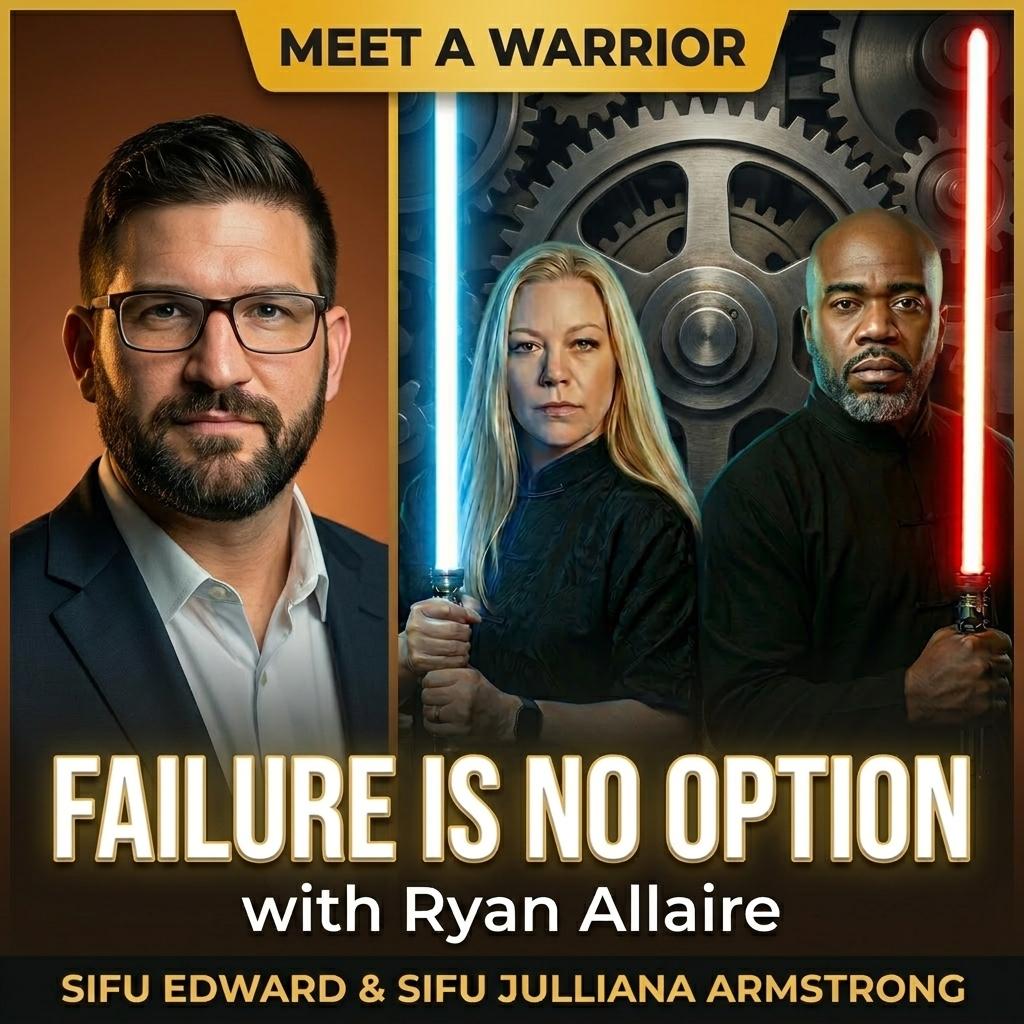
Adapted from the recorded conversation; the guest's words are verbatim. The questions are reconstructed and voiced by Sifu Edward and Sifu Julliana Armstrong.
🎥 Video podcast coming soon. The complete interview will play here once published. The full conversation is transcribed below, and the audio edition will be available on sifuarmstrong.tv.
In a new Sifu Armstrong interview, the creator of Mailbox Secrets explains why he built an entire marching order out of the certainty that failure will keep coming.
Growing up in a motel room in Florida, Ryan Allaire learned a lesson at thirteen that took most people a lifetime to miss entirely. Watching his parents work punishing hours without ever getting ahead, while a friend’s family accumulated wealth doing what looked like far less, he landed on the distinction that would define his career. “It’s not really just how hard you work, it’s also how you work, and how you apply it,” he told Sifu Edward and Sifu Julliana Armstrong in the latest Warrior Intelligence Series conversation.
That insight carried him from a direct-mail mail room job into building Mailbox Secrets, his own marketing operation, and into the orbit of early internet-marketing pioneers. But the story Allaire told wasn’t a straight climb. It was a repeating cycle: six figures, collapse, betrayal, rebuild. His answer to that cycle has a name. “FINO is my marching beat, because failure will happen,” he said, describing a mindset built specifically to survive getting knocked down and starting over, more than once.
Allaire was candid that failure used to control him before he reframed it. Describing a costly mailing mistake, he offered the hosts an image that stuck: “Are you going to cry there for two hours, or call for help, put on the spare, and take off again?” It’s a small metaphor doing a lot of work, the difference between a setback that becomes an identity and one that becomes a mechanical problem to diagnose and fix.
The most striking moment in the conversation came when Allaire described what he did after a back-end service he sold ran into a real technical failure. Rather than issue refunds or a form apology, he personally called every affected customer and asked, “How can I serve you? How can I personally work with you?” He wasn’t pitching anything on those calls. He was repairing trust. The result, he said, was that those same customers became some of his most loyal buyers afterward, converting at rates he called astronomical, without a single sales attempt.
The conversation moves easily between direct-mail mechanics (his LESS method for diagnosing a failing campaign, the plain economics of a $97 front-end offer), and something closer to a discipline of character. Allaire’s daughter trains karate, a detail the hosts returned to more than once, treating it as evidence that he already understands what a real teacher owes a student: service before sale, every time.
That’s the thread that makes this interview worth a warrior’s attention. Allaire never pretends the failures didn’t happen; he built an entire method around the certainty that they would keep coming. Hard work alone never changed his parents' trajectory. It was method, applied consistently, that changed his own. It’s the same principle that separates a brawler who swings with everything until he’s exhausted from a fighter who applies force with precision and is still standing when it counts. Allaire’s path (from a motel room, through repeated collapse, to a mindset that refuses to let any single loss be the final word) is the same discipline the Armstrongs drill into every warrior on their mat: train smart, expect the setback, and never let defeat write the ending.
In This Conversation
- The motel-room lesson at thirteen that reframed effort versus method
- Why physical mail still out-performs digital for repeat exposure without added spend
- FINO. A mindset built to survive repeated financial collapse and betrayal
- The LESS method for diagnosing a failing marketing campaign
- How personally calling 20 unhappy customers became his best back-end result
- Where to find Ryan Allaire and Mailbox Secrets
The Full Conversation
Sifu Edward Armstrong: Ryan Allaire grew up in a motel room, and by thirteen he'd already spotted the thing most people never learn: it's not just how hard you work, it's how you work. He watched his parents (the hardest workers he knows) never get ahead, while others made millions moving a few sheets of paper. That single distinction built everything he has, and it's the exact difference between a brawler and a trained fighter.
Sifu Julliana Armstrong: And I love his marching order: FINO, failure is no option. He's been up to six figures, lost it all, been betrayed in a deal, and relaunched, over and over. He doesn't pretend the failures didn't happen; he's built a whole mindset and a whole method around the fact that they will. That's a competitor's relationship with defeat, and I wanted to dig into it. (It doesn't hurt that his daughter trains karate, so he already knows our world a little.)
Our guest is Ryan Allaire, direct-marketing powerhouse and creator of Mailbox Secrets. Ryan, a real pleasure.
Ryan Allaire: Thank you so much. It's so great to be here.
Sifu Edward Armstrong: Take us back to the motel room, and the lesson you learned at thirteen.
Ryan Allaire: It's kind of a cliché rags-to-riches story, but it started at 13, growing up in a motel room in Florida. We were there closer to two years. My parents always struggled with money, and I watched them struggle. Then I had a friend whose parents were the complete opposite: money just ran into them, multiple homes, vacation homes. My parents are probably the hardest workers I know. My mom detailed boats and worked in a fruit field, my dad was in sales working long hours, but they never got ahead. And the irony that taught me at a young age is that it's not really just how hard you work, it's also how you work, and how you apply it. I worked at a golf course and McDonald's, then transitioned to working in the mail room of my friend's dad's direct-mail business. And that's when it came full circle, because I got to see exactly how it worked. They'd mail out a bundle of paper, a four- to ten-page letter, and sell products from $20 to thousands on the back end. I'm watching this thinking, these people are making millions of dollars by sending out a couple pieces of paper and postage.
And to bridge how we went online. My mentor's mentor was Corey Rudl, out of Canada, who basically started internetmarketing.com and mentored people like Tony Hsieh of Zappos. Corey told my mentor, "The writing's on the wall. The same thing you're doing offline, you can do online. Before you had a name and address; now you have a name and email address." We never stopped the direct mail (it was the bread and butter and the highest-converting stuff, still is), but we added email. We were the number-two affiliate on Mike Filsaime's Butterfly Marketing launch, ahead of Russell Brunson, just by emailing our direct-mail customer base. And we hosted Michael Cheney's very first speaking gig in 2008.
Sifu Edward Armstrong: "It's not just how hard you work, it's how you work." That is the difference between a brawler and a warrior, stated in a motel room by a thirteen-year-old. A brawler swings with everything he has and gasses out in ninety seconds. A trained fighter applies force with precision and lasts all day. Your parents had the work ethic, what they were never shown was the method. And the method is exactly what a real teacher transmits, so effort finally translates into ground gained.
Sifu Edward Armstrong: For operators who don't know direct mail, what does it do that online can't?
Ryan Allaire: Online is virtual: a Facebook ad, an email, a YouTube video. Direct mail is physical and offline: long-form sales letters, postcards, whole product kits. Tony Robbins taught, based on a Stanford study, that it used to take six, eight, ten touchpoints for someone to buy. Fast-forward two decades and those touchpoints have skyrocketed, dozens now, because we're in a digital era on ten different apps with multiple email accounts. Back when you heard "You've got mail," you'd run over and check it. Now you wouldn't. But it's gone full circle, because of Amazon, people are excited to check their physical mailbox again. And what I love is that direct mail is the only option where you make one touchpoint and re-market over and over without spending more money. People call our office and say, "Your booklet's been sitting on my table for two weeks and I've been going through it." A physical piece takes up real estate in someone's home or office. Once someone scrolls past an email or an ad, it's gone. The physical piece circulates.
Sifu Edward Armstrong: People fear the cost. What's the honest economics?
Ryan Allaire: Email technically isn't free either. You spend money to accumulate the list, whether it's solo ads or paid social. Every serious business owner understands the lifeblood of any business is marketing. And it's customer acquisition. You can spend $50 to acquire a $10 sale on Facebook and be doing good, because ideally you have a funnel and the back end is where you make your money. We were in Russell Brunson's top 10 affiliates when they launched ClickFunnels. We sent a postcard and emailed our buyers pushing the Dot Com Secrets book. Nobody makes money on the book; you make it on the back-end software. Same with direct mail: at a $97 front-end price and a 1% conversion, sending 1,000 pieces costs about $850 and gets you 10 sales for $970. You're already in profit, and then the back end is where it adds up. You don't need a $100,000 mailer. My mentor showed me a $300 case study. My first mailing was under $1,000, and I turned $4,500 into just shy of $60,000 in about 70 days, because we serviced dozens of back-end buyers at $2,000 to $5,000. It's the snowball effect. You start small and scale. Last week we had 40,000 pieces go out.
Sifu Julliana Armstrong: Now the mindset. FINO, failure is no option. But you're candid that failure kept happening. Tell me about the ups and downs.
Ryan Allaire: FINO is my marching beat, because failure will happen. Even in my journey: at 13 I had a good mentor and a great connection, and in my late teens and early 20s I was making six figures, life-changing money, "rich." Then I lost it all due to bad decisions and partying, the glitz and glamour. Then I relaunched, had some money coming in, and got taken advantage of in a business deal. Then I relaunched again. You always have those ups and downs, even today. We had a mailing that cost me tens of thousands in mistakes. But I focus on two things: the mindset and the method. FINO is the mindset. I expect failure to happen, because it will. It used to tear me up, beat me up. I've let what should've been a speed bump become a pothole that gave me a flat tire, purely because of my mindset toward it. So now I say, okay, issues are going to happen, but I can't let it be the dictating factor that keeps me stuck.
Sifu Julliana Armstrong: "Failure is no option" doesn't mean failure won't happen. You're crystal clear on that, and it's why it's real. It means failure isn't allowed to be the final word. Six figures, lost to partying; relaunch; betrayed; relaunch again. Most people take one of those hits and quit for good. You treated each one as a round, not the whole fight. And "it's not just how hard you work, it's how you work" ties straight to this, the brawler burns out swinging, the warrior trains smart and is still standing in the final round. Effort without method is just exhaustion with extra steps.
Sifu Edward Armstrong: Your method has a name too, LESS. Break it down.
Ryan Allaire: FINO is the mindset; LESS is the method, doing less to produce more. It's an acronym. L is lead source, where your data or traffic comes from. E is the envelope structure: how your marketing goes out; online, that's your emails, your sales page, your video. The first S is the sales piece: the postcard, or a full shock-and-awe kit. And the last S is the selling process, what you do on the back end after you acquire the sale. When that big mailing failed, I ran it through LESS: the envelope was fine, the sales piece was fine, the selling process was fine. It was the lead source. A couple of small fixes took us from under half a percent to 6% conversion. Night and day. And on the envelope: to a cold list, if it looks like generic junk mail, it gets treated like junk. Our winning piece looks like a card: a six-by-nine coloured envelope, handwritten font, "special notice enclosed," so people think, is this an RSVP to a wedding? We change it by season, a bunny in spring, a snowflake at Christmas.
Sifu Julliana Armstrong: And when you do get hit, how do you actually recover?
Ryan Allaire: It's all perspective. In this flat-tire analogy, if it's a speed bump or a small divot, maybe you avoid it, or if you hit it, how fast can you get out and put on the spare? Are you going to cry there for two hours, or call for help, put on the spare, and take off again? Failure will happen, but when it does, I go back to the fundamentals: how, where, and what do I need to fix? In that case it was one lead-source thing: a couple small changes and I went from losing tons of money to making tons of money.
Sifu Julliana Armstrong: "Are you going to cry there for two hours, or put on the spare and take off?" That's the whole difference between people who make it and people who don't. Everyone gets the flat tire. The warrior doesn't waste the fight raging at the road. They change the tire and get moving, and they go back to fundamentals to find the actual problem instead of flailing. Fix the one thing that's broken, not everything you're panicking about.
Sifu Julliana Armstrong: The story I most want our warriors to hear is what you did when a service you sold had problems.
Ryan Allaire: I sold a back-end service, a couple hundred bucks a month, and there were real issues, people weren't getting emails because of a mail-server problem. It was only about 20 people. So I personally called every single one and said, "This wasn't a one-on-one offer, but we've had some issues. How can I serve you? How can I personally work with you?" I didn't try to sell them anything. Out of those 20, I worked personally with six or seven, and I didn't get more money from them. I just wanted to serve. And the crazy part: the conversions into my back-end programs afterward were astronomical. By over-delivering when we'd made a mistake, we brought in tens of thousands in back-end services without even trying to sell. As Dan Kennedy said, to be a good seller you must be a good buyer, and I'm a huge buyer, so I know that when you buy something and can't access it, that's buyer's remorse. You fix those small things, and it keeps happy clients happy. It's how you handle the issues, how you approach them, and what you do next that dictates the outcome.
Sifu Julliana Armstrong: That's the standard, exactly. You didn't hide from the failure or paper over it. You walked toward the people you'd let down and asked how you could serve them, with no sale attached. And it came back to you a hundredfold, because people can feel the difference between being sold and being served. That's how we run an academy: when we fall short of a student, we don't defend. We over-deliver, we make it right. And that your daughter trains karate tells me you already know that a real teacher serves the student first. Where can people find you, Ryan?
Ryan Allaire: mailboxsecrets.com gets you the multi-book series and resources for $89, or you can just get on the resource list. And I'm on social, The Ryan Allaire on Facebook and Instagram, tons of content and case studies. Thanks so much for having me.
Sifu Edward Armstrong: Ryan, we've covered so much ground, thank you for taking us on the journey.
Ryan Allaire: Thank you for having me.
Sifu Julliana's closing word: Ryan's mantra is the whole thing: FINO, failure is no option, not because failure won't come, but because it's never allowed to be the final word. He's been rich, lost it, been betrayed, relaunched, over and over, and treated each hit as a round instead of the fight. And when he fell short of people, he walked toward them and served with no sale attached. The brawler swings hard and tires. The warrior trains smart and lasts. Effort without method is just exhaustion with extra steps.
Sifu Edward's closing word: A thirteen-year-old in a motel room saw the truth his hardworking parents were never shown: it's not just how hard you work, it's how you work. That's the gap a real teacher closes, turning raw effort into method, so the work finally moves the ground beneath you. Expect the failure, build the system, fix the one broken thing, and serve the people you let down. Work smart, refuse the final word, and honour the ones you're here to serve. We don't entertain warriors. We create them.
Ryan Allaire, direct-marketing entrepreneur and creator of Mailbox Secrets (mailboxsecrets.com). Find him as The Ryan Allaire on Facebook and Instagram.
ILLUSTRATIVE RESULTS. Any revenue, enrollment, margin or retention figure in this conversation is either a documented result from one of our own operations, a figure the guest reports about their own business, or an illustrative example, never a projection of your results.
Nothing here is financial, legal or tax advice.
Stay in the Fight
This conversation is part of the Sifu Armstrong Warrior Intelligence Series: interviews with world-class performers, builders, and thinkers, filtered through the lens of the warrior's path.
Subscribe at sifuarmstrong.news for every new interview, delivered to you.
Join Club Sabernet, the member community of the whole Sifu Armstrong ecosystem, where warriors train, connect, and hold each other to the standard.
Ready to build your own floor? Find your path at sifuarmstrong.com/which-path.