Everything Is Learnable: Sifu Edward & Sifu Julliana Armstrong Sit Down With Affiliate Marketer Alan Clayton
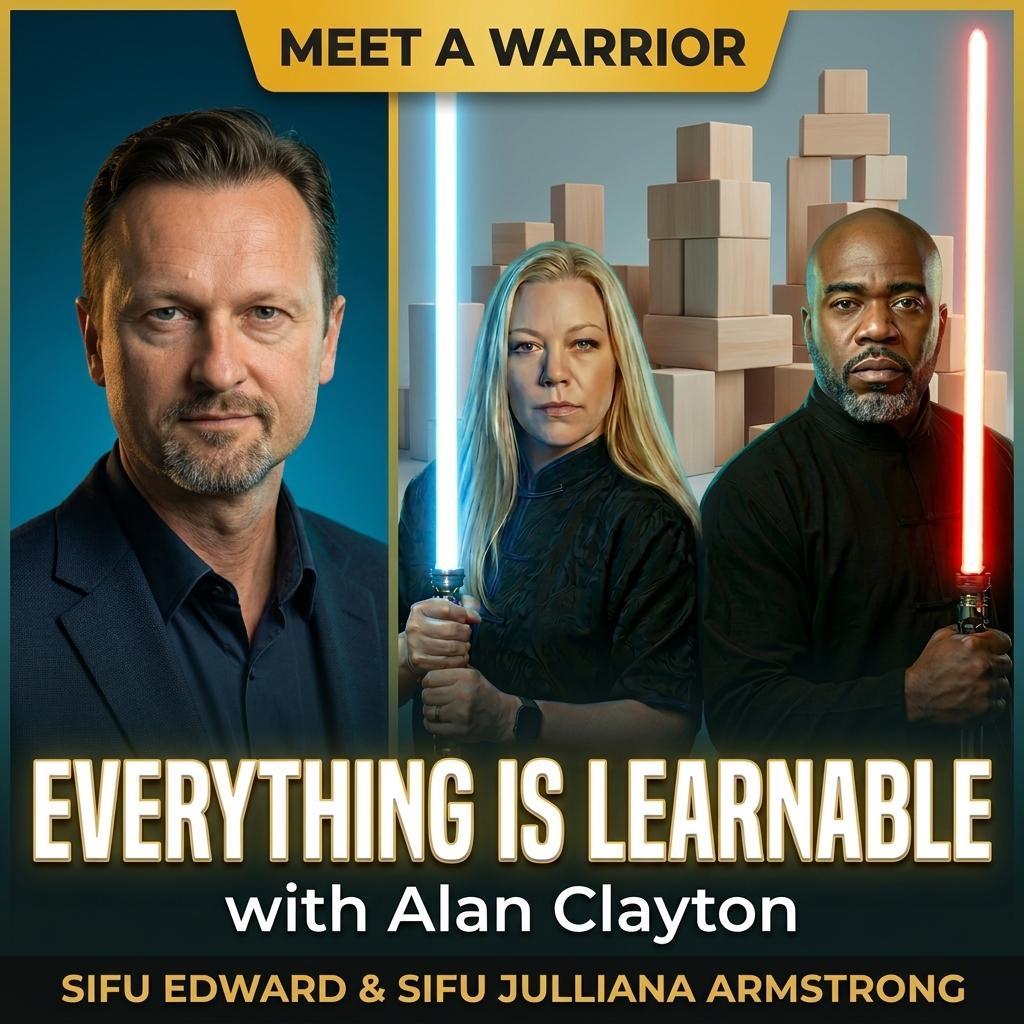
Adapted from the recorded conversation; the guest's words are verbatim. The questions are reconstructed and voiced by Sifu Edward and Sifu Julliana Armstrong.
🎥 Video podcast coming soon. The complete interview will play here once published. The full conversation is transcribed below, and the audio edition will be available on sifuarmstrong.tv.
In a new Sifu Armstrong interview, the Clayton Digital founder explains how a Paris restaurateur with no tech background closed his first high-ticket sale within seven weeks of starting online.
Alan Clayton spent two decades running a restaurant business in Paris before the pandemic ended it almost overnight, forcing him into an online world he barely knew existed. He told Sifu Edward and Sifu Julliana Armstrong how he rebuilt from a standing start for the latest Warrior Intelligence Series conversation on sifuarmstrong.news.
“I barely knew it existed,” Clayton said of the internet business model he now teaches. He’d never used Facebook personally before COVID forced his hand, yet within six or seven weeks of starting from scratch, guided by someone slightly further along than himself, he closed his first high-ticket sale. “I just reached out to someone who was two steps ahead of me,” Clayton said. “I told him, 'Hey, just show me how things work.'”
What gave him the belief to keep going, he said, was a line he credits to Brian Tracy. “All the business skills are learnable. Talent has nothing to do with it. Everything is learnable,” Clayton said, describing it as the idea that let him treat a completely unfamiliar skill set (one he’d long assumed was reserved for “IT guys”) as something he could simply decide to acquire.
Clayton built his entire business on organic Facebook reach, without ever paying for traffic, and he’s adamant that the popular promise of a free path online is a myth. Every approach carries a cost, he argues, whether it’s money or time. “I would rather put that money into my knowledge... the skills end up paying your bills,” Clayton said, explaining why he has repeatedly invested in private mentorships rather than advertising spend.
Clayton draws a direct line back to his years in the restaurant trade. “When you’re in a local, brick-and-mortar business, you have that full understanding that no matter what business you’re starting, offline or online, there’s some upfront investment,” he said, contrasting that instinct with people coming from salaried jobs who often struggle to accept the same principle.
He was equally candid about the hardest part of the transition from a brick-and-mortar business: delayed gratification. Offline, a day’s work is paid on Friday. Online, the payoff can take months to appear, and Clayton says it’s the reason roughly 90 percent of people quit right before results arrive, unless they have someone farther down the path telling them the effort is working.
Clayton also warned operators against spreading themselves across every platform at once, arguing that focused attention on one channel (in his case, Facebook, with more than two billion users) beats a thin presence everywhere. He’s had to guard his own name closely, too, warning that his account has been cloned repeatedly and that the real way to protect an audience from platform risk is to build an email list you actually own.
It’s a lesson that mirrors what the Armstrongs see on the mat every day: nobody is born capable. Every skill, without exception, is built.
In This Conversation
- Closing a first high-ticket sale within seven weeks of a total restart
- The mentor “two steps ahead” who changed everything
- “Talent has nothing to do with it. Everything is learnable.”
- Why “free” traffic is a myth, and where Clayton invests instead
- The delayed-gratification valley that makes 90 percent quit too early
- Guarding against platform risk: cloned accounts and owning your list
The Full Conversation
Sifu Edward Armstrong: There is one belief at the absolute foundation of everything we teach, and Alan Clayton said it out loud in this conversation: talent has nothing to do with it. Everything is learnable. He lost a twenty-year restaurant business to the pandemic and rebuilt from a complete standing start online, on the strength of that single conviction. When I found a man whose whole story is proof that you are not born capable, you are made capable, I knew our warriors needed to hear it.
Sifu Julliana Armstrong: And what I connected with is how honestly he talks about the hardest part, the delayed gratification. Offline, you work and you get paid Friday. Online, and on the mat, you pour in effort for months before you see the payoff, and without a guide, most people quit right before it lands. He's living proof of what a mentor two steps ahead can do.
Our guest is Alan Clayton, affiliate marketer and founder of Clayton Digital, based in Paris. Alan, welcome.
Alan Clayton: Nice for having me here. Thanks. Appreciate it.
Sifu Edward Armstrong: Take us through the pivot, from two decades in restaurants to building online.
Alan Clayton: Well, it's quite a story. We all know what happened back in 2020. I used to be in the restaurant business almost all my life, for two decades. Then COVID came and it just smashed my offline business completely. I had no other choice than to give it a shot online, because during the lockdowns, the only thing that was truly working was the internet. And aside from COVID. I live in Paris, and we all know what's happened here in the past years, all the problems with terrorism, with street riots. There's always something happening in the city. As a local business owner, you're constantly impacted by these things. I was sick of it. I wanted to dive into a business model where, no matter what's going on outside my door, I could be fully focused on what I was doing. Online business is perfect for that. We have full control, it's just between us and the screen. The transition was tough, nothing to do with what I was doing before. But when I saw it working, it gave me the confidence and validation that the concept was working, and I went all in.
Sifu Edward Armstrong: You'd never done anything online before. How did a complete newbie get traction so fast?
Alan Clayton: No, not at all. I barely knew it existed. I was never using Facebook for my personal life. But I was introduced to this opportunity, and although I was a complete newbie, I just reached out to someone who was two steps ahead of me. I told him, "Hey, just show me how things work." That's where things shifted for me. Only six or seven weeks after I started from scratch, I was able to close my first high-ticket sale. I was blown away. I realised I was actually dealing with a real business model, and I decided to go all in once again.
Sifu Edward Armstrong: "I reached out to someone two steps ahead of me." That's the whole thing right there. Not someone at the summit, unreachable. Someone two steps ahead, close enough to turn around and pull you up. That's what an Academy Commander is to a new student, and it's why we build the ladder deliberately.
Sifu Julliana Armstrong: What actually gave you the belief you could do this, a restaurateur with no tech background?
Alan Clayton: Well, the motivation was feeding my family, basically. I'm going to be straight up with you. The situation was critical. But I was always intrigued with this. I just never thought it was for me. I always viewed online business as something reserved for those IT guys with heavy technical skills. As it turned out, nothing's further from the truth. Until this day, I don't use much tech, my entire income comes out of my Facebook profile, and I've never spent a dime on traffic. What gave me the confidence was a quote I heard from Brian Tracy, one of my favourite business people, who kept repeating that all the business skills are learnable. It's something people need to hear. Talent has nothing to do with it. Everything is learnable. Even the most difficult thing, stuff like coding or something that feels completely strange to you. You could become an expert at it if you put your mind to it and fully commit. That was my choice.
Sifu Julliana Armstrong: "Talent has nothing to do with it. Everything is learnable." Alan, that is the sentence our entire art is built on. People watch a skilled martial artist and call it a gift, and it lets them off the hook. "I could never." But it's a lie. Every capability you admire was built, rep by rep, by someone who decided to commit. You are not born a warrior. You are made one. He proved it in six weeks with a screen; we prove it on the mat every day.
Sifu Edward Armstrong: You built it all on Facebook, with no paid ads, and you're adamant "free" is a myth. Walk our operators through your actual model.
Alan Clayton: I wouldn't say easy. I'd say simple, which is not the same term. There are not 150 ways to drive traffic to your offers. Either you pay for it, or you do it organically, and in both cases, there's a cost involved. There's this massive myth online that you can do something for free. It's a myth. The quicker people understand it, the quicker they'll start making money. Given there's an upfront investment either way, I'd rather put that money into my knowledge than blow it on ads, because ad money goes down the drain, it gives temporary results, whereas if you invest in your skills, the skills end up paying your bills. I heavily invested in myself, but I've never paid for traffic.
I started as an affiliate, which is a great way to start, then shifted to more advanced stuff and heavily invested in private mentorships, to the point where I built my own coaching platform. My field specifically is the inbound attraction market, on Facebook, because no matter what people say, it's still by far the most powerful platform. I teach people how to grab the attention of a relevant audience no matter what they're selling. People have this false belief that you can only target (geography, gender, age), with paid ads. But you can do almost the same thing organically, without ever paying for traffic, by working Facebook's algorithm to grab the attention of relevant people and raise their interest to the point where they raise their hand and reach out to you. That's a high-income skill, and once you have it down, you don't worry about your bills anymore.
Sifu Julliana Armstrong: You said the hardest part of going from offline to online is the delayed gratification. That's my whole world. Explain it.
Alan Clayton: I did get some scepticism. People around you are sceptical, which is only temporary. Once things start working, you'd be surprised how quickly they get interested in what you're doing. But work ethic matters a lot. Online business is all based on consistency, and it's very difficult to be consistent with something you don't fully trust or constantly doubt. The hardest thing when you shift from offline to online is that offline, in the real world, you had instant gratification. You get a job, you know you get paid at the end of the week. No matter what action you take, you see the payoff. Online, there's no such thing. The gratification is delayed. Mindset-wise, if you're not guided, it's very difficult to put in so much effort upfront for the long term without seeing it pay off. It might feel pretty vain in the beginning. You're doing something and wondering, "Is it even making sense?" This is why you need the guidance of someone who went that path before you. Otherwise you keep doubting, and you end up giving up, like 90% of people do.
Sifu Julliana Armstrong: That is the exact valley every white belt walks through. You train and train and see nothing, and the voice says "this isn't working, you don't have it." The reps ARE working. The payoff is just delayed, banking underground where you can't see it. And you're right: the thing that carries you across that valley isn't willpower, it's a teacher who's already crossed it, telling you "keep going, it's coming." That's the entire reason a Sifu exists.
Sifu Julliana Armstrong: You keep coming back to investing in mentors. How central is that for you?
Alan Clayton: This confidence honestly comes from results. Even when I didn't have results, I had people around me who did. As I signed up to more private mentorships, I regularly had people in front of me on Zoom (even to this day), who are making $50, $80,000 per month doing what I'm doing. They share those things with you, you see it in their content, in their system, and there's no doubt you can get that far. But one thing all those people have in common is that they're heavily invested in their skills. Every time I invested in a mentor, my results just 10X'd. It always pays off, if it's not in two months, then in six months, but there's always ROI, massive ROI. I keep doing it. I literally feel bad when I'm not mentored, if I'm honest.
Sifu Edward Armstrong: What did the restaurant years teach you that you carried in, and how do you handle the risk of building on someone else's platform?
Alan Clayton: When you're in a local, brick-and-mortar business, you have that full understanding that no matter what business you're starting, offline or online, there's some upfront investment. You cannot work in something for free. I see the difference when I deal with people who come from the nine-to-five world versus people with a local business background like myself, two completely different mindsets. People who work for a salary have a much harder time accepting that to reap the benefits, they first have to put something in. And everything on YouTube ("affiliate marketing for free"), it's full of lies. That's where the myth of starting for free comes from. It's a business like any other.
As for the platform risk. I'd be lying if I told you it doesn't worry me. Socials are cool, but we're guests there. We can be deleted. We don't own it. My account is probably one of the most cloned out there (hundreds of cloned accounts of my name), which is why I keep telling people, check the URL, make sure you're talking to the real Alan Clayton, at alan.clayton.official. People say a website is something you own, but it's so much harder to get traffic to a website than to a social account. The way to secure your presence is by building a list. If I get erased, my email list, which is the only traffic we truly own, just like Russell Brunson repeats in his books, lets me move my audience instantly to a new account. And one massive tip: don't spread yourself across every platform. People feel they need a little Facebook, a little Instagram, a little TikTok, and the more they spread their attention, the less traction they get anywhere. Two or three billion users on Facebook is more than enough. Focus on one. Give it your full attention. I moved away from all the rest.
Sifu Edward Armstrong: Alan, this has been a real pleasure. Where do people find you?
Alan Clayton: Facebook.com/alan.clayton.official, that way you know you're truly talking to me. If you see numbers in the URL, it's not me. If anyone's calling about Bitcoin or a trading opportunity, it's not me. I'm just an online marketer. Everything's explained in the bio of my profile, and you can join my free private community. That's the best way to connect and see my work from the inside. I go live in there every single week and provide a lot of value. The link is right in the bio.
Sifu Edward Armstrong: Alan, thank you so much for your time. It's been an absolute pleasure. We wish you every success.
Alan Clayton: Thank you. Have a great day.
Sifu Julliana's closing word: The line I'm keeping is about the valley, that delayed gratification where you work for months and see nothing, and 90% of people quit right before it pays. Every white belt lives there. The reps are working; the payoff is just banking underground. And what carries you across isn't grit alone, it's someone two steps ahead saying "keep going, it's coming." Alan found that person. Be that person for someone, and find one for yourself.
Sifu Edward's closing word: Alan lost twenty years of work to a pandemic and rebuilt from nothing on one conviction: everything is learnable, talent has nothing to do with it. That is the foundation stone of our entire art. Nobody is born a warrior. Every single one is built: one learnable skill, one guided rep at a time, by someone two steps ahead who turns around and pulls them up. That's not a slogan. It's the whole promise. We don't entertain warriors. We create them.
Alan Clayton, affiliate marketer and founder of Clayton Digital, based in Paris. Find him only at facebook.com/alan.clayton.official (beware cloned accounts).
ILLUSTRATIVE RESULTS. Any revenue, enrollment, margin or retention figure in this conversation is either a documented result from one of our own operations, a figure the guest reports about their own business, or an illustrative example, never a projection of your results.
Nothing here is financial, legal or tax advice.
Stay in the Fight
This conversation is part of the Sifu Armstrong Warrior Intelligence Series: interviews with world-class performers, builders, and thinkers, filtered through the lens of the warrior's path.
Subscribe at sifuarmstrong.news for every new interview, delivered to you.
Join Club Sabernet, the member community of the whole Sifu Armstrong ecosystem, where warriors train, connect, and hold each other to the standard.
Ready to build your own floor? Find your path at sifuarmstrong.com/which-path.