Every Missile Adjusts: Sifu Edward & Sifu Julliana Armstrong Sit Down With Fighter Pilot Ed Rush
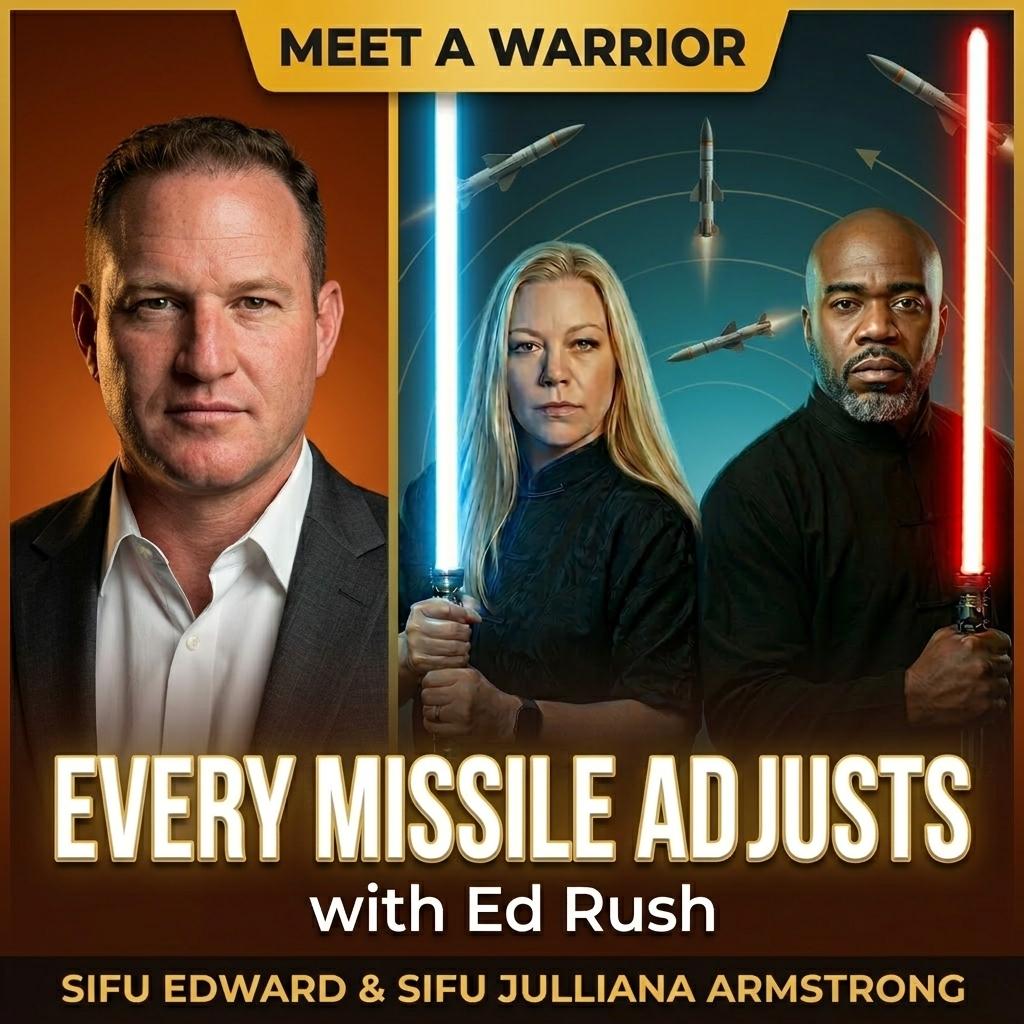
Adapted from the recorded conversation; the guest's words are verbatim. The questions are reconstructed and voiced by Sifu Edward and Sifu Julliana Armstrong.
🎥 Video podcast coming soon. The complete interview will play here once published. The full conversation is transcribed below, and the audio edition will be available on sifuarmstrong.tv.
In a new Sifu Armstrong interview, the thirteen-year Marine Corps fighter pilot and five-time bestselling author explains why a straight line misses, and why he walked away from flying rather than accept an empty chair at his own dinner table.
Ed Rush failed kindergarten. He says it plainly, and without irony: “I’m a person who failed kindergarten. I wasn’t the sharpest tool in the shed.” What he learned from that early setback, he told Sifu Edward and Sifu Julliana Armstrong during his conversation for the Warrior Intelligence Series, is that success has never been about raw talent for him. It’s been about relentlessly modeling people who were already ahead of him. That habit carried him through college, into the Marine Corps, and eventually to a posting as the Corps' number-one instructor in one-on-one dogfighting.
Rush’s clearest description of how any pursuit actually unfolds comes from his years flying F-18s. “Every single missile initially takes some pretty wild turns on its way to the target,” he said, describing how a missile’s tracking system doesn’t even activate until it’s already partway through its flight, and once it does, it never stops making corrections, big ones early and small ones as it closes in. The reason, Rush explained, is twofold: the missile is almost always slightly off course, and the target it’s chasing is always moving. He treats that as a literal description of how business and marketing work, constant correction against a market that refuses to hold still.
That same refusal to wait for perfect conditions shows up in how Rush approaches nearly everything he builds, from businesses to books. “You’re never going to be ready, so you might as well just do it now,” he said, describing an operating style he sums up as ready, fire, aim. Start the project, the podcast, the book, before you know exactly how it’s going to go, because the doing teaches what deliberation never will.
Rush walked away from a flying career he loved for the same reason he built everything that came after it: a deployment overseas, timed just as he’d started a family, forced him to confront what he actually wanted his home life to look like. He didn’t want an empty chair at the dinner table defining his household, so he built an online business instead, one that eventually grew successful enough that some of the biggest names in internet marketing sought him out to learn the very discipline he’d stumbled into by trying to stay home.
The Armstrongs connected Rush’s missile metaphor directly to the mat, that no opponent stands still, and mastery was never about holding a perfect line to begin with. It’s the ten thousand corrections, not the flawless plan, that gets a person to the target.
It’s a lesson that applies to any pursuit worth the name: the ones who win aren’t the ones who aimed perfectly. They’re the ones who never stopped adjusting.
In This Conversation
- “I’m a person who failed kindergarten,” and what he learned from modeling others
- Becoming the Marine Corps' top instructor in one-on-one dogfighting
- Walking away from flying to avoid an empty chair at the dinner table
- The missile metaphor: constant correction toward a target that keeps moving
- “Ready, fire, aim,” why waiting to feel prepared is the real risk
- Writing a #1 bestseller in 21 days, built to generate leads rather than revenue
The Full Conversation
Sifu Julliana Armstrong: Every so often we get to sit with an actual warrior, and Ed Rush is one: thirteen years a Marine Corps F-18 fighter pilot, the number-one instructor in the Corps for one-on-one dogfighting, and, fittingly, the author of a book literally called Warrior. When a man who fought in the air tells you that a missile is always correcting toward a moving target, he's handing you the deepest truth of combat and of life. I couldn't wait.
Sifu Edward Armstrong: And what I respect is that this warrior led with his family. He walked away from flying because he refused to let an empty chair at the dinner table define his home. Then he built businesses, wrote five bestsellers, and taught the biggest marketers on earth the one thing none of them had. He's a builder and a fighter both, exactly the combination we honour.
Our guest is Ed Rush, five-time number-one bestselling author, speaker, and former F-18 fighter pilot. Ed, welcome.
Ed Rush: It's great to be here. I just absolutely enjoy the chance to talk about how people can grow their brand, have more fun, change the world, share their message, and still make it home for dinner.
Sifu Julliana Armstrong: So, thirteen years flying F-18s. Is it really like Top Gun?
Ed Rush: Being a fighter pilot was both stressful and, as you'd imagine, insanely fun. I flew F-18s on and off aircraft carriers and into combat. The most interesting part is that I'm a person who failed kindergarten (I wasn't the sharpest tool in the shed), so I learned early that to be successful at anything, I needed to follow successful people. That led me not only to graduating kindergarten, but from college and into the Marine Corps, and at one point I was the number-one instructor in the Marine Corps for one-versus-one dogfighting. All this from the kid who failed kindergarten. And is it like Top Gun? Down to the presence of Tom Cruise in everyone's ready room. Fundamentally, to fly a plane is simple. I teach it in three sentences: if you push the stick forward, the houses get bigger. If you pull the stick back, the houses get smaller. And when you push the red button, all the houses go away. That's all you need to know.
Sifu Julliana Armstrong: "I failed kindergarten, so I learned to follow successful people." That's the whole secret, stated backwards. The person who thinks they're already gifted never bothers to model a master. You started from the bottom and climbed to the top of the most demanding combat skill there is, by studying the ones who'd already done it. That's exactly what the mat asks: leave your ego at the door and follow the one who's ahead of you.
Sifu Edward Armstrong: How does a fighter pilot end up building online businesses, and I understand your wife saw it before you did.
Ed Rush: Back in 2005, 2006, I was looking at being deployed overseas for about a year, right as I'd started a family, a five-month-old at home. And in that instant I decided I didn't want my home life dominated by an empty chair at the dinner table. So I looked where pilots look (the airlines), and started putting in applications. Then one night, in the middle of a movie, my wife stopped it, looked at me, and said, "Is that really what you want to do?" She knew me better than I knew myself. I would have gone crazy with that job. So I started learning about online marketing, and I created a tiny ebook about how to become a fighter pilot. My goal was to make enough to buy a computer, about $2,500. I put it online, woke up the next morning, and I had a sale, this kid bought it for $14.50, read it page to page, and emailed me: "Dude, thank you, it literally changed my life." The rest of the story is that kid went on into the air force and actually became a pilot. That little business turned into about $15,000 a month. Then I started another with my dad: a famous basketball referee who refereed with Michael Jordan, Larry Bird, and Magic Johnson, a course for referees, using all the same principles. That turned into about a quarter-million-dollar-a-year business that's still running today, 700 members at $30 a month.
Sifu Edward Armstrong: Success came fast, but you're honest that it took a mountain of learning and a lot of failure.
Ed Rush: I'm so thankful that first business was successful, but I definitely had help. I bought every single information marketing training product I could get my hands on. I learned from Dan Kennedy and from Perry Marshall (one of my key mentors), who taught me Google AdWords and landing pages. I spent that first year's worth of $15,000 a month on training courses and Masterminds. I crammed about 10 years of learning into 10 months. And I had failures along the way: a lot of times we remember the high points, but there were probably another five businesses I tried and failed at. Which brings me to one of my favourite success tips, which I learned from Perry Marshall: fail fast next. I was a fail-fast-next kind of guy. I zigzagged to success, but did it fairly quickly.
Sifu Julliana Armstrong: You wrote your fifth book in 21 days. Where does that kind of discipline (and that refusal to wait until you're "ready") come from?
Ed Rush: The Marine Corps is where I learned it. I was a Marine before I became a fighter pilot, and the whole idea of "if you're five minutes early, you're already ten minutes late" was the motto even more than Semper Fi. I learned the discipline of flat-out getting things done. Sometimes someone tells me, "Ed, I have a problem with procrastination," and I tell them there are two ways to solve it. Method one: recognise you have a problem, buy some books and courses on overcoming procrastination, get a daily planner, make your list of objectives and sub-lists of action steps and dates and accountability. And method two: literally just start the project. Start writing the book, start the podcast, start the events. My approach to productivity even early on was ready, fire, aim. I started doing things before I even knew how to do them. That's probably the most important success tip I could give: you're never going to be ready, so you might as well just do it now. Make the call, get the sale, put the website up, write the book. You're never going to know everything you need to know, so start now, because life's too short to wait.
Sifu Julliana Armstrong: "You're never going to be ready, so do it now." A fighter pilot and a martial artist agree completely. You don't wait until you feel prepared to spar. You'd wait forever. You step onto the mat scared and undercooked, and the doing is what makes you ready. "Ready, fire, aim" isn't recklessness; it's the understanding that action teaches what deliberation never can. And "five minutes early is ten minutes late." That's the standard we hold, exactly.
Sifu Julliana Armstrong: Now the one I've been waiting for. You have a way of describing failure and adjustment using a missile, and as a fighter, I need to hear it.
Ed Rush: Statistically, my best guess is I've had about 19 failures for every single success, on the micro and macro level. And the cool thing about those failures is they act like a missile on an F-18. When a missile comes off the aeroplane, it initially flies straight for about 400 metres, the tracking system doesn't even turn on until halfway through, partly because we buy missiles from the lowest bidder and want to be careful not to hit ourselves. But after that, the tracking turns on, and every single missile (no matter how technologically robust), initially takes some pretty wild turns on its way to the target. If you follow a Sidewinder's trajectory, it's constantly making corrections (the big corrections happen far away, the small ones happen up close), constantly adjusting left and right, up and down. That's for two reasons: the missile is almost always off course, and the target it's chasing is always moving. In business, and especially online, your targeting is never perfect, so you're always adjusting your message to your market. But the market's always changing too. We're recording this in the middle of the coronavirus lockdown, and the world has completely changed in two weeks. Companies are still rolling out stuff that worked a month ago, and nobody's paying attention. So just like a missile, you're always, always adjusting. And the fun part is, right about the time you have it all figured out, life changes and you get to figure it out all over again. As long as you look at it as a big fun game, you're going to have a blast, make a lot of money, and help a lot of people.
Sifu Julliana Armstrong: That is the single most perfect description of combat I've heard on this show, and it comes from a man who actually did it. The opponent is always moving. So are you. Mastery isn't holding a perfect straight line, a straight line misses. Mastery is the ten thousand corrections, big ones far out and tiny ones up close, that keep you locked on a target that refuses to stand still. On the mat, in the market, in life, the ones who win aren't the ones who aimed perfectly. They're the ones who never stopped adjusting.
Sifu Edward Armstrong: You write bestsellers fast, and you use the book as a lead machine rather than a revenue stream. Walk our operators through that.
Ed Rush: My book 21 Day Miracle is my pride and joy. I went from idea to published to number-one bestseller in 21 days, and I've sold nearly 30,000 copies. My process is simple: I create in motion. I gave myself a time window and sat down and did it: about 7 to 8,000 words a day, 9 in the morning until 1 or 2. The first few pages of anything you write are near-meaningless drivel; your mind has to kick-start. But chapter two gets better, chapter three better, chapter five is Nirvana, and then you go back and fix chapter one. The creative process is done more through motion than meditation. It became Amazon's number-one business book, beating Tim Ferriss and Seth Godin (over a thousand sales in a single day), and I barely marketed it; I think I sent one email to my list.
And here's the important point: the revenue is meaningless to me. My digital book is 99 cents, the paperback about $8. Amazon keeps sending me charts showing if I raise the price we'll both make more money, but every time the price goes up, the number of buyers goes down, and I'm interested in the lead more than the revenue. This book is designed from the ground up to encourage people to opt into my email list: 25.7% of buyers opt in, which is a really high number. I've got 7,000, 8,000 new people on my list because of this book, and that's what I'm after. People find my book on Amazon, become believers in what I teach, then show up at my events and become clients. That's what I'm proudest of. The lives I've been able to influence through the book.
Sifu Edward Armstrong: You ended up teaching the biggest marketers on earth. How?
Ed Rush: Totally by accident. When I got successful in 2008, 2009, event hosts would bring me up on stage and ask about my online success, and on the break someone would come up and ask to pay me to help their business. My philosophy is simple: if somebody wants to give you money, let them. Then I ended up in Mastermind groups, Bill Glazer's, with some of the best marketers on the planet. At that point I was making $20,000 to $25,000 a month on about five hours a month. I'd set things up on autopilot. And one of the biggest internet marketers on the planet pulled me aside and said, "We're all working 15 hours a day in this business, and it turns out you created the thing we're all talking about, but none of us have." I thought that was such a brutal, honest assessment, internet marketing gurus working their butts off to teach people how to not work. So these guys started bringing me in through the back door to turn their businesses into actual businesses instead of jobs. I've worked with Brian Tracy twice, John Assaraf from The Secret, Mike Koenigs. We did about seven seven-figure launches together.
Sifu Edward Armstrong: Your advice to someone starting or growing. What is it?
Ed Rush: First: it's all about the problem you solve. When a business owner asks for my help, my first or second question is, "What's the big problem you solve?" And I can predict how successful they'll be by the next thing out of their mouth. 90% start talking about themselves, precisely the wrong answer. 10% say, "Here's the problem, and here's how we solve it." Marketing is solving problems. Second, the information marketing world is drastically different than 10 years ago. Ten years ago you could sell an ebook on how to build a terraced garden for $97 all day. Now there's so much free information you're competing with free, which in some markets is impossible. So experience and unique selling propositions matter more. You need to offer true transformation, usually attached to a real person and personality, combined with a community, with a unique user experience. That's what's working now.
Sifu Julliana Armstrong: Last from me. Your wife saw the truth before you did, and she's been on the roller coaster with you. And you named a book Warrior. Where does all of it point next?
Ed Rush: Being an entrepreneur's spouse can be truly terrifying, and I have such respect for my wife, who's been on this roller coaster with me for 14 years. It's worked out great, and she was right about that flying thing. I'm blessed every day to inspire people to pursue greatness in their lives and their callings. What's next: I'm two weeks into launching a daily online show, I run two events a year (The Ultimate Speaker, teaching business owners to become paid keynote speakers), and one of the fastest ways to make money is to use your knowledge to help someone else get what they want. And down the road, my big mission is to change the way we lead here in the United States: to raise up 400 new leaders, completely nonpartisan, because I think the best answers come from entrepreneurs and innovators, and it's time for a new generation of leaders to step up. You can find me at edrushbook.com for my 99-cent book and a free membership site, and everything else at edrush.com. When you opt in, email me and tell me who you are: I actually read and respond.
Sifu Edward Armstrong: Ed, this has been a genuine honour, from one warrior to another. Thank you.
Ed Rush: Thank you. And to everyone in your community: go get them. Ready, fire, aim. Let's go change the world.
Sifu Julliana's closing word: A real fighter pilot handed us the truest picture of combat I've heard: every missile takes wild turns on its way to a target that won't stand still. The opponent is always moving. So are you. Mastery isn't a perfect straight line, a straight line misses. It's the ten thousand corrections, and the refusal to stop adjusting. And "you're never going to be ready, so do it now." That's how you step onto any mat worth stepping onto.
Sifu Edward's closing word: Ed is a warrior in the fullest sense. He flew the jet, he wrote the book called Warrior, and he still led with his family and an empty chair he refused to accept. He proves the things we teach: model the masters, act before you're ready, solve the real problem, and raise up leaders. He built the thing the whole industry talks about but few have, a life on his own terms. Ready, fire, aim, and keep adjusting toward the target. We don't entertain warriors. We create them.
Ed Rush, five-time #1 bestselling author, speaker, and former US Marine Corps F-18 fighter pilot. Free book at edrushbook.com; everything else at edrush.com.
ILLUSTRATIVE RESULTS. Any revenue, enrollment, margin or retention figure in this conversation is either a documented result from one of our own operations, a figure the guest reports about their own business, or an illustrative example, never a projection of your results.
Nothing here is financial, legal or tax advice.
Stay in the Fight
This conversation is part of the Sifu Armstrong Warrior Intelligence Series: interviews with world-class performers, builders, and thinkers, filtered through the lens of the warrior's path.
Subscribe at sifuarmstrong.news for every new interview, delivered to you.
Join Club Sabernet, the member community of the whole Sifu Armstrong ecosystem, where warriors train, connect, and hold each other to the standard.
Ready to build your own floor? Find your path at sifuarmstrong.com/which-path.