Don't Fight the Black Belt on Day One: Sifu Edward & Sifu Julliana Armstrong Sit Down With Jason Fladlien
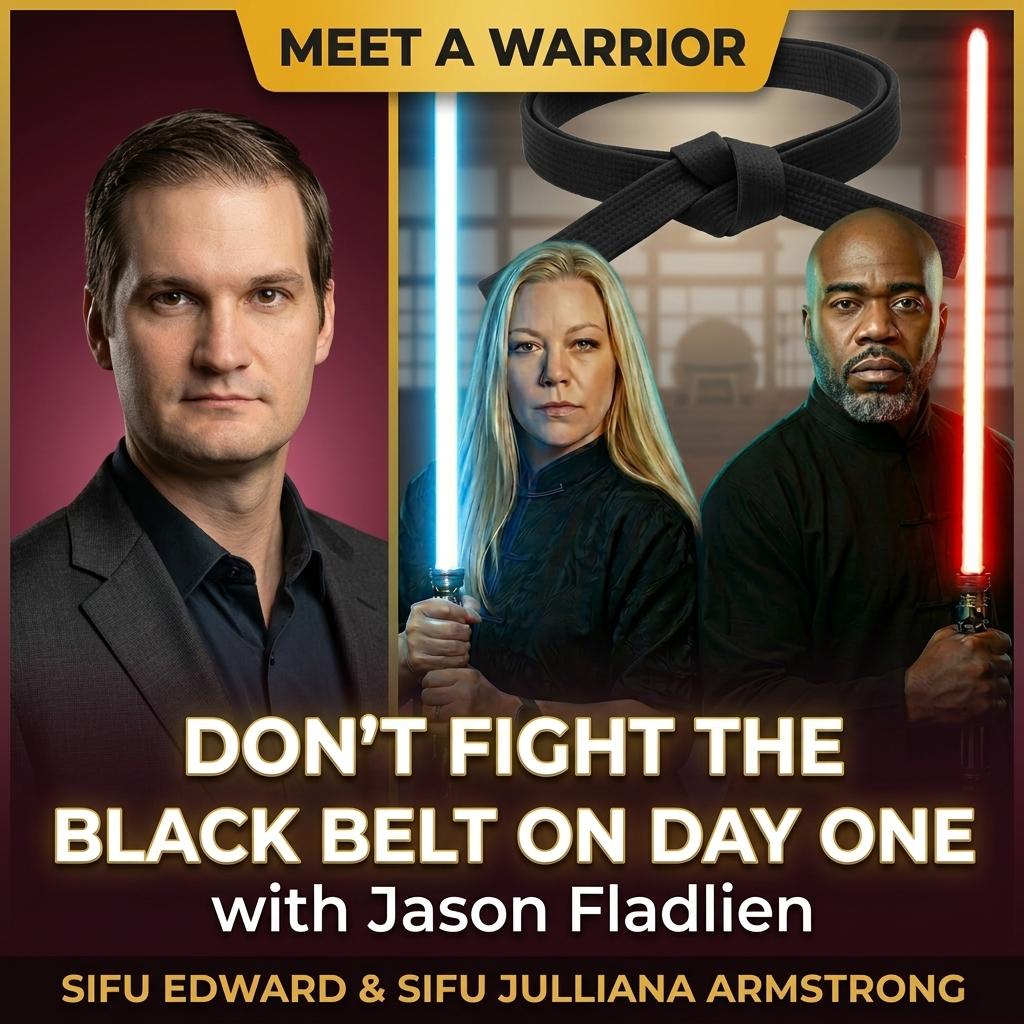
Adapted from the recorded conversation; the guest's words are verbatim. The questions are reconstructed and voiced by Sifu Edward and Sifu Julliana Armstrong.
🎥 Video podcast coming soon. The complete interview will play here once published. The full conversation is transcribed below, and the audio edition will be available on sifuarmstrong.tv.
In a new Sifu Armstrong interview, the co-founder of Rapid Crush Inc. traces a quarter-billion dollars in sales back to a single refusal: never try to fight the black belt on day one.
Jason Fladlien built his career the way a martial artist builds rank (one earned step at a time), and he said as much in a new Sifu Armstrong interview with Sifu Edward and Sifu Julliana Armstrong for the latest Warrior Intelligence Series conversation. Fladlien is the co-founder of Rapid Crush Inc. and author of One to Many, and his path ran through rapping as a child, a bout of agoraphobia at eighteen, and a failed attempt at a music career before he ever touched internet marketing.
His first real product came from desperation: a $4 ebook on article writing, sold with a money-back guarantee, that outsold a week of freelance writing in two days. From there, Fladlien describes a method he calls “trading up,” using one small, mastered skill as the foundation for the next. Writing articles led to writing emails, which led to writing sales letters, which led to his first webinar in 2008, built on what he calls the “I don’t know if this will work or not” strategy.
That stair-step approach is where he places his sharpest warning for anyone tempted to shortcut the process. “A lot of people want to fight the black belt the first day they take karate, and that’s no wonder that they fail,” Fladlien said, describing how he built webinar mastery only after training webinars, then packaging webinar series, then selling webinar series with webinars, never skipping a stage. “I stair stepped my way up there by getting comfortable in this setting and then trading up and then trading up and then trading up.”
Sixteen years and one book later, a book he says he wrote from the same material he sold in person for $5,000 and packaged as a $1,500 recording before turning it into a $10 ebook, never hiding the derivation from his audience, Fladlien traces over $250 million in product sales to strategic partnerships rather than solo effort. No single person can be a ten-out-of-ten at traffic, conversion, fulfillment, and support simultaneously, he argues, so he built his business by pairing his own strength in conversion with partners who excelled elsewhere.
Fladlien compares that early advantage to how a new company builds without the weight of decades of assumptions. “I was able to organically build it from the ground up,” he said of his early webinar years, “very much like Tesla built their vehicle from the ground up. They weren’t like Ford or GM that had a hundred years of 'experience,' but couldn’t apply it in a new paradigm as easily.”
Underneath all of it sits a belief in compounding that he borrows from Warren Buffett. “People overestimate what they can do in a year, but they underestimate what they can do in 10 years,” Fladlien said, a lesson he’s currently relearning by starting over, humbled, as he builds a YouTube presence from scratch after building his entire fortune without one.
It’s a philosophy the Armstrongs recognize instantly: competence compounds, mastery is a staircase, and nobody gets to skip a rung.
In This Conversation
- From teenage rapper to $250 million in product sales
- The $4 ebook and the “trading up” method that followed
- Why fighting the black belt on day one guarantees failure
- Strategic partnerships over solo mastery: traffic, conversion, fulfillment, support
- One product, three formats: the $5,000 event, the $1,500 recording, the $10 book
- Starting over as a beginner on YouTube after sixteen years of mastery elsewhere
The Full Conversation
Sifu Edward Armstrong: Mastery is never a single leap. It's a staircase. Every warrior who walks into my academy wants the black belt today, and the work of a true teacher is to slow them down, give them the next achievable rung, and let competence compound. So when I found a man who built a quarter-billion dollars in sales by relentlessly "trading up" one small skill at a time, I recognised the warrior's path dressed in a marketer's clothes.
Sifu Julliana Armstrong: And his story is the part competitors understand in their bones. He didn't start gifted, he started at the bottom and found the one thing he was both passionate about and built for. That combination is everything. I've watched naturally talented athletes lose to the ones who found their edge and compounded it daily. Jason is living proof of what that compounding becomes over sixteen years.
Our guest is Jason Fladlien, a trailblazer in internet marketing and webinars with product sales in excess of $250 million. Alongside Wil Mattos he co-founded Rapid Crush Inc., and he's the author of One to Many, which delves deep into the secrets of successful webinars. Jason, welcome.
Jason Fladlien: Pleasure to be here.
Sifu Edward Armstrong: I built my art from the lowest point of my own life: burned by a franchise, doubted by everyone, with nothing but a conviction. So I'm always drawn to where a person started, because the bottom is where the real foundation gets poured. Tell us about your early days. The road from being a rapper and a monk to a leading figure in internet marketing.
Jason Fladlien: Yeah, you could really start anywhere in this business. That's the good news.
I was always interested in music and specifically hip hop, and I started rapping in front of audiences at seven years old, seven or eight, somewhere along there. So it felt very natural to me.
And I always thought music would be where I would end up. So I tried that off and on throughout the years.
But I had a lot of trauma that went through my life when I was growing up. I was in a household that there was a lot of drug abuse and a lot of chaos.
And I ended up being about 18 years old and just so depressed. I had all these panic attacks all the time. I ended up having agoraphobia, which is afraid of open spaces, meaning you really don't go outside much. And I'm just sitting there just lost.
And a friend of mine who was in the music space, he had went and he travelled with the Hare Krishnas for a little bit and he came back and he was telling me about that.
So I was intellectually curious, always was, still am. So I started Googling around and looking at it and I started reading it and I'm like, "Okay, I'm at my lowest point in my life. I can't focus, I can't do anything. I'm staying up till 7:00 in the morning, sleeping until 3:00 or 4:00 in the afternoon. That was my life living with my dad in this little tiny apartment." And so I said, "I'll try it and see what happens." So really saved my life.
I eventually got rid of all my panic attacks in a few months and I just felt really invigorated to go out and do something boldly. And so I tried that with the music.
The music, unfortunately though, it was at about the worst time you could launch a music career because CD sales were dying out, but streaming hadn't been figured out yet.
And I wasn't frankly very good at it. I had have to work eight or nine hours to do something that talented musicians could do in one to two hours.
I'm not one to give up though. I was trying really hard this, that, and the other. And so I started looking at the business and marketing side of the music and I started trying to apply those methods to the music that I was putting out there and it wasn't working well.
And out of desperation, I said, "You know what? I need capital. That's the answer to the music business." Because I didn't have any money. So let me make some money online and then I'll pour that into the music business.
That was about 2006. And now here we are going on in 2024, still haven't circled back around to the music, got into the internet space and just kept going.
Sifu Julliana Armstrong: That line about working eight or nine hours to do what a talented musician did in one or two, every competitor has felt that. Do you regret leaving the rapping behind? Or did you find something you were actually built for?
Jason Fladlien: No.
I always thought that the music would be the thing that switch me on, and I didn't find anything else as attractive to me. But the marketing very quickly became as attractive if not more attractive to me. So I had the passion for it, but I also had the skill set to it. Whereas music, I had the passion for it, but I lacked on the skill set side.
So you really want both. You want something that you're passionate about that also comes naturally to you, and it still will be hard, don't get me wrong, but at least you're predisposed to getting it and you can do something with it.
And that's what I really saw with the marketing was, "Wow, I like it. It's very interesting to me. It motivates me, it gets me excited and I can get it right away. I don't have to practise extra hard for many, many more hours just to be barely competent at it. I can pick it up in a decent timeframe so therefore maybe I can get some traction and some momentum." And that's why I don't think I ever came back to the music.
Sifu Edward Armstrong: Passion plus a natural edge. That's the same thing I look for in a future Academy Commander. You were also remarkably early to your arena. You mentioned CDs dying and streaming not yet figured out. That was the internet finding its feet too. When did you first get online?
Jason Fladlien: Way long ago.
So I was actually 14 when I first got online. So this was 1997. And I remember I bought a little 286 computer. So this was not a tower. You laid it flat on the desk and I painted houses for a month just trying to make some money to save up. And I bought this computer and I got the internet.
And I was really just so fascinated with how the internet worked. And this was in '97 when it was just... Nobody even... Barely anybody had the internet.
And I started learning how to build websites back then. And that was really cool.
We were doing music back then. I was working on music, so I was trying to produce albums even when I was 14 and I was building websites around anything and everything because really to put anything online back then...
I had a lot of different interests and passions. And in order to put anything online, you had no code. It's not like these days where you just go to Twitter and type it on your phone.
So starting when I was 14, I really got onto the internet and then I didn't look at it as a way to make money until maybe seven years later with the music.
So I'd always really been a child of the internet. Nowadays, every kid is a child of the internet, but back then it was very, very rare that somebody that was young was into the internet.
So that also was a huge advantage for me. So I was able to see a lot of things as they came out of their infancy and see what worked and see what didn't work and get this awareness and be fresh about it too because a lot of people in the time that were starting to get in the space, they are as old as I am now, 40.
I've learned at 40 you have a lot of biases that you've accrued along the way that are hard to set aside. So it makes you very resistant to new emerging technologies.
And I didn't have that back then, so I was a rare breed that I could get it on the ground floor.
Sifu Edward Armstrong: Getting in on the ground floor of a new paradigm before the world has caught up. That's exactly where we stand with light sword, building the rules of a brand-new sanctioned art. So you put the music on pause and went all-in on the marketing. What was your first product, and where did the inspiration come from?
Jason Fladlien: Yeah. I first started to try to be an affiliate marketer.
And it is an interesting story because my dad and my mom got a divorce and I'm living with my dad now and I'm 20 some years old, and my dad wanted to get back in the dating scene.
So he bought a product from a guy named David DeAngelo, a well respected marketer, goes by the name of Eben Pagan, who I've later given advice and consulted with him and his wife on a project. It's a small world, but at that time it was like... "Okay, I had heard about Eben because he was the first guy I've ever offered 200% affiliate commission. So you saw my $40 eBook and I'll pay you 80 bucks," something like that.
And so my dad had his back end because my dad must've bought the book and then bought his $200 advanced dating secrets or what have you and...
We didn't have much space. We lived in this tiny little apartment right next to a pawn shop, a cash for gold place, and a redneck bar, so not a very good area to live in.
And I found this one day and I just got into a marketing and I'm like, "Oh, I got source material so I can write these articles to pre-sell this programme and then make 200% affiliate commission."
So I tried for about two months writing article after article after article. My model was really simple. There was a site called EzineArticles back then, and if you wrote the right keywords into those articles with the right density, you could get some traffic. So you'd write an article and get a hundred or 200 clicks in some instances, maybe even more.
So I would pick this different keyword focused dating concepts, write articles about them, put a little bio box. So you had 25, 50 words you could put at the end of every article, and it would be like, "Hey, if you want my free eBook on blah blah, blah, go here."
So I wrote an eBook and then I wrote 50 articles. I was writing an article every day pretty much for 60 days and did not make any money. I think I made a total of $160.
And then I was like, "Well, hold on a second. This ain't going to work because then I don't get paid until two months after that," because there's a 45 or 60-day holding period. So A, I'm not making any money. And, B, if I make money, I don't even see it for a long period of time, and I'm so damn broke, I need money quicker.
So because I had learned how to write these articles, I get this brilliant idea one day that I go, "I'm going to write articles for other people as a ghostwriter."
Now keep in mind, and I left this part of the story out, I was painting houses full time during the day just to try to make some money to just keep my article or my music business going. So I could only work an hour or two before I went to go paint houses and an hour or two after that, work a full-time job and then sandwich two hours before and two hours after into trying to build my business.
And we worked a lot in the painting business. I worked with this crew and we would typically work six to seven days a week, and I had to drive an hour to and from each day to go to most of the job sites that we were at. That's why when I say I was working two hours before and two hours after, that was literally my whole day. I didn't have much else I could do back then.
So I said, "You know what? I want to write articles for other people because at least I can replace this painting job that I have right now so I could work from home and move one step closer."
So the first day that we had a rainout from painting houses, it was raining outside and we were working on an exterior job. I went home and I said, "This is the day I'm going to do it."
And the problem was I didn't have a portfolio with a lot of different articles. I only had dating articles. So I used one of those. And then I wrote nine other articles on nine other topics just to show that I had this portfolio that was a variety of different topics I could write on. And then I built a one-page website that basically said, "Hey, I'll write articles for you. It's $3 and 25 cents an article. I guarantee 24-hour turnaround time." I was that desperate.
And there was a website back then the biggest forum for internet marketers it was called the Warrior Forum. And just like that bio box on an article, if you posted on the forum, you could have a little one or two sentence bio box.
All I did was went through and found different popular threads that were happening right now and responded with my 2 cents for whatever that was worth. And then they would see the bio box, "Need a high quality article done cheaply, fast, click here," and then they go to the website.
And after posting just on a few different replies, I had three different clients that wanted to hire me to write articles. And I said, "Oh my God, this is awesome."
And then seven days later, I quit painting houses because I was making a little bit more money because I'm making about 12 bucks an hour painting houses. I was making about 15 bucks an hour writing these articles. And I knew I was way under price and I knew I could increase the price.
And I started to have clients that I had to turn down because I had too much demand, so they were willing to pay me more money. And so in seven days, I started working for myself.
And that was what changed everything. I now had proof that I could make money online, which is everything. I was trying to do things without any proof behind them. So it's really hard. Writing articles on dating, but I wasn't interested in being a pickup artist or anything like that. There's no proof associated with that. There's no authority. So that's why it's really hard. In internet marketing space, there's no authority.
But now I had authority. I could show people that I could make money online and I had a system in order to do that, and that's really the game changer.
So after about six months of writing articles, I decided to publish an eBook on the topic and I wrote a little eBook about six pages. It wasn't that long on my article writing system because I could write an article on any topic, and I could write it fast and it would be high quality.
And so I taught this article writing system and showed people how to do it. And I sold the thing for $4 because I was so... I didn't think anybody would pay me any amount of money. I was so scared to take money from other people for an eBook. I didn't want them to get a bad deal. I didn't have any confidence. I didn't know what I was doing.
So I sold this little eBook for four bucks and I took out a classified ad on the Warrior Forum, 20 bucks to take the thing out. And I basically...
The pitch is brilliant. I didn't know what I was doing, but it worked really well. The pitch was essentially like, "I am confident I could cut your article writing time in half the first time you read my eBook, and it's only $4 for you to find out. And if you don't like it, I'll give you your four bucks back."
That was almost the whole pitch. I think I threw in a couple other bullet points and then I said, "Go here and buy." And that was it.
I made more money in two days selling an eBook than I did all week writing articles. And I'm like, "Hmm, this is really cool."
And something happened that I wasn't really tuned into consciously, but I recognised when I saw it, people were buying this product and they were reporting back, "Oh my God." And 30 minutes after they bought, they were seeing a benefit in telling other people about it. And that's very uncommon even now. But back then, it was very uncommon in the info space that somebody could buy a product and within 30 minutes already got more than their money back because they're like, "Jesus, this is already improving my life instantaneously almost."
So I saw that and like a Neanderthal, I was just like, "I'll just do more of that. I'll just find one little thing that I can improve upon for people that the first time they understand it, they could apply it so they could obviously see they got a good deal and I'll sell really cheap products and I'll just make them really short eBooks very down to the second, do this, do this, do this, do that, do that, do that, done. All step-by-step without much else in between." And then the pitch is basically like, "It's not much money, even if all it does is save you time, it will be worth it for you. Try me out."
And people really responded back. So I did that for a few months straight where I was just going out trying to find these one little problems, one little solution type of products I could create, and I developed a reputation very fast as somebody that was up and coming, somebody that really had some value to offer out there, and that got me really pumped up.
But it also... What was cool is building these products. They say the best way to learn something is to teach it. So I would teach these topics that were not connected, but there was some overlap to them. So then I was able to connect them. So then that made me what I call trade up so I could trade up a skill set that was small and make it larger.
So for example, there's not a whole lot of difference between writing articles and writing emails, so email content that people needed for their autoresponders. So I started teaching people how to do that. I had clients that had hired me to do that during my article writing days. So I could teach that.
If you think about it too, if you take three info products that are on one specific topic, if you found three related topics, you could combine those three together. So I was able to combine different elements together or add a little bit extra on top of a foundation.
So membership sites are very popular back then. So I'm like, "Okay, I already know how to create information and package it, so let me make the small leap to selling it with a subscription basis instead of a one-off basis because I had to write sales letters for all of these products I was launching, let me teach people how I write sales letters."
And then it was, "Let me teach people how I create products because I'm creating all these products."
So I would do something, it would create proof and experience that I could then publish on the next thing. And so within 12 months, I was really cooking and I was always looking to trade up my skills. "Now that I can do this, what can I build on top of that?"
And that's when my world forever changed because I did my first webinar ever, and man, I never looked back. That's when I really found my edge.
Sifu Julliana Armstrong: I have to stop you there, because that "trade up" idea is exactly how we build a fighter, one form unlocks the next, and you never skip a rung. Walk us into that first webinar. How did it actually begin?
Jason Fladlien: Yeah. So here's the story. It's really interesting.
One day, and this is a technique I still use to this very day, I run a... It's a $30,000 mastermind now per year. It's called Driven. And I run it with Perry Belcher and Kasim Aslam. And I instruct these multi-million dollar business owners the same strategy that I've used myself. And then I first stumbled upon many years ago with this first webinar that I ever did, and I call it the I don't know if this will work or not strategy.
I saw webinars as a thing and I was looking for an edge to get into them. So I go to my list one day, it says, "Hey, listen, you've seen me be super productive because I'm publishing all these products and creating all this content all the time. I want to teach you how to create what I do for my time management. Now, I've never done a webinar before, so I don't know how it'll work. It could be a complete train wreck. I could mess the whole thing up. So if you'll indulge me, you come to the webinar and you show up, I'll give you the recording of the product for free because I'm going to create my next product live on a webinar."
And that was a time management system for internet marketers. That was the name of the product, terrible name, but whatever you learn.
And I was all jazzed up thinking everybody and their brother was going to show up to this thing because who wouldn't want a free product? These are people that are buying products from me constantly.
Only 17 people showed up. Now, I didn't know that that was a small number. I was super excited. I was like, "Cool, 17 people. Awesome. I'm excited." This is September 7th, 2008, by the way. I just looked it up. That's the first webinar that I ever did on this time management system, and I taught it, and a lot of people liked it. Out of 17, six left me a really good testimonial.
I go back to my list the next day and I say, "Hey, you screwed up, but I'll give you a second chance. I plan on selling this product for $37. The next 48 hours, you can get it for 27 bucks." And I watch more people buy that product than any product I'd launched previous because they missed out. They could have got it free the day before they screwed up. I'm giving them a second chance so they better make good on it. But I noticed that I could feed back from the results of the live webinar we just did.
Now, that was a pure training webinar in the sense of, "You come for free, you get the product. If not, I'll sell the product later," which is a great model to this very day. Very effective model.
So then I started thinking, I'm like, "Okay, that worked out well to fulfil. What could I use it for next?"
So I had this little product called Three Hour Ad, and it was how to write near world-class copy in less than three hours.
So everybody back then taught this really complicated copywriting system that would take hours and hours and hours of research and then days and days of toiling over every single word. And I never wrote copy like that. I would just sit down and say, "Okay, I've noticed that there's four ways to basically write a headline." So I've studied all these different sales letters and there's five categories I could put them into. And the fifth one was miscellaneous.
So there was typically four ways that I would write a headline and then a lead. There's basically five ways to open the sales copy and then bullet points. Well, there's a really easy system to write bullet points if you're not trying to be creative.
So I was creating templatized type of copy and spitting it out there. So I wrote a little book on it, a little eBook. People really liked it. They liked it so much in fact that they would write into me asking for more examples, asking if I could expound on a certain point, so on and so forth.
So I get this brilliant idea. I say, "Hey, listen," and this is a twelve-step copywriting process. That's how many steps I had in it. So I'm thinking, "Wow. Webinars are great to teach on. I'll just do one session a week." So a 12-week eClass.
And I told the audience, I say, "Hey, you bought the book, but some of you want go further. So I'm going to try this new group coaching programme. I've never done it before, so I don't really know what I'm doing, so I don't want to open it up to too many people. I want to be hands-on with the people and then we'll sell the recordings later. But I want to make sure everybody who joins gets the best experience possible. That's why I'm limiting."
I think I limit to 14 people and I charged either 200 or 300 bucks. I can't remember now.
What I do remember is this is the first time I hit triple digits on a price point because before that it was forty-seven bucks was the highest price point I think I'd ever sold at.
And so I took in all these people, 14 people for 300 bucks. So it was a lot of work to do this product, but I was able to do training on a webinar, so I got better at it because each session would be about two hours. So 24 hours of experience on the webinar. So this is the second webinar that I ever did was a series of webinars packaged up as a group coaching programme.
So then the third webinar that I ever did was a fulfilment for Product eClass. So I thought, "Well, that worked for copywriting. Let me teach people the same stuff I put in an eBook, but put it in motion, had more depth, had more interaction," and then that became Product eClass. And so that was the third webinar that I ever did.
And then after that... Well, this is the greatest thing that I made the leap towards. I thought, "If I'm fulfilling on webinars, then I should use a webinar to sell the series of webinars that I'm offering." Because then the pitch is simple, isn't it? "Hey, did you enjoy this free webinar that we did one time here? Would you like X number more or the same where we can go even more depth over a period of time? Would you be willing to pay something for it? Okay, here's the deal." And so this is a nice free preview of what they could pay for, and that's how I did it.
So I went from a class that if you attended free, you'd get the recorded product of, so I was recording the product on the webinar, then I went to, "Pay me money, and you'll get a series of live webinars that you also get the recordings of to a webinar to sell a series of live webinars that you would get the recordings to."
And then only after that, after doing that several times, then we decided to use a webinar to sell things that weren't fulfilled by webinars, but that's the progression.
A lot of people want to skip that. They want to fight the black belt the first day they take karate, and that's no wonder that they fail.
Sifu Edward Armstrong: Stop right there. "They want to fight the black belt the first day they take karate." You just spoke our native language.
Sifu Julliana Armstrong: I've watched it on the mat a hundred times. The white belt who's furious they can't spar the champion in week one, and quits when they get humbled, instead of earning the next rung. You stair-stepped it. Finish the thought, because this is the whole secret.
Jason Fladlien: I stair stepped my way up there by getting comfortable in this setting and then trading up and then trading up and then trading up.
And that's when it really hit, man, because nobody knew how to do webinars back then. It was a new emerging technology, and I was making the rules up as I went because I didn't have any previous experience to draw from. I didn't know how to sell on stage, I didn't know how to do teleseminars. So I was able to organically build it from the ground up.
Very much like Tesla built their vehicle from the ground up. They weren't like Ford or GM that had a hundred years of "experience," but couldn't apply it in a new paradigm as easily.
So I was able to really get an edge in that business, and that's what took it over for me. I said, "Man, let's just figure out everything we can about webinars." And here I am 16 years later, still trying to figure it out.
Sifu Julliana Armstrong: You've just released One to Many about all of this. How did the book come about, an extension of the work, or a burning desire?
Jason Fladlien: Yeah. So that's an interesting story.
So that book, I think we released it on 2017 or 2018, somewhere around there. So it's a relatively old book.
I joke that it's probably perfect for the market now because I have the curse of expertise. I'm so far ahead of... I'm so unconsciously competent at the thing that there's a challenge for me to bring it back to people who are just learning to be consciously competent with it. So the book is perfect timing for 2024 in my opinion.
But this is a lesson. And this is how I always think very strategically. So I had wanted to create a training programme on webinars forever, but the first time I did it, I think I did in 2011, the market wasn't ready for it yet.
So I tried it again in 2014 and the market still wasn't ready for it yet. So I'm like, "People don't want to learn how to do webinars because think about it, man, you got to be a good public speaker. That's hard. That's like the thing people are afraid of the most. Then you have to be a good educator. So that's hard. Then you have to be a good salesperson, and that's hard." And there's a lot of moving parts. So the technology is also challenging when it comes to webinars too.
So I was using webinars to sell other things to my audiences. So I was not selling shovels. I was using the shovel to dig for the gold. And so I didn't even have an audience that came to me to learn how to do webinars, so I just pushed it away and my initial attempts to be successful with it, I was too ahead of the market.
But then finally in 2017, I thought, "Man, maybe it's time to do this now."
So I'm always looking for these elegant solutions. How can we do one thing that gives us many solutions? And so I created a programme that I initially sold for $5000 in person, 70 some odd people could come to this room.
I partnered with Joe Polish because he had the audience. I'm like, "Dude, you have the audience. I'll do all the work. We split the money, we'll just... You record it and I'll prepare everything and we'll split it fifty-fifty down the line."
We created a programme called Genius webinars, and the way it was created was people paid $5000 to be in person because there's an interesting market dynamic that a lot of people aren't aware of is to a millionaire, $5000 is... What is that 0.5% of their net worth? It's nothing. To somebody who's worth $50,000, a $5000 offer is 10% of their net worth. It's 20 times as much. Okay?
Now, people generally will either have too little of time or too little of money, and if they have both too little of time and too little of money, there's one that they'll have even less of.
And so people that are super successful, they almost always have too little time. It's crazy. They have so little time. It's scary in a way. So they'll buy time.
And so the way that I'm selling this is if you come in person and we cram it down your throat for two days, that's probably the only way you'll get it. If you're too busy otherwise, I got to force feed it to you.
The second way successful people buy time is they get the advanced version of the thing. So I pitched it as, "Hey, we're going to do it. We're going to train it in person, and then later on we're going to take it, edit it, record it, put it out there. So if you want to wait a couple months, you could pay less for it." But to the person in the right condition waiting a couple months is far more expensive to them an opportunity cost than it would be to pay a premium on the product.
So everybody knew going in, "I'm going to create this recording of this product that we're going to sell for $1500. So you can pay 5000 and be in person at the live concert, right? Or you can download the MP3s later for $1500. Your choice."
I knew we'd sell it out because there's also this concept of scarcity supply and demand. So if there's 73 spots, and if you don't get it, somebody else does, I knew we could find seventy-three people.
So we created this course, we got paid to create it in advance. I go and I do it in person. We take the training of the programme, and then we package up and we sell it for $1500.
And the course, we deprecated it now. It's not available anymore because I just finished a new training in October of 2023 called G.O.A.T. Webinars, which I don't even know if we have that live yet and ready to sell. But that's what we were using before G.O.A.T Webinars was Genius Webinars. So we sold the recording for $1500.
And then from that, I took it and wrote the book off the same exact materials. And everybody knew all along the way, this was all derivative. I never once hid it from the audience. I told everybody up front, because the book, it's two-dimensional, whereas the recordings are three-dimensional. You don't get to see me demonstrate the book in action with the techniques, whereas on the recordings that you do.
And so we were able to derive from a $5000 product to a $1500 recording of the product to a $10 eBook or a $20 paper book, paperback book from that one activity.
And I've learned that throughout the years is, man, you can take one thing, put it into three different things, not pretend, and hope people don't find out about it. Just tell them straight up that that's what you're going to do. And different segments of the market will assort themselves accordingly. And so that's what that book ended up being.
And then what's cool about the book, and I didn't anticipate this, we put a book out there because at the time, we were dabbling with the idea of doing webinars for people as an agency. Did not work at all. Terrible idea.
But nonetheless, the book is a very effective way to help get lead gen for agencies. It's one of the most effective ways. And if you're speaking and doing podcasts, a book is one of the most effective ways to get clients. So we created the book to do that.
The good news is, man, the book is also the thing that has the most longevity, has the slowest burn in terms of profitability, but it has the longest longevity, has the most longevity.
So that book continues to this very day to bring in very high profile clientele to me that start by reading that book. So that's where the book fits into the thing, but it was an afterthought. It was a strategic byproduct that we could also capitalise on from an existing foundation of intellectual property.
And so this is a lesson, anybody listening, if you can get really unbelievably good at one thing, there's two byproducts to that. One you can trade up like we've talked about, but two, you can also go horizontal. You can create a lot of different variations of that one thing. And that's almost always better than having 10 separate things.
Sifu Edward Armstrong: That "one thing into many" lesson is exactly how we run our ecosystem, this very conversation becomes an article on sifuarmstrong.news and an episode on sifuarmstrong.tv, the same wisdom in different forms. Now the question everyone's waiting for. Over $250 million in sales, a quarter of a billion dollars. How?
Jason Fladlien: Yeah. I'm still trying to figure that one out.
So mostly with strategic partnerships.
Nobody can do everything excellently. So if you look at and you break down, there's really four elements to any online business. So you got to drive the traffic, you got to have conversion, you got to have fulfilment, and then you got to have support. Okay?
So traffic, how do we get people to come to the thing? Conversion, how do we get as many of them as possible to buy the thing? Fulfilment, how do we make the thing as excellent as it possibly could be? Because then that not only obviously increases the brand affinity, but it also increases the backend potential.
The easiest thing to sell to somebody is, "Hey, you just bought something from me and it was awesome, wasn't it?" "Yes." "You also need this thing, don't you?" "Yes." "Would you like to buy it?" "Yes, because the last thing I bought from you was excellent, and because I bought that thing, you know something about me that most other people don't know."
And so this is what you want to do. You want to create excellent products so that way people can come back and buy more from you so people can get a better result so they can brag about you, and so they can refer other people.
And then the support is the glue that holds all that together. So support pre-sale, support during the sell, support after the sell really sets that thing up.
It's almost impossible for you to be a 10 out of 10 in all of those categories. And there's a significant difference between being a 10 out of 10 and a nine out of 10. In every market that matures, there's usually one or two, almost always just one, occasionally two dominant players in that space.
So in the tablet space, there's iPad, and then there's who? Right? Surface? Maybe, kind of, right?
There's Coca-Cola, there's Pepsi, and then there's who? There's nobody.
The electric car market, there's Tesla and then there's Prius. I don't know, man, it's not that... It's hard to figure that out afterwards.
So most markets, they can only manage one person. If you break through, then you get all the attention. But if you don't break through, you're in obscurity. You see the same thing on algorithms.
So on YouTube, if you can tip the algorithm, you can get millions of views, but if you can't tip it, you're lucky to get hundreds of views.
So being a 10 out of 10 is often the difference. Nine out of tens fight for crumbs, but the 10 out of 10 takes everything. It's just how markets work.
So you want to be a 10 out of 10, but in order to be a 10 out of 10, it's something you almost have to sacrifice everything else. So you can be like a 10 out of 10 in one category, you can be an eight out of 10 at best in another category, then you can be a five out 10 at best in a third category, and then you're a three out of 10 in the fourth category. Over time, maybe you can improve upon it, but it's unlikely.
So Amazon, biggest company on the internet for many, many years had the worst customer support for their vendors that you could ever possibly imagine. Now, they had good customer support for their users, but at the expense of their vendors, it was terrible.
And by the way, that's a lesson in itself. Their vendors are these third party sellers. Amazon couldn't create all the products, so they had to partner with people that could create all the products.
So this is what we look at. We say, "Okay, if we're really excellent at conversion, which is where I spend all my time, and we can focus on that, then we'd need to partner with people who have the best products." Because I can't always create the best product and if I can create the best product for only a segment of a market, not for every segment of the market, so we got to find the best product. So there's a partnership there.
And then we have to drive traffic. So we do it with affiliates. So that's another partnership there.
And then we just try to be excellent because over time you can be a 10 out of 10 at two things, but it takes a while. So 10 out of 10 in the first decade, then 10 out of 10 in the second decade. So we have the support that glues all that together. So we're good at conversion, we're good at support.
I'm very good at fulfilment, but I can't do excellent fulfilment and simultaneously do excellent selling. I can't do both at the same time. So either got to find somebody to sell the thing, and then I can spend all my time on fulfilment, or I can spend all my time selling it and then partner with somebody who has all the fulfilment.
So a lot of our big successes came through strategic partnerships. Taking their very best thing...
So here's what I try to do. I look at the market and say, "What is the marketplace need the most right now that if they had the best version of it would make the biggest difference in their life?" And then I say, "Can I create it? And if I can't create it, can I find somebody who's created it?" And if they haven't got there yet, "Can I help them get to there and then partner with them?"
And then because we have affiliates, here's where conversion drives traffic, people know that when everything aligns right, nobody can now convert me. We hold all the records. We have biggest product launch record in our space. We hold biggest affiliate promotion in our space. So if all the stars and the moon line up, nobody's going to beat Fladlien on a conversion event.
So affiliates like to promote my stuff because it will make them more money than promoting their own stuff or somebody else's stuff. And so that's the other side of the thing. So that's how we got there.
But I started by really focusing on being excellent at fulfilment. That was my first thing.
The cool thing, and this is double dipping it, this doesn't apply to every business, but the lesson applies to every business. I got so good at fulfilment, I could shift fulfilment to the sales pitch.
So because I could create transformational products in one sitting on my info products, I just had to switch that to the front end. So the things that I would sell for four or five or 10 bucks became the content portion of my webinar that I would then give away for free. And then I would sell other things that were higher ticket on the back of that.
And I'll tell you one thing, and this is always the truth. It's very hard to do, very easy to understand though, is compounding is the greatest thing you could ever do to your money and your skill set.
So Warren Buffett says, "Compound interest is the eighth wonder of the world. He who understand it benefits from it. He who doesn't pays it." So everybody pays compound interest on their credit cards and they stay broke, and they pay compound interest on their homes when they take mortgages out on them.
And it sounds only 4% or whatever, it's way higher these days. But generally, let's just say it's 4%. It's like on a half million dollar home, you're going to pay double that on the interest rate. That's how they get you so they can become richest through compounding.
Buffet has made all of his money because his favourite holding period is forever. If you take a penny and you double it in 30 days, you will have over a million dollars. Okay? So compounding is the most effective thing you could possibly do.
And so what I did was compound a skillset repeatedly to the point where I became the very best at it, and then nobody could compete with me and nobody wanted to compete with me, and everybody wanted to learn it from me.
And that's what you got to do, is you got to stay true to this one skillset. And if you can, you can get in at four bucks, you can start there and then you can end up setting all the records, which is incredible and it's crazy, but that's how you do it. People will overestimate what they can do in a year, but they underestimate what they can do in 10 years.
And what I'm suggesting is get really good at something and compound it by trading up and finding the strategic byproducts for it, and then you will win.
This is why I'm struggling so damn hard in the YouTube space these days because I've decided to become more present on social media because I did all this stuff without any social media following, which is insane. It's a whole different topic for a whole different day.
But now I'm frustrated because I know that I can reach more people if I use social media, but it's very humbling because I have to start over again. And I've struggled for the last year on it.
I say struggled. We look at the numbers. We had over a million views and grew three times the subscriber base on YouTube and so on and so forth. But I have no idea what I'm doing, and I feel like I'm lost, which is crazy because a lot of stuff seems similar, but it's not.
And that's the beauty of it. So like an open loop on a webinar, I could do that all damn day long. I could sit nested loops and all kinds of crazy stuff. So the concept of open looping still is important on YouTube, but the application of it, very different, very nuanced and slightly different, but that slight difference is everything.
And so I'm humbling myself in having to learn it from the scratch again. And now I'm like, "Okay, I got to do it for five or 10 years to become really excellent at it or get lucky." But the harder I work, the luckier I get.
Sifu Edward Armstrong: "The harder I work, the luckier I get," and a man with a quarter-billion in sales still willing to be a white belt again on a new platform. That humility is the mastery.
Sifu Julliana Armstrong: You never stop learning. That's the warrior's whole life. Jason, for anyone who wants to find more of you and Rapid Crush, where should they head?
Jason Fladlien: Yeah. Get my book. It's on Amazon. It's called One to Many, and then subscribe to the YouTube channel because, man, dude, I am going extra hard on that stuff right now, so there's some really good value there. So Jason Fladlien, just put me in YouTube and you'll find me there.
Sifu Julliana Armstrong: Great stuff. Thank you so much for your time today. It's been an absolute pleasure, and good luck with the climb on YouTube.
Jason Fladlien: Oh, you're most welcome.
Sifu Julliana's closing word: Jason gave us the truest sentence in this whole series: people want to fight the black belt the first day they take karate, and that's why they fail. Nobody skips belts. You stair-step your way to mastery or you don't get there at all. And the proof he's the real thing? A quarter-billion in sales and he's still willing to be a beginner again on YouTube. Stay humble enough to start over, disciplined enough to compound, and the records take care of themselves.
Sifu Edward's closing word: What Jason calls "trading up," we call the path, one form opening the door to the next, competence compounding into mastery over a decade nobody sees. Be the 10 out of 10 in your one thing; the world only remembers the dominant name in any field, which is exactly why we built light sword to be the sanctioned art, not the ninth-best. Then take that one mastered thing and let it become many, a federation, a curriculum, a tour, a broadcast. People overestimate a year and underestimate a decade. Pick your rung, climb, compound. We don't entertain warriors. We create them.
Jason Fladlien, co-founder of Rapid Crush Inc. and author of One to Many. Over $250 million in product sales. Find his book on Amazon and his channel on YouTube under Jason Fladlien.
ILLUSTRATIVE RESULTS. Any revenue, enrollment, margin or retention figure in this conversation is either a documented result from one of our own operations, a figure the guest reports about their own business, or an illustrative example, never a projection of your results.
Nothing here is financial, legal or tax advice.
Stay in the Fight
This conversation is part of the Sifu Armstrong Warrior Intelligence Series: interviews with world-class performers, builders, and thinkers, filtered through the lens of the warrior's path.
Subscribe at sifuarmstrong.news for every new interview, delivered to you.
Join Club Sabernet, the member community of the whole Sifu Armstrong ecosystem, where warriors train, connect, and hold each other to the standard.
Ready to build your own floor? Find your path at sifuarmstrong.com/which-path.