Don't Be a Headless Chicken: Sifu Edward & Sifu Julliana Armstrong Sit Down With Mo Latif
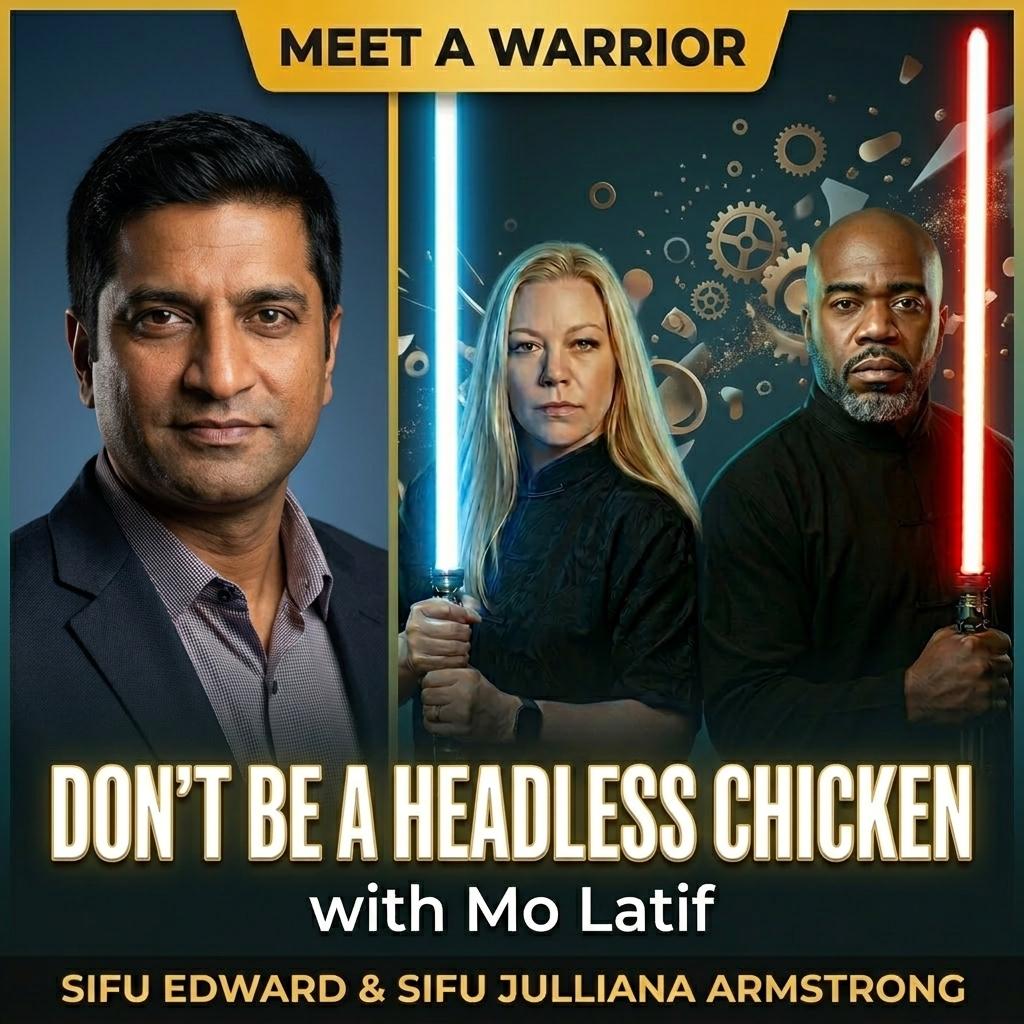
Adapted from the recorded conversation; the guest's words are verbatim. The questions are reconstructed and voiced by Sifu Edward and Sifu Julliana Armstrong.
🎥 Video podcast coming soon. The complete interview will play here once published. The full conversation is transcribed below, and the audio edition will be available on sifuarmstrong.tv.
In a new Sifu Armstrong interview, the founder of ClickDesigns describes being paid handsomely for 18 months to do almost nothing, and the ordinary commute that finally woke him up to it.
Mo Latif’s escape from investment banking didn’t start with a bold plan. It started with boredom, and then with a single automated spreadsheet key. He joined Sifu Edward and Sifu Julliana Armstrong for the latest Warrior Intelligence Series conversation to describe both.
Latif: founder of ClickDesigns, a design tool built for direct-response marketers, and a 20-year veteran of digital marketing based in Scotland, spent his banking days building a macro-enabled spreadsheet so efficient that his entire monthly workload collapsed into one action. “For 18 months they were just paying me to press F9,” he admitted. The comfort should have felt like winning. Instead, it felt like nothing. “I literally got bored,” he said. “I don’t want to do this. There’s more to this.”
The moment he actually left came from something almost trivial. A friend invited him somewhere different after a chance meeting at the tube station, and Latif said yes, then found himself walking straight to the machine to pay for his usual train home anyway, purely on autopilot. He calls the pattern being a “headless chicken,” robotically repeating a life without noticing it. Catching himself mid-habit was the wake-up call. He went home and left London that same night.
What followed was fifteen-plus years of copywriting work before ClickDesigns existed at all, copy Latif calls the first and most essential skill he ever built. But the pain that eventually became ClickDesigns was a different one entirely: outsourced graphic design that was slow, expensive, and endlessly revised. He built a tool to remove the designer from the equation and used it privately for three years, quietly producing his own graphics while people assumed he’d hired someone. When a skeptic finally demanded proof (“you need to stop lying, stop bullshitting,” the man told him) Latif didn’t argue. He shared his screen instead, and within a couple of minutes the doubter cut him off: “No, I get what this is: just give me access.” Using the tool internally with no outside designer, he and his partner did, in his words, “over $4 million in revenue.”
Latif’s philosophy on why visuals matter so much ties directly back to how people actually process a page. “We look with our eyes first, before the mind even decides to read,” he said, which is why, in his view, presentation is never decoration, it’s the first decision a viewer makes before a single word gets read.
Copywriting, Latif says, remains the foundation everything else was built on. He learned it first, on the advice of the marketers he watched early on, before graphics, before software, before any of it. ClickDesigns now integrates directly with site builders like GroovePages, Go High Level, ClickFunnels, and Kartra, letting users build a graphic and drop it straight into a page.
The Armstrongs saw in both stories (the F9 cage and the demonstration that ended an argument in two minutes), a shared lesson: comfort can be its own kind of sleep, and the surest way to answer a doubter is never to debate, but to show them the work.
In This Conversation
- The macro that let him get paid just to press F9
- Becoming a “headless chicken,” and the tube station moment that woke him up
- Leaving London that same night
- Building ClickDesigns to kill the endless designer back-and-forth
- Proving it with a two-minute screen share instead of an argument
- Why visuals decide before the reader’s mind ever does
The Full Conversation
Sifu Edward Armstrong: Mo Latif built ClickDesigns, a design tool that took the marketing industry by storm, but the story that grabbed me is how he escaped his old life. He had a cushy bank job where he'd automated his own work down to pressing a single key, F9, and getting paid for it. And he walked away, because comfort was never the point. That's a builder's soul, and I wanted to talk to it.
Sifu Julliana Armstrong: And his wake-up moment is unforgettable. He was so programmed by the daily grind that he calls it being a "headless chicken," robotically doing the same thing without even noticing. One day he paid for a train home on pure autopilot even though a friend had just invited him elsewhere, and in that instant he saw the trance he was living in, and left London that same night. That's the moment a person wakes up, and it's the most important moment there is.
Our guest is Mo Latif, founder of ClickDesigns. Mo, welcome.
Mo Latif: Thanks a lot. Thanks for having me.
Sifu Edward Armstrong: Take us to the beginning, the banker who wanted out.
Mo Latif: My background was accountancy and investment banking in London, and I got bored of the still life around Liverpool Street and Bank. Around 1998, Google was born, and I hated the commute, hated going to work, but I believed the internet was going to stay. I registered my first domain in 2002, thinking, "Is this thing for real?" It took me three years of procrastinating ("it's not going to stay, it's going to stay, I've got to learn this"), until 2005, when I watched video series by the old-school marketers, John Reese, Jeff Walker, and the rest. After watching them I thought, "If they can do it, why can't I?" I went to my first event in the States in 2007, which cost me an arm and a leg, came back and did my first product launch, super successful. And my number-one skill, the first thing I ever learned, was copywriting. All the gurus tell you: learn copywriting. So I did, and became really good at it: email, VSLs, webinar scripts. Eventually my partner and I became top 1% vendors on JVZoo.
Sifu Edward Armstrong: "If they can do it, why can't I?" and copywriting first, before anything else. That's the right foundation, because the word is what moves people, and it underlies every business you'll ever build. But I also note you procrastinated for three years before you leapt. That's honest, and it's human, most people spend years circling the water before they jump. The leap is rarely on time. What matters is that eventually you jump, and you did.
Sifu Julliana Armstrong: Now the F9 story and the headless chicken. This is the part I most want our warriors to hear.
Mo Latif: I only worked for someone maybe 18 months, tops. I'm a systems guy. I look for things to make life easier. While working in investment banking, I created a macro-enabled Excel sheet that integrated with their management system, so at the end of the month all I had to do was press F9. I kept it quiet (probably shouldn't be saying this), but for 18 months they were just paying me to press F9. And I thought, "That's cool, I can keep doing this." But I literally got bored. Even though you're getting paid a good amount, you think, "I don't want to do this. There's more to this." And the reason I moved out of London: someone had warned me I'd end up a "headless chicken", robotically continuing to do something every single day, programmed to just do it without noticing. One day I bumped into a friend at the tube station who said, "Come see me at this place," and I said okay, and then I still went to the machine and paid to go home, because I was programmed. That was my wake-up call. I thought, "You've just done it. It's time to leave." I went home and left that same night.
Sifu Julliana Armstrong: You had the dream that traps most people (paid handsomely to do almost nothing), and you were awake enough to feel it was a cage. That's rare. Comfort is the most seductive prison there is, because the door isn't even locked; you just stop noticing it's a door. And the headless chicken is the perfect image: most people sleepwalk through their entire lives on autopilot, paying for the train home even when life just offered them somewhere better to go. The warrior's first victory is simply waking up, seeing the trance for what it is. You saw it, and you walked out that same night. That decisiveness, the instant you see clearly, is everything.
Sifu Edward Armstrong: ClickDesigns came from a pain you'd carried for two decades. Tell our operators.
Mo Latif: For twenty years, every project was the same process: idea, copywriting, website, design. ClickFunnels, from my old friend Russell Brunson, fixed the programming and website problem. But the real, lingering pain was the graphics: outsourcing to designers across different countries, endless back-and-forth revisions, missed deadlines, an excuse every time. A dot on an image would take three days and a hundred dollars to remove. After fifteen-plus years I thought, "This needs to stop, I can't keep doing this." So I built a tool to eliminate the designer, and I used it internally for three years before anyone knew I had it. Every launch, I'd do my own graphics, and people would ask, "Who's your designer?" I'd say, "Me," and nobody believed it, because I was known as the copywriter.
Sifu Julliana Armstrong: And how you finally convinced them is my kind of answer. You didn't argue, you demonstrated.
Mo Latif: For 18 months people kept saying, "Who's your designer? We know you can't do it." Then one guy said, "You need to stop lying, stop bullshitting." So I said, "Let me show you," and we got on a call and I did a live screen share. Within a couple of minutes, he stopped the conversation, "Right, okay, I've seen enough." I said, "Don't you want the rest of the demo?" He said, "No, I get what this is: just give me access." Over three years with my partner, using the software with no graphic designer at all, we did over $4 million in revenue. And when I finally sent it to high-profile marketers, the responses poured in, one fired a five-year designer within three weeks.
Sifu Julliana Armstrong: "Stop lying," and instead of arguing, you shared your screen and let the work silence the room in two minutes. That is the only way to answer a doubter worth answering: don't debate, demonstrate. Talk is cheap and endless; a demonstration ends the conversation. On the mat, you never win an argument about whether you can do a technique. You do the technique, and the argument evaporates. Let your work be so undeniable that the skeptic stops you mid-demo and says, "I've seen enough." Proof doesn't need a defense.
Sifu Edward Armstrong: You're a copywriter who came to revere the visual. Why do the graphics matter so much, and how should they work?
Mo Latif: Copy is king, absolutely, but here's the thing. There's so much content now, and when people hit a page with too much to read, they start scanning. So the graphics have to tell the story. If I have a paragraph, I'll have a graphic that represents it, so as you scroll down, the images carry the message all the way to the buy button. And visuals matter because we're visual creatures, the brain processes images 60,000 times faster than text. Put an ugly 1970s Datsun next to today's Lamborghini; no matter how good the copy, which catches your eye? We look with our eyes first, before the mind even decides to read. They say don't judge a book by its cover, but you can't help it. So the graphic should represent the content, present your visuals so they carry the story, and your conversions just get easier. And I went global from day one. Why sell only to local or national people when the internet lets you go worldwide?
Sifu Edward Armstrong: "We look with our eyes first." That is why we've never treated the visual as decoration. When a warrior encounters the Sifu Armstrong world (the look, the imagery, the way it's staged), the eyes decide in a heartbeat whether this is serious, whether these are real masters, before a single word is read. The graphic that carries the story to the decision, the presentation that says "this is the real thing." That's not vanity, it's respect for how humans actually work. And going global from day one is the only vision worth having. Why claim one town when the whole world is the arena?
Sifu Edward Armstrong: Tell our operators what ClickDesigns makes, and where to find it.
Mo Latif: Every design we use for our own businesses is available inside ClickDesigns: ebook and podcast covers, landing-page graphics, icons, device mockups, security seals, the whole range. It's a subscription with a 14-day free trial, and it works seamlessly with the site builders (GroovePages, Go High Level, ClickFunnels, Kajabi, Kartra), you create a graphic and drop it straight in. Someone called us "Canva, but for direct-response marketers," and that stuck. Just go to ClickDesigns.com, click "try it free," and play with it: break it, and if it solves your problem, perfect; if not, tell us why and we'll improve it.
Sifu Edward Armstrong: Mo, it's been an absolute pleasure. Thank you.
Mo Latif: Likewise. Thanks a lot.
Sifu Julliana's closing word: Mo had the golden cage (paid to press one key), and was awake enough to feel it was a cage. Most people sleepwalk through their whole life on autopilot, paying for the train home even when life just offered them somewhere better. The warrior's first victory is waking up, seeing the trance, and walking out that same night. And when a doubter said "prove it," he didn't argue. He demonstrated, and the work ended the conversation in two minutes. Don't debate. Show them.
Sifu Edward's closing word: Mo built the word first (copywriting, the foundation), and then honored the truth that we look with our eyes first, which is exactly why presentation is never vanity in our world; it's respect for how people actually decide. He escaped comfort because comfort was never the point, thought global from day one, and let his work silence every skeptic. Wake up from the autopilot, master the craft, present it like it's worth what it is, and claim the whole world as your arena. We don't entertain warriors. We create them.
Mo Latif, founder of ClickDesigns (clickdesigns.com), the design tool built for direct-response marketers; copywriter and 20-year veteran of digital marketing, based in Scotland.
ILLUSTRATIVE RESULTS. Any revenue, enrollment, margin or retention figure in this conversation is either a documented result from one of our own operations, a figure the guest reports about their own business, or an illustrative example, never a projection of your results.
Nothing here is financial, legal or tax advice.
Stay in the Fight
This conversation is part of the Sifu Armstrong Warrior Intelligence Series: interviews with world-class performers, builders, and thinkers, filtered through the lens of the warrior's path.
Subscribe at sifuarmstrong.news for every new interview, delivered to you.
Join Club Sabernet, the member community of the whole Sifu Armstrong ecosystem, where warriors train, connect, and hold each other to the standard.
Ready to build your own floor? Find your path at sifuarmstrong.com/which-path.