Build Without Burnout: Sifu Edward & Sifu Julliana Armstrong Sit Down With Donna Kennedy
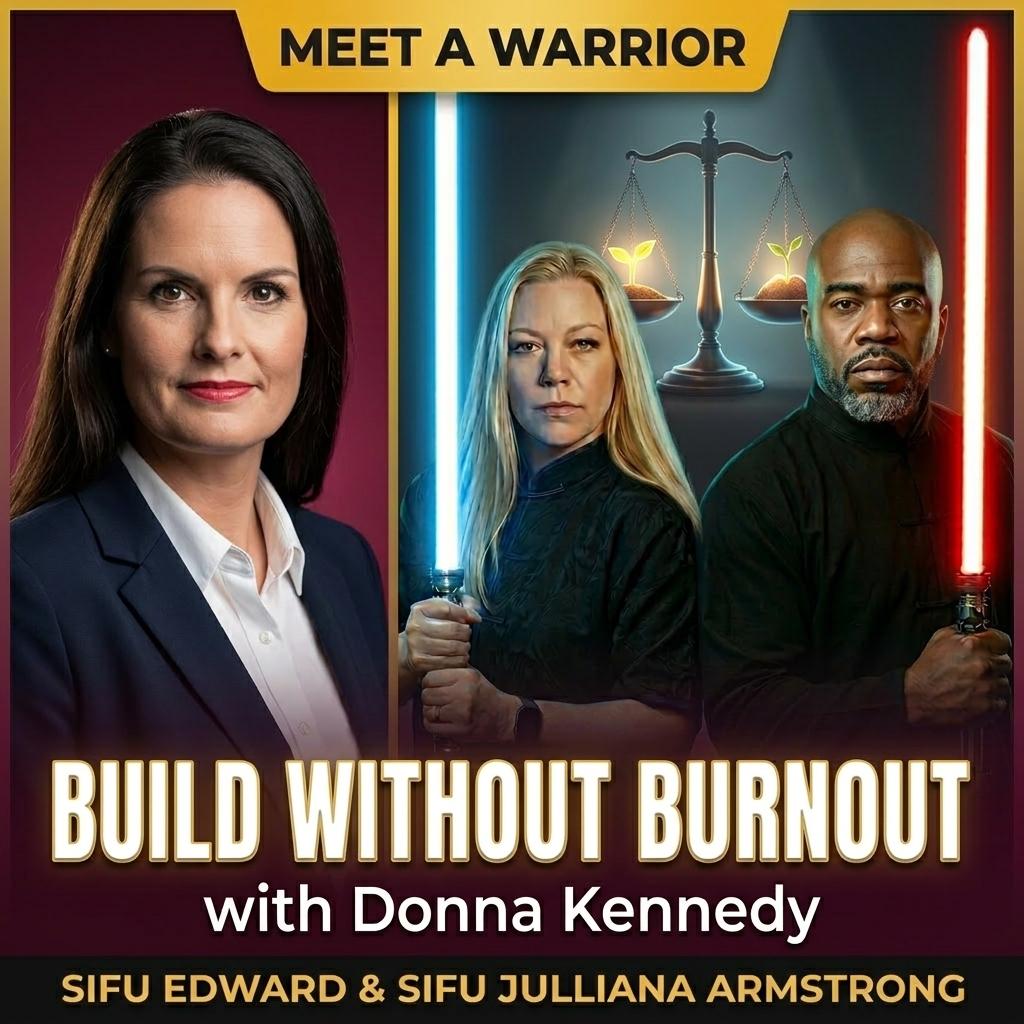
Adapted from the recorded conversation; the guest's words are verbatim. The questions are reconstructed and voiced by Sifu Edward and Sifu Julliana Armstrong.
🎥 Video podcast coming soon. The complete interview will play here once published. The full conversation is transcribed below, and the audio edition will be available on sifuarmstrong.tv.
In a new Sifu Armstrong interview, the Irish entrepreneur and nine-time author argues that motivation is unreliable by nature, so resilience has to be built on something sturdier.
Donna Kennedy started her first business at five years old, selling brooches from a homemade “stage” on a garden wall. In her conversation with Sifu Edward and Sifu Julliana Armstrong for the Warrior Intelligence Series, the Irish entrepreneur and author of nine books traces a throughline from that early hustle to a philosophy built almost entirely around one idea: mindset isn’t a supporting feature of success. It’s the whole foundation.
Kennedy is direct about where that philosophy was forged. She spent twenty years, by her account, in “a very difficult place.” Rather than treat that history as background color, she brings it forward as the source of her clearest teaching: resilience isn’t a personality trait some people are lucky enough to have. It’s a discipline you practice regardless of how you feel on a given day. “Don’t wait for motivation,” she told the Armstrongs. “You have to realise that you’re going to have to do it anyway.”
That refusal to depend on feeling ready shows up throughout her work, including her ninth book, built around the idea of committing to a single “plan A” instead of keeping an exit ready. People sabotage themselves, she argues, the moment a backup plan quietly signals that failure is an option. It also shapes her core diagnostic for founders: mindset comes before strategy, not after it. “You can have the best strategy, you can have the best qualifications, you can be the most skilled in an area,” she said, “but if you don’t have mindset at the foundation, it will collapse 100%.”
Kennedy pushed back hard against the curated version of success people see online, the version where everyone is motivated at 5 a.m. and nobody posts the bad days. Her antidote is a regular, honest self-check-in across every area of life: mental, physical, emotional, and, for some, spiritual, done every couple of months without exception, precisely so a weak area gets caught before it becomes a collapse. She’s unsentimental about the discomfort that requires. “There is a strength in vulnerability,” she told the Armstrongs. “It’s not a weakness.”
That same audit applies to business itself, which she insists is a vehicle, not the destination. “Your business is a vehicle for living your lifestyle,” she said. “If it’s the other way around, you’re going to be a very unhappy person and probably broke.” When she and her husband decided to have their son, she didn’t abandon her goals. She restructured how she’d pursue them, choosing to be present for mornings rather than treating ambition and family as competing forces.
Underneath the frameworks is a repeated insistence that comparison, not circumstance, is most people’s real obstacle. Rejection, she argues (not death, not public speaking) is the fear actually driving most self-sabotage, rooted in a survival-level need to be accepted. Her fix starts simply: stop comparing your behind-the-scenes to someone else’s highlight reel, and get honest about which parts of your life actually need attention before they become a crisis.
For the Armstrongs, Kennedy’s insistence that the path doesn’t retire when the body ages, or when life gets hard, tracks with everything they’ve built the Ageless Warrior path around: the mat doesn’t reward whoever felt most inspired that morning. It rewards whoever showed up anyway.
In This Conversation
- Kennedy’s earliest entrepreneurial instincts, from selling brooches at five to yule logs at twelve
- Turning twenty hard years into the source of her teaching
- Why she commits to a single “plan A” instead of keeping an exit plan in her back pocket
- Mindset as the foundation beneath strategy, skill, and qualifications
- Her regular whole-life check-in across mental, physical, and emotional health
- Treating business as a vehicle for lifestyle, not the other way around
The Full Conversation
Sifu Edward Armstrong: The lie I most want to destroy is that the warrior's path ends with youth, that strength has an expiry date. We built the Ageless Warrior avatar and the Dragon Cane program precisely to prove the opposite: that mastery, vitality, and purpose can deepen with age if you build sustainably instead of burning yourself to the ground. Our guest today is living proof that you can come through the very worst life can throw at you and build something that lasts.
Sifu Julliana Armstrong: What moved me most preparing for this is her honesty. She talks openly about coming through twenty hard years and turning it around, and her core teaching is the one every champion learns the hard way: mindset is the foundation, and you don't wait to feel motivated, you train anyway. That's not soft. That's the hardest discipline there is.
Our guest is Donna Kennedy, Irish entrepreneur, business mentor, and author of nine books including DECISION: The Gateway to Your Unlimited Potential. She helps founders build profitable businesses that actually fit their lives. Donna, it's great to have you with us.
Donna Kennedy: It's great to be here.
Sifu Edward Armstrong: I built my own art out of a hard ending and a lot of doubt, desperation has a way of forging people. Take us right back to the start of your entrepreneurial journey and what led you there.
Donna Kennedy: I guess I was an entrepreneur at five. I started my first business, selling brooches. I really was always interested in entrepreneurship without realising that I was an entrepreneur. I had a very difficult past, and at a part of my life it was very, very difficult, but I turned it around. And as many people who have successful businesses and go on to help others through leadership, many people have had a rough start or they've had humble beginnings. Because there is a point where you get to have desperation, and that desperation is a catalyst for building something better.
I've always had an entrepreneurial spirit. What I mean by that is, as I said, when I was five, I used to sell brooches. At home, we had this pillar on a wall, and I used to sit on it with a little Fisher-Price record player, and I thought I was a busker. I was going to make all this money. Then at Christmas time I made and I sold yule logs when I was 12 and Christmas wreaths. So, there's lots of different things all the time.
I'm interested in people in particular and I'm interested in creating things. I'm known for a phrase, "Let's give it a go." Anything that happens and I look, okay, well that could be interesting. And then if I really love it, well, why not make money from it? And it's always a win-win, so everyone... I guess it's a little bit of an adventure. It's a journey of fun and everyone makes money.
Sifu Julliana Armstrong: "Let's give it a go." That's the white-belt spirit I wish I could bottle. What did those early years teach you about business that you still carry today?
Donna Kennedy: Definitely that business is all about people. Especially in today's age, people try to sell product, and they focus so much on the product and on the glitz and the glam and all of that kind of thing. But really, businesses are built on relationships long term. If you think of any restaurants that you've ever been to, you've probably been to it because somebody has recommended it more so than just seeing an ad in a newspaper or on social media.
So, recommendation is probably the best form of accelerating your business and your life. But I think that comes very much from recommendation, people, and building relationships.
Sifu Edward Armstrong: Built on people and recommendation. That's how a warrior nation grows, one trusted hand pulling in the next. You've just finished your ninth book, all about action. Tell us about it.
Donna Kennedy: Yes, it's my ninth baby, so I'm able to say I'm delivering this into the world. It's all about action. It's when there's only plan A and that involves into action. And many people find themselves giving, I guess, procrastination, hesitation, and they say, well, if it doesn't work out, then I'll just do plan B. I guess sometimes people sabotage themselves, it wasn't going to work out anyway, and this kind of thing.
Whereas if you have literally one plan, it's plan A, and you make it work. To do that, you have to have action. Again, social media can be responsible for it a little bit. But there's a lot of not-solid stuff out there at the moment, which are things like you wish for it and it'll happen, or you have the law of attraction only and it'll happen, think about it often enough and it will happen. Which is true to an extent that there are universal laws, but personally, I believe that you also have to have action as part of that.
So, you have to visualise it, you have to have the vision, you have to have the passion, determination. But if you do nothing, nothing happens. You can get it on Amazon. You can also get it on my website, which is donnakennedy.com, or if anybody wants to email and ask for details, it's info@donnakennedy.com.
Sifu Julliana Armstrong: "Only plan A" (no escape hatch) is exactly the mindset I take onto a competition floor; the back-up plan is half a step toward quitting. You talk a lot about building success that's sustainable. What does that mean in practice?
Donna Kennedy: It's long term. There's a lot of people who build businesses. They have the vision, but they don't do the things that they need to do to get it started, but importantly to maintain it. And when things get tough, which they always do in any business or in your life, people can often... I suppose fail is a bad word, but they just stop. They give up. They don't push through the obstacles. They blame themselves, criticise themselves, say things like, as I said, "It won't work anyway," or such and such, "A person said it wasn't going to work out, and they were right."
If you want to be sustainable, you have to be prepared to know that the fact is there will be obstacles, many. It's like life. You have to go through those obstacles, go over them, go under them, do whatever you have to do to get through them. And when you do, it's worth it. If anybody looks back to their entire life and anything they've ever got a result... That could be getting 10 out of 10 in a spelling test, so it doesn't have to be anything monumental... there were mistakes, many mistakes made to get there.
I think sometimes we can criticise ourselves a little bit too much and be too hard on ourselves, when really it's just about you can say to yourself, "That was a mess-up. We won't do that again, but what did we learn from it?", or, "That actually really worked," and then look at that equally. It's all a kind of trial and error, but a calculated one at the same time. And give yourself a break.
Sifu Julliana Armstrong: "Give yourself a break" while still demanding the reps, that balance is the whole art of staying in the game for decades. You've written nine books, so motivation clearly isn't your problem. What actually drives you, and what would you tell our warriors about it?
Donna Kennedy: I would say don't wait for motivation. I certainly wasn't motivated at the beginning, that's the truth. People often ask me about confidence as well. Motivation, confidence, determination, they're words, and they actually mean nothing in a tangible sense. They're states of being. And any state of being is open to change, it fluctuates from moment to moment. There are plenty of people who will tell you they're motivated all of the time. They get up at five o'clock and they seem to run on nothing, and then they sleep for three hours. That is ridiculous and not maintainable in the real world.
I would say don't wait for motivation or anything that links to that. You have to realise that you're going to have to do it anyway. There will be days where you don't feel like it, and there will be days where it's easier to pull the duvet over your head or when it's easier not to get sociable or go to an event. But to make it happen, you need to. And importantly, I think for people to scale it back a little bit, the small steps are the most important steps, and the steps that are calculated are the most important steps.
Whereas when we look at social media and we see people who seem to be so successful and they have everything, all of their good pictures go online. Very few people put up the bad pictures, so we have a very false perception of what real life is. But I can tell you, there's a lot of... Everybody gets up with hair like a bird's nest, unless you don't have hair. Everybody. We all are the same type of people, we just do different things.
I think it's just about when you are more authentic, when you're real about things, you don't have to have the facade. I guess maybe that's one of the lessons that I learned. There is a strength in vulnerability, it's not a weakness. But people run from the vulnerabilities and they run from things that maybe don't look good on social media. Or if they've got a bad day, they don't let other people know about it. If you meet somebody and you ask them, "How are you?", they'll normally say, "Oh, busy." Busy doing what?
I don't want to be busy. I want to be enjoying my life. So, it's setting up systems that work and that means being authentic. And if you've got a bad day, so what? You're not going to mull over, you're not going to moan about it. But at the same time, you have to acknowledge life for what it is. It's up and down, it's every way. And then it's just creating systems, creating processes, creating good relationships, as I said, and surrounding yourself with the right people.
And really importantly is keeping your mindset right. Your mindset is the foundation for everything, in my opinion. Everything. You can have the best strategy, you can have the best qualifications, you can be the most skilled in an area, but if you don't have mindset at the foundation, it will collapse 100%. So I would say to people, focus on your mindset first and everything else will fall into place.
Sifu Julliana Armstrong: "Mindset is the foundation, everything else collapses without it." Every guest we most admire keeps arriving at that same summit from a different trail. And do you believe business should actually be fun? Because you come across as someone who refuses to be miserable about it.
Donna Kennedy: I don't want to be miserable. I certainly want to have fun in my life. I'm known for a phrase, "Live fully." Again, that comes from... I spent 20 years in a very difficult place, so I know what it is. I know what the opposite is, and it's certainly not one that I choose. And I really value time. I think if we value time more, we would be very selective as to what we do with it and who we share it with, and importantly, to have fun, but also to have meaning.
Life needs to feel meaningful. It needs to feel full. It needs to feel that you're living according to your values of what's important to you, being around the people who are important to you. Otherwise, what's the point? To impress people on social media or to do whatever it is that you feel impresses people? For me personally, I prefer to do things that I really love to do, rather than just to be busy for the sake of it or to pretend.
Sifu Edward Armstrong: "Live fully," and you earned that phrase through twenty hard years, which gives it a weight no slogan could carry. I know there's been joy lately too, with your marriage. How much has the support of family shaped you?
Donna Kennedy: Huge. You're not always going to receive support at certain times. I have a huge family, but the reality is, every single... If you even take siblings, for example, I have seven. Every single one of those siblings have lived a different life. They've been with their parents at different stages of their parents. They've walked in on a specific chapter of their parents' life, if that makes sense. So, no one of those siblings have lived the same life. Your family are going to have a certain level of understanding. Not all of them will know how to support you, and then there's your personal traits. I would say don't rely on family support, but it is nice when you get it.
I had fantastic parents. They stuck with me 100%, for sure. I can imagine, now a parent myself, it would've been really difficult. But people I thought would support me didn't support me.
You have to remember that you can't rely or expect other people's support, because ultimately it comes down to you creating your life, you having a good mindset, or you creating your business. Ultimately, it comes down to what you do. Many people blame the world, and I could blame the world as well, but blaming other people or other things or your advantages or disadvantages, where you grew up, it doesn't help the situations at all. It's more important to focus on what you do want.
Sifu Edward Armstrong: Twenty hard years, and you came out of them teaching. The resilience you carry isn't theory; it was forged. For the warrior listening who wants to build that kind of resilience, where do they begin?
Donna Kennedy: Number one is stop comparing yourself to other people. It will take half the battle out of it. We look at other people on social media, in our neighbourhood and everywhere else around us, and we say, look how good they're doing. If you look at everything, any behaviour, look at it or read it, any book, or listen to any podcast, you'll always find that the number one thing it comes back to... If you peel it away like an onion with the layers, the number one difficulty that people have is feeling good enough. That comes from, in my opinion, when you're born, you know that you need to survive in the world, and the way you do that is you're being accepted, and therefore we do everything we can to be accepted.
Rejection is the number one fear. They say fear of public speaking, fear of death, but it's actually rejection, if you take all the fluff out of it. In fact, they use isolation in some countries as a form of torture, because people know that we want to be accepted by people. And because we want to be accepted by people, a lot of our behaviours, a lot of our resilience, a lot of our mindset is based on what other people think of us and how they view us. So, the first thing I would say is stop comparing yourself to people. You have a version of their lives that you see. You don't have the whole picture. And you're comparing yourself to the best bits.
I do think that you need to definitely, every single day, look at your mindset and keep yourself physically well. But mentally, physically, emotionally, and spiritually for some people, it's really about checking in. Every two months, I still do it, years and years and years later. I only did it last week. It's an exercise that I have that I actually track where I'm at in each area of my life. Some of them are not going to be wonderful, but if I know the areas that aren't wonderful, I can then improve on them.
That keeps you on your toes, it keeps you in check. And when you're regularly tracking, say, "How am I doing in that area? How am I feeling in that area?", any little improvements, you can make them before they become a disaster. For resilience, you have to take care of yourself, otherwise you're running on empty, you're on half battery. That's where people fall, is where they have a weakness in certain areas, and normally those weaknesses are to do with either mentally or physically.
When you look at it, when you really look at it, most people have the skill to do what it is, and if they don't have the skill, they can learn it. If they don't have the context, they can get them. The fluffy stuff or the surface stuff really isn't what keeps you resilient. What keeps you resilient is checking in on yourself regularly and doing it with authenticity and being honest. When I work with people, when I mentor people, one of the first things I'll do is I'll do an analysis of their life. Some of them are like, "Why are we doing an analysis of this?" Because it's the most important thing.
You can have an amazing business and you can have a horrendous marriage because you're so focused on one area, or you could have an amazing business and your health is in dire straits because you're focused on one area. Whereas if you can look at your life as a balanced overview and say, "What's important to me? Who's important to me? And where do I need to consistently improve?"... There will be areas that will always, without a shadow of a doubt, be vulnerable.
For example, during the whole COVID thing, you found a lot of people became very vulnerable, and all of a sudden they didn't know what to do. Suicide rates went through the roof, businesses collapsed, because people were so focused on one area and they forgot the rest. So, your mindset is huge, and making sure that you take care of yourself. When you do that, that is what resilience is about. Resilience is not about skill or strategy in a business. That's execution of skill.
Sifu Edward Armstrong: That balanced check-in across every area of your life. We've now heard it from Tom Beal as his Trinity and from Simon Hartley as three interwoven strands, and here it is again from you. When the wisest people keep drawing the same map, a warrior pays attention.
Sifu Julliana Armstrong: And it's the heart of why we built the Ageless Warrior path and the Dragon Cane program. You don't get to retire your health, your relationships, or your spirit just because the business is thriving. Give us the practical steps, Donna. How do you actually do this self-care in real life?
Donna Kennedy: The important thing, first of all, is clarity and what it is that you want. And then you have to break down strategies that will get you there, but you have to do it in bite-sized chunks. And for that, you need clarity, not just on an overall, this is what I want, or this is the kind of business that I want, or the kind of life that I want. It's this is what I want, but what do I need to do this week, and then what do I need to do every day? And do those daily steps while keeping the big vision there.
Clarity is very important, because if you don't have clarity, you're really muffling through and wading your steps through the dark and figuring out as you go, which really isn't going to create success short term or long term. You'll get lost. So, have the clarity at the beginning. That means looking at what is important to you. What is it that you actually want? Your business is a vehicle for living your lifestyle. If it's the other way around, you're going to be a very unhappy person and probably broke.
So, the clarity is huge, assessing what someone's values are, assessing your goals and making sure the goals are yours, they're not based on other people's standards and what other people feel that you should or could do. Also, looking at your interests and making sure they're incorporated into your goals. Looking at the people in your life, the ones that you want to stay in your life and saying, "How is this going to work for me?".
For example, when myself and my husband, we decided we were going to have our son, I knew I was pregnant very early on. I decided I still have my goals, but I'm going to achieve them in a different way, because I wanted to be there in the morning with my son. That was just my choice, and I know not everyone is in that position. But I was not going to be able to achieve my goals in the same way as I would've before, so I had to adjust and say, "He's now important to me, so how can I achieve my goals and include him and include my husband and include everything else in my life?".
That means sitting down on a regular basis and getting clarity around those, and also doing a little review of who's in your life and whether they add to it or whether they are dragging out of it. A lot of the time we can spend are on people and things that really have nothing to do with our goals and valuing time. So, I would look at where is somebody putting their time. They might be very surprised as where they put their time and how much of it, that if they use more constructively, they could claw back hours in a day, and then have many of those hours doing things that they absolutely love.
So, there are many things, but a lot of it is getting very honest with yourself, not criticising yourself or judging yourself. It's honest for the sake of getting it crystal clear on what you want, and then making decisions the right way as you go along and assessing those decisions. Is this for my greater good? Is this for the greater good of my business? Is this still the direction that I want to go in? Having a pause every now and again is a good thing. It doesn't mean you're lazy. The most successful entrepreneurs that I know, they've all got balanced lives. The ones with happy lives, they're not out there being crazy people being busy. They know who they are and they delegate where they need to delegate, and they're clear about what they want and they value time. I can't stress enough how important it is to value time.
Sifu Julliana Armstrong: "Your business is a vehicle for your lifestyle, not the other way around." For a warrior, the art serves the life, never the reverse. The first book of yours a lot of people meet is DECISION: The Gateway to Your Unlimited Potential. Tell us how that one came about.
Donna Kennedy: There's certain things that you need in order to create a result. Whether you are somebody to be an aspiring Olympian or whether you're somebody aspiring to have a great business, there's certain things that you will have to do when it comes to decision. For example, you could be at a crossroads and you may be completely confused. What do you do in those moments of confusion? If you are having to make decisions and you happen to have an environment that isn't necessarily supportive of what it is that you want to do, what do you do in those moments? If you don't feel motivated, if you don't feel energetic, what do you do in those moments?
The particular book was written after COVID. I found that a lot of people were at crossroads. Obviously, when you mentor people, they tell stuff privately to you that they wouldn't to the public. But a lot of people were at crossroads because their careers had to change. You'd be amazed at how many people couldn't use a computer effectively enough to make a business. There were lots and lots of people at home, and they were suddenly at a crossroads, and what do I do now, so that period of indecision.
When people are in that period of indecision, they'll do a couple of things. They'll either run away because it's ultimately a perceived threat in your mind. They'll either run away or they'll freeze or they'll fight. Many people froze and they just didn't know what to do. When somebody freezes, sometimes I always step in and I say, "Okay, I understand it. It's completely normal. But now let's look at what you need to do in these moments." Getting that clarity and having that plan is so important.
And then making the decisions that are authentic. That's where the book DECISION really came from, was because so many people were confused and they were lost. The book about action, I guess, was from that. Because then when people make decisions, then they need to create a plan for clear action. People would generally enter a situation, a goal, something that they want to have happen, they'll enter it with always I'll have a plan B in my back pocket in case it doesn't work out. But what if you didn't have a plan B? What if you only had plan A? Your actions would be a lot more purposeful, and they would be a lot more intentional. This is, I guess, why so many people, when they have humble beginnings, they don't have a plan B, so it has to work and they make it work. You will find that when people are in the most desperate situations, that's when they get faster, that's where they get stronger, that's when all of their ideas come out of their head. That really is about taking those actions. So, action really is the follow on from decision.
Sifu Edward Armstrong: Donna, it's been an absolute privilege. For anyone who wants to find you and your nine books, where should they go?
Donna Kennedy: If they go to donnakennedy.com, and as I said, I'm always open to connecting with new people, so don't be afraid to send me an email or add me on socials and send me a message. I'm also open to new opportunities and seeing what happens next.
Sifu Edward Armstrong: Thank you again for your time today, and for your honesty. It's been a real pleasure.
Donna Kennedy: Perfect. All right. Have an amazing day.
Sifu Julliana's closing word: Donna survived what would break most people and came out teaching this: don't wait for motivation, do it anyway; mindset is the foundation; and check in on every area of your life before the weak one becomes a disaster. That's the champion's discipline exactly. The scoreboard, the launch, the title, none of it holds if the foundation underneath is cracked. Train the mind, guard the balance, and give yourself the break you'd give a teammate.
Sifu Edward's closing word: Donna is the Ageless Warrior made flesh, proof that the path doesn't end with youth and that you build for the long road by refusing burnout, not by glorifying it. Plan A only. Live fully. Value your time and the people who add to your life. And run the same whole-life check-in the masters keep describing (Donna's areas, Tom Beal's Trinity, Simon Hartley's three strands), because a warrior who neglects the foundation will fall no matter how sharp the blade. There is no retirement from the warrior's path, only a change of weapon. We don't entertain warriors. We create them.
Donna Kennedy, Irish entrepreneur, mentor, and author of nine books including DECISION: The Gateway to Your Unlimited Potential. Find her and her work at donnakennedy.com.
ILLUSTRATIVE RESULTS. Any revenue, enrollment, margin or retention figure in this conversation is either a documented result from one of our own operations, a figure the guest reports about their own business, or an illustrative example, never a projection of your results.
Nothing here is financial, legal or tax advice.
Stay in the Fight
This conversation is part of the Sifu Armstrong Warrior Intelligence Series: interviews with world-class performers, builders, and thinkers, filtered through the lens of the warrior's path.
Subscribe at sifuarmstrong.news for every new interview, delivered to you.
Join Club Sabernet, the member community of the whole Sifu Armstrong ecosystem, where warriors train, connect, and hold each other to the standard.
Ready to build your own floor? Find your path at sifuarmstrong.com/which-path.