Build the Muscle: Sifu Edward & Sifu Julliana Armstrong Sit Down With WebinarKit's Stefan Ciancio
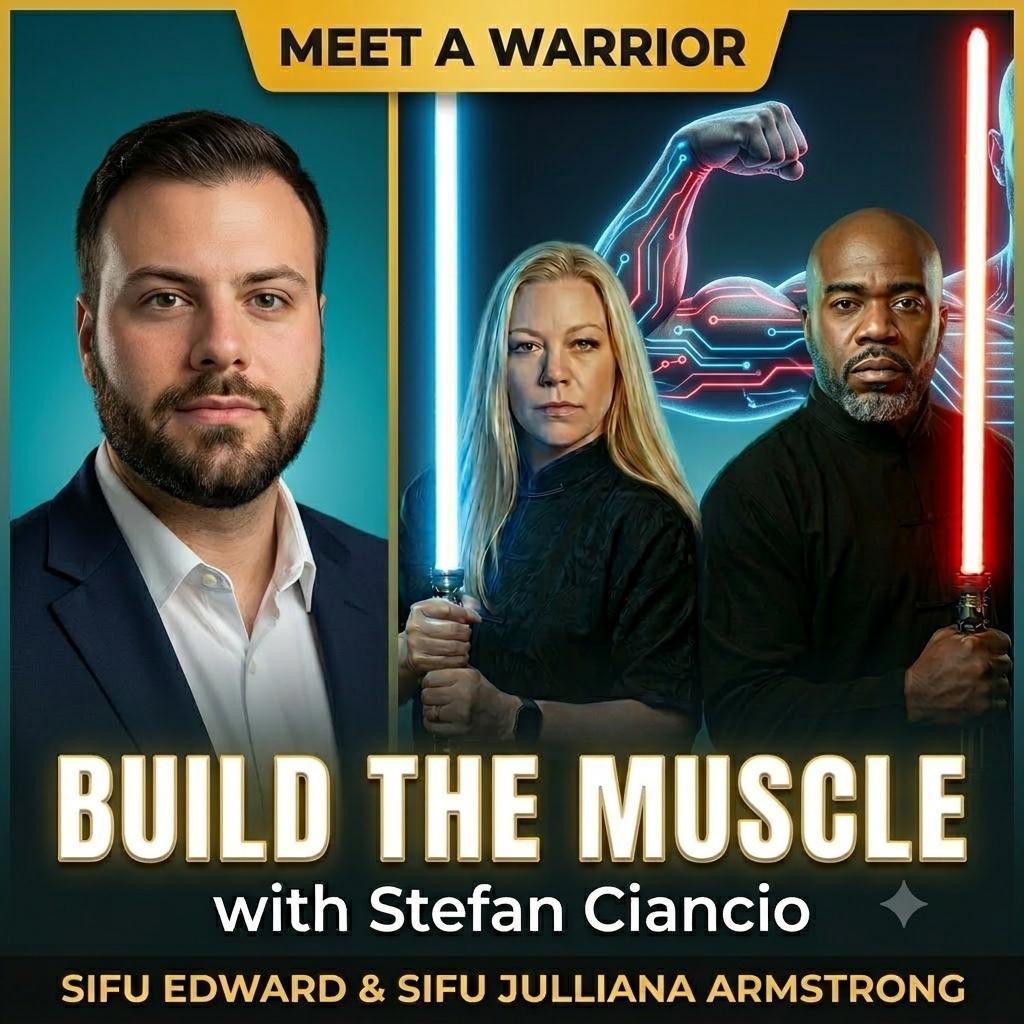
Adapted from the recorded conversation; the guest's words are verbatim. The questions are reconstructed and voiced by Sifu Edward and Sifu Julliana Armstrong.
🎥 Video podcast coming soon. The complete interview will play here once published. The full conversation is transcribed below, and the audio edition will be available on sifuarmstrong.tv.
In a new Sifu Armstrong interview, the CEO of WebinarKit argues that automated sales systems only work once the founder has actually built the underlying skill live, in front of real people.
Stefan Ciancio spent three years as a mechanical engineer before deciding the actual skill he wanted to master was persuasion at scale, and in his conversation with Sifu Edward and Sifu Julliana Armstrong for the Warrior Intelligence Series, he lays out exactly how a single sales format became the backbone of his entire career.
Ciancio’s path into digital business started with eBay sales, then digital products (courses, coaching, agency services) all of which he found he could sell reliably with one tool: the webinar. “Webinars became the backbone for success in any business that I started,” he told the Armstrongs. When the existing webinar software kept falling short (no autoplay, clunky templates, nothing built for how marketers actually needed to work), he partnered with a software-side co-founder in 2019 to build WebinarKit, which has since grown to more than 20,000 users and now includes an AI tool that can generate an entire webinar script and slide deck from a website link in minutes, plus a white-label option that started, he said, simply because a user asked for it.
Asked how the company handles the inevitable hard stretches, Ciancio didn’t point to a growth hack. “Every time we’ve dealt with a significant challenge in business, it always comes back down to the core fundamentals,” he said: messaging, offer, and whether either one is actually resonating with the market. He credits WebinarKit’s continued growth to reading that market early, particularly the shift toward AI: building an AI webinar builder before competitors did, he said, kept the company ahead rather than watching sales erode.
For anyone too afraid to host a webinar live, his advice skips the pep talk and goes straight to the mechanism. “You just need to build the muscle,” he told the Armstrongs. Start with five or ten people instead of five hundred, and let repetition do what confidence alone can’t. He’s candid that AI tools, including an upcoming AI voice and video feature that can deliver a webinar in a founder’s own cloned voice, will let people skip that fear entirely, though he’s not fully certain that’s a good thing. Sifu Julliana Armstrong pushed back gently on the same point in the conversation, cautioning that a founder should let automation carry them past the first fear without skipping the reps that make the pitch genuinely theirs.
On the numbers that actually matter, Ciancio was specific: registration rate, live attendance, and a conversion rate of at least 2 to 3 percent on cold traffic, rising to 10 to 30 percent with a warm list, plus a 24-to-48-hour urgency window on replays that mimics the pressure of a live event. Underneath the tactics is a simpler ambition. “I wanted to just build systems that allow me to sell while I’m not around and allow me to do whatever it is I want to do,” he said, describing a business that now runs largely on autopilot even while he’s traveling.
For the Armstrongs, that’s the real appeal of what Ciancio has built, not the software itself, but the idea of a system that carries a founder’s best pitch into rooms they can’t personally be in, freeing them to be on the mat, or across the world building the next academy, while the art keeps enrolling people anyway.
In This Conversation
- How Ciancio went from mechanical engineering to eBay sales to building his career on webinars
- Why WebinarKit was built to fix autoplay, templates, and speed that older webinar software got wrong
- The core-fundamentals lesson: messaging and offer, not tactics, solve most business problems
- “Build the muscle,” his advice for founders too afraid to go live
- The metrics that actually matter: registration, live attendance, and cold-traffic conversion rate
- Building systems that let the founder sell while traveling, instead of owning his whole life
The Full Conversation
Sifu Edward Armstrong: I can't be in every room where a future warrior decides whether to commit, and neither can any Academy Commander. The dream is a system that tells the story of the art, handles the objections, and enrols the right people while you're on the mat or competing on the other side of the world. That's what an automated webinar does, and our guest built the best engine for it I've seen.
Sifu Julliana Armstrong: And he says the thing every athlete knows in their bones: you have to build the muscle. Start with five people, then ten, then a room. There's no shortcut around the reps. There's only doing them until the skill becomes automatic. I respect a builder who tells you the truth about the work.
Our guest is Stefan Ciancio, CEO and co-founder of WebinarKit, a platform that turns webinars into automated sales machines with slides, scripts, funnels, AI chat, and follow-ups all in one system. Stefan, really nice to meet you.
Stefan Ciancio: Thanks for having me. Super excited to be here.
Sifu Edward Armstrong: I left a "safe" path to build something of my own, so I'm always drawn to the moment someone walks away from the day job. What started you in webinars, and what made you build WebinarKit, including the white-label piece?
Stefan Ciancio: Yeah. So, I used to be a mechanical engineer when I was out of school, and I worked in that field for three years, but the whole time I was always interested in doing something more, working for myself. Basically, I wanted to find a way to get out of my day job and make money for myself. One of the first things I did was eBay sales. That eventually led me towards appreciating selling digital products. So, I got into the space of selling courses, coaching, agency services. And the way in which I was able to sell all of those successfully was with a sales webinar.
So, webinars became the backbone for success in any business that I started. And that led me to seeing the problems with the existing webinar software out there and their limitations and wanting to build something better. So, in 2019, I partnered with someone who was on the software side. And we were like, "Let's create something that's actually built for marketers to get better success with webinars." And now, we've built a software that's had over 20,000 users, has fixed a lot of the problems with existing webinar software, and has allowed multiple businesses to actually succeed in areas where other software fell flat for them.
The white label, believe it or not, it came through a user who had reached out to us and said, "Hey, why don't you guys do white label?" And we just thought about it and we're like, "Sure." So, we like to listen to our users. And my goal is to build something that people actually want. So we built in the feature. Initially it was a separate offering, and we've integrated it in now to be one of our main offers. We believe in selling the whole solution. So, not just giving people a piece of the puzzle, but the whole puzzle. Now they get software, we give courses, we give community, and one of our plans does include the white label. So, for the people who do have products, it becomes another lever in their business. And for the people who don't have a product, you could sell ours. So, we go from being most of the solution to being the complete package, where I have never seen anyone else offer that exact solution before.
Sifu Julliana Armstrong: Walk us through how it actually works, because the part that excites me is accessibility. We never want the technology to be a wall that keeps a willing person out. How easy have you made it for a total beginner to get a webinar live?
Stefan Ciancio: So, one of the first reasons we started it was with autoplay. All these other automated webinar solutions didn't autoplay. So people still had to go into the watch room and press play. It defeats the purpose of this feeling like an event where you're just along for the ride. So, we fixed that. That was the first thing. And then we made it much easier to use, much more modern. A lot of these tools had been around forever. They were legacy. So, we built in better templates, a modern drag-and-drop page builder, the ability to embed the entire webinar on your own website, and an AI webinar builder that will build your entire webinar presentation for you in minutes, as opposed to having to go out and spend $10,000 to get an agency to do it.
That's been huge because anyone who has wanted to take advantage of webinars to grow their business now is able to. Whereas, in the past, it was almost like gate-kept. You either needed to put months of time in or $10,000-plus. And now, you could just go into WebinarKit, put your site link in, and all of a sudden, you've got a webinar ready to go.
It's pretty easy. You grab your website link and you put it in WebinarKit, and within a few minutes you've got a script ready to go. You can make edits to that script or use it as is. Once you're satisfied, you go to the slide builder, take that script, press a button, choose your styles, and you'll be able to create a slide. And that's it. It doesn't get easier than that. I'm using it myself for some of my presentations. And we have people using it every day.
Sifu Edward Armstrong: Tearing down the gate so anyone willing can walk through. That's exactly our heart with the art. Now, that road from 2019 to today wasn't smooth. When a real challenge hits, where do you go?
Stefan Ciancio: That's a good question. We deal with new challenges every day as business owners. But I would say that, honestly, every time we've dealt with a significant challenge in business, it always comes back down to the core fundamentals. What's your messaging? What's your offer? Is it resonating with your audience? Is it resonating with what the market wants? And if you could focus there, the majority of your issues will go away.
And markets change. For example, if we had not adopted our business into the world of AI by building an AI webinar builder, we would not be ahead of all the other webinar software like we are now. We also would probably have seen a really big sales drop. People want AI now. So, you need to be aware of your market, aware of where things are going. And the people who adapt first are going to be the ones that survive. Unfortunately, the ones who don't are going to be further behind.
So, we try to read the market. We do surveys to our audience quite regularly. And if you're really confused, what I love to do is just host a live webinar to my audience and get on a call with them, call it a town hall, and just say, "Hey, guys, this is what we're doing. What would you guys like to see?" And a good tip for anyone who runs webinars: at the end of your webinar, you're going to have people on who haven't bought and aren't asking questions. Call them out by name one by one and say, "Why haven't you bought yet? Just curious." Find out what's stopping the people who haven't bought, and then you could address that in your product and in your marketing.
Sifu Julliana Armstrong: "Adapt first or fall behind": improvise, adapt, overcome, like the warriors we train. But I want to talk to the person who's terrified to ever go live. What do you say to them about taking the first step?
Stefan Ciancio: Well, there's two schools of thought there. If you're going to do it live, I say just go for it. You could start with a small audience. You don't need to get on with five hundred. You can get on with five or 10 people and start building that muscle. That's really what it comes down to, is you just need to build the muscle. But in the age of AI, you could use tools like WebinarKit, which will build the webinar for you. And then within the next month or so, we're going to have the AI voice and AI video live where you can actually just have an AI version of your voice record the webinar. So, I don't know if that's a good thing or a bad thing (it's allowing people to circumvent their fears), but if that's the route you want to go, you have two options there.
Whether you have or haven't run webinars already, I've run a lot of live webinars, but I can't wait to use that feature myself. It's just going to save me a lot of time. There's so many people already doing AI clones for their videos, but imagine for your webinars. It's going to be pretty wild.
Sifu Julliana Armstrong: "Build the muscle." Start with five, build to a room.
Sifu Edward Armstrong: That's the whole truth of the mat. Nobody spars a champion on day one; you drill with a partner, then two, then the room, until the nerve burns off and the skill is just there.
Sifu Julliana Armstrong: And I'd gently say to the warrior tempted to hide behind an AI clone forever: let it carry you past the first fear, but don't skip the reps that make you real. Stefan, when you host, what numbers tell you a webinar actually worked?
Stefan Ciancio: Yeah, absolutely. The metrics you really want to look at are a few things. Registration rate on the webinar lander. Then how many people are actually attending live. And then what is your conversion? On the conversion rate, it really depends on what kind of traffic you have, but ideally, you're closing at least 2 to 3% on a cold traffic webinar live.
And then what has really worked for us as of late is replays. So, we take a three-day timer and at the end of the webinar we run a replay period with the urgency and the special deal closing. And we just look at the numbers like earnings per attendee. How much are we getting per the average attendee that shows up? And if you know your earnings per attendee, you can figure out your earnings per registration. And then you can see how much you can spend on ads, because that's your cost per registration.
On an automated webinar, it's the same thing. One thing that's worked really well is the same urgency using something like Deadline Funnel or WebinarKit, which now has this functionality built in where you can cookie the timer to the end of the webinar. If someone watches an automated webinar, that gives them 24, 48 hours to get the webinar deal. So, now you get the same urgency that you get on a live webinar, but automated. So, 2% is a good conversion rate on cold traffic. If you have a warm list, you could see 10, 20, 30% conversions.
Sifu Julliana Armstrong: Who do you look up to in this world? Who's shaped how you build and present?
Stefan Ciancio: I really like Anik Singal. He actually wrote the foreword for our book, Sell More with Webinars, which is on Amazon. He's been a pretty big person that has helped me in the space. This guy, Caleb O'dowd is another guy. He's an Irish guy. He's built some pretty killer webinars. Another guy named Stephen Sommers, another Irish guy, actually. I guess the Irish are really good at webinars. Russell Brunson has been influential. I've gone through his whole playbook on webinars. And we've adapted a lot of this stuff from him, from the other people I mentioned, and a combination of our own findings.
And we have a little bit of a unique perspective because we're not just a guru. Really, we're running a webinar platform. So, we get behind-the-scenes of seeing what different businesses are doing. It's a unique perspective. You're not just being a guy who's running webinars, but you have a backstage pass to all these people who are running webinars on your platform. So, you have a very unique, open-minded view of what could work.
Sifu Julliana Armstrong: Anik Singal wrote your foreword. We sat down with Anik on this very platform, the FTC-investigation rebuild story. The web of these builders keeps closing in on itself, and that backstage pass you describe is its own kind of mastery: you learn from a thousand people's reps, not just your own.
Sifu Edward Armstrong: That backstage view is exactly what a federation gives me across all our academies. Stefan, let's talk freedom, WebinarKit could swallow your whole life. How do you keep it running without it owning you?
Stefan Ciancio: Well, first thing I do is I make sure we have our automated webinar running 24/7, because that's a layer of making sure we have ads running that are automated. I was just travelling, and I was working a little bit, but I had the business largely running on autopilot because of the systems that I've built. And those are the same systems that we sell with WebinarKit to other people.
Outside of that, I really enjoy travel. I enjoy going out to eat. I'm a pretty simple guy, really. I like my freedom. And I was not someone who did well with the whole 9:00 to 5:00 thing. So, I wanted to just build systems that allow me to sell while I'm not around and allow me to do whatever it is I want to do.
And it was a good time to launch automated webinar software, around the pandemic. We definitely experienced sales got a bit harder as people started leaving their homes and COVID started phasing out. That said, I think we've stayed on top of it with new features, leveraging AI, and making it easier for people. That's really what we're going to keep doing.
Sifu Julliana Armstrong: Systems that sell while you sleep so the founder gets their freedom. That's the dream every Operator-Builder chases. Going back to the leap itself: you left mechanical engineering for this. Was your circle supportive, or did they think you'd lost it?
Stefan Ciancio: Yeah, I think America has more of an entrepreneurial community now than before. It's not uncommon to quit your job and go try to start your own thing, especially in 2025. But when I was starting in 2013, it was a lot less common. It was considered a lot more risky. Back then, my co-workers all thought I was crazy. My family were not totally unsupportive. Their whole thing was, "Hey, you've got a degree that you could fall back on." And I just remember saying to them one day, "I just want to light my degree on fire. I don't care about my degree. I'll never go back to doing that."
Co-workers were more the ones who were shocked. And I don't know if that's out of, "Hey, I could have done this myself," and I need to defend my ego, or genuinely concerned, maybe a combination of both. But nowadays, if I had told people I'm going to quit my job and try to start a business, it would be a lot more accepted, just because it's become so much more mainstream.
Sifu Edward Armstrong: "I want to light my degree on fire." That's burn-the-boats energy, the same fire it took me to start a brand-new art with everyone telling me to play it safe. You clearly obsessed over making the tool simple and good-looking too. Was that deliberate, and who built it with you, and where should people go to find it?
Stefan Ciancio: Yeah. We just really wanted to focus entirely on making it super easy for people to get results. I was using tools myself and I was super frustrated with a lot of these tools. I don't claim to be some hyper-intelligent person. I'm just a very simple person. And I wanted to build something that felt like anyone could use it. So, if I could use it, anyone can use it.
I actually partnered with my high school friend who was a software engineer. I was more of the marketing. He was handling the tech side, I was handling the marketing side. Now, we've got a team that helps with sales, billing retention, support, and development. But we started with just the two of us. I love that you can have a lean team and still make a good amount of money. You don't need to have this big giant company. You could keep a lean international remote team and do some damage, which is really cool.
You could find everything at getwebinarkit.com. Nice and easy. If you want to connect with me personally, I'm on Instagram and Facebook. Facebook, I'm Stefan Ciancio. Instagram, actiontakingstefan. I got made fun of for that username a lot, but I like it.
Sifu Edward Armstrong: It's been an absolute pleasure, Stefan. We wish you all the best for the future.
Stefan Ciancio: Thanks for having me. I really appreciate it.
Sifu Julliana's closing word: Stefan said the truest thing about any skill: you build the muscle. Five people, then ten, then a room. There's no app that skips the reps that make you real. Use the tools to carry you past the first fear, absolutely, but don't outsource the becoming. You build the muscle, then the muscle carries you. That's webinars, that's the mat, that's everything.
Sifu Edward's closing word: What Stefan really gave us is a way to clone the founder's best pitch and let it work around the clock, so the art keeps enrolling warriors while the master is on the mat or chasing the World Games. Return to fundamentals when challenged, adapt before the market forces you to, and build systems that free you instead of owning you. Light the safe degree on fire if you must, then build the machine that sells while you sleep. We don't entertain warriors. We create them.
Stefan Ciancio, CEO and co-founder of WebinarKit and co-author of Sell More with Webinars (foreword by Anik Singal). Find the platform at getwebinarkit.com; connect on Instagram @actiontakingstefan.
ILLUSTRATIVE RESULTS. Any revenue, enrollment, margin or retention figure in this conversation is either a documented result from one of our own operations, a figure the guest reports about their own business, or an illustrative example, never a projection of your results.
Nothing here is financial, legal or tax advice.
Stay in the Fight
This conversation is part of the Sifu Armstrong Warrior Intelligence Series: interviews with world-class performers, builders, and thinkers, filtered through the lens of the warrior's path.
Subscribe at sifuarmstrong.news for every new interview, delivered to you.
Join Club Sabernet, the member community of the whole Sifu Armstrong ecosystem, where warriors train, connect, and hold each other to the standard.
Ready to build your own floor? Find your path at sifuarmstrong.com/which-path.