Beware the Loudest Voice: Sifu Edward & Sifu Julliana Armstrong Sit Down With Nick James (Part 2)
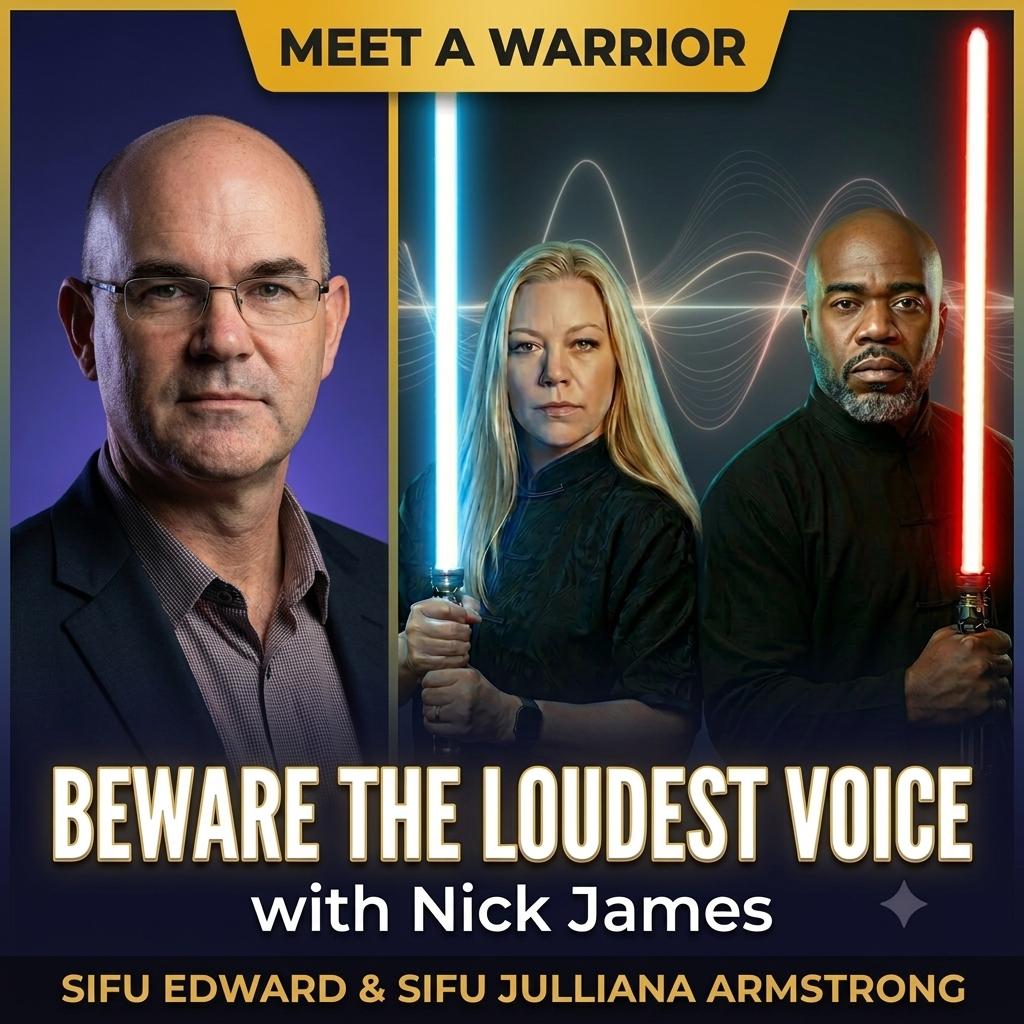
Adapted from the recorded conversation; the guest's words are verbatim. The questions are reconstructed and voiced by Sifu Edward and Sifu Julliana Armstrong.
🎥 Video podcast coming soon. The complete interview will play here once published. The full conversation is transcribed below, and the audio edition will be available on sifuarmstrong.tv.
In a new Sifu Armstrong interview (a Part 2 conversation, following Issue 104), the eShowcase founder argues that the tactics change every few years, but the discipline of finding a real teacher, not the loudest one, never does.
Twenty-five years into a career that started with a Corey Rudl seminar in Wembley, Nick James returned to the Warrior Intelligence Series for a second conversation with Sifu Edward and Sifu Julliana Armstrong, this time to talk about what actually keeps a business alive across a quarter-century of internet upheaval, and who not to listen to along the way.
James’s first information product was, fittingly, a licensed recording of the very seminar that inspired him. What kept him in the game for 25 years since, he told the Armstrongs, wasn’t any single tactic. It was recognizing that the tactics change constantly while the underlying principle doesn’t. Where he once rented mailing lists and paid for postage stamps, he now buys attention on Meta’s 3.48 billion daily users; where an opt-in box used to reliably capture visitors, Google’s AI overviews now keep most searchers from ever leaving the results page. “You have to have your money goggles on,” he said. “The principle is the same (you have to get somebody to raise their hand and show interest), but the tactic that used to work maybe isn’t as effective as it was.”
That adaptability shaped eShowcase, the all-in-one business platform James built after growing tired of stitching together separate calendar, webinar, funnel, and CRM tools into what he called “a Frankenstein monster.” It also underlies his concept of “lines of convergence,” the idea, borrowed from a 1990s Bill Myers tape, that major technological leaps (the printing press, the steam engine, the telephone, the internet, and now AI) keep arriving closer together, compressing what used to take a lifetime of infrastructure into something anyone can access from a laptop the same day they buy it.
On AI specifically, James pushes back on the idea that it has killed the information-product opportunity. The output, he argues, is only as good as the operator’s own expertise and the quality of the question they ask it. He’s become deliberate about how he prompts tools like Claude, writing detailed, 300-to-800-word prompts and, half-seriously, being polite to it the way he’d brief a freelancer sitting next to him. He compares the learning curve to making friends with a camera or learning to drive a manual car: awkward and effortful at first, until one day it becomes instinct.
The sharpest moment of the conversation, though, is a warning about who gets to shape that instinct. “Be careful of who the loudest voice is,” James said, describing how a student named Shane nearly wrecked a promising product launch by following confident-but-untested advice about button placement. James instead fed the actual upsell page into Claude, diagnosed that the buy button was appearing before the benefits were explained, and watched Shane’s conversion rate climb from 3–4 percent to 15 percent once the fix went in. “If you just listen to the loudest person spouting opinion with no experience of actually testing something scientifically, you can be thrown wildly off,” he said.
Underneath all of it is a simpler refusal, the one that got James started in the first place. “I was living my entire life under a glass ceiling,” he told the Armstrongs, “and it was time to take that glass ceiling away.” A quarter-century later, that refusal to accept an inherited limit is still, in his telling, the actual engine. Everything else is just which tool happens to be in fashion that year.
For the Armstrongs, James’s warning about loud, untested voices lands as a version of something they teach on the mat: the internet gives everyone a microphone, but only the ones who’ve actually walked the path have earned the right to be followed.
In This Conversation
- James’s start with a licensed Corey Rudl seminar recording in 2000, at the dawn of email marketing
- “Lines of convergence,” why major technologies now arrive closer together, compressing decades into days
- Building eShowcase to replace a stitched-together stack of separate marketing tools
- Why AI hasn’t killed the information-product opportunity, only raised the bar for expertise
- Learning to prompt AI like briefing a freelancer, and why that removes the anxiety
- The Shane story, how following the “loudest voice” nearly tanked a launch, and what fixed it
The Full Conversation
Sifu Edward Armstrong: We spoke with Nick James once about how he started; this time we wanted the perspective of a man who's survived twenty-five years and every single shift the internet has thrown at him. And he gave us a line every warrior needs tattooed somewhere: be careful of listening to the loudest person in the room. In an age where everyone has a microphone, the ability to tell a real master from a loud amateur is a survival skill.
Sifu Julliana Armstrong: And I loved how he talks about tools becoming natural, making friends with the camera, learning to drive until your hands and feet move without thought. That's muscle memory. That's the form becoming instinct. He's describing, in the language of AI and business, the exact thing that happens on the mat after ten thousand reps.
Our guest, back for Part 2, is Nick James, internet veteran of 25 years and founder of the eShowcase platform. Nick, welcome back.
Nick James: Hey, thank you very much. Great to be here to share how things were, how they are now, and how everyone can benefit from all these latest AI changes.
Sifu Edward Armstrong: Your journey started in 2000, just after the dot-com bubble burst. What did the landscape look like?
Nick James: I remember going to a conference in London, in Wembley, that featured a guy from Canada called Corey Rudl, making a presentation about how to make money with email. I remember thinking, "Oh my goodness, wouldn't it be great if I could build up an email database, send out emails, make money with it?" And I licensed his presentation because I was so inspired, although I had absolutely no experience. My first information product was selling Corey Rudl explaining how to make money with email. Then I thought, "I better get a website, an email account, an auto-responder." That was 2000, 2001. And we've come a long way, but what has remained constant is I still make an absolute fortune sending emails. Corey was so ahead of his time.
Sifu Julliana Armstrong: What actually made you jump in with both feet? Because I sense it was about breaking a ceiling.
Nick James: When you get onto somebody's list and start to discover there's a new way of making money that doesn't involve exchanging time for money, that was the biggest thing. Here was a way of breaking free from the traditional grind. I remember my dad didn't go into a career he wanted; he went into a career his parents chose for him. Even going back a generation, it was tougher. But when my eyes were opened to this whole thing ("hold on, I'm not restricted to a salary income"), whether your salary is 30, 40, 100,000 a year, when you sell widgets on the internet that don't even need to be shipped physically, there is no limit to the income you can have. I realised I was living my entire life under a glass ceiling, and it was time to take that glass ceiling away.
Sifu Julliana Armstrong: "I was living under a glass ceiling, and it was time to take it away." That's the moment a person stops accepting the limits someone else drew for them. Your dad had his career chosen for him; you refused to hand that choice to anyone. That refusal (to let the world tell you how high you're allowed to reach) is the first thing a warrior has to decide. Everything after it is just training.
Sifu Edward Armstrong: You've survived twenty-five years while countless others vanished. What's the key to that longevity?
Nick James: It's been listening to people and having your money goggles on, looking at the trends that keep changing. When I first got started, if I wanted my offer in front of people, I'd rent someone's mailing list ("who have you got that has bought something similar?"), and write to those people. That was great back in the day of low-cost stamps and no GDPR. But as time moves on, you have to embrace new technologies. Now, instead of renting a company's customer list, you look at what Meta is doing (3.48 billion people on the platform every single day), and you put a little classified ad there. It's a completely different way of finding customers. And the days of just putting an opt-in box on your website saying "join my free newsletter" are largely gone, not that they don't work, but it's harder to get people to visit your website than ever, especially now Google puts AI suggestions at the top of the first page and keeps people on Google. So you have to have your money goggles on: the principle is the same (you have to get somebody to raise their hand and show interest), but the tactic that used to work maybe isn't as effective as it was. The key is asking, "How do we do it today, if what worked yesterday doesn't work so much?"
Sifu Edward Armstrong: That led you to build eShowcase, and to a concept you call the lines of convergence. Walk our operators through both.
Nick James: Our tech stack looked like a Frankenstein monster: Calendly for appointments, GoTo Webinar for webinars, funnel builders, automation systems, costing us five or six hundred dollars a month. So we put it all under one roof: shopping cart, affiliate program, CRM. That's eShowcase. It's been running our business for at least 18 months, and now we make it available to others. We've even talked to a dentist who specialises in horse dentistry about using it.
And the lines of convergence. I first heard this from Bill Myers on a videotape in the mid-1990s. It's about what has come into place to make now the best possible time to run a business. We're not living in a suppressed country; in the Western world, everyone has the freedom to start a business. You don't go down on bended knee to the emperor to ask permission. We have high-speed computing, the World Wide Web, 24-hour couriers, real-time credit card processing. When I started, I had to print out someone's 16-digit card number from a webpage and type it into a tabletop machine. I had capability risk, I couldn't process more than 200 or 300 orders a day. Now everyone has Stripe. And AI is a line of convergence. Think about how discoveries keep getting closer together: fire, then the wheel, the printing press 550 years ago, the steam engine, the telephone 150 years ago, radio, TV, the computer, the internet, the World Wide Web in 1989, and now AI in the last couple of years. Each massive invention is arriving faster and faster, until today anyone can walk into a PC store, buy a laptop, and be in business that day. Your website takes up the same-size shop window on someone's screen as Facebook or Google or Apple. You've got the same-size shop window as anybody else. Never before has it been so easy and cost-effective for everyone to start a business.
Sifu Edward Armstrong: Some people say AI has killed the opportunity, that if AI can write the information, why sell information? What's your answer?
Nick James: It takes some crooked thinking to break why this is such an amazing opportunity, but let's address it. Yes, AI can create information. You can ask it a question and it answers. But if that's all you're doing with ChatGPT, treating it like Google, you're missing the whole AI explosion. And that information is only as good as the prompt you give it. If you ask a bad question, it gives a bad answer. So as an individual, you still need to be a subject-matter expert. You still need to ask the right questions, and be clever enough to know when it's given you a bad answer. Is there a future in information products? Absolutely, everyone still wants to learn. Using AI is just like a tool. Twenty years ago people talked about "internet marketing" or "digital marketing"; today that's just called marketing. In the future when they say "was that generated by AI?": well, everything will be, because that's just how the world moved on. The opportunity isn't gone because AI exists. That's a limited way to think.
Sifu Julliana Armstrong: You said something that stopped me. That you're polite to your AI, that you treat it like a person. And you compared getting comfortable with tools to making friends with a camera, or learning to drive. That's mastery becoming instinct, and it's my whole world.
Nick James: Someone in a class called out, "Nick, is it important that you're being polite to the chatbot?" And it made me think. I like using Claude, by the company Anthropic. I talk to it like a freelancer or an employee sat next to me. "Hey, Claude, please can you help me with this today, and if you've got any questions, please ask." I actually quizzed Claude on whether it makes a difference, and it was insightful. It said it responds like for like, and that talking to it like a freelancer takes away the anxiousness of "how to prompt an AI," because you just treat it like a human and give it more detailed information. The more I talk to it that way, the better the response. The first time I asked AI to write me a sales letter, it was terrible. Now I've created entire sales presentations start to finish with Claude, by treating it like a freelancer and showing examples of what I wanted.
The only time I've seen someone get it wrong, I asked, "What question did you ask?" and they'd put in two sentences. When I'm prompting, I'm writing anywhere between 300 and 800 words, putting in that effort at the beginning to get back what I wanted. It reminds me of the first time I made friends with a video camera, a lot of people become a deer in the headlights the first time. But when you make friends with the camera, it becomes natural. Or learning to drive a manual car (the graunching gears, the stalling, feeling like a fool), but there comes a point where you drive from A to B without even thinking about your feet and hands. We need to get to that same place with AI. The more you use these tools, the more you'll see them as a natural extension of the way you think.
Sifu Julliana Armstrong: That's it exactly. You're describing muscle memory. The stalling, graunching learner and the driver dreaming down the highway are the same person after enough reps. On the mat, a form is agony and thought at first, and then one day it just happens while your mind is elsewhere. That's when the tool disappears and becomes an extension of you. Whether it's a saber, a camera, or an AI, mastery is the moment the tool stops being separate from your hand.
Sifu Edward Armstrong: Heading into 2026. What's the biggest opportunity, and how should operators focus?
Nick James: I give everyone four key things. We call it QuadroNetics. Ways to get more leads, more conversions, more profit per order (average cart value), and higher customer lifetime value. Just focus on those four. On leads, instead of forcing people to visit your website, our software builds your list by having someone comment under a Facebook post; that lets you send them a direct message. You can have an AI agent answer the phone and ask for their email, or use WhatsApp or text. On conversions. You can reach out by email, text, and Facebook message to retarget and build the know, like, and trust. On order value: order bumps, upsells, never making anyone enter their card details more than once. And on lifetime value, recurring income. Plus, remember that great content has a lifetime: a Meta story lasts 24 hours, then it's gone, so recycle it. Repost that Facebook post 28 or 56 days later on a cycle, so all your great content is automatically re-added to an audience that's never seen it before.
Sifu Julliana Armstrong: For someone overwhelmed, what's the first mindset piece, because I heard "patience and resourcefulness," and that sounds a lot like training.
Nick James: Patience and resourcefulness. It's not spoken about enough. When we try something new, we all get a knot in our stomach when we can't figure something out, technical stuff, fixing the car, DIY. But on the other side of that knot, when you actually work out how to do it, you have a sense of achievement. Just because you can't work something out. Google's your friend, join a community, look on YouTube, be resourceful. That's where the magic happens. When you push through these challenges and get to the other side, sure, there's always another challenge, but you get this action-and-reward infinity loop: you take action when inspired, you get a result, and that inspires you to take more action. Push through.
Sifu Julliana Armstrong: "On the other side of the knot is a sense of achievement." That knot is the exact feeling before a technique clicks, before a belt test, before you step onto the floor. Most people quit at the knot. They mistake the discomfort for a stop sign. It's the opposite. The knot is the doorway. Push through it, feel the achievement, and you've just trained the loop that makes you unstoppable: struggle, breakthrough, hunger for the next struggle.
Sifu Edward Armstrong: And then the line I most wanted to underline, beware the loudest voice. Tell us about Shane.
Nick James: When you're being resourceful and asking questions in communities, qualify who's giving you advice. I love Meta for its 3.48 billion users; I don't love that it gives everyone a voice, even people who aren't qualified to help. Be careful of who the loudest voice is. Sometimes the people that aren't busy being successful are just hanging out online. I've stopped counting how much money we make. I count the money our students make. We've got a student, Shane, who launched a product; he went from about $38,000 to well over $50,000, did over $12,000 in a five-day promotion. Now, a loud voice in the room was insisting, "People don't read anymore, put your call-to-action button at the top, all over the page." Shane came to me. The front end was going great, but his first upsell was on its backside, converting at 3 or 4%. So what did I do? I took the URL of his upsell page, put it into Claude, and said, "Tell me the weakness of this upsell page." One point Claude raised was that he was giving people the yes/no option before he'd sold the benefits. So against the loud voice, I told Shane to get rid of the order button at the top and put it after he'd explained the benefits. His upsell jumped from 3-4% to 10%, and with a few more tweaks, 15% by the end of his launch. So if you just listen to the loudest person spouting opinion with no experience of actually testing something scientifically, you can be thrown wildly off. It pays to seek out someone who's not just accomplished what you want to do, but actually walked that path, remembers what it's like, and is prepared to help you.
Sifu Edward Armstrong: That is the whole reason the title of Sifu means something. The internet gives everyone a voice; the mat gives it only to those who've earned it. A loud amateur will confidently send you off a cliff, because opinion costs them nothing. Follow the one who walked the path, who tested it, bled for it, and can prove it with the results of the people they've raised. Not the one who shouts the loudest. Nick, thank you, for both conversations. Where do people find you?
Nick James: Head over to nick-james.com: my authority site, with lots of articles, videos, and free resources. You can request a free book; we'll ship it anywhere in the world, just cover a bit of the postage. It's been number one on Amazon, like all our books, but you can grab one right now for free. It tells my story from a chance meeting with someone I met in a car park, who invited me to the seminar where I was inspired about email marketing, and it lays out those four keys, QuadroNetics: more leads, more sales, more profits, and higher customer lifetime value.
Sifu Edward Armstrong: Nick James, a genuine pleasure both times. Thank you.
Nick James: Appreciate it. Good to be here.
Sifu Julliana's closing word: Two things I'm taking from Nick's long view. Mastery is when the tool disappears, the learner stalling the car and the driver dreaming down the highway are the same person after enough reps, and it's true of a saber, a camera, or an AI. And the knot in your stomach is a doorway, not a stop sign. Most people quit right at the knot. The warrior pushes through it, feels the achievement, and gets addicted to the loop. Struggle, breakthrough, hunger for more.
Sifu Edward's closing word: Twenty-five years in, Nick's sharpest wisdom is about who you listen to. The internet gives everyone a voice. The mat gives it only to those who've earned it. A loud amateur will send you off a cliff with total confidence, because opinion is free. Follow the one who walked the path, tested it, and can prove it with the warriors they've raised, not the one who shouts the loudest. Keep your money goggles on, master the tools until they vanish into your hand, and honour the real teacher. We don't entertain warriors. We create them.
Nick James, internet veteran of 25 years, Internet Marketer of the Year, founder of the eShowcase platform. Free book and resources at nick-james.com. (See also Part 1, Issue 104.)
ILLUSTRATIVE RESULTS. Any revenue, enrollment, margin or retention figure in this conversation is either a documented result from one of our own operations, a figure the guest reports about their own business, or an illustrative example, never a projection of your results.
Nothing here is financial, legal or tax advice.
Stay in the Fight
This conversation is part of the Sifu Armstrong Warrior Intelligence Series: interviews with world-class performers, builders, and thinkers, filtered through the lens of the warrior's path.
Subscribe at sifuarmstrong.news for every new interview, delivered to you.
Join Club Sabernet, the member community of the whole Sifu Armstrong ecosystem, where warriors train, connect, and hold each other to the standard.
Ready to build your own floor? Find your path at sifuarmstrong.com/which-path.