Beggar on a Beach of Gold: Sifu Edward & Sifu Julliana Armstrong Sit Down With Publishing Expert Christopher John Payne
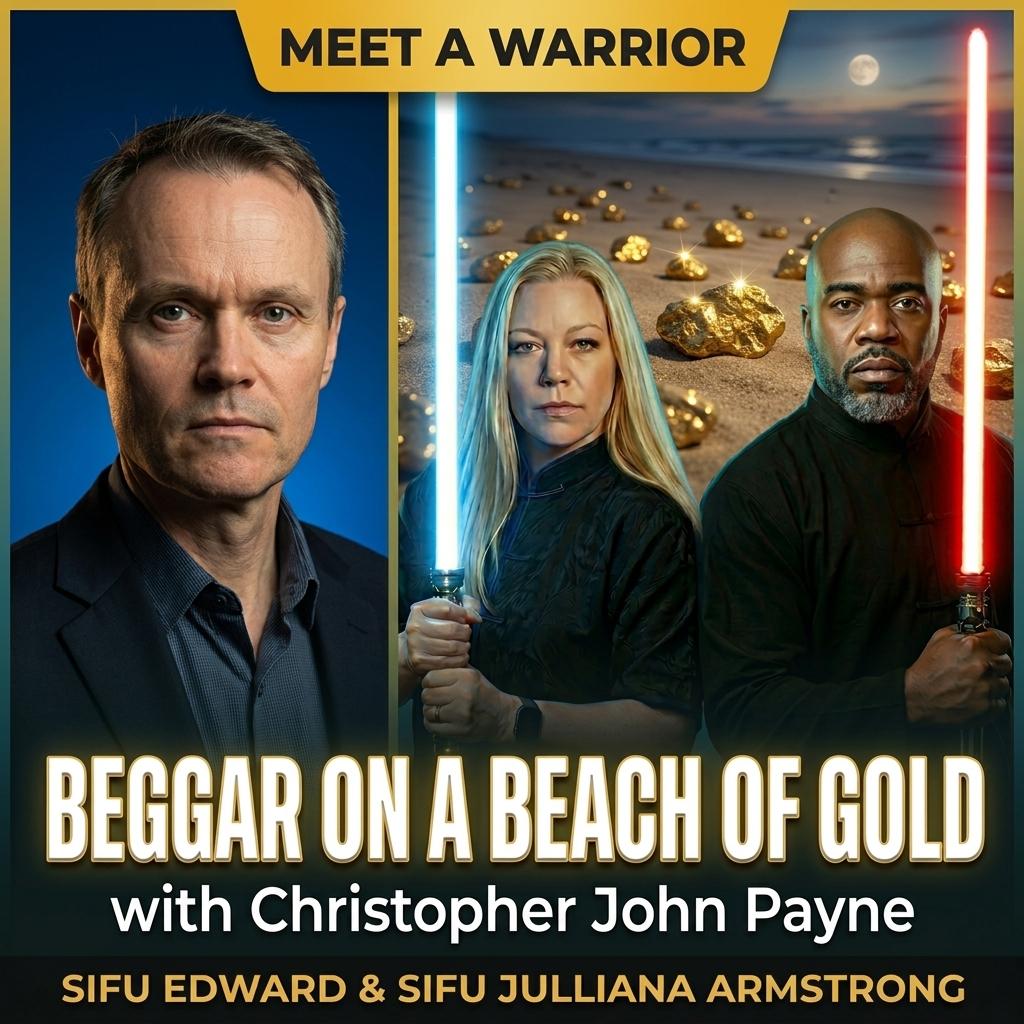
Adapted from the recorded conversation; the guest's words are verbatim. The questions are reconstructed and voiced by Sifu Edward and Sifu Julliana Armstrong.
🎥 Video podcast coming soon. The complete interview will play here once published. The full conversation is transcribed below, and the audio edition will be available on sifuarmstrong.tv.
In a new Sifu Armstrong interview, the man behind 300-plus published books argues that everybody already has the material. The only thing missing is a template and the courage to finish a rough draft.
Christopher John Payne spent decades teaching people to write sales letters before he ever taught anyone to write a book, and in his conversation with Sifu Edward and Sifu Julliana Armstrong for the Warrior Intelligence Series, he makes the case that the two skills are the same discipline, aimed at a different reader.
Payne learned to write from Derek Meakin, the UK publisher who launched the country’s first free newspaper, spending seven years absorbing red-ink edits until, he says, there was nothing left to correct. That apprenticeship built a direct-mail business called LifeTools, mailing up to a million letters a year across the UK, until the internet made importing and reselling personal-development courses unworkable, and a difficult marriage brought the whole thing down. “I completely collapsed,” he told the Armstrongs. Out of that collapse came a new calling: helping clients rebuild their sales letters, their websites, and eventually, their books.
He’s now worked on more than 300 titles, mostly published through Amazon’s print-on-demand pipeline, which he describes as almost frictionless, no inventory, no upfront cost, and a Kindle e-book or paperback that can be live within a day. The real obstacle, he says, isn’t logistics. It’s a mix of imposter syndrome and what he calls “ugly baby syndrome.” Everyone believes their idea for a book is beautiful, and it usually needs work. His fix is radical simplicity: record ten or fifteen minutes of someone talking, run it through AI to restructure, and hand them a finished first draft. As he put it, “there’s something called, 'All first draughts are rubbish.'” The goal is just to get something into a person’s hands fast enough that they believe they’re actually an author.
Payne is unsentimental about why this matters to him personally. He’s obsessed with the idea of la deuxième mort, the second death, the moment your name is spoken for the last time. “For many people, they die with the stories in them,” he said. His own metaphor for the opportunity sitting untapped in most people’s heads comes from a Mike Rutherford album title: everyone, he argues, is a beggar on a beach of gold, unaware that the material for a book (and often a business) is already inside them.
He’s equally clear-eyed about AI’s role in all this. It can restructure and accelerate, but it can’t supply the lived detail that makes a book land. “AI can’t do that,” he said of the personal stories and vignettes a writer has to bring themselves. “It has to be a human.” Feed it garbage, in his words, and the old logic applies to prose as much as anything else.
At 65, Payne says what drives him now isn’t the shelf of 300 books with his name in them, proud as he is of it. It’s the readers who write back to say something he helped them put on paper changed their life. “I’m here to serve,” he told the Armstrongs simply.
It’s a fitting closer for a conversation about permanence: about making sure the knowledge a person carries doesn’t disappear with them, but gets written down, passed on, and left for whoever comes next.
In This Conversation
- How a 40-year apprenticeship under UK publisher Derek Meakin taught Payne to write for a reader, not himself
- The collapse of his direct-mail business LifeTools and the divorce that led him into coaching, then publishing
- Why Amazon’s print-on-demand pipeline makes a book nearly free and nearly instant to launch
- “Ugly baby syndrome” and the fastest way to get a rough first draft out of someone’s head
- Where AI helps (structure, speed) and where it can’t go (lived experience, your own stories)
- The idea of la deuxième mort, writing as a way to outlive your own second death
The Full Conversation
Sifu Edward Armstrong: The single greatest fear I carry as a founder is that the art dies with the people who hold it, that a master takes everything he knows into the ground. Everything we build, from the curriculum to the World Games pathway, is an argument against that. So when I found a man who has helped bring more than three hundred books to life (who teaches ordinary people to get the story out of their heads and into readers' hands), I knew our operators had to hear him.
Sifu Julliana Armstrong: And what moved me is that he came to this work through his own hard years, and turned that into a ferocious care for the people he serves. That's the warrior's alchemy, taking the wound and making it the gift.
Our guest is Christopher John Payne, publishing expert, former direct-mail entrepreneur, and the man who has helped hundreds of people become published authors. Chris, lovely to meet you.
Chris Payne: Thrilled to meet you too. Thanks for having me on.
Sifu Edward Armstrong: Start with your story. How did you get into this, and who taught you to write?
Chris Payne: Well, I had a background in magazine publishing. I used to work for a computer magazine publisher. And then set up a mail order business called LifeTools. So I was importing speed reading courses and meditation courses and general personal development courses into the UK, and selling them via direct mail. So I was mailing up to a million letters a year around the UK. That was just little old me writing these letters, which were 8- or 16-page sales letters, and mailing them around the UK. I put adverts in Men's Health magazine and Cosmopolitan magazine, New Scientist, and all the national newspapers, and getting a quarter million people writing in. The key out of all this, what matters is, I learnt how to write. How do you write something that gets people to order online or ring in and buy it? I have to have that now. I've only got a first page through a sales letter, and I'm having to buy. That's what I learnt, and I just learnt from the best.
Sifu Edward Armstrong: Who was "the best"? Every art is transmitted master to student. I'm always curious who stood at the front of the room.
Chris Payne: Yeah, I developed it. The guy I worked for many years ago, it was a guy called Derek Meakin. Derek launched the first free newspaper in the UK. Eddy Shah was a guy who created the Today newspaper, and he's quoted saying, "Derek Meakin was my inspiration." So I worked for Derek, and he taught me how to write. He would get me to write stuff for a magazine, and then he'd cover my printout in red ink, and I'd have to retype all the corrections. I'd go back to him, and then he'd change it all again. After a year, every time I used to give him something, he'd say, "Oh, Chris, you're not giving me anything because I'll never find anything, because you're so good now." And he'd literally find one tiny thing. We were like best buddies. I mean, he was decades older than me. He was like a surrogate father at the time. He taught me so much about how you communicate with a reader and get them excited about a magazine or an article or whatever.
Sifu Edward Armstrong: How long ago was this, and what did you build from it?
Chris Payne: Oh, you're looking at 40 years ago that this happened. I was working with him for seven years. He eventually made me managing director of the software division, and I launched various bits of software that were very successful. Anyway, I left and literally started from scratch. From my kitchen table, set up this business, and slowly but surely built up a business that ended up with big offices and up to 25 people in the team and big warehouse with full of CD sets and DVD sets and video sets that I was mailing out. But it was me. I don't think I was the best manager or anything, but what I learned, understood was the power of writing. I just loved spending a lot of time sitting and writing these long-form letters which anybody watching has read. That power, when you're reading it, you're shaking arm and thinking, "Oh, my god, this sounds so exciting. I got to hope it's not too expensive." And then sure enough, they think, "Oh, it's less than I thought." And then they buy it and they buy the upsells. Well, that, for me, is such fun to put that together.
Sifu Edward Armstrong: You lived through the arrival of the internet, which must have upended a business built on importing and reselling. How did that work, and how did it change?
Chris Payne: Very much. When, of course, I started, there wasn't the internet. So I could launch stuff in the UK and put much higher price. I'd buy something in from America, and almost maybe double or triple the price, and add in all these extra bonuses, and there'd be enough margin for me to make a good profit. But when the internet came, people could say, "Well, I can actually buy this from America and save five pound or fiver dollars." But they'll take three weeks extra to get the thing delivered. So the business just changed when the internet came along.
Yes, the process was that I would find products at exhibitions, conferences in the US, or through reading personal growth magazines from the States, going through them, and then ringing up the company and saying, "I would like to sell this product in the UK for you." I think of one case where the company in the States created this product, and it wasn't doing well, and they were really struggling financially. They sold the products to me, and I rewrote all their sales material, wrote it more enthusiastically, and I was selling far more in the UK, which is a fraction of the size of the American market, selling far more than they were selling in America. And then they saw what I was doing in how to put together a sales letter, and then adopting some of those practises themselves.
Sifu Julliana Armstrong: Then something changed everything, and it wasn't business, it was personal. How did you get from that world to helping people write books?
Chris Payne: Well, one of them was just a life change. I mean, I had a difficult marriage. I had a complete breakdown with the behaviour of my wife at the time, I'll just be honest. So I completely collapsed. I ended up having to close LifeTools as a result. It's just one of these things that happened. I thought, "Well, what would I do differently?" So I decided to be a consultant. So what I would do is take people who were interested in making money online. They might have a small email list, and that they'd have a product, they'd spend six months developing it, they'd launch it to their email list, and it would fail. They'd come to me almost in tears, and I would say, "Right. Sit down with me in my home, and let's rewrite the sales letter. Let's redesign the website. Let's go into one of my bedrooms, and we'll set up some lights and record some new videos." And then they would have much greater success. Part of that journey was, a couple of those clients wanted help to create a book. And I owned not many, just 3,000 books. Is that many?
So I had had 3,000 books, non-fiction books. I was obsessed with non-fiction. So I helped them put together those books. So I started to do webinars, showing the basics of how to produce books and sell them on Amazon. And I've now worked on over 300 books. So what I basically do on a day-to-day basis is, I have an online training programme where I teach people to go from the vaguest of idea, even no idea, to launching books on Amazon. The thing about Amazon is, if you have an idea for a book, people understand this idea of an e-book, and that could be a PDF. What they don't know is they can actually upload that effectively to Amazon, and it doesn't cost anything. That document can be turned into a Kindle e-book and also into a paperback very easily. And Amazon doesn't store stock, it actually manufactures the book as the order comes in.
So it means that somebody listening to this could literally put together a book, upload it to Amazon, and it would be on sale tomorrow. It could sell a hundred copies tomorrow, but no money is being spent by you, because Amazon takes all the money, like 10 pounds or $10 for that book, and they give you the lion's share of the profit. So the big lesson with Amazon is, you are uploading a digital file, you are spending no money at all, and you just reap the profits. Amazon is doing all the promotion, a lot of the promotion for you. I have people that I've worked with that have dozens of books on Amazon.
The great thing is you can use a pen name or a series of pen names. So you can be John Smith or Joanne Jones, and nobody will know it is you. So you can launch books in a multiple of niches. Now, with the power of AI, you can use AI, if you use it cleverly, to launch as many books you want. So I say I've been involved in more than 300 books. In other words, if you came to my home, I could show you a bookcase, and there are 300 books in it. Each one, if you pull out, it's got my name in it saying thank you, or there's a story about me in it, or I wrote it myself or whatever. And I'm ridiculously proud of that. When my mom was alive until recent, my dad, I'd go and show them, "Look what I've just been working on. This is working on Amazon." And they were ridiculously proud, which is great.
So, books really excite me. The first book I created was a list of stories of people, clients I work with, and it was called Are You Next? It was just full of stories of people who came to me, often in tears, seriously, really frustrated, really hurt that their business is failing. My job was to hold their hand and guide them forward and actually do it for them wherever possible, because I felt that's what they deserved. I think one of the reasons I care so much for my clients is because I went through this bad marriage. I felt how the therapist I was dealing with not only really wasn't listening to the pain that was going on, but equally, that person who was our therapist wasn't really solving our problem. Really, they just wanted our money every week. So the relationship was not improving no matter how many hours and months we spent with them.
The consequence was, I nearly died from the pain of all this, having a psychotic collapse as it were, which is so painful. And I thought, "Well, I'm not going to treat anybody that myself. People deserve better." And I think so many coaches and online experts aren't that great, and my job is to be the best I can possibly be because that's really what people deserve. I think most people can identify with that.
Sifu Julliana Armstrong: Thank you for that honesty, Chris. You took the exact thing that nearly killed you (being unseen, unheard, unhelped), and made it the standard you refuse to fall below. That's sacred.
Sifu Julliana Armstrong: The process you describe is genuinely simple. So what actually stops most people from writing their first book?
Chris Payne: What stops people from writing their first book is imposter syndrome often, or this concept of how do we eat an elephant? The answer is one bite at a time. People really struggle with that. So what I tell people to do is create the smallest, smallest version of a book. The smallest book you can create, physical book, is 24 pages, and that is 2,000 words. Now, this interview will be about 30 minutes, and as a result, that'll be me talking for about 5,000 words. So really, 10 minutes of our conversation would be the very first version of a book. So in my programmes and whoever I work with, there is a template, and I say, "Literally, I can just record you talking for 10 minutes, get it restructured using AI, and that will be the very first version of a book. And you will have it physically in your hands in two days time."
So literally, if you and I were sitting together, I would ask you a series of questions. We quickly use AI to pull it into shape, pour it into a template in Microsoft Word, save it as a PDF, upload it to Amazon, and say to Amazon, "Please, could you send me five copies as soon as possible?" Within 36 hours, that's a day and a half from now, we'd have five copies in our hand. Yes. Nobody on Amazon would know. You can't find that book. So whatever it's called, you wouldn't be able to find it on Amazon. I mean, I've come up with a book last week that I put together in half an hour called Punch Them in the Face. It's the idea that if you want to make an impact with people, like with a sales letter or with a free PDF or anything, you've got to punch them in the face, as in you've got to make them sit up and take notice. Of course, the exaggeration. This is not about violence because, of course, I abhor violence, but it's about making people sit up and take notice.
So I put that together very quickly in half an hour and just talked into an AI, and then got it structured, got a cover design within three minutes, and basically the book will be here in my home very shortly. So we can do that now. It's speed. The key is, you just need to be laser-focused in terms of what you want to create. So bottom line, you can create a book literally with little as 10 or 15 minutes of speaking, and then have a good title, obviously that goes with it, and that can go on sale. Now, some people still buy that even if it's 24-page paperback, which would obviously be a small Kindle, and people will buy that through Kindle Unlimited or just through the Kindle. Kindle Unlimited is a subscription service that Amazon has millions of people in.
You could then just make that book better. You just say, "Well, how can I make this better?" And you can ask AI to make it better, and that will help. You can have some of your own stories. So what I try and do with my clients is say, "Go from a standing start to something in your hand in the fastest possible time." Because once you have a book in your hand, you go, "My god, I can't believe it. I'm now a published author." You can show it to your partner or your children or your parents or your siblings or your friends, or keep it a secret, but it's just the first version. There's something called, "All first draughts are rubbish," except there's a word which was S-H-1-T, which was Ernest Hemingway, the most famous American writer. So the first draught is just the first draught. So you just keep, incrementally, one step at a time, making it better.
Sifu Edward Armstrong: This is a rinse-and-repeat business, then: one book leads to two, to three, to three hundred, each one earning. How do you work with people through that?
Chris Payne: Exactly. I have people in my... So I have two ways that I work with people, either through an online training. So everything they could possibly ask is in the online training, but equally, they can drop me a line at my personal email address, and say, "What do you mean by that? But what about this case?" And I answer them. And I do fortnightly trainings in an evening for a couple of hours where I had to show them new stuff about AI and also answering questions. But I also have one-on-one clients who just say, "Chris, I don't want to learn how to do anything. Could you just put the book together for me?" which I would like to come back to. But what I have is, my online people, is I say, "Just put together something."
I have a member, he said, "Oh, I'm going to put together, I can do this really quickly, which is a weekend I spent this amazing football match with my mates in Europe." They wanted to do a few copies to give to their mates. And somebody was like, "I'm going to do this gift for my wife. It's a really thin book, but it's all the homes we went to, and the dogs we had, and it's got pictures of the dogs." And they put it together really, really simply. And you think, "Well, nobody's going to buy that." Well, no, it wasn't designed to be sold. It was designed to be given out. But because they did that, like just a trial, they then went on to produce books, a proper book, that's only like a hundred pages that actually solves somebody's problem, that actually is making money for them online. So you've got to almost start with a home project, as it were, before you have the courage to say, "Now I understand the process. I'm now going to solve somebody's real problem."
Sifu Julliana Armstrong: No matter how messy the first draft is, your advice is: just get it finished. But there's something deeper in why you push people so hard to do it. Tell me.
Chris Payne: You've got it. The thing is, people think, "Well, I haven't really got ideas." And I think people have. When I talk with people... I love going up to people in coffee shops and chattering with the people behind the counter and all the rest, or going to a shop to buy a newspaper or a magazine or some chocolate or something. And I chat to people that look like a very bored person behind the till, and there's nobody behind me so I just ask them something. They will always will end up telling me a story, which is mind-blowing, just blows your mind. So I love connecting with people. Everybody has stories. People are not used to being listened to, and as a result, they don't listen to their own really great thoughts.
I think there's an album... You know the band called Genesis? One of the members of the band... Genesis, you heard of Peter Gabriel and Phil Collins. Well, the other band member, one of the band members is Mike Rutherford, and he wrote an album, put together an album called Beggar on a Beach of Gold. And that's what we are, we're beggars, and that we're sitting on sand that actually is just gold and we are not realising it. So basically, anybody who says, "Chris, I've got an idea for a book in me," I literally sit down with them, and within an hour or two, we've got an amazing book idea. Because from their internal mind, and then they'll be like, "I never would've thought that I could make money from that." I said, "Absolutely, and I can show you how to make 50,000 pound or $50,000, or 100,000 pound, $100,000 from that idea if that's what you want, because that is what you deserve."
There's something called la deuxième mort, the second death. There's a death of you and your body, and there's the death of the final time that your name is mentioned. For many people, they die with the stories in them. Whereas others, they will tell stories or put it in a book, and their name will be spoken of for 50 years or 100 years or 200 years, and they will change lives.
I remember when I was very sick, and I came out of my divorce. I became a coach, personal coach for people. And this couple came to see me. The wife was considering divorcing the husband because he's driving her nuts. She was saying, "I want to have a child, and I don't know whether this guy's the right person." So I just worked with them because I am obsessed with personal growth, and I'd read a lot of stuff about relationship dynamics after my divorce especially. So I just worked with them. And then I saw them a year and a half later with their baby child. I think that's what it's about. You work with people. Something that I say or you will say to somebody that will make their lives better, and we all want to make other people's lives better. We want to feel that our life is worthwhile. And I think one of the ways that you can make it feel as though your life is worthwhile is to share what you know.
I'm sure everybody listening or reading this article can say, "There's somebody said, 'Do you know that time you said to me X and Y five years ago? Well, that really stuck with me, and that's really made a difference and really made my life so much better.'" Everybody really can relate to that, that somebody said that what they said really helped them, and it really makes a difference. But the difference is to have people emailing you at like a secret email address. I could use it like johnsmithbookwriter@gmail.com, could be a made-up email address that you could use for your pseudonym, your pen name, your made-up name that people won't know. They'll drop you a line and say, "Your book had made a massive difference to my life. It might even have saved my life." And that's what everybody can do. To wake up each morning, to know that you have made somebody's life better is one of the greatest things you can ever do to yourself.
Sifu Julliana Armstrong: They say everybody has a book inside them. Is that actually true?
Chris Payne: Everybody does. But there's something called ugly baby syndrome. And it's this: Every parent thinks their baby is beautiful, but I'm very sorry, but some of them just aren't. This is not a judgement about babies because the truth is, I think all babies are actually gorgeous. But the concept is that sometimes our ideas are ugly. So we all think we have this brilliant idea for a book, but invariably, when somebody comes to me and says, "I've got this great idea for a book," I say, "Actually, it won't work as that. But if you just make these three changes, change the title a little bit, focus more on this and less on that, you will sell a lot."
The biggest mistake you'll make is, "I want to write a book about the story of my life." I said, "Honestly, nobody cares, but it's what you went through." So I had somebody who, she had been abused by her husband, and she'd now divorced him, and she'd now forgave him. I said, "Well, there's a book on forgiveness." So she put together a really lovely book on forgiveness and the power of forgiveness. She couldn't believe it. She was weak, crying. She said, "I can't believe I've got this book in front of me. My children can't believe that I'm a book author. My whole sense of how I see myself has changed."
Sifu Edward Armstrong: So it's about the angle, distilling a life into the one theme a reader actually needs. Say more about that craft.
Chris Payne: Yes. It's all about the angle that you come from, and it's saying... You've got to distil it down, just like you can get a coffee, you buy it as granules or you buy it as a bean. You don't generally buy it in a supermarket with all the liquid in it. You have the granules. So you distil your story down to a core theme. And at the end of the day, if you really want to make a difference, don't think of your book as one book, think of it as three. Because if you think of it as three possible books, and then you focus on one, you're actually narrowing down to one facet of your story, one part of your story. That way, you're thinking, "What is it the reader really needs to hear?" They really do want to know your story, but the key is, don't bore them.
One of the rules is, how long should a sales letter be or how long should a book be? The answer is, can be as long as it is. The key is, don't bore anybody. The purpose of the first line of a sales letter or the first line of a book is to get people to read the next line. And what's the purpose? So the purpose of the headline is to read the first line of the letter. What's the purpose of the first line of the letter? To get people to read the second line. What happens is, people sit down to read a book, and what you want is them to be angry. I was thinking, "Oh, my god, I sat down to read this book, and I only had three minutes. And here I am an hour later, I'm going to be late for something." They love it even though they're annoyed.
So you want your readers to curse you because your book is so fascinating. Here's the thing: The big thing is, can you make a solid living just from publishing book? Absolutely. You just have to be laser-focused on your audience. And that is hard. I've never been anybody else. I've only been me. I see the world through my eyes, and it's very difficult to know what other people think. I'm sure anybody reading this or listening to this, our partners will say, "So what do you think then?" "What do you mean?" And they say, "Well, what do you think about what I was just thinking about?" And we say, "Well, I didn't know what you think about because I can't read your mind." Partners often think we can mind-read, and we just can't.
So we don't realise... So what we've always got to do is, you've got to put yourself in the mind of your reader. You as an individual know far more. I know nothing about cars. I do know about book writing. I do know about personal growth and relationships and so on, but there's an awful lot I don't know about my engineering and so on. But I forget how much I know about the subjects like book writing and so on. And it's the same with everybody. Everybody has a core knowledge that they don't think about, and they just assume other people have the same. They don't. But if you actually sit down with somebody who's ignorant... I mean, a way to create a book is, let's say you're an expert on running, let's say, and somebody who would like to run, well, you just sit down and then just listen to every question they have. They ask the dumbest questions because they don't know, nothing.
But if you just answer every question they have and then get AI to structure that into a book, and I show prompts how to actually do that, then you actually will produce and publish a book that is exactly what the reader wanting. Because when that reader reads the book, you say, "Oh, well, this is really, really interesting. What I'd really like to know is this." And the next paragraph, "Oh, my god, this next paragraph is exactly what I was just thinking. It's like the writer of this book is a mind reader." And you say, "Oh, it'd be really good if the next chapter was about X," and they read the next chapter and it's about X. They go, "How can that be possible?" Well, because the writer actually thought it through and broke it down and structured everything. So that's why people adore books, because it's laid out so cleverly that every question is addressed so there's nothing left undone.
Sifu Edward Armstrong: Make it concrete. If I started right after this conversation, how quickly could I actually have a published book?
Chris Payne: Yeah. So I'll tell you a story. A few weeks ago, a guy rang me up and said, "Could I fly you out to Spain to create a book with me?" He said, "I'll pay for your rates and fly you out. I'll pay for your flight. I'll pay for your travel. I'll pay for your hotel and all the food. Please, you come out." So I went out, and I was like, "Great." So I flew out, second class. I'm not prima donna. I just go coach class. So I fly out, and I sit down with this guy, and we literally sat in a hotel sitting room. And I just asked him questions after question after question after question all day. I recorded it with a device called the Limitless AI, which is a device which hooks onto your shirt. What it does is, it listens to everything around. So it heard my questions, it heard the answers from this individual. We did that for a full day.
And then I spent the next day using an AI app and spent the whole day saying to it... Basically, I said, "Take my questions and integrate them with the answers of this person. Always make the answers be in that person's voice." Obviously I don't want to be mentioned here. So it took all day, but that became a set of text. All I did was, I basically... To cut a long story short, I have a team member that I found through an online site, and he just took the raw text that I provided and put it into a template, a Word template, gave me back as a DOCX file and a PDF, and I simply uploaded them to Amazon with a cover. I have a colleague who is a brilliant book cover design. He's done thousands of book covers. Some books that you may own, he has done the covers for. He does a special rate for me, and did this wonderful cover. And the books were in my hand two days later.
So that particular person that I interviewed, they're making a few more changes. And then they can literally make some changes to the doc file, save it as a PDF, and then they press the publish button on Amazon and charge $9.95, 9 pound 95. It'll be launched all over the world, and people will find it, because Amazon will say, "Well, this book is about this," and Amazon will email people who have bought similar books.
Sifu Edward Armstrong: You've leaned into AI throughout, which frightens a lot of people. How do you use it without letting it hollow out the work?
Chris Payne: I really have embraced AI. At the time of this recording, the models have refined and refined and refined, and so it's far, far better than it was a year or so or two years ago. But you do have to prompt it well. What I've certainly seen is some people create books using AI that are just dreadful. So there's a concept from 40, 50 years ago called garbage in, garbage out. If you feed garbage into a computer, you get garbage out. So you do need to really be very careful what you ask of AI. You need to be clear, the kind of language you want, so that it's short sentences, simple words, it has some good stories in it, because you can't just have AI create it because AI doesn't have a life.
For me, if I'm writing a book, one of the things, let's say I'm writing a book on relationships, a great way for me to start is, I have had great relationships and I've failed in relationships, and I have made mistakes, and certain things that I used to believe were true, I now believe are no longer true. And this is what I've learned in the... So I will add some of my own little stories and vignettes from my life, which will make the book far richer. AI can't do that. It has to be a human. AI will hallucinate, so it will give citations to various research that doesn't exist. And that's one of the side effects of what I call large language models, they hallucinate, because they're basically very, very clever text prediction tools.
So when you try and text somebody on an iPhone or an Android phone, you'll see that it's guessing what the next word will be. Sometimes it's great, and sometimes you can literally sit with your phone and just press on suggestions. Some sentences will be completely correct, but sometimes it's completely wrong and you have to course correct it. And that's all AI is. It isn't intelligent. It may be a few more years before we have what's called AGI, where it's really like a human being, but I think it's further out than people think. But you have to bear in mind that it's a tool. It's like a calculator. A calculator will not make you money. It's what you type into it that will help make money. A spreadsheet won't make you money, but for me, the spreadsheet is the best piece of software ever invented because it's made me multiple millions, because I put all my sales data into spreadsheets and then decided which is the smartest thing to do and what's the dumbest thing to do. So it's a tool. You can't let it rule. You have to be in charge of it.
Sifu Julliana Armstrong: Chris, this has been a gift. Where do people find you and the work?
Chris Payne: Yes. So if anybody wants to get in contact with me and get a little gift from me, they email me at [personal email address removed, MASTER-BRAIN ruling 8]. As I say, that is my personal email address. Equally, I have a website at christopherjohnpayne.com where they can find out more about my history and people I've worked with. But if you drop me a line and ask me a question, or you say, "Can you give me a free gift on beginnings of how to use AI?" I will very happily send them that, because I've got all kinds of little things I can just send them.
But life is about relationship. We are monogamous people. Most of us have one core partner, and we bring up our own children. I like to have relationship with people, and I like to have people in my life that want to have, I've got to call, almost like a sacred relationship where I really connect with them, proper deep friendships. And I like to have clients who are just lovely people. So if you are a lovely person who just wants some help, I am here for you because you're a fellow human like me on this journey called life. I am 65 now, and I haven't got that many years, maybe 20 years, but I'm towards the end of my life so I keep fit, but I'm here to serve. That's what I do. So if I can help you, I am here for you.
Sifu Julliana Armstrong: "I'm here to serve." That's the whole art, isn't it: at 65, at 25, on the page or on the mat.
Sifu Julliana's closing word: Chris took the season that nearly killed him and forged it into a vow: nobody in his care goes unheard the way he did. That's the alchemy every warrior has to learn, the wound isn't the end of your story, it's the beginning of what you were put here to give. And "beggar on a beach of gold" is all of us, standing on stories we've never bothered to pick up.
Sifu Edward's closing word: My deepest fear as a founder is la deuxième mort, that the art dies with the master who never wrote it down. Chris's whole life is the antidote: get it out of your head, into a form that outlives you, and let it change people for a hundred years. The art dies with the master who never transmits it. Write it down. Pass it on. Outlive your own second death. We don't entertain warriors. We create them.
Christopher John Payne, publishing expert who has helped bring 300+ books to life, former direct-mail entrepreneur (LifeTools). Reach him at christopherjohnpayne.com.
ILLUSTRATIVE RESULTS. Any revenue, enrollment, margin or retention figure in this conversation is either a documented result from one of our own operations, a figure the guest reports about their own business, or an illustrative example, never a projection of your results.
Nothing here is financial, legal or tax advice.
Stay in the Fight
This conversation is part of the Sifu Armstrong Warrior Intelligence Series: interviews with world-class performers, builders, and thinkers, filtered through the lens of the warrior's path.
Subscribe at sifuarmstrong.news for every new interview, delivered to you.
Join Club Sabernet, the member community of the whole Sifu Armstrong ecosystem, where warriors train, connect, and hold each other to the standard.
Ready to build your own floor? Find your path at sifuarmstrong.com/which-path.