Be World Class: Sifu Edward & Sifu Julliana Armstrong Sit Down With Performance Psychologist Simon Hartley
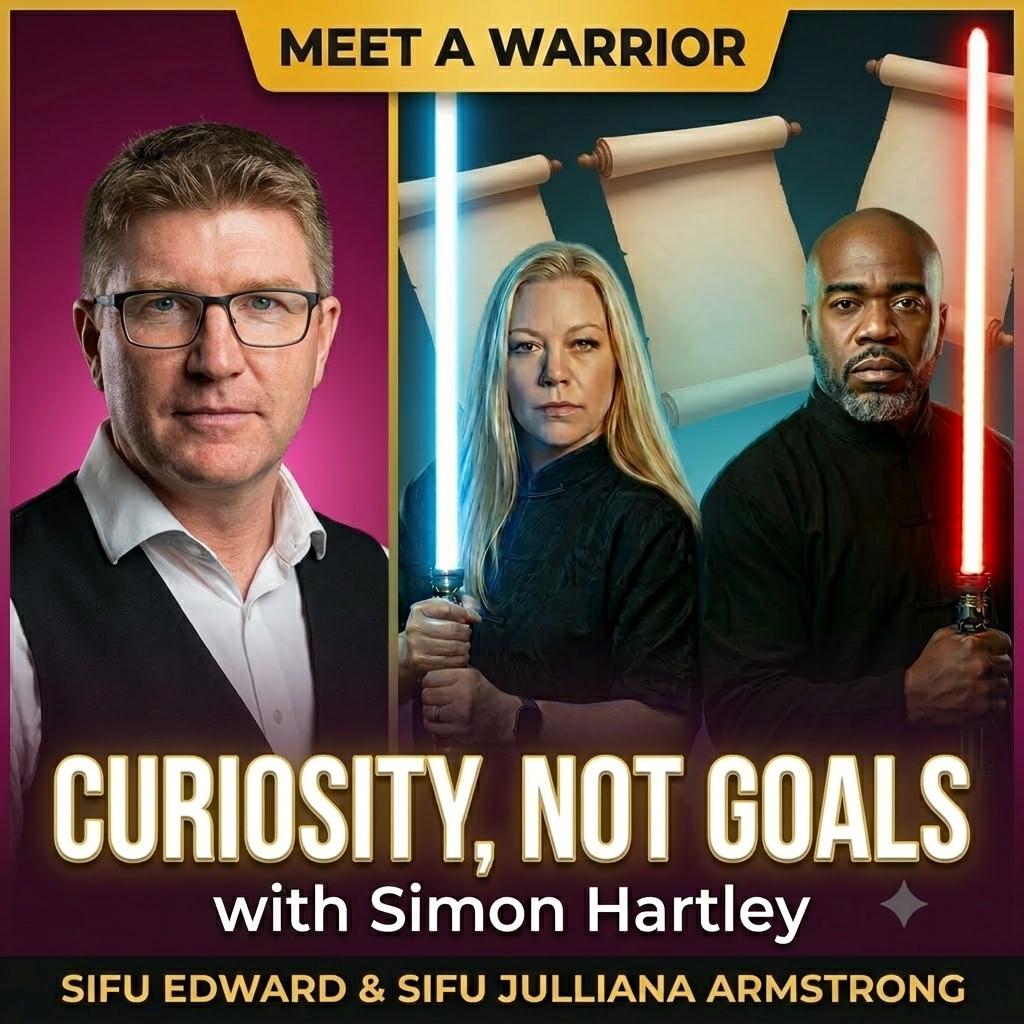
Adapted from the recorded conversation; the guest's words are verbatim. The questions are reconstructed and voiced by Sifu Edward and Sifu Julliana Armstrong.
🎥 Video podcast coming soon. The complete interview will play here once published. The full conversation is transcribed below, and the audio edition will be available on sifuarmstrong.tv.
In a new Sifu Armstrong interview, the Be World Class founder makes the case that elite performers are driven by questions, not trophies, and that laughter belongs on the KPI board.
The world’s best performers aren’t chasing goals. They’re chasing curiosity. That’s the central claim from performance psychologist Simon Hartley, who joined Sifu Edward and Sifu Julliana Armstrong for the latest Warrior Intelligence Series conversation.
Hartley, founder of Be World Class and a consultant with nearly three decades inside Olympic programs, Premier League clubs and elite boardrooms, says the trait that separates the truly world-class isn’t ambition in the way most people imagine it.
“They’re not usually chasing a goal because their curiosity is not goal-orientated,” Hartley said. “They’re just following their passion, their curiosity.”
That curiosity, he argues, shows up in the environment around a team as much as in the individual. Working with the Fiji Rugby Sevens squad, Hartley found an unlikely performance metric: “Laughter in that environment was one of our biggest performance-related KPIs,” he said. “If our players were having fun and enjoying themselves, there was a very good chance they were going to perform well.”
He’s equally direct about leadership built on fear, which he says may produce short-term results but rarely lasts. Leaders, he contends, should ask why people would choose to go the extra mile “if nobody was watching,” a philosophy he calls “cat herding.”
Underpinning it all is what Hartley describes as three interwoven strands: “To know yourself, to be yourself, to love and accept yourself.” When those combine, he says, performers stop needing external validation, and perform differently because of it.
It’s a framework that maps cleanly onto the warrior’s path the Armstrongs teach: build the person, and performance follows.
In This Conversation
- Why curiosity (not goals) drives the world’s best performers
- The Fiji Rugby Sevens and “laughter as a KPI”
- The PEAR model of motivation: Purpose, Enjoyment, Ambition, Recognition
- “Cat herding”: leading by influence instead of fear
- The three interwoven strands of self-worth
- Hartley’s books and free resources
The Full Conversation
Sifu Edward Armstrong: When I started Light Sword Training Academy, people told me I was building a sport. I wasn't. I was building warriors, and there's a difference. A sport entertains. A warrior is made, rep by rep, breath by breath, on the mat, long after the crowd goes home. So when I came across the work of our guest today, it stopped me in my tracks, because he's spent nearly three decades proving the same thing in a different arena.
Sifu Julliana Armstrong: And for me it was personal. I've competed at the world championship level. I know what it feels like when the body is ready and the mind is the variable, when everything you trained for comes down to what's happening between your ears in the final seconds. Simon's work is the science behind what every serious competitor already knows is true.
Our guest is Simon Hartley, a performance coach and sports psychology consultant who has spent nearly 30 years working with elite athletes, teams, and organisations around the world. He's the founder of Be World Class and co-founder of Success Engineers, and has helped everyone from Premier League footballers to Olympic gold medalists unlock their potential. Simon is also a bestselling author and keynote speaker known for turning big ideas about performance into simple practical steps that anyone can use to raise their game. What drew us to Simon is that he doesn't study champions from the outside. He builds them from the inside, and that is exactly the work we do at LSTA every time a student steps onto the mat. Simon, thank you so much for joining us.
Simon Hartley: Thank you. Very, very happy to be here.
Sifu Julliana Armstrong: I want to start with your road in, because it speaks to something I think a lot of competitors experience. You started in sports science, which is a wide discipline: physiology, biomechanics, psychology, all of it. Most people pick a lane. Tell us about the journey that led you specifically into performance psychology.
Simon Hartley: Yeah. I studied sports science when I was at college and at university. And whilst I was studying, I was also working in elite sport. I was very, very fortunate that, at the start of my second year undergraduate, I was working with elite rugby league players, England cricketers, and that gave me a platform to go and work in elite sport as I left university. And very quickly... I mean, sports science is quite a wide discipline. It includes physiology and biomechanics and psychology, all sorts of things. At university, I knew that I'd become very, very interested in the psychology of sport and performance. So I narrowed my studies down into that. And as I started becoming a practitioner, I also became more of a practitioner in psychology than any of the other disciplines within sports science. And that really sort of set my path. One of the bizarre things... I'm going to call it bizarre because it probably should have occurred to me a lot sooner.
I always described that I worked in sports psychology, but the truth is I worked in human psychology. And it took me quite a long time to realise that sports psychology is a misnomer, and what I was doing helped anybody. We were talking about how to get the best out of our minds really. And it doesn't matter whether you're an Olympic athlete, a salesperson, a doctor, a consultant, whatever you are, the same stuff works for everybody. So then, I realised it was really performance psychology and that what I was doing was coaching performance psychology. It's what goes on between our ears, and making sure that the stuff that goes on between our ears helps us rather than hinders us. And if we can start to engineer our mental game, as I call it, we could actually start to achieve much more.
Sifu Edward Armstrong: That word "engineer" lands hard with me, because that's exactly how I think about the warrior's path. You don't hope for it, you build it. At LSTA we have three kinds of people who walk through the door: the Warrior-In-Waiting in their prime, the Operator-Builder who wants to run an academy, and the Ageless Warrior picking up the Dragon Cane at 60. Three completely different humans, one shared idea: that excellence is something you can construct. You built a whole company on that idea. For everyone reading or listening, tell us. What does Be World Class mean in practise?
Simon Hartley: Yeah. As well as working in elite sport and in the field of performance psychology, I've always been really curious to understand how the very best in the world operate. So I set myself a little mission. And after working in the Olympic programmes for a few years and working in elite sport, I wanted to know whether, "If I studied the best in the world outside of sport, would I find the same characteristics at work? Are they driven by the same stuff? Have they got the same going on between their ears as the athletes have?" So I studied some individual world-class performers, including people like a Michelin Star chef, head of a world-leading science and medical research institute, a World Barista champion, mountaineer, polar explorer, all sorts of people. And actually, I found, yes, there were some common characteristics that drove all of these world-class people.
And it was part of my curiosity to understand not just how the best in the world operate, but also what can we learn from them and, "Is there a way I can distil that down and help other people adopt those principles?" So really Be World Class is a combination of my studies, my work with world-class performers, but also my passion to turn that into meaningful insights that people can actually use, principles that they can adopt, so that they can drive their own performance and become great too.
Sifu Julliana Armstrong: Here's a realisation I had preparing for competition, the athletes who kept improving weren't the ones chasing the next belt or the next medal. They were the ones who were endlessly curious about what they didn't know yet. They looked forward to the next obstacle because it was another answer waiting to be found. Give us the one thing you'd say is the foundation of becoming world class. What do we all need to do?
Simon Hartley: Yeah. I think there's a foundation, and I used to describe it by saying that world-class performers were fueled by passion. It's partly true, it's a version of passion. It's curiosity. If I think about my own journey, I actually describe it as following my curiosity. I've sort of described to you how I saw athletes at work. I wanted to know why some athletes were consistently better than others. And then, I was curious about other world-class performers. And over time, that's led me to also look at world-class teams and leaders and organisations. Actually, I find the same at work in world-class operators, whether they're individual performers, whether they're leaders, whether they're CEOs or captains of a sports team, whatever they are, they're usually driven by curiosity. They just want to know, "How can I be better? What can I do differently? How can I improve?" And I've heard that articulated in all sorts of different ways over the years.
So a mountaineer, a friend of mine, Alan, who's climbed all of the 14 8,000-metre peaks on Earth, there are only a handful of people who have, and he was one of the first. He described it by saying, "It's not necessarily I want to climb a higher mountain," because he climbed Everest quite early in his mountaineering career, but he wanted to climb a harder mountain. And he said K2 was the biggest mountaineering challenge, but the north face of the Eiger is a huge mountaineering challenge. That's a real tough one. So he wants to know how you climb these. And James, who's the World Barista champion, was always curious about how to not just make better coffee, because you don't win the World Barista Championship just by making the best cup of coffee, but, "How do you serve the best cup of coffee? How do you create an experience for somebody, and help them enjoy drinking that cup of coffee more than they would somebody else's coffee?
And that curiosity drove him to find the answers, to put them into practise. Usually, you go through that process of you have a little light-bulb moment where you think, "Oh, wow. Yeah, I think I understand it now." You put it into practise, and it doesn't quite work the way you expected. So then, you have to reshape it and go again, and reshape it and go again and learn. And there's this, I call it, yellow brick road of questions and answers. They probably don't even realise that there's a point at which they really do stand out and can be classed as a genuine world-class performer in their field, that they're probably not even aware of that because they're so busy finding the answer to the next question in their mind, that they look back at some point and go, "Oh, wow. Blimey, they've just handed me a world championship," or "I've just become one of the handful of people to climb all 14 8,000-metre peaks." They're not usually chasing a goal because their curiosity is not goal-orientated, but they're just following their passion, their curiosity.
Sifu Edward Armstrong: There's a phrase I had to unlearn. In the early academy days, every time something broke (a venue fell through, an instructor walked, a number didn't land), I'd say it all went "pear-shaped." It was the language of a man bracing for the worst. Then I found your work and discovered you'd taken that exact phrase and built a whole model around it. Walk us through the PEAR model (P-E-A-R), and what it teaches leaders about what actually drives people.
Simon Hartley: Yeah. I wrote the book called Motivation Is PEAR-Shaped because of that phrase, people do describe things as going pear-shaped. But I'd also come to realise, and this is something that's dawned on me probably in the last 10-ish years, it sometimes takes me a long time to see the simplicity in something. So if you'd have asked me 20 years ago to describe motivation, I probably would've waffled around the subject quite a lot. It would've appeared quite complex. At the time, when I started out 20, nearly 30 years ago, I often ask people, "Why do you come here and do this stuff, and why do you come here and do this stuff with us?" And over the years, I thought I was getting hundreds and hundreds of different answers. And then it occurred to me, actually, I've only really heard four. All of those answers either relate to purpose, which is the P of PEAR, and people talking about the difference that we make.
Maybe we change lives, maybe it's that we just make people happy, maybe we save lives, but there's an inherent value to what we do and a real understanding of the importance of what we do. And that's kind of encapsulated within the P of purpose. Some people would talk about the enjoyment, and it might not be that they like the tasks that they do, but maybe they enjoy the camaraderie. Maybe they're surrounded by a great team, maybe they work with great clients, maybe they enjoy the essence of what they do. I know lots of people who maybe don't enjoy selling, if they're salespeople, but they enjoy working with clients, solving problems with them. Sometimes it's the enjoyment of the challenge, that actually the easy stuff is the boring stuff. We like the challenge, we like to be creative, we like the autonomy, but there's an element of our job that we really enjoy.
The A is for ambition and achievement. And that recognises that lots of people really like being good at stuff and feeling like they're good. Whether it's I feel that we are good as an organisation and I'm part of something that's good, or I understand that I'm good at what I do and that I'm improving, developing, growing, that's all great. Some people, they love hitting goals. That comes into that feeling of achievement. But lots of people are really motivated by that feeling of accomplishing things and achieving, and feeling like they're great at what they do. And the art is recognition and reward, which really simply means that we feel like we're recognised and rewarded for what we do. It doesn't purely come into being paid more or getting commissions or bonus checks or incentives. A lot of it, it's simple stuff like giving people a pat on the back and a, "Well done, and a, "Thank you. What you've done really made a difference."
And well as helping me understand that really everybody's motivation falls into these four, it also helped me to understand that, personally, we've got slightly different biases on these four. It's a little bit like personality typing. So if you read into any of the personality type profiles that have spun out of Carl Jung's original work, we start to understand we have all of the personality types, but in different strengths. So there'll be a dominant one in a secondary and a tertiary, and usually a weaker personality type. It's the same with these motivational drivers. As I described them, I'm sure anybody listening would think, "Oh yeah, that kind of describes me. I'm maybe quite achievement-orientated. I really love to win or I love to feel like I'm achieving, or I'm quite purpose-driven." So we can probably see that some of these are stronger than others.
If we looked around at the people we work with, we could see that other people had some stronger drivers and weaker drivers. And that really helps us if we're trying to motivate others because we can tap into that. But for leaders, it helps us to understand that if we built four really strong pillars of motivation in our organisation, then actually we'd motivate most of the people most of the time. And if we did that, the other thing that I realised is that if we've got all four and they're all strong, we create this fifth dimension, and that's that we create a place people are proud to belong to, "They're proud to belong here and do this stuff with us." And in motivational terms, that's enormous.
Sifu Edward Armstrong: That fifth dimension (a place people are proud to belong to) is the whole game for us. Club Sabernet, our member community, isn't a mailing list. It's a home. And our Academy Commanders, the licensed operators who run certified academies, succeed or fail on whether their students feel that pride walking in the door. I've watched ordinary clubs become great the moment that shifted. From where you stand, having been inside Olympic programmes and boardrooms alike. What do you think organisations could do to go from just being good to being truly great?
Simon Hartley: I think it starts by understanding what really does matter to our people. And sometimes, yeah, they will appreciate being paid a little bit more. But sometimes you can offer things that are not cash bonuses, that actually have more meaning than cash bonuses, mean more to them than a cash bonus would. A few years ago, I worked with the Fiji Rugby Sevens team. And at the turn of the year, we set them the hardest challenge that they'd ever had. It was a really, really hard training week. Physically, it was a hard training week in terms of taking them outside of their comfort zone. It probably took them further than any other week that we'd challenged them with. And their prize, at the end of it...
We created two teams within the squad. And at the end of the week, they played against each other. One wore the home shirts and one wore the away shirts. And there was a prize, at the end of it, for the winning team. And the prize was pizzas and beer, which cost a grand total of 150 Fijian dollars, which is about 50 GB pounds. That motivated that squad to work as hard as they did and push themselves as hard as they did for an entire week, for the prospect of pizzas and beer.
Sifu Julliana Armstrong: That's exactly what I see at every grading and every competition. The students don't grind for the certificate. They grind for the moment after, the laughing, the brotherhood, the pizza on the mat. And I'd ask you directly about this, Simon, because as a competitor I notice it immediately when a training environment has it and when it doesn't. What role does enjoyment play in long-term performance?
Simon Hartley: Yeah, enjoyment, I think, is also critical. This is something else that I really learned from working with the Fiji Rugby Sevens team. We had all sorts of performance markers available to us. And in sports science these days, you can measure just about anything. It's the same in business. There are KPIs flying around an organisation. But if you look at what really, really drives performance, laughter in that environment was one of our biggest performance-related KPIs. If our players were having fun and enjoying themselves, there was a very good chance they were going to perform well on the field. If they weren't having fun, if we weren't hearing laughter, we weren't likely to get a good performance on the field. And we were so tuned into this because we realised the impact that laughter had on the scoreboard, and the enjoyment and fun had on the scoreboard, we could see that direct link.
So making sure that the environment was fun was critical. Yes, it had to be serious as well, and we had to do the hard work, all that sort of stuff. But if the players weren't enjoying it, forget it. It's a waste of time. As I was reflecting on that, I wondered, "How many CEOs are tuned into this? How many organisations have a fun-o-metre on the wall or measure the decibels of laughter in the organisation? How many KPIs are there around enjoyment?" But if we think about how much impact it has on performance, maybe there should be some KPIs around enjoyment and fun and laughter.
Sifu Edward Armstrong: I have a confession. The franchise I trained under led by fear. Bark loud enough, threaten the certification, keep everyone scared, and yes, it produced numbers for a while. When I broke away to build LSTA, I swore I'd never lead a single warrior that way. But I'll be honest, fear is seductive because it works fast. You've sat across from leaders who run on it. Walk me through what that approach really does to people, and to the leader.
Simon Hartley: Yeah. I think you're right, lots of managers traditionally have managed by fear or through fear, and I think it does a couple of things. It might get you some short-term results. Equally though, it might not be that sustainable. I mean, how long does that really last? And how long does it take people to just become numb to it, and not really care anymore? My other question would always be, "So what happens when you're not watching? What do people just naturally do?" Because if we think about the characteristics that we want in our people and the kind of culture, that's going to exist whether we are watching or not. That's our real culture, our authentic culture, and the character that people are exhibiting. And I often talk to leaders about a little philosophy that I call cat herding.
The art of cat herding is to understand, "Why people would choose to... Why would they choose to go the extra mile? Why would they choose to work a little bit harder? Why would they choose to care a little bit more? Why would they choose to care a little bit more about their teammates, about their customers, about the quality of their work? Why would they do that? If you weren't watching, if nobody was watching, why would they choose to do that?" And that sometimes is a question that leaders find difficult to answer. Because they're so used to waving the big stick and banging the drum harder and shouting louder that they haven't really started to think about why people would choose to.
Sifu Edward Armstrong: "What do they do when you're not watching." That's the warrior code in one sentence. Discipline isn't what you do under the eye of the master; it's what you do alone. I had to ask myself whether I could sustain a different way of leading over the long game (across a federation of network academies, 1,500+ warriors trained since 2015) without burning out or breaking character. Is that cost as real for the fear-based leader as I suspect it is?
Simon Hartley: It's absolutely true. And for a lot of leaders, because it's actually quite inauthentic, that's not them as a person. Maybe they've learned it from previous leaders. Maybe that's culturally the norm within the organisation, and they're gravitating towards that. But if you met that person for beer, would they be that kind of person? For a lot of them, they wouldn't. And therefore, because it's inauthentic, it's also exhausting. They're not getting anything out of it. They're not feeling fulfilled themselves. They're not leading in a way that makes them proud. They wouldn't look at themselves in the mirror when they got home and think, "Yeah, good job. Yeah, I did a good job today. I'm really, really happy with that." And that becomes exhausting. It becomes not particularly sustainable. It leads people to burnout. So it's not just for the benefit of their people, it's also for the benefit of their leader to actually probably lead in a more rounded way.
Sifu Julliana Armstrong: That word "authentic" is one I sit with differently as a competitor. Because in the middle of a match, there's nowhere to hide, whoever you are is exactly who shows up. I've watched athletes who trained hard but led themselves through fear of losing, and they'd crumble when it mattered. The ones who were comfortable in their own skin competed differently. So how do you help a leader or an athlete find that authenticity, especially when it's been buried under years of performing who they think they should be?
Simon Hartley: If we go back to that word, authentic, which unfortunately has become enormously overused over the years, and probably taken out of context, it's almost become cliche. Authentic means to be yourself. And let's take this wider than leadership. That's a challenge most people have, to be themselves.
When I was studying at university and I was studying sports psychology, my tutor encouraged us to look a lot wider than the textbooks on sports psychology, "Start to read wider. Understand human beings from a much more diverse viewpoint." So I read a lot of philosophy. I read quite a lot of Socratic philosophy, so the workings of Socrates, et cetera. And Socrates will say, "You've got to know yourself." Many people would say, "One of those missions in life is to be yourself." And I've come to understand those two are linked with each other, but there's a third dimension. I call them three interwoven strands of rope. To know yourself, to be yourself, to love and accept yourself, are the three strands. When we get these three working in combination, we are very comfortable to be ourselves, to live in our own skin. We don't need to be anybody else.
The ego starts to take a back seat because we're not particularly worried about what others are thinking of us either or whether people are judging us or not, because we're happy just being ourselves and being in our own skin. And it's a really, really powerful place to be. In my experience, it takes a long time to get there. I see relatively few people who genuinely get to a position where they can intertwine those three strands. There are lots of people who I describe sort of the way that ego is trying to fill a hole, and it's the hole where self-worth should be. If we're desperately worried about what other people are thinking of us, and we need our results to validate us, we need promotion, we need other people's approval, we need whatever it is to validate ourselves, that's a sign that we've got this vacuum-like hole where self-worth should be. And it's ego that's trying desperately to fill that hole.
So if we get to the point where there is no hole because we've got this nice solid foundation of self-worth, because we have those three interwoven strands, "We know ourselves, we like ourselves, we're happy to be ourselves," actually we operate very, very differently. Not just in a work context, but in life. And when I see leaders who are in that position, their leadership is also very, very different. They don't tend to be tyrannical or, equally, the David Brent style of a person that's desperately looking for other people's approval or wanting to be popular, or whatever, because we don't need that anymore.
Sifu Julliana Armstrong: Three interwoven strands: know yourself, be yourself, accept yourself. I felt that. Competing is one of the fastest paths to finding out exactly who you are, because pressure strips everything else away. For the warrior reading this right now whose chest just tightened (the one fighting more demons in their head than opponents on the mat) which of your books do you point them to first?
Simon Hartley: That's a very good question. Bizarrely, the one that is probably least known is a book called Silence Your Demons. It's a fictional book. I originally wrote it for teenagers to help them with the demons in their heads, all that chaotic stuff that flies around between our ears. And I've learned, having published it, that it's probably more useful for 40, 50, and 60-year-olds than it is for 14, 15, and 16-year-olds. The feedback that I've had from most people of those ages who have read it is, "Why didn't I have access to this when I was younger? I'd love to have read this book when I was in my teens or my 20s. It's unfortunate now that I'm in my 40s, 50s, 60s, and I've only just come across it." So I'd say Silence Your Demons, which is not available on Amazon. We have a dedicated website, silenceyourdemons.co.uk. And that's probably the best one to really understand how this works.
Sifu Julliana Armstrong: That's amazing. So silenceyourdemons.co.uk. We'll make sure that's linked.
Simon Hartley: Yeah.
Sifu Edward Armstrong: One of the things I'm proudest of building at LSTA is the path itself, a curriculum where each stage opens the door to the next, the way the 9 Forms build one on another. And listening to you describe your body of work, it sounds like your books followed exactly that kind of progression, one question pulling you toward the next. For the warriors who want to walk that whole path with you, give us the map.
Simon Hartley: Yeah. So there's a little journey through all of those. I started by trying to understand my own method. If you'd have asked me 25 years ago, I'd have said, "I don't really have a method. I have a toolbox." Whenever I encounter somebody, I take my toolbox and I'll use whichever tool is most appropriate at that time. And probably after 10, 15 years working, I realised there was a method to it. And then because I'd understood the method, I thought, "Oh, I can communicate this to people, and they can start to use it." Maybe practitioners could start to use it, but people could start to use it in their own mental game. And it was all about how focus, confidence, motivation, all fed each other. And how when we got those things right, we were happier to step outside of our comfort zone. And when we did that, we were happier to release, what I call, our mental handbrake. And then we took a very different view on pressure, and that it's all related.
So when people talk about performing under pressure, we have to get the foundations of focus, confidence, and motivation right in order to get there. So I wrote that into a little book called Peak Performance Every Time, which we published in 2010, and that's just out of a second edition. But whilst I was writing it, I'd started to become really curious about world-class individual performers. "What made the best in the world, the best in the world? How did they think? How did they overcome problems? How did they overcome challenges? What happens when they hit setbacks? How do they deal with those?", that's what I really wanted to understand, "How do they perceive risk?" So I interviewed and worked with 12 world-class performers in vastly different fields, including the Michelin Star chef and the World Barista champion, and wrote that all into a little book called How to Shine.
Whilst I was doing that, another couple of sparks of curiosity were ignited. One, "What about world-class teams then?" So I started researching the very best teams in the world, including Formula One pit crews, racing yacht crews, the Red Arrows, the aerobatic display team, special forces units, all sorts, and figured out that actually there were a set of characteristics that they had as well. And that if teams across the world, business teams or sports teams, whoever they are, adopted these characteristics, they'd become great too. So I published that into a book called Stronger Together. My curiosity that had spiralled off in a slightly different direction took me to wondering how people take on, quote, unquote, "impossible challenges." So I found a bunch of people who had taken on seemingly impossible challenges, talked to them about their experience, but also I wanted to understand this personally through my own experience.
So I took on a daft challenge, and documented what happened between my ears when I hit the hurdles, fell over, got my bloody nose, got back up again. So that's a mixture of both the research and the personal journey of taking on the "impossible challenge." And I wrote that into a little book called Could I Do That? There was another one that spun out of my research into world-class teams. I discovered, and this is going to make me sound really stupid, I know, when you find world-class teams, you tend to find world-class leaders. So when I research world-class teams, I ended up researching world-class leadership, even though I haven't planned to. It struck me afterwards that the world-class teams and leaders tend to go hand-in-hand. And one of the things that I've noticed is that world-class leaders were great at leading through influence, cat herding, as I call it. So there was a book that was supposed to be a chapter in Stronger Together that ended up becoming a book in its own right called How to Herd Cats.
Sifu Julliana Armstrong: Where do people go to find you and get their hands on these resources?
Simon Hartley: There is, and it's got a really stupid URL, which I won't give you. But we do have a free resource page on the website, worldclassresources.com. It'll take you to a page where you can pick up free resources. And lots of what we've been talking about is held within the site, so you can navigate to the site from that page if you want to find out more. There's documentaries and there's podcasts, there's all sorts of things on there which you can get. But the free resources will also send... We've got a programme called Podium Mindset, and there's a little espresso version to get people started on their own journey, which is the free resource that they can grab through that page.
Sifu Edward Armstrong: We're chasing our own podium right now (the World Games Pathway, taking light sword from the mat to the global stage), so "Podium Mindset" is speaking my language. One final question from me, Simon: what's next for you? What is your next big challenge?
Simon Hartley: I've got some personal challenges. One is that I'm learning to fly, at the moment. So I've got one more exam in my pilot's training, and probably another maybe 10 flying hours to do before I qualify as a pilot. That's been a huge challenge, so far. That's really taken me outside of my comfort zone. Professionally, we have a conference coming up. It's our sixth big conference event. And because I'm a ridiculously ambitious individual as well, we've doubled the size of the audience for this one. So that's a challenge. I've also got to navigate my way through my own 50th birthday. That'll be a toughie.
Sifu Edward Armstrong: Good luck.
Simon Hartley: And the project that we kicked off last year is a documentary series called This is Mental, helping people take on their own big, hairy, audacious, scary goals. We are looking at taking that from a pilot into a proper broadcast series. So that's one of the other challenges I've got on my plate at the moment, as well as the next book, which is a seedling in my mind at the moment.
Sifu Julliana Armstrong: How do you rest? When do you take a moment to yourself?
Simon Hartley: Resting is easy because I'm exhausted by the end of all this.
Sifu Edward Armstrong: Well, Simon, it's been an absolute pleasure chatting with you. Thank you so much for your time today.
Simon Hartley: Thank you.
Sifu Julliana's closing word: The three interwoven strands landed with me in a way I wasn't expecting: know yourself, be yourself, accept yourself. Every competitor I've admired at the world level carries those three things into the arena, whether they can name them or not. The ones who fall apart under pressure? They're fighting themselves and the opponent at the same time. Simon gave us the map for that inner fight. Take it seriously.
Sifu Edward's closing word: I came into this conversation thinking I'd hear about athletes. I walked out with a mirror. Curiosity over goals. Laughter as a performance metric. Leading by influence instead of fear. None of that is soft. It's the hardest, longest work there is, and it's exactly the work that turns a person into a warrior. Train the mind like you train the body, and the body will follow. We don't entertain warriors. We create them.
Simon Hartley, Founder of Be World Class and co-founder of Success Engineers. Books: Peak Performance Every Time, How to Shine, Stronger Together, Could I Do That?, How to Herd Cats, Silence Your Demons. Free resources at worldclassresources.com · silenceyourdemons.co.uk
ILLUSTRATIVE RESULTS. Any revenue, enrollment, margin or retention figure in this conversation is either a documented result from one of our own operations, a figure the guest reports about their own business, or an illustrative example, never a projection of your results.
Nothing here is financial, legal or tax advice.
Stay in the Fight
This conversation is part of the Sifu Armstrong Warrior Intelligence Series: interviews with world-class performers, builders, and thinkers, filtered through the lens of the warrior's path.
Subscribe at sifuarmstrong.news for every new interview, delivered to you.
Join Club Sabernet, the member community of the whole Sifu Armstrong ecosystem, where warriors train, connect, and hold each other to the standard.
Ready to build your own floor? Find your path at sifuarmstrong.com/which-path.