Attract the Right, Repel the Wrong: Sifu Edward & Sifu Julliana Armstrong Sit Down With SAVVii Media's Richard Conduit
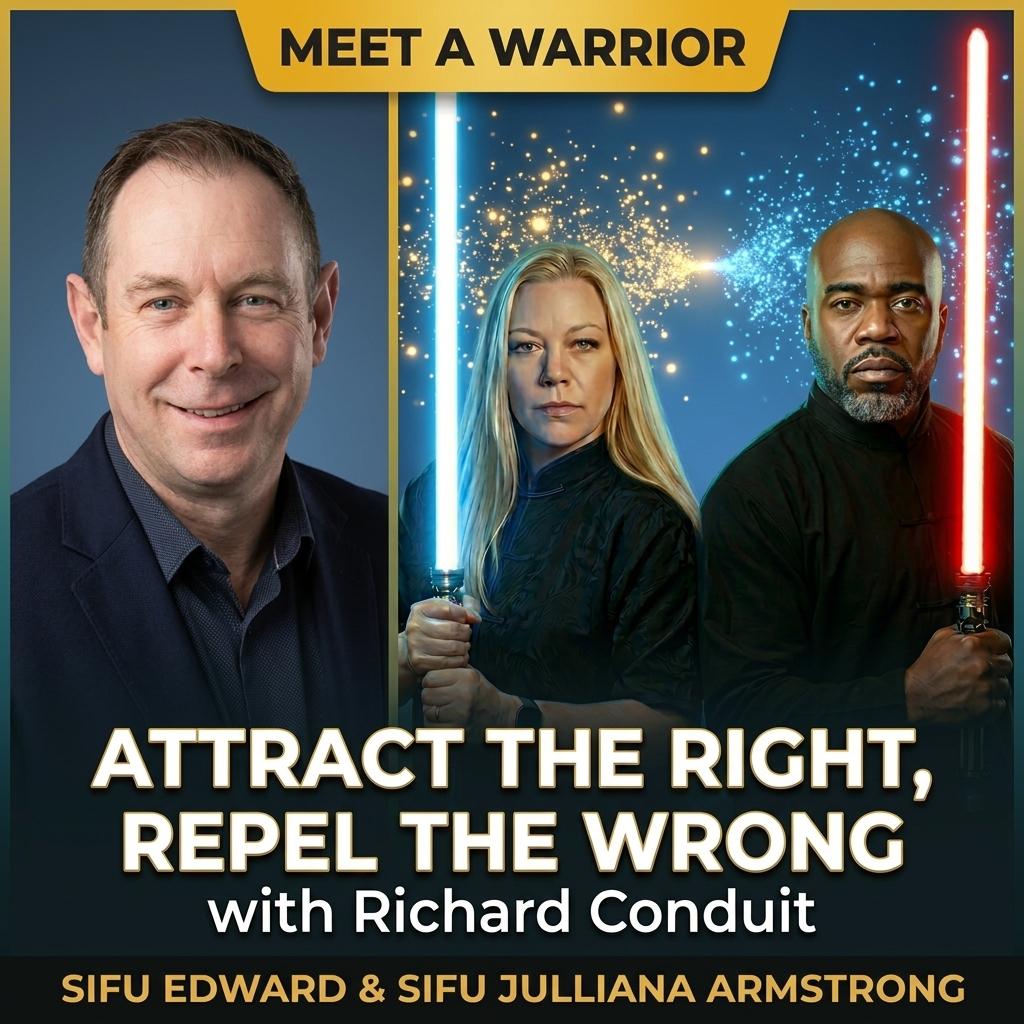
Adapted from the recorded conversation; the guest's words are verbatim. The questions are reconstructed and voiced by Sifu Edward and Sifu Julliana Armstrong.
🎥 Video podcast coming soon. The complete interview will play here once published. The full conversation is transcribed below, and the audio edition will be available on sifuarmstrong.tv.
In a new Sifu Armstrong interview, the performance-marketing founder argues that in today’s algorithm, the ad copy itself (not audience targeting) is what decides who shows up.
Richard Conduit didn’t start out as a Facebook ads specialist. He started as a martial artist who needed to fill his own mats, and in his conversation with Sifu Edward and Sifu Julliana Armstrong for the Warrior Intelligence Series, that origin story turns out to be the whole reason his agency, SAVVii Media, exists.
Conduit spent nearly twenty years in sales, from door-knocking to corporate roles, before he began running Facebook ads in 2014 to bring new members into his own gym, a dojo, in fact. “I had a gym, a dojo of my own, and I started to run in 2014 Facebook ads in order to get new members into my gym,” he told the Armstrongs, back when, as he put it, “you could run two pounds a day in ad spend, which you cannot do anymore.” It worked well enough that other gym owners started asking him to do the same for them. By early 2016, the side project was matching his day-job income, and he quit to build SAVVii Media full-time, an origin the Armstrongs flagged immediately as the exact problem every academy operator they license has to solve.
The ad landscape Conduit describes has changed almost beyond recognition since then. The detailed interest- and demographic-based targeting that once let advertisers narrow an audience by job title, income, or specific pages liked was stripped away over several years, largely following Congressional scrutiny of Meta’s data practices. What’s replaced it, he argues, is a far more capable algorithm, one that no longer needs precise targeting instructions, because it reads the ad itself. “Facebook wants your ad (your copy, your creative, your video, whatever you’re using), to attract and call out the correct market, the correct target, and to repel the wrong people,” Conduit said. Get the creative right, feed the algorithm plenty of variations to test, and make sure conversion tracking is actually reporting correctly to the platform, and it will find the right audience more efficiently than manual targeting ever could.
That same idea (that the message itself should do the work of sorting the right prospect from the wrong one) struck a chord with Sifu Julliana Armstrong, who drew a direct line to how the Armstrongs talk about their own art: never softening the difficulty to attract more people, because the honesty of the message is what calls the right ones in and sends the wrong ones elsewhere.
Conduit was equally direct about the operational discipline that keeps an ad account alive. Overstated claims, before-and-after photos, and a disapproved-to-approved ad ratio above 1-to-10 are among the fastest routes to a ban that’s nearly impossible to reverse: Facebook doesn’t hand out human representatives, he said, unless an account is spending millions a month. And in a claim he says he’s fully convinced of, businesses that keep advertising straight through the expensive fourth quarter, rather than pausing when costs spike around Black Friday and Christmas, see their costs drop once January arrives. “Facebook, as far as I’m concerned, rewards you for keeping your ads going permanently,” he said.
For an industry Conduit describes as changing weekly, his advice to a small-business owner boils down to fundamentals over hacks: structure a real variety of ad formats, don’t cut ads early, verify tracking against your own CRM rather than trusting Ads Manager’s numbers, and expect the platform to reward whoever stayed in the arena longest.
In This Conversation
- How Conduit went from running a dojo to building SAVVii Media after his own Facebook ads worked too well
- Why detailed audience targeting disappeared from Meta’s platform after Congressional scrutiny
- The shift to creative-driven targeting: ad copy that attracts the right buyer and repels the wrong one
- Red flags that get ad accounts banned, including claims, before-and-afters, and disapproval ratios
- Why running ads straight through an expensive Q4 pays off once January hits
- Practical starting steps for a small business testing paid traffic for the first time
The Full Conversation
Sifu Edward Armstrong: I want our Academy Commanders to lean in for this one, because our guest didn't start as a marketer. He started exactly where they are. Richard Conduit ran a gym, a dojo of his own, and taught himself Facebook ads to fill it with members. That's the precise problem every operator we license has to solve: how do you get the right people through your door? He turned the answer into an entire agency.
Sifu Julliana Armstrong: And the thing that made me sit up is his core principle, that the best advertising doesn't just attract the right people, it actively repels the wrong ones. That's not a marketing tactic to me. That's how you protect a standard. The message that calls a warrior should send the tourist somewhere else.
Our guest is Richard Conduit, founder of SAVVii Media, a performance marketing agency specialising in paid traffic and lead generation. Richard, welcome.
Richard Conduit: Hey, welcome.
Sifu Edward Armstrong: Start with the backstory, and I want our academy owners to hear how it began, because it began in a gym.
Richard Conduit: Yeah, sure. I spent a long time, nearly 20 years in sales, everything from door knocking and telesales through to corporate sales. And I had a gym, a dojo of my own, and I started to run in 2014 Facebook ads in order to get new members into my gym. Those were the days when you could run two pounds a day in ad spend, which you cannot do anymore, and it worked and I had no idea what I was doing. I built a little landing page, ran some ads, and we got a lot of members join. I then started getting other gyms asking me to do the same thing, and after a while, I was earning the same kind of money as I was for my job, and I quit my job. That was the beginning of 2016.
There were two things that attracted me. First of all, it worked really, really well for my own business, and then I realised everybody wanted it. Every person I spoke to knew they should be advertising on Facebook. This was even before Instagram, it was always just Facebook. Everybody wanted to do it, nobody knew how to do it. So it was just one of those conversations back in 2016, '17, everybody wanted it, and I found it very easy to get business. In the beginning, yes, it was trial and error. It was me doing everything, building the funnels, running all the ads. It was all interest-based targeting, so it was a lot more intuitive than it is now.
Sifu Edward Armstrong: So you're the proof of concept for every Academy Commander we have. A martial artist who filled his own mats by learning to reach the right people, then discovered every other academy owner needed the exact same thing. That's not a side note. That's the whole model.
Sifu Edward Armstrong: The ad landscape has changed dramatically in ten years. Walk us through what actually happened.
Richard Conduit: It is so fast. All my ad managers are on a meeting with the Facebook policy guys and our reps every week because the policies change all the time. At the beginning, it was all interest-based, which meant you could pick interests you knew your audience had: places they go, pages they liked, job titles, credit scores, earnings, all this. The big change happened when Zuckerberg was hauled in front of Congress over data leakage. One of the things that came from that hearing was that advertisers were able to exclude certain demographics from their advertising, especially in real estate ads, they would exclude certain people from certain areas. So immediately after that, they started to remove a whole array of specific targeting inside the Ads Manager so that couldn't happen anymore. That has continued year after year, so there's very little targeting compared to what there used to be. Then you had the stuff with Apple where people could opt out, so now the algorithm (although it's far better than it ever was), works in a completely different way.
Sifu Julliana Armstrong: This is the part I want to dwell on. You said the targeting now happens in the creative itself, that your ad's job is to attract the right people and repel the wrong ones. Explain that, because I think it's bigger than advertising.
Richard Conduit: It's a little bit of both: the AI makes running the ads harder, especially if you're trying to do your own, but the algorithm now is far better than it ever was. In my opinion, it's the best algorithm out there. If you run the ads properly, everything now is about the creative. Facebook wants your ad (your copy, your creative, your video, whatever you're using), to attract and call out the correct market, the correct target, and to repel the wrong people. If you can do that in your ads, as opposed to targeting in the audience, then the algorithm is extremely efficient at finding the right people. There are two things you really have to do. One is set up the correct ad copy to attract these people. The second is to give the algorithm lots of choice: lots of different ads, different audiences. And the tracking has to be right, because inside the Ads Manager Facebook does not track things very well, so you have to send the information back to Facebook correctly in order for it to learn. If you do that, it will work better than it's ever worked before.
Sifu Julliana Armstrong: That's the whole philosophy of how we speak about the art. We never say "anyone can do this, it's easy." We say the opposite. This is hard, this is for warriors, this will demand everything. And that message does two jobs at once: it magnetises the person who's ready, and it quietly sends away the person who wanted something easy. You don't protect a standard by chasing everyone. You protect it by calling the right ones and letting the wrong ones self-select out.
Sifu Edward Armstrong: Where do you see the best returns, and what are the red flags that get people's accounts shut down?
Richard Conduit: It depends on the business. For coaches, consultants, high-ticket programs, course creators. It's always going to be Meta, both Facebook and Instagram. Google is good for businesses where the person's initial thought is "I need to Google somebody, I need a plumber." But Facebook, even though some people say it doesn't work anymore, is by far the most profitable platform still. We run millions every month in ads on Facebook and it still works very well. You just have to do things very differently than you used to.
On red flags. You have to be very, very careful, and this is a boring thing for people to do, but you really do need to take notice of the policies. If you get your ad account disabled, it's very hard to get back. You're highly at risk if you're making big claims or using before-and-after photos. One of the biggest reasons accounts get banned is the ratio between approved and disapproved ads, if your disapproved-to-approved ratio goes above 1 to 10, you're at high risk. And payments: if you don't talk to your credit card provider before you start running ads, the bank will often protect you and not allow the payment through, and Facebook will spank you for that. Your ad costs will skyrocket for three or four days before settling back down. Facebook does punish you for these things.
Sifu Julliana Armstrong: How competitive and costly has it gotten, and is there any reward for the ones who just keep going?
Richard Conduit: Depending on the market, it's extremely competitive, and costs go up every single year. Quarter four of every year, you can expect your ad costs to climb (Black Friday, Christmas, Cyber Monday), the amount of advertisers going for the same audience increases dramatically. But here's what I'm absolutely convinced of, and nobody will ever tell me different: if you continue your advertising all through the year, once January hits, you get kind of rewarded for it. A lot of people stop their ads when it gets more expensive during quarter four, but we see it every year, your ad costs go down. So Facebook, as far as I'm concerned, rewards you for keeping your ads going permanently.
Sifu Julliana Armstrong: Of course it does. That's true of everything worth doing. The ones who quit when it gets expensive and hard leave the field to the ones who don't, and the platform, like the podium, rewards whoever was still there when everyone else went home. Consistency isn't just a virtue. It's a competitive weapon.
Sifu Julliana Armstrong: For a small business owner with limited funds, where should they actually start?
Richard Conduit: To be fair, buying courses for Facebook is a dangerous game, because Facebook courses are out of date within a couple of months of you buying them. The best way is to structure your campaigns properly. You need various different ads in there: video ads, image ads, carousels, lots of different copy, different headlines, and allow Facebook to test all of these things and do its thing. Do not cut off ads where spend isn't going to them. Facebook will automatically direct spend to the better converting ads. And the most important thing is to make sure your tracking is correct. If you're going on what it says in the Ads Manager about how many leads you've got, you're in real trouble, because it doesn't report leads or purchases correctly, so you need to be checking your backend, whatever CRM you're using. Even on a small budget, it's worth talking to somebody like us, even if it's just for an audit, or consulting. We have calls with people once a week, tell them how to structure their campaigns, and eventually, once it starts working, they realise, "Actually, I don't really want to do this: even though it's profitable, it's too much work." And then it becomes obvious why people like us exist.
Sifu Edward Armstrong: And once someone has a black mark against them (bought fake likes, got flagged) how hard is it to recover?
Richard Conduit: It's a very difficult position to be in. It's almost impossible to speak to a human at Facebook. It's not how it used to be. They don't hand out reps anymore. We're fortunate because we have reps, but only because we have a client that spends a couple of million dollars a month just on Facebook, so Facebook gave them a human rep we can talk to. Nobody gets a rep unless they're spending a lot of money. If you have a black mark against you, you're in real trouble. We're dealing with a woman now whose ad costs are just unbelievable every time she runs ads, and one of the reasons is she bought likes for her page and Instagram from some third-world country. Doing anything dodgy like that, Facebook will find it and punish you for it.
Sifu Edward Armstrong: Richard, this has been genuinely useful. Where do people find you, and do you work worldwide?
Richard Conduit: You can go to savviimedia.com. That's S-A-V-V-I-I Media. Fill out the form, book a call, or call the phone number there. You can also reach out through Facebook (I'm pretty much on there all the time), or LinkedIn. And not at all UK-only. The vast majority of our clients for the last 10 years have been in the States. We work US hours, and we have clients all over, US, Canada, Australia, South Africa, Europe, South America.
Sifu Edward Armstrong: Richard, it's been a real pleasure demystifying what many people consider the dark art of Facebook and Google Ads. Thank you for your time.
Richard Conduit: Thank you ever so much. I really appreciate it.
Sifu Julliana's closing word: Two things I'm taking from Richard. First, that the platform rewards whoever kept going when everyone else quit. That's the podium, and it's the market, and it's life. And second, the deepest one: the best message doesn't chase everyone, it calls the right person and repels the wrong one. We do that every time we say this path is hard. It's not exclusion for its own sake. It's how you protect the ones who are actually ready.
Sifu Edward's closing word: Richard is the living blueprint for our Academy Commanders, a martial artist who filled his own mats by learning to reach the right people, then built an empire teaching others to do the same. And his core truth is one we live by: the right message calls the warrior and repels the tourist. That's not just advertising. That's how you protect the standard. Attract the ones who are ready. Let the rest self-select out. We don't entertain warriors. We create them.
Richard Conduit, founder of SAVVii Media (savviimedia.com), a performance marketing agency specialising in paid traffic and lead generation, serving clients worldwide.
ILLUSTRATIVE RESULTS. Any revenue, enrollment, margin or retention figure in this conversation is either a documented result from one of our own operations, a figure the guest reports about their own business, or an illustrative example, never a projection of your results.
Nothing here is financial, legal or tax advice.
Stay in the Fight
This conversation is part of the Sifu Armstrong Warrior Intelligence Series: interviews with world-class performers, builders, and thinkers, filtered through the lens of the warrior's path.
Subscribe at sifuarmstrong.news for every new interview, delivered to you.
Join Club Sabernet, the member community of the whole Sifu Armstrong ecosystem, where warriors train, connect, and hold each other to the standard.
Ready to build your own floor? Find your path at sifuarmstrong.com/which-path.