Anchor or Fuel: Sifu Edward & Sifu Julliana Armstrong Sit Down With Dr. Richard Kaye
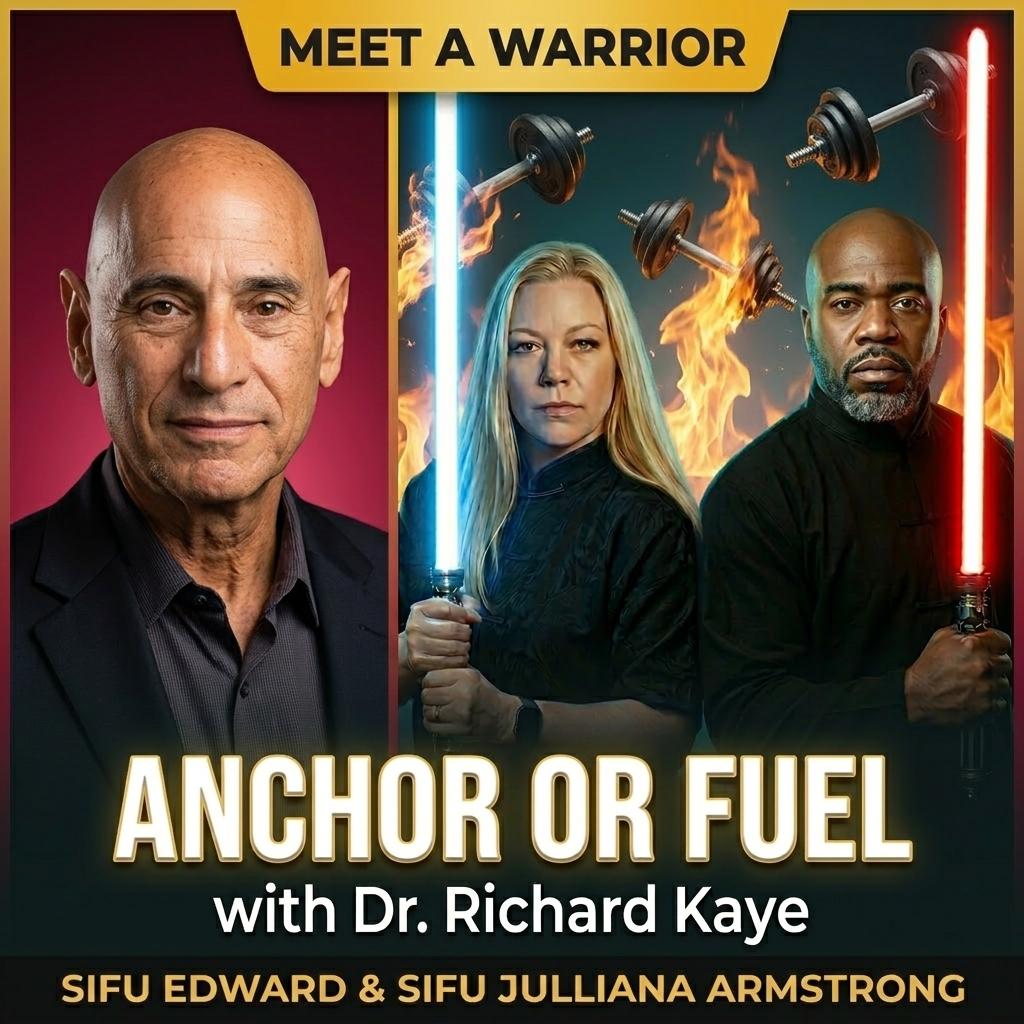
Adapted from the recorded conversation; the guest's words are verbatim. The questions are reconstructed and voiced by Sifu Edward and Sifu Julliana Armstrong.
🎥 Video podcast coming soon. The complete interview will play here once published. The full conversation is transcribed below, and the audio edition will be available on sifuarmstrong.tv.
In a new Sifu Armstrong interview, the former chiropractor turned mentor argues that trauma doesn’t determine a life. The choice of what to do with it does.
Dr. Richard Kaye closed a thriving 30-year chiropractic practice in three weeks after what he describes as a moment of meditation clarity, and spent the 25 years since mentoring entrepreneurs. He shared the decision-making behind that leap, and the philosophy that followed it, with Sifu Edward and Sifu Julliana Armstrong for the latest Warrior Intelligence Series conversation on sifuarmstrong.news.
“I heard, 'Shut your practice and work with entrepreneurs,'” Kaye said of the moment that redirected his career. “I kid you not. I looked around, there was nobody there.” Three weeks later the practice was closed for good.
Kaye, who says he’s unemployable by his own design, rejects the idea that success requires fitting inside conventional expectations. “There is no box,” he said. “That’s made up by people who want to control you.” Discipline, in his telling, isn’t imposed from outside. It’s self-generated, built around getting up and structuring a day around what needs to be accomplished rather than waiting for someone else’s instruction.
He built his own visibility the same deliberate way, using local television and newspaper features to stand out among 300 competing chiropractors in San Diego, until national media outlets started calling him directly. But the portion of the conversation that carried the most weight was about pain, his own and everyone else’s. Kaye has survived abuse, a violent assault, abandonment, divorce, and a car accident, and he’s direct about what determines the outcome of hardship like that. “We can use the drama and the trauma in our life in one of two ways,” he said. “One is an anchor that holds us down, or you can use it as fuel to move forward.”
Kaye also distinguishes between two ways of building anything new. An “internal” creator, he said, builds incrementally on what already exists. His example was Bill Gates moving from DOS to each successive version of Windows. An “external” creator, his own mode, sees the finished thing before it exists and works backward from there: “if I’m designing a webpage, I see it finished first, and then I do what has to be done to get there.”
He’s equally direct about learning from mentors without losing yourself in the process. “Don’t believe a thing I say... until you’ve lived it through your own experience”: advice he gives his own students, insisting that a lesson only becomes true once it’s tested against a person’s own life, not simply absorbed on faith.
Kaye also shared a story about thanking an easily overlooked cleaning woman at a conference, a small act of respect that led directly to a new business relationship, a reminder, he said, that “you never know how far-reaching something you say or do will be.” He tied it to the parable of a boy throwing stranded starfish back into the ocean, telling a skeptic who says it can’t matter: “Made a difference to that one.”
It’s a philosophy that sits at the center of everything the Armstrongs teach: the wound is either the anchor that drowns you or the fuel that forges you, and which one it becomes is always a choice.
In This Conversation
- The meditation moment that ended a 30-year chiropractic career in three weeks
- “There is no box”: Kaye’s case against self-imposed limits
- Building visibility from zero among 300 competitors through publicity
- Anchor or fuel: the choice Kaye says determines what trauma becomes
- Learning from mentors without becoming a copy of them
- The cleaning woman, the starfish story, and the value of the one person in front of you
The Full Conversation
Sifu Edward Armstrong: Of all the conversations in this series, this may be the one that lands closest to the heart of everything we do. Dr. Richard Kaye walked away from a thriving 30-year chiropractic practice because he heard a calling, and he's spent 25 years since then helping others build and be seen. And he handed us the single sentence that our whole federation is built on: your trauma is either an anchor that holds you down, or it's fuel that moves you forward, and which one it becomes is a choice.
Sifu Julliana Armstrong: And he understands the master-and-student bond better than almost anyone we've spoken to. He studied with legends and learned from all of them without ever trying to become any of them. "Don't believe a thing I say," he tells his own students, "until you've lived it through your own experience. Then it's your truth." That is the sacred relationship at the center of the Sifu tradition, and I could not imagine a better guest to close with.
Our guest is Dr. Richard Kaye, entrepreneur, publicity expert, and mentor to entrepreneurs across the world. Richard, it's an honour.
Dr. Richard Kaye: Thanks for the opportunity to show up and serve your audience.
Sifu Julliana Armstrong: Take us to the moment everything changed, because it came as a calling.
Dr. Richard Kaye: I was a chiropractor with a very thriving practice, and I was working part-time with a business growth company: at the time the largest in the world; we launched Chicken Soup for the Soul, we launched Lisa Nichols, people raised billions. And I was meditating one day, and I heard, "Shut your practice and work with entrepreneurs." I kid you not. I looked around, there was nobody there. The condensed version: three weeks later, I shut down 30 years of chiropractic, took a year off, and I've been serving entrepreneurs for about 25 years since.
Sifu Julliana Armstrong: Thirty years of a life you'd built, closed in three weeks, because you heard a call and you answered it. Most people hear that voice (the one that says there's a bigger version of your life waiting), and they spend decades explaining to themselves why they can't move toward it. You heard it and you obeyed it, fast, before fear could talk you out of it. That willingness to walk away from the safe, successful thing when a deeper purpose calls is one of the bravest acts there is. The calling is worthless if you won't answer it.
Sifu Edward Armstrong: You describe yourself as unemployable, and you have a fierce thing to say about the "box." Tell our operators.
Dr. Richard Kaye: As an entrepreneur, I said, I'm not employable, no one's going to hire me, which is a good thing. People say color within the box. No, there is no box. That's made up by people who want to control you. And when people ask how I discipline myself with no boss: what's discipline? I get up when I'm done sleeping, and I structure my day so I accomplish what I want. When I was an electronics engineer, I had a boss who'd come by, see the production line running itself, and hand me another one. So someone's always going to tell you what to do, let it be yourself. Successful entrepreneurs are self-motivated; we're not interested in someone telling us what to do, we're interested in what has to be done to achieve an outcome.
Sifu Edward Armstrong: "There is no box. It's made up by people who want to control you." That is a warrior's declaration, and it's why I left a franchise to build this federation. The box, the rules, the "this is how it's done," so much of it exists not because it's true but because it keeps you manageable, predictable, small. And "someone's always going to tell you what to do, so let it be yourself." That's the whole of self-mastery. The person who won't command themselves will always end up commanded by someone else. Rule yourself, or be ruled.
Sifu Edward Armstrong: You built your name through publicity, and you see the world as a creator. Walk us through both.
Dr. Richard Kaye: When I started my practice, there were 300 chiropractors in San Diego. How do you grow in a crowded field like that? Publicity. I got invited onto a morning TV talk show, turned that into a monthly spot, got featured in the San Diego newspaper, then the LA Times, and then the key moment: a producer from ABC News called and asked, in essence, "Who are you? We keep seeing and hearing your name around town." Now I had a news segment. Then PBS called the same way. Publicity gets your name out to the world. And the way I create, there are internals and externals. An internal, like Bill Gates, builds on the past: DOS, then Windows, then the next version. An external, like Steve Jobs, goes out and sees something that doesn't exist yet, sells it before it's built, then hires the engineers to create it. I'm an external, if I'm designing a webpage, I see it finished first, and then I do what has to be done to get there.
Sifu Edward Armstrong: "I see it finished first, then do what has to be done to get there." That is how every great thing gets built, on the mat and off it. You hold the completed vision so vividly that it becomes a magnet, pulling the work toward it. We saw the Sifu Armstrong federation whole before a single piece of it existed. The vision comes first, fully formed, and then reality is just the process of catching up to what you already clearly see. And publicity (being known, being sought) is not vanity; in a field of 300, it's how the right people find the master worth finding.
Sifu Edward Armstrong: You surround yourself with giants. Why does that matter so much?
Dr. Richard Kaye: My wife Angela is a creative. She writes children's books designed so kids fall in love with themselves, because if you love yourself, you don't go shoot up a school. She's my biggest supporter. And I've worked with David Fagan, who ran Guerrilla Marketing. He's clear that he didn't sell those 26 million books, the company did. And Berny Dohrmann, the founder of CEO Space, was my closest friend and most significant mentor before he passed. I've been blessed to be surrounded by leaders. In the US there's an expression: if you've got the biggest house on the block, you're on the wrong block. Same in business, if you're the smartest one in the room, find a different room. Find people who are smarter, wiser, more experienced than you.
Sifu Edward Armstrong: "If you're the smartest one in the room, find a different room." That's the whole philosophy of a training circle, and it's why the greatest fighters seek out the rooms where they get humbled. Comfort is being the best in the room; growth is being the worst, surrounded by people who force you to rise. The ego wants to be the biggest house on the block. The warrior deliberately moves to the block where they're the smallest, because that's where you become more.
Sifu Julliana Armstrong: Now the heart of it for me, how you learn from a master without losing yourself. Give our warriors the lessons.
Dr. Richard Kaye: Shut up and listen. Be the sponge, absorb things, but do not give your power away. I tell people from the stage: don't believe a thing I say when it comes to growing business. Because then whose truth is it? It's mine. Until you take it in, massage it through your own experience, and live it, then it can be your truth, then you can own it. So be the sponge, filter it, have no judgment on it, because you don't know what someone went through to develop that experience. Try it on, if it works for you, it's brilliant; if it doesn't, so what. We've all got different gifts. And for God's sake, don't try to be like any of them. You're put on this planet to be you, if you become just like somebody else, one of you is not necessary. And don't put them on pedestals. Treat them as human beings, and they'll respect you more and share much more.
Sifu Julliana Armstrong: Richard, that is the truest description of the master-student bond I've ever heard, and it resolves the paradox at the center of the Sifu tradition. You must study a master with total humility (shut up, listen, be the sponge), and yet you must never surrender your power, never try to become a copy of them, because a copy is worth nothing; one of them already exists. The teaching isn't yours until you've bled it through your own body and made it your own. That's why a real Sifu doesn't want clones. We want warriors who absorb the transmission and then express it in a voice that is unmistakably theirs. Learn everything from the master. Become no one but yourself.
Sifu Edward Armstrong: You've faced real collapse. How do you find the door when the one you knew slams shut?
Dr. Richard Kaye: I was vice president of CEO Space, and the founder (who was in essence the organisation, his brilliance, his connections), died. Suddenly my main channel for serving entrepreneurs no longer existed. Is that unique? No. It happens to everyone. Laid off, fired, the company folds. After you get through the "oh no" moment, you regroup. And a year or so later, David Fagan called me and said, "What are you doing with the rest of your life?" and flew my wife and me to Phoenix ("let's work together." When one door closes, another opens; but take it larger), when one door opens, another hundred close and another hundred open. And get out of judgment about right and wrong, because you have no clue. The Talmud tells us we don't see the world as it is: we see it as we are. Everything is through our own lens. So what do you want to focus on?
Sifu Edward Armstrong: "We don't see the world as it is; we see it as we are." That's the deepest truth about the mind, and it's why two warriors can face the same defeat and one is destroyed while the other is forged. The event is neutral; the lens is everything. When the door you built your life around slams shut (and for me it was a franchise and a betrayal), the temptation is to stand there staring at the closed door forever. The discipline is to turn around and see the hundred that just opened. Same reality, different lens, entirely different life.
Sifu Julliana Armstrong: And this is the sentence our whole world is built on. You've survived real darkness, and you say it's a choice what you do with it.
Dr. Richard Kaye: We all have this stuff. You can choose to be a victim. I was abused, I was raped, I was abandoned, I was divorced, I was in a car accident. Does that fuel you, or does it hold you down? We can use the drama and the trauma in our life in one of two ways: one is an anchor that holds us down, or you can use it as fuel to move forward. Lisa Nichols (I knew her before she was famous), her history is horrible. Same with Oprah, abused, violently beaten, and look what she's done, turned it into gifts that changed millions of lives. There's a cartoon: a reporter asks a bum on the street how he got there. "My father was an alcoholic, so I followed in his footsteps." Then he asks a wealthy man in his big office the same thing: "my father was an alcoholic, so I decided I wasn't going to be like him." You've got choices. Step out of victim mode. It doesn't serve you, and frankly it bores the hell out of everyone you tell it to.
Sifu Julliana Armstrong: Richard, thank you for your courage in naming what you survived, because it gives your words their weight. "Anchor or fuel" is the single truth this entire federation is built on. The exact same wound will drown one person and forge another, and the only variable is the choice. Two people, the same alcoholic father. One becomes him, one refuses to. Your past hands you the raw material; you decide whether it becomes the thing that sinks you or the fire that drives you. We have seen broken people walk onto the mat and become unrecognizable, not because the pain went away, but because they finally chose to burn it as fuel. That choice is available to every single person reading this, right now.
Sifu Julliana Armstrong: And what you do with all of it comes down to service. Tell the cleaning-lady story.
Dr. Richard Kaye: I don't believe in accidents. I believe in on-purposes. My chiropractic was never about headaches and back pain; it was about improving the quality of people's lives, and you never know the impact you have just by saying hello. Years ago at a conference, I passed a bedraggled little old lady with a carpet sweeper, and I just said, "Thank you for keeping this place looking so nice." You'd think she'd won the lottery. She lit up, because people like that are invisible to most. Then I hear footsteps hustling up behind me, and a man says, "Who are you? I saw and heard what you said to that lady", and that led to him wanting to do business with me. Show up and serve people. The housekeepers, the security guards. They're invisible, and people only talk to those who can help them. Don't be a user or a taker. There's the starfish story too: a boy throwing stranded starfish back into the sea, and a man says "you can't make a difference, there are thousands." The boy throws another and says, "Made a difference to that one." All it takes is one person. You never know how far-reaching something you say or do will be.
Sifu Julliana Armstrong: "Made a difference to that one." That is why we do this, not for the thousands, but for the one warrior in front of us, and then the next one. And thanking the invisible woman with the carpet sweeper, expecting nothing, is the truest test of a person's character, how you treat the people who can do nothing for you. That you served her freely, and it came back to you a hundredfold, is exactly how the universe rewards a genuine servant's heart. Serve because it's who you are, not because of what it returns, and watch what returns anyway.
Sifu Edward Armstrong: Richard, this feels like the right note to build toward. What's ahead, and where do people find you?
Dr. Richard Kaye: My wife and I are embarking on new adventures: a free virtual event, the Trailblazer Event, at trailblazerevent.com, with some of the top mentors on the planet: Lisa Nichols, Mark Victor Hansen, John Gray, Denis Waitley, John Demartini, Michael Gerber. And they're not getting paid to speak, because when you reach what some call a pinnacle, the only thing left to do is serve, to give back. As Zig Ziglar said, you can have anything you want if you just help enough other people get what they want. This isn't a sales event. They're just there to serve, so you can up-level and give more of your gifts to the world. You can reach me at talkaboutpublicity.com, and there's a free gift, "10 Ways to Leverage Your Publicity," at richardkaye.com/leverage.
Sifu Edward Armstrong: Richard, thank you, for the wisdom, and for the reminder of why any of this matters.
Dr. Richard Kaye: Thank you for the opportunity to serve.
Sifu Julliana's closing word: Richard closed this series the way it should be closed, on the master-student bond and the choice at the center of every warrior's life. Learn everything from the master, and become no one but yourself, because a copy is worth nothing. And your trauma is raw material, nothing more: the same wound drowns one person and forges another, and the only difference is the choice to burn it as fuel. Serve the one in front of you, thank the invisible, and never surrender your power. That's the whole path.
Sifu Edward's closing word: There is no better conversation to build toward, because Richard named the thing this entire federation exists for. The wound is either the anchor that drowns you or the fuel that forges you, and which one it becomes is a choice, available to every person reading this, right now. Answer the calling. Refuse the box others built to control you. Find the room where you're the smallest. And when you reach anything worth calling a pinnacle, understand that the only thing left to do is serve, to reach down and pull the next one up. That is why we don't entertain warriors. We create them.
Dr. Richard Kaye, former chiropractor and electronics engineer turned entrepreneur, publicity expert, and mentor; recipient of the White House Presidential Lifetime Achievement Award. talkaboutpublicity.com · richardkaye.com. Free virtual Trailblazer Event at trailblazerevent.com.
ILLUSTRATIVE RESULTS. Any revenue, enrollment, margin or retention figure in this conversation is either a documented result from one of our own operations, a figure the guest reports about their own business, or an illustrative example, never a projection of your results.
Nothing here is financial, legal or tax advice.
Stay in the Fight
This conversation is part of the Sifu Armstrong Warrior Intelligence Series: interviews with world-class performers, builders, and thinkers, filtered through the lens of the warrior's path.
Subscribe at sifuarmstrong.news for every new interview, delivered to you.
Join Club Sabernet, the member community of the whole Sifu Armstrong ecosystem, where warriors train, connect, and hold each other to the standard.
Ready to build your own floor? Find your path at sifuarmstrong.com/which-path.