An Eight-Year-Old Showed Me: Sifu Edward & Sifu Julliana Armstrong Sit Down With Greg Cesar
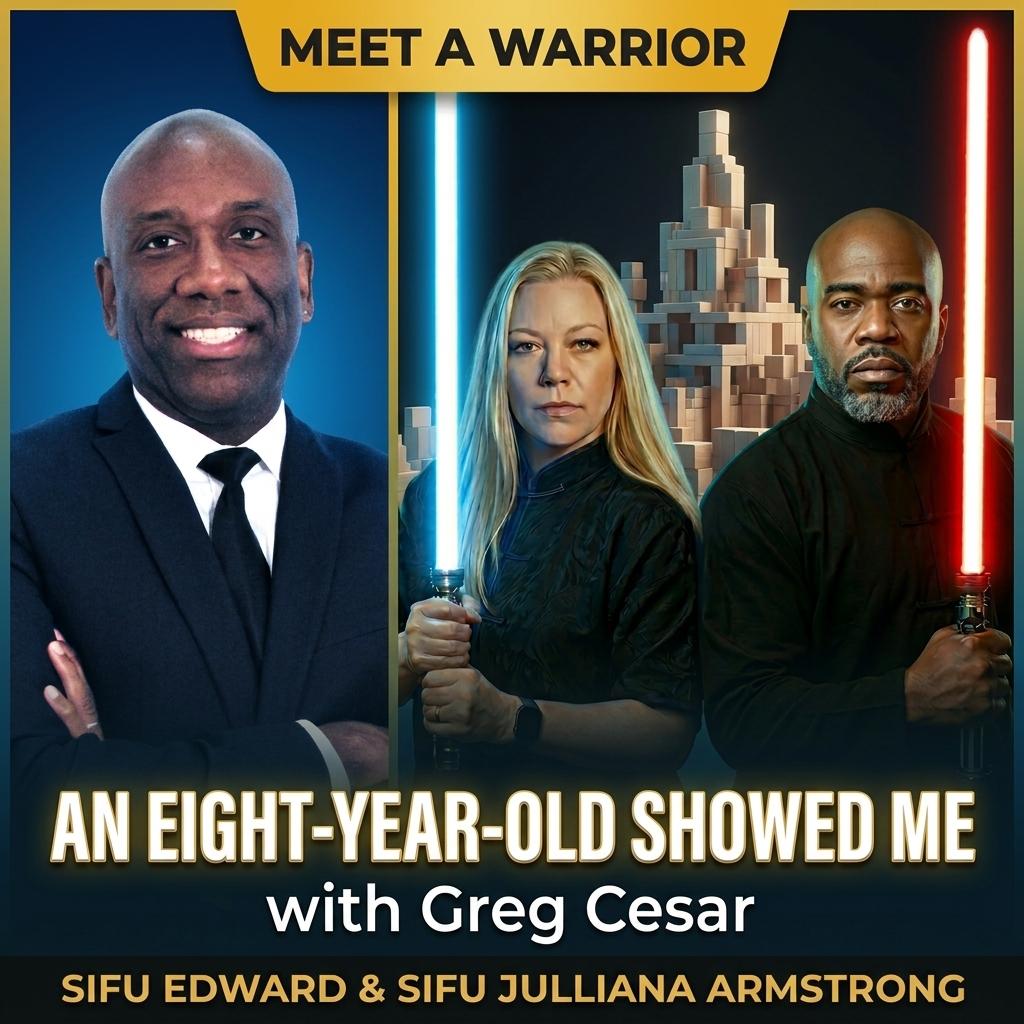
Adapted from the recorded conversation; the guest's words are verbatim. The questions are reconstructed and voiced by Sifu Edward and Sifu Julliana Armstrong.
🎥 Video podcast coming soon. The complete interview will play here once published. The full conversation is transcribed below, and the audio edition will be available on sifuarmstrong.tv.
In a new Sifu Armstrong interview, the Amazon FBA veteran argues that format, not content, is what actually sets your price, and that no market is too unfamiliar to dominate.
Greg Cesar has built a business selling content on Amazon in niches he has never set foot in: including, by his own account, a musical instrument he has never played. He joined Sifu Edward and Sifu Julliana Armstrong for the latest Warrior Intelligence Series conversation to explain why that isn’t as strange as it sounds.
Cesar (an Amazon FBA and niche-market expert with 170,000-plus customers over the years) traces his whole approach back to a single humbling moment at a barbecue, watching an eight-year-old outsell him online. “God dang it, if an eight-year-old is kicking my butt on Amazon, what do I have to be afraid of?” he remembers thinking. The lesson stuck, and it shaped how he now treats expertise itself: “There’s no shame in the game. Whoever has the knowledge, I’m going to take it. Age doesn’t matter. Whoever’s doing it successfully is who you want to learn from.”
That willingness to learn from anyone (a child, a teenager, a stranger with a license to sell) is how Cesar breaks into markets he knows nothing about. Rather than building expertise from scratch, he licenses it, buys PLR (private label rights), or simply finds the person already doing it well and asks what it costs to work with them.
But the insight that struck the Armstrongs hardest wasn’t about sourcing content. It was about pricing it. Cesar’s central claim is that the exact same words, unchanged, are worth wildly different amounts depending on how they’re packaged. “The medium your content comes in. That’s what determines your price,” he said. A written guide might sell for a few dollars; turned into audio, video, or a modular course with the same untouched content, the price climbs tenfold, even though, in his words, “you haven’t changed one word of the content.”
Underneath all of it sits what Cesar calls the biggest epiphany of his career: the gap between a product earning $100 a month and one earning a million isn’t extra effort. It’s audience size. “The difference between a product that makes $100 a month and a product that makes a million dollars a month is demand,” he said. Find the hungry market, he argues, and the work required is identical.
Cesar is equally unbothered by polish. Calling himself “One-Take Greg,” he records with no editing, ums and uhs intact, on the theory that customers care about results, not production value, and he hires outsourced talent on trust rather than reviewing every project, believing “someone who does good work doesn’t know how to do bad work.” On the practical side of running an Amazon business, he advises starting small on inventory too: sending a handful of units first, then scaling up only once sales prove the product, so a seller never runs out of stock and loses their ranking.
Cesar’s advice to anyone still circling the idea of starting is blunt: start small, expect nothing to be perfect, and let the fear shrink once the stakes do. It’s a message that lands cleanly alongside the discipline the Armstrongs teach on the mat: that mastery isn’t reserved for the already-credentialed, and that the willingness to keep learning, from anyone, at any age, is what actually separates people who build something from people who don’t.
In This Conversation
- The eight-year-old on Amazon who changed Cesar’s whole mindset
- “No shame in the game,” learning from a sixteen-year-old, too
- Licensing and PLR: dominating niches you know nothing about
- The packaging insight: same words, ten times the price across formats
- “One-Take Greg”: why polish matters less than solving the problem
- The epiphany that demand, not effort, separates $100 from a million
The Full Conversation
Sifu Edward Armstrong: Greg Cesar sells content on Amazon and dominates niches he knows nothing about, including a musical instrument he's never even held. His deepest lesson for our operators is about packaging: the exact same content, in a different format, sells for ten times the price. Nothing changes but the presentation, and everything changes about the value.
Sifu Julliana Armstrong: And the thing I love most is his humility. This is a man with 170,000 customers who got started because an eight-year-old was outselling him on Amazon, and instead of feeling threatened, he said, "If an eight-year-old can do it, what am I afraid of?" He learned newspaper advertising from a sixteen-year-old. "No shame in the game," he says. The master who can still learn from a child is the one who never stops growing. I couldn't wait.
Our guest is Greg Cesar, Amazon FBA and niche-market expert, author, and international trainer. Greg, welcome.
Greg Cesar: Thank you for having me.
Sifu Edward Armstrong: Take us to the beginning, because you found out something about yourself early.
Greg Cesar: I graduated college and got a corporate job, aiming to climb the ladder and become president of a company. And one day a boss told me, "When I tell you to do something, you do it." I instantly realised I was unemployable. There's just no way I could work for someone who'd tell me that. So in '97 or '98, I bought a work-at-home product from television, and when I quit my job I said, "Let's start this internet thing everybody keeps talking about." I began consulting local businesses on marketing online, and they all thought I was crazy, one guy told me, "This internet thing is not going to be any good until the year 2050." Back then, if you wanted to rank number one on Yahoo, you just put a letter or number in front of your domain. I got good at selling content and information online (170,000 customers over the years), and it turned out that what I'd thought was impossible was actually the easiest thing, once I learned how to do it.
Sifu Edward Armstrong: "When I tell you to do something, you do it," and you instantly knew you were unemployable. I know that feeling in my bones. Some people are built to be commanded, and some are built to build, and the moment a true builder hears that line, something in them says never again. That's not arrogance. It's the recognition that you're meant to own the ground you stand on, not rent it from someone who'll revoke it. It's the same refusal that started this federation.
Sifu Julliana Armstrong: The eight-year-old story is my favorite thing you've said. Tell it.
Greg Cesar: Around 2014 everyone was talking about Amazon FBA, and I hesitated, because the model everyone pushed meant ordering a thousand blenders for twenty grand before you knew anything would work. What actually motivated me to try: I went to a barbecue, and a friend showed up and said, "You won't believe it, my daughter's making $38 a day on Amazon." And she was eight years old. I said to myself, "God dang it, if an eight-year-old is kicking my butt on Amazon, what do I have to be afraid of?" So I took one of my courses, turned it into audio on a CD (a physical product so I could charge $50, $90 instead of Kindle's few dollars), and made $9 the first day, $3,000 a month within two months. And it's the second opportunity a kid gave me. I once saw a sixteen-year-old succeeding with newspaper ads, so who did I call? The sixteen-year-old. There's no shame in the game. Whoever has the knowledge, I'm going to take it. Age doesn't matter. Whoever's doing it successfully is who you want to learn from.
Sifu Julliana Armstrong: "No shame in the game, whoever has the knowledge, age doesn't matter." That is one of the most powerful things a person can live by, and it's the rarest. Ego whispers that learning from a child, or a beginner, or someone younger and less credentialed, is beneath you, and ego is how people stop growing the day they get good. The real master stays a student forever, and will kneel to learn from an eight-year-old if the eight-year-old knows something they don't. The moment you become unteachable, you've stopped being a master, no matter what your rank says.
Sifu Edward Armstrong: You dominate niches you know nothing about. How, and what's the content play?
Greg Cesar: Because we sell content and information, 99% of the barriers are gone. The only thing that can hold you back is your own laziness. I have a product in a market I know nothing about, a musical instrument I don't even play. So I found someone really good at it who already sold courses, and asked, "What would you charge me for a license to sell your product?" I figured this five-star product with thousands of reviews would cost me, and he said, "Send me $500 and it's yours." I PayPaled it faster than you can blink. I changed the name, put a different instructor name, made my own graphics, and started selling. That's on the expensive side: usually I get things for $90, $100, or PLR (private label rights) for as little as $10. There was a $9 PLR product I reverse-engineered as doing almost a million dollars in sales on Amazon. So when the PLR was no longer available, I just posted, "I need someone to create content in this space." The idea is the hard part; the content, I can always fix or outsource. I finally figured out I could take myself out of the equation entirely.
Sifu Edward Armstrong: And the packaging insight, media determines price. Break it down.
Greg Cesar: The medium your content comes in. That's what determines your price. Take a product and don't change a single word: on Kindle I might get $3 or $4. Record it as audio on a CD (same words read into a microphone), and it sells for $27 to $40. Turn it into video, $60 or $70. Break the chapters into individual modules with a graphic showing nine little modules so it looks huge, and now it's a $100 product, yet you haven't changed one word of the content. The media changes what you can sell it for. A physical book by itself maxes out at 10 or 12 bucks; you're not getting 60 for a book. So the format is everything.
Sifu Edward Armstrong: "Not one word changed (only the format), and the price goes up tenfold." That is the most important lesson in positioning our operators will ever hear. The same core knowledge, presented as a cheap download or as a premium, structured, beautifully-packaged program, is worth ten times more in the second frame, and it's the same knowledge. This is exactly why the nine Forms delivered as a discount class and the nine Forms delivered as a Sifu Armstrong academy experience are worlds apart in value. Never sell your mastery in the cheapest possible wrapper. How you present the transformation is part of the transformation.
Sifu Julliana Armstrong: You call yourself "One-Take Greg," no editing, ums and all. There's a philosophy in that.
Greg Cesar: When I outsource, students ask, "How do you know it's any good? Do you read it?" And I say, I never look at it. If I create a course teaching Portuguese, how would I know the person on the audio is even speaking Portuguese? So instead I hire right. I hire people with good reviews, because my belief is that someone who does good work doesn't know how to do bad work. And I don't edit, there are ums and uhs in my recordings, and people don't care. What people care about is the solution. Are you solving their problem? If you sold the cure to cancer and someone with stage-four cancer bought it, they're never going to say, "You've got ums in there and recorded this on an old iPhone, I want my money back." The solution to their problem is way more important. So look for people with big problems. They don't care how you made it, they care: can you fix my back pain? Can you help me lose weight for my wedding day? That's what matters.
Sifu Julliana Armstrong: "People care about the solution, not the ums." That frees so many people from the perfectionism that keeps them from ever shipping anything. The person in real pain doesn't want a flawless production. They want to be helped. A student drowning doesn't critique your swimming form while you pull them out. And "someone who does good work doesn't know how to do bad work." That's how you trust: you don't inspect every rep, you choose people of proven character and let them be who they are. Serve the outcome, not your own vanity about the polish.
Sifu Julliana Armstrong: Your number-one tip is one word. And it comes with a confession about fear.
Greg Cesar: My thing is: start. Don't be afraid of "can I do this, is this hard?" It's not. People say, "that's because you're a guru", no. When I started on Amazon I was terrified. I sat on it for a year before I did anything. It took that eight-year-old to show me I could do it. I was completely green, didn't know what I was doing, but I got started, and that was the only difference between succeeding and not. Don't worry if it's perfect; there's no such thing. Start small, with five products, sub-$100 to get going, because if it only cost you fifty bucks, there's no fear. Who cares if you get it right? That lets you just do it. And then you say, "Wow, it's easy."
Sifu Julliana Armstrong: "I sat on it for a year, terrified, until an eight-year-old showed me." A guru with 170,000 customers, frozen by fear for a full year. Let every beginner hear that. The people you admire were paralyzed too; they just eventually started. And the trick of starting small to kill the fear is pure wisdom: you lower the stakes until stepping onto the mat feels survivable, and once you've moved, the fear evaporates and you discover it was never as big as it looked. Start so small it isn't scary. Then start.
Sifu Edward Armstrong: Leave our operators with the mindset shift that changed everything for you, and where do people find you?
Greg Cesar: The biggest epiphany of my life: the difference between a product that makes $100 a month and one that makes a million dollars a month is demand. That's it. What you do to make a million is exactly what you did to make a hundred bucks, one market has 50 people searching, the other has a million. Most people think making a million requires some grandiose amount of extra work. No. I realised I didn't need to spend a hundred thousand hours on products. I needed to find the products that were already selling. And on inventory: start by sending Amazon five units, snowball up as you sell, and once you're moving volume, keep a cushion so you never run out and lose your ranking. You can find everything at gregcesar.com.
Sifu Edward Armstrong: "The difference between $100 and a million is demand, not effort." Go where the hunger already is. Greg, this has been genuinely valuable. Thank you.
Greg Cesar: My pleasure. I enjoyed it.
Sifu Julliana's closing word: Greg got started because an eight-year-old outsold him, and he learned from a sixteen-year-old too, because he refuses to let ego make him unteachable. The master who is too proud to learn from a child has stopped being a master, the moment you can't be taught, you've stopped growing. And a guru sat frozen in fear for a full year until a kid showed him it was possible. Start so small it isn't scary. Then start.
Sifu Edward's closing word: Greg hands our operators two positioning truths. The same content in a premium wrapper is worth ten times the cheap one, so never sell your mastery in the flimsiest package, because how you present the transformation is part of the transformation. And the difference between small and enormous is demand, not effort. Serve where the hunger already lives. Refuse to be commanded, stay teachable by anyone, package your value like it's worth what it is, and go where you're already needed. We don't entertain warriors. We create them.
Greg Cesar, Amazon FBA and niche-market expert, author of "Selling Info Products Through Amazon FBA," and international trainer with 170,000+ customers. gregcesar.com.
ILLUSTRATIVE RESULTS. Any revenue, enrollment, margin or retention figure in this conversation is either a documented result from one of our own operations, a figure the guest reports about their own business, or an illustrative example, never a projection of your results.
Nothing here is financial, legal or tax advice.
Stay in the Fight
This conversation is part of the Sifu Armstrong Warrior Intelligence Series: interviews with world-class performers, builders, and thinkers, filtered through the lens of the warrior's path.
Subscribe at sifuarmstrong.news for every new interview, delivered to you.
Join Club Sabernet, the member community of the whole Sifu Armstrong ecosystem, where warriors train, connect, and hold each other to the standard.
Ready to build your own floor? Find your path at sifuarmstrong.com/which-path.