AI Can't Touch Community: Sifu Edward & Sifu Julliana Armstrong Sit Down With Christina Rowe
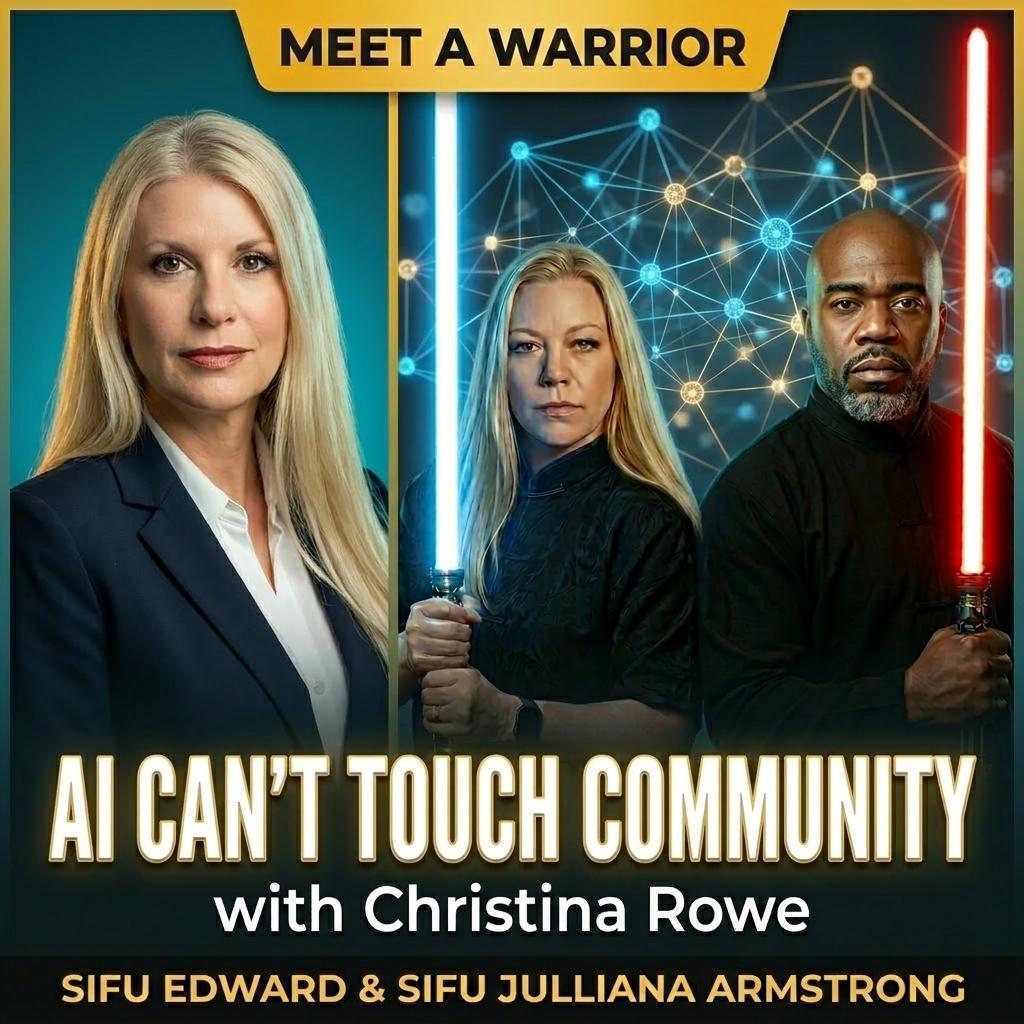
Adapted from the recorded conversation; the guest's words are verbatim. The questions are reconstructed and voiced by Sifu Edward and Sifu Julliana Armstrong.
🎥 Video podcast coming soon. The complete interview will play here once published. The full conversation is transcribed below, and the audio edition will be available on sifuarmstrong.tv.
In a new Sifu Armstrong interview, the founder of Women Helping Women Entrepreneurs argues that as automation floods every feed, a real room of real people becomes the one asset no algorithm can replicate.
Christina Rowe built one of the largest women’s entrepreneur communities online (closing in on two million members across Women Helping Women Entrepreneurs and its affiliated groups), and in her conversation with Sifu Edward and Sifu Julliana Armstrong for the Warrior Intelligence Series, she makes an argument that cuts against most of the current AI hype: the more automated the internet gets, the more valuable a real community becomes.
Rowe’s path there started with a hair and nail salon in New Jersey, a divorce, and a self-published book about it in 2006, a decision that pulled her, almost by accident, into online marketing and coaching. After moving to South Florida, she and a group of women started a live-event organization that evolved, by 2016, into Women Helping Women Entrepreneurs. The Facebook group grew fast enough that Facebook itself took notice, featuring Rowe’s community in its own ads and inviting her to the Facebook Community Summit in 2019.
The foundation of that growth, she told the Armstrongs, is a refusal to think in terms of competitors. “When you think in those terms, you really don’t have any competitors, because someone is for everyone,” she said, describing how she’s partnered with (rather than competed against) women who built similar-sized communities of their own, combining memberships and running joint summits. It’s an abundance mindset she credits with everything that followed, including her Stand Out Online membership, which lets entrepreneurs “borrow” her audience to promote their own businesses through approved posts, podcast spotlights, and an AI-matched collaboration tool called Match and Monetize.
Rowe is emphatic that none of this works as a broadcast channel. “A community is a place where you’re inviting people to your house, you’re having that relationship,” she said, which is why she spends more time in the comments than posting herself. “It’s more important to be in the comments than posting,” she told the Armstrongs, arguing that too many online marketers set their groups up as a one-way guru-to-student channel instead of an actual gathering.
That emphasis on real human contact is the spine of her sharpest claim: that community is the one thing AI genuinely cannot replace. “AI cannot touch communities,” she said. “They’re going to want to be in communities. They’re not going to want to be talking to robots all the time.” As automation and what she calls a “trust recession” make people more wary of anonymous online offers, she believes real, in-person-feeling connection (not more content, not slicker funnels) will be the deciding factor in who earns a stranger’s business.
She also pressed on the unglamorous mechanics of visibility: an optimized profile and banner on every platform, credibility built through local media rather than vanity press logos, and a still-useful role for a self-published book as, in her words, a business card. None of it, she stressed, substitutes for showing up consistently and doing the actual work of being in the room.
For the Armstrongs, Rowe’s argument lands close to home. You cannot download a training partner, and you cannot automate the moment a teacher corrects a student by hand, the value of a real room, in either world, only rises as everything else gets automated.
In This Conversation
- How a self-published divorce memoir in 2006 led Rowe into online marketing and coaching
- Building Women Helping Women Entrepreneurs from a local live-event group into a nearly two-million-member network
- Why “someone is for everyone” makes collaboration, not competition, the smarter long game
- The Stand Out Online model of letting members “borrow” Rowe’s audience
- Why community, in her view, is the one thing AI cannot replicate
- The unglamorous branding basics: optimized profiles, local media, a book as a business card
The Full Conversation
Sifu Edward Armstrong: Everything we've built rests on one truth: a warrior alone is fragile, but a warrior in a tribe is unstoppable. Club Sabernet isn't a mailing list to us. It's a home. So when I found a woman who has gathered nearly two million people into a single thriving community, built on collaboration instead of competition, I knew she could teach our operators how a movement actually scales.
Sifu Julliana Armstrong: And the line of hers that stopped me cold is that AI cannot touch a real community, that as the world gets more automated, people will hunger to be in a room with other humans. There is no more human room on earth than a training floor. What she's proven online is the same thing we prove on the mat every single night: people don't want to talk to robots, they want to belong.
Our guest is Christina Rowe, founder of Stand Out! Media Group and the powerhouse behind Women Helping Women Entrepreneurs, a global community of nearly two million members. Christina, it's lovely to meet you.
Christina Rowe: It is so wonderful to meet you.
Sifu Edward Armstrong: My own movement was born out of a hard ending. I walked away from a franchise and rebuilt from nothing. I understand you turned a painful chapter into a beginning too. Share your journey into entrepreneurship and what led to Stand Out! Media Group.
Christina Rowe: Okay, so it's interesting. I used to have a hair and nail salon back, gosh, in my other life I call it, back in New Jersey with my ex-husband. And so, that was the beginning of being an entrepreneur. And then when I got divorced, we sold the salon and I had such a horrendous divorce, I decided to write a book about it. And then this was 2006, so I made a decision to self-publish, which led me to online marketing. And then other people started asking me, "Well, how did you do that?" Because that's back in the beginning when everybody was just getting started with all of the internet stuff where there was no click funnels. We were using front page back then, it's like the dark ages.
And that started me helping other authors and starting to coach them. But it was when I moved to South Florida and I met some other women and we started a women's organisation. And we started doing live events and helping women, which then evolved into me starting Women Helping Women Entrepreneurs. That was 2016. And the communities on Facebook, just started growing like crazy. Facebook took notice of it. We were one of the Facebook commercials that they had. They were playing them all over and on the radio and TV. I got invited to Facebook itself, to the Facebook Community Summit in 2019, which was amazing.
So the community just kept growing and I decided to create a space for women to be able to promote their businesses by borrowing my audience, and that's the Stand Out Online Membership programme. So this way, they could grow their businesses from my platform and my audiences across social media. Time of right now, we have almost 900,000 in the group, but we have all the subgroups and maybe 1.23 million. So we're getting toward the 2 million mark.
Sifu Julliana Armstrong: Nearly two million, and built on "women helping women," collaboration over competition. That's the warrior code most people get backwards: they think the mat is about beating the person across from you, when really you rise by lifting your training partner. How does it feel to have gathered that many people, and why is collaboration the whole game for you?
Christina Rowe: It's amazing to have so many women. And the whole premise is women helping women. So we really want everyone to collaborate, not compete, because I'm a strong believer in that. And so, I've had women who've been with me for years and grown their Facebook communities to 200,000, 100,000, 50, 80,000, and they've taken my model of allowing women to pay to promote in their group and giving the benefits. And we've actually collaborated and done summits together.
So I don't believe in competition. I believe in let's collaborate and we've put our memberships together and sold it as a package. And so, I think if women and people in general start thinking like that about collaboration, you really don't have any competitors because someone is for everyone. So you're not going to resonate maybe with someone in business with someone else. So being in this industry and instead of thinking that there's people out there, well, that's my competitor and that's my competitor, to think more in terms of how you guys can collaborate.
When you have that mindset, you could be doing the same exact thing as someone. And before the group, I partnered with women and we were doing the same exact thing. And when I used to have clients, they, "Think I got too many clients, this person would be perfect for you," or, "I don't do this part of it, take this client," vice versa. So it's really powerful when you think in those terms. It's like thinking in abundance instead of scarcity.
Sifu Julliana Armstrong: "Someone is for everyone." That's exactly why we don't see other martial arts as enemies; there's a warrior for every art and an art for every warrior. Now, since you started, the tools have changed completely. For someone taking their first step today is it easier or harder, and how do they protect what they build?
Christina Rowe: Goodness, it is so much easier. So when I started, like I said, there was no click funnels. It was this thing called front page, which was we called the opt in page. The landing page was a squeeze page back then. And there was no Facebook ads back in 2006. So there was a lot of tech you had to learn to build things out. Now, especially with AI, it's so easy for people to start. It just compresses time. What may take you years back then, can now compress into months because you have all the tools, you have everything at your disposal to start a business. Literally Claude and ChatGPT and all these AI tools just do the work for you, if you know how to prompt them correctly. And back then, we didn't have any of that.
So definitely a great opportunity to get involved in entrepreneurship and online marketing. But I would say the key is, and I've been saying this now, is that you have to AI proof at the same time, your business. And how you can do that is by starting communities. Because AI cannot touch communities. It's going to get to the point and people, they're going to want to be in communities. They're not going to want to be talking to robots all the time. So as it invades us more and more, people are going to want to be in person. They're going to be online in feeling like they have that human connection.
So that plus your brand is going to be the most important thing because like I say too, we're in this trust recession right now. I say it's not 2020 anymore where everybody went crazy. COVID, everybody jumped online, people were buying like crazy. And now, people are more hesitant, a little jaded. There's some bad characters. So people just entering right now, starting out on online businesses, they're going to be like, "Well, gosh, how do I build trust?" And by starting a community, it's a great way to do that.
Sifu Edward Armstrong: "AI cannot touch communities."
Sifu Julliana Armstrong: That's the whole thing, isn't it? You cannot download a sparring partner. You cannot automate the moment a master corrects your stance with their own hands. The more the world drifts toward robots, the more precious a real room of real people becomes, and a dojo is the most human room there is.
Sifu Edward Armstrong: Which is exactly why we'll never be afraid of the technology. We use it to fill the room, never to replace it. Christina, a lot of people tell me that when they start online, they feel completely invisible. What's the first step to get noticed?
Christina Rowe: Well, it's the hugest problem. It's like crickets online. You're posting, you're in a sea of people with the reels and it's very hard to get noticed. And that's why one of the things I tell everybody and teach is to borrow other people's audiences. Russell Brunson talks about the Dream 100. So you should create a Dream 100 of Facebook groups, Skool groups, communities, and not to go in with the mindset, "Well, I'm going to go spam them all and try to sell them." It's to build the relationships and establish yourself as an expert and authority.
And how you can do that is simply, you got to spend the time. There's no quick, easy fix. And people think, "Oh, gosh, I'm just going to sit in my underwear on a beach or in a bikini and I'm going to be on the computer and make a million dollars." You have to put in the work. And so, if you spend half an hour a day answering questions in Facebook groups, just with your authority, people are going to notice that, they're going to reach out. I've had members of my own group who do this, and they make money just by being authentic.
Because it goes into the DMs, but they're not being sleazy. They're not cold DMing people. And everybody's just so turned off to that. So if you want visibility, it's a way to start, is to start getting involved in communities and start talking to people and start establishing yourself with your expertise.
Sifu Julliana Armstrong: You've built media groups, memberships, masterminds. With that many platforms, how do you decide where to put your own energy?
Christina Rowe: So I try to focus primarily with my members in my groups. And we also have a Skool community that is getting close to 10,000 right there in Skool now too. So I want to be able to spend time. I post, but it's more important to be in the comments than posting because people forget what a community is. And a lot of online marketers do this too. It's like they set these things up as a channel to teach a guru to student. And that's not what a community is.
A community is a place where you're inviting people to your house, you're having that relationship. It's like a gathering. So you want to be part of that gathering as the leader and encouraging the members to be posting, the members to be doing things. So from that, you're just starting out, you want to also get in there, get into communities, but start your own community as well.
Sifu Edward Armstrong: "It's more important to be in the comments than posting." That's the difference between a master who broadcasts from a pedestal and one who's down on the mat sweating alongside the students. We built Club Sabernet to be a gathering, not a lecture. Now, your Stand Out system is famous for getting members featured and noticed by borrowing your audience. Walk us through how that works.
Christina Rowe: Yeah. So I created that because when my group is starting to grow, and I was doing coaching at the time. It is back 2016, '17. And then I noticed, I'm like, I don't want to compete directly with my members, a lot of coaches. I'm like, how could I let them borrow my audience? So how that helps them is you can do posting in the group. You can go live. We have a directory blog post. You can borrow our podcast and submit podcast episodes that we put up. It's on Spotify and all the channels, and we do spotlights. We just started a new programme called Match and Monetize. So we have an AI software where you submit your information, your niche, what platforms you're on, what you're looking for, and it'll match you with other like-minded members.
And it'll send an email to each other and you can do email swaps, webinar swaps, Facebook group swaps, like shout each other out. It's basically to form those collaborations from inside the membership with other like-minded, so you guys are all collaborating together. So we've had members with tremendous success with posting in the group. And they're the only ones who can do promotional we call them, type posts where the other members... it goes through the queue, so they get pre-approval on the group. And the best use case of that in the group is to do lead-generating posts as opposed to trying to sell.
So giving high value free-lead magnets. Like, "I have templates that I made for this niche and who wants it?" Or driving people to your own Facebook group. We have people say, "Where are my Christian entrepreneurs, or where are my Muslim entrepreneurs? Where are my spiritual women? I have a community or we're going to do coffee chats." And people raise their hand in the comments, then you comment with the link to wherever you want to send them, whether it's a landing page or your Facebook group. And I suggest the Facebook group a lot because you can get the email on the three questions when they're coming into the group. And then you can send them the lead magnet of course, but now you have them in two places.
So now, you've got them in your group that if they're active, Facebook is going to show the group in the feed. It's one of the few things... Things have changed. Right now, all the platforms have turned to interest-based. So it doesn't matter how many followers you really have anymore, it's about are people interested? They're matching the interests, but they're still showing groups. So if they see that you've been in a group and you're active, you will start seeing posts from that group in your feed. And that's the goal, so you want to be top of mind. So now, if you just get the email, it goes to spam or they don't see it, or ignore it. But now you have two places where you can get that attention because we're all vying for attention in this culture, right?
Sifu Julliana Armstrong: That model (letting members borrow your audience to rise) is the same spirit as our Academy Commanders carrying the LSTA standard into their own towns. Let me ask about something close to my own world as the competitive face of this brand: how important is personal brand, and how important has it been in your journey?
Christina Rowe: Personal brand is crucial because anybody's going to do business with you, they're going to Google you, and if nothing comes up or if your Facebook profile has a picture of a flower or your dog and you don't have any... I can't tell you how many times you check someone out and it's not optimised. All of your social platforms should be branded, optimised with links where you want people to go, including, a lot of people don't know this, but when you're in Facebook groups, you have your own profile. It looks just like your real Facebook profile, but it's each group, you can edit it and you can completely change it for each group with different call to actions.
So I tell people, make a banner. In my group, I have a separate banner for the group profile that leads to my Skool community. It says, "Click on the image," because that opens up on Facebook where you can put the link. So I use that in that way.
But for branding, I would say credibility that we're in, like I said, the trust recession. You need to have that instant credibility being on the media, getting logos. And I'm not talking about the logos that everybody gets like MSN. I'm talking about go to your local media. It's very easy to get in local media. It's just people always perceive celebrity or media as better or credible. It's just our culture, especially in the United States. So you want to make sure you're on podcasts, that you have the logos up there. That you're doing that, so people feel comfortable giving you money, that you're reputable.
So if you're ignoring your brand, get professional photos, start going on podcasts. Try getting some local media, build that credibility and make sure you're all branded across the board. Because it's going to be very important, especially now with people choosing, especially if you do high ticket or whatever, people are going to be looking at different people. And it will turn someone off if there's like, "Okay, there's nothing on this person. How do I know they're legitimate? Are they going to rip me off?" So the more you can build your brand and have credibility, the better.
Sifu Edward Armstrong: Credibility in a trust recession. That's the entire reason we built a real federation with a real governing body instead of just a logo. Is having a book part of that for you?
Christina Rowe: Having a book is a wonderful way to gain authority. I think it was more important maybe a couple of years ago. I don't know if people search out now, okay, you have to have a book. It's still phenomenal, and you can still do it extremely easily now with AI. Of course, you want to edit it and make it human, but it could help you with your outline and everything. And you can self-publish on Amazon. PrintOnDemand, and it gives you that authority. So I think having a book, yes, it's amazing. And then you can use it, I say as your business card.
When I wrote my book in 2006, I had a well-known author who helped me. And he said to me, "Your book is just your business card." And I was actually like, "What? What are you talking about? My business card? I put all this effort. It's my life of my divorce," and this and that. I wrote about my divorce, but I understood what he meant. He was 100% right, because it's credibility. You can give your book away. I would say it's definitely an important thing to do, but don't stress if you don't have a book. If it's, "Oh, my God, how am I going to write a book now?" It's something you can do down the line, but if you can do one, definitely.
Sifu Edward Armstrong: Christina, this has been fascinating. I know we could talk for hours. For anyone who wants to find you and learn how you can help them build their own online business, where should they go?
Christina Rowe: So obviously I'm on Facebook, Christina Rowe, if you put that on Facebook. My main website's christinarowe.com. So that's easy to reach me through the website as well. And that has basically all the ways you can reach me and it has everything on there as well. Christinarowe.com is probably the best avenue. And the big group, if you're not in it already, is free, womenhelpingwomen.group is the redirect to the Facebook group.
Sifu Edward Armstrong: Thank you so much for all your insights today, Christina. It's been a fascinating conversation, and we appreciate you being so generous with your time.
Christina Rowe: Oh, well, it's an honour to be on your podcast. I really appreciate you having me, and this was so much fun.
Sifu Julliana's closing word: Christina said a community is a place you invite people into your house, and the mat is the most human house there is. You can't automate belonging. You can't download a training partner who'll catch you when you fall. The more the world fills up with robots, the more a real room of real warriors becomes the most valuable thing you can offer anyone. That's not nostalgia. That's the future.
Sifu Edward's closing word: Christina handed us the blueprint for scale without losing the soul: collaborate instead of compete, lead from inside the comments instead of above them, and build the one asset AI can never replicate, a genuine community. "Someone is for everyone," she said, and that's why we welcome every warrior and every art into the alliance rather than fearing them. Build the house, gather the tribe, lift each other, and the movement takes care of itself. We don't entertain warriors. We create them.
Christina Rowe, founder of Stand Out! Media Group and Women Helping Women Entrepreneurs (nearly 2M members). Find her at christinarowe.com, the free group at womenhelpingwomen.group, and the Stand Out Online system at standoutonlinesystem.com.
ILLUSTRATIVE RESULTS. Any revenue, enrollment, margin or retention figure in this conversation is either a documented result from one of our own operations, a figure the guest reports about their own business, or an illustrative example, never a projection of your results.
Nothing here is financial, legal or tax advice.
Stay in the Fight
This conversation is part of the Sifu Armstrong Warrior Intelligence Series: interviews with world-class performers, builders, and thinkers, filtered through the lens of the warrior's path.
Subscribe at sifuarmstrong.news for every new interview, delivered to you.
Join Club Sabernet, the member community of the whole Sifu Armstrong ecosystem, where warriors train, connect, and hold each other to the standard.
Ready to build your own floor? Find your path at sifuarmstrong.com/which-path.