A Problem Is an Opportunity: Sifu Edward & Sifu Julliana Armstrong Sit Down With Matt Garrett
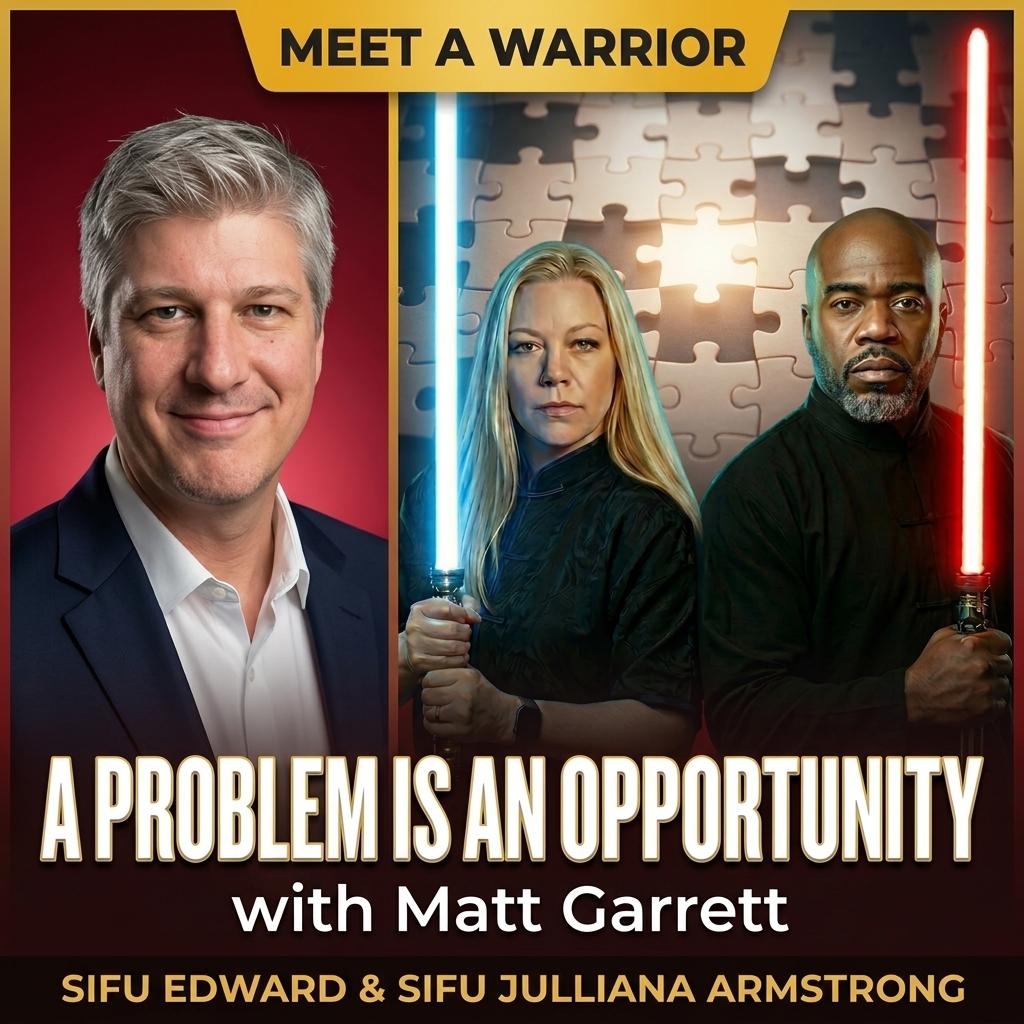
Adapted from the recorded conversation; the guest's words are verbatim. The questions are reconstructed and voiced by Sifu Edward and Sifu Julliana Armstrong.
🎥 Video podcast coming soon. The complete interview will play here once published. The full conversation is transcribed below, and the audio edition will be available on sifuarmstrong.tv.
In a new Sifu Armstrong interview, the UK plugin builder behind 150-plus software products makes an honest confession about the runaway success he let quietly decline.
Matt Garrett has launched more than 150 WordPress plugins and software products in seven years, and he’s not a coder. He builds everything through partners who cover the gaps in his own skill set, and he told Sifu Edward and Sifu Julliana Armstrong, on the latest Warrior Intelligence Series, that the single mental habit behind all of it is remarkably simple.
Garrett’s own start came almost by accident in 2000, when friends began asking him for help with online security and he stumbled onto an affiliate link on a firewall company’s website. Within three or four years, commissions from that single affiliate link had grown large enough that he quit his job outright. The beginning of a career built almost entirely on spotting problems and turning the fix into something sellable.
“A problem is genuinely or generally an opportunity if you reframe it,” Garrett said, describing how nearly every product he’s built (from WP Toolkit to WP Profiler, which visually shows site owners what’s slowing their pages down) started as a problem he personally ran into. If it was a problem for him, he reasoned, it was probably a problem for plenty of other people too.
Garrett credits partnerships, not solo talent, for the scale he’s reached. His work with developer John Merrick started over drinks in Portugal; his marketing partnerships with affiliates have become genuine friendships built on shared accountability and complementary skills. “You make a more rounded individual between you,” he said, each partner filling exactly the gap the other one can’t.
The most candid moment of the conversation came when Garrett was asked about a hit that slipped through his fingers. Niche Reaper, a keyword tool launched around 2010, sold 120 recurring $67-a-month memberships in under a week, a runaway early win. Then the momentum stalled. “We got a bit lazy,” Garrett admitted. “We made some improvements, but we didn’t push it as much as we should have... we’d dropped the ball.” The product’s data source eventually changed its API, and Garrett had to retire it entirely, a loss he compares to losing something that had been part of his life for years.
Garrett has since built a deliberately protected personal life around the lesson: no weekend work, regular time outside with his fiancée, and a firm belief that burnout, not laziness, is what actually erodes quality over time. “If you don’t have the downtime, the work you do will decrease in value and quality over time,” he said. On the support side of the business, he leans on a ticketing desk rather than an inbox, on the theory that people mostly get upset when they feel unheard, not when they have to wait a day for a reply, and that honest, responsive communication solves most problems before they ever escalate.
His advice for anyone starting is unglamorous but proven: pick something you’re genuinely comfortable with, be patient, and stay consistent, because the businesses that last aren’t the ones chasing a fast win, they’re the ones that keep showing up after the first one fades.
In This Conversation
- How a non-coder built 150-plus software products through partnerships, not solo skill
- “A problem is an opportunity if you reframe it,” the reframe behind nearly every product he’s launched
- The honest story of Niche Reaper: 120 sales in a week, then a slow, quiet decline into retirement
- Why complementary partnerships make “a more rounded individual” out of two people
- The hard line around weekends and downtime that protects the quality of his work
- Where to find his current projects and weekly coaching at mattgarrett.com and mat1.com
The Full Conversation
Sifu Edward Armstrong: Matt Garrett has launched over 150 software products in seven years (WordPress plugins and tools), and here's the thing our operators should note: he's not a coder. He builds through partners, each covering what the other can't, and he lives by a single reframe: a problem is an opportunity. That's the operator's mindset and the warrior's both.
Sifu Julliana Armstrong: And he told us a cautionary tale I want every person who's ever won something to hear. He had a runaway hit (120 recurring subscriptions in a single week), and then, in his own honest words, "we got a bit lazy, we dropped the ball," and watched it decline until he had to retire it. Complacency after a win is the quietest killer there is, and I wanted to talk about it plainly.
Our guest is Matt Garrett, UK-based software and plugin entrepreneur behind WP Toolkit, WP Profiler, and more. Matt, great to meet you.
Matt Garrett: Hi, good to speak to you.
Sifu Edward Armstrong: Take us to the start, and how a non-coder ends up building software.
Matt Garrett: I got started in 2000, almost by accident. I was one of the first among my friends to get online, so they'd come to me about security, how to stop getting a virus. I was using a firewall called Zone Alarm, and one day on their site I noticed a link at the bottom saying "affiliates." I looked into it, grabbed my link, put it on my own website, and started making commissions when friends clicked through. Within three or four years I was earning so much I sacked my boss. I had the pleasure of walking in and saying "I'm out of here," and they asked how much they could pay to keep me. And now I do software, but I've got to credit my partners, because I'm not really a software-creation person. I have partners who do the hard work of coding, Tony Marriott on local-marketing SaaS, John Merrick on WordPress plugins. My favourite is WP Profiler, which loads on your site and shows you visually what's slowing it down, because people add too many plugins, which hurts speed and security. The practical idea is that we use these ourselves. We come across a problem, work out the solution, and if we can turn it into a plugin, we sell it too.
Sifu Julliana Armstrong: You said something I want to underline, that a problem is an opportunity if you reframe it. That's my whole world.
Matt Garrett: If there's a problem, there's a solution. If it's a problem for me, I'll find a way through it, and in the process I'll normally come up with an idea for something I can sell based on that. I don't view problems the same way as some people. A problem is genuinely, generally an opportunity if you reframe it. As long as you work on the basis that if it's a problem I face, other people are going to face it, it's a great way of coming up with ideas.
Sifu Julliana Armstrong: "A problem is an opportunity if you reframe it." That single mental move separates the people who grow from the people who get stuck. The same obstacle that makes one person quit makes another person build, and the only difference is the frame they put around it. On the mat, the training partner who keeps catching you with the same technique isn't your tormentor; he's showing you exactly the hole you need to close. The problem is the map to the improvement. Learn to feel that reflexive flip, from "why is this happening to me?" to "what is this showing me?" and almost nothing can stop you.
Sifu Edward Armstrong: You build everything through partnerships. What makes that work?
Matt Garrett: The partnerships I've built over the years are massive. A lot of our sales come through affiliates, and a heck of a lot of those people are now really good friends. It's partly accountability, because when you work with someone you each know what you've got to do and you've got timescales. But it's also partly skillsets. We each have our own area of expertise, so we fill in the bits the other person doesn't have. You make a more rounded individual between you, as it were. That partnership with John started over a beer or two in Portugal. He'd become free from a previous partnership, and I said, "How about we do some more plugins?" Simple as that.
Sifu Edward Armstrong: "You make a more rounded individual between you." That's the truest reason to build with a partner, not to split the work, but to become, together, something neither of you is alone. He's not a coder; his partners aren't marketers. Apart, each has a fatal gap. Together, there's no gap. That's exactly how Julliana and I run this federation. She is precisely what I'm not, and the whole is far stronger than either half. Find the person who's strong where you're weak, and guard that partnership.
Sifu Edward Armstrong: You've launched 150-plus products in seven years. How (without burning out), and how do you handle support?
Matt Garrett: They're not all brand-new launches. Because it's software, you add new features and release a new version, and because I sell across JVZoo, WarriorPlus, ClickBank, and AppSumo, you can roll the same product out on multiple platforms. So it's working smart with each product. And the easiest thing in the world is to improve something when you've got customers using it, because they'll tell you exactly what to do. You listen, put in the new bits, release a new version. On support, I use a support desk rather than a support email, because with email people expect an instant response, whereas with a ticket they're happy to wait their turn. I aim to answer within 24 to 36 hours. And if you get truly stuck, you've always got the fallback of a refund. The big thing is: people mostly get upset if they feel you're not listening to them. If you communicate with them, they're generally going to be happy and work with you.
Sifu Edward Armstrong: "People get upset if they feel you're not listening." Write that on the dojo wall. It's rarely the mistake itself that loses a student or a customer. It's the silence, the sense that no one heard them. Communicate honestly, respond, and when you truly can't fix it, say so and make it right. And "listen to your customers, they'll tell you exactly what to improve." The same is true of students. The people you serve are constantly handing you the blueprint for getting better. Most operators are too busy talking to hear it.
Sifu Julliana Armstrong: Now the story I most wanted, the hit you let slip. Be honest with our warriors.
Matt Garrett: One of my favourites was Niche Reaper, a keyword tool I created back around 2010. When we first launched it, we sold about 120 recurring memberships at $67 a month in less than a week flat, and we were both going, "Well, that went quite well." But then we got a bit lazy. We made some improvements, but we didn't push it as much as we should have. Over time, not everybody stuck with it, and the money slowly decreased, and it was a year or two later when we suddenly realised we'd dropped the ball. We had a really good bit of software we should have been pushing harder. The end result is the software no longer works, the data source changed their API, and I've had to retire it. It's a bit like my baby's gone. And it's the same with products I've sold off (Blog Defender sold over 7,500 units), it's hard to let these things go, because they've been part of your life and made you a lot of money, but sometimes you have to let go so you can move on to other things.
Sifu Julliana Armstrong: "We got a bit lazy, we dropped the ball." Thank you for saying it plainly, because it's the quietest, most common way people lose. Nothing kills a champion faster than a win they got comfortable with. The moment you decide you've arrived (that the hit will keep hitting on its own), the decline has already started, you just can't feel it yet. The title you stop defending is the title you're about to lose. A win is not a resting place; it's a higher ledge you now have to keep fighting to hold. And I respect the other half of it too, knowing when to let something go and move on. Non-attachment is its own discipline. You hold the practice fiercely and the trophy lightly.
Sifu Julliana Armstrong: You've deliberately built a life with a hard line around work. Tell me why that matters.
Matt Garrett: I've got a fiancée now, and I've made a rule that I no longer work weekends, because I like spending time with her. I do enjoy my work, but I also enjoy living life. You've got to have something outside of work that you enjoy, because it keeps you passionate about the work. We both play Pokémon, so we spend a lot of time wandering in the fresh air, and we like trying different restaurants. Having that time is really important, because it keeps you charged for when you do want to get on and do the work. If you don't have the downtime, the work you do will decrease in value and quality over time. People imagine the internet lifestyle as a laptop on a beach, but have you ever tried working on a laptop on a beach? If it's sunny you can't see the screen, if it's windy you get sand in it. My work stays at my desk. Once I step outside, everything's switched off.
Sifu Julliana Armstrong: "If you don't have the downtime, the work decreases in value and quality over time." Every serious athlete knows this in their body: the recovery isn't the opposite of the training, it's part of it. Muscle is built in the rest, not the rep. The warrior who trains every single day with no recovery doesn't get stronger. They break down. Your hard line around work isn't a lack of hunger; it's the wisdom that keeps the hunger sharp. Sharpen the blade, then let it rest, so it's ready when it's needed.
Sifu Edward Armstrong: Your best advice for someone starting, and where do people find you?
Matt Garrett: There are so many things you can do that the first job is to work out what you're comfortable with, which might take playing with a few things. Set up a YouTube channel, or a blog and write about what you're interested in, things you can start with almost no tools. But the biggest thing is to be patient and consistent, because going in expecting thousands this week isn't likely. It's about building an audience, a tribe interested in the same thing you are, and then reaching them with offers, start with affiliate marketing, and over time create your own products that solve your audience's problems. Just be consistent and persistent. You can find me at mattgarrett.com, or mat1.com where I do weekly training and coaching.
Sifu Edward Armstrong: Matt, this has been genuinely useful, thank you for the honesty about the setbacks as much as the wins.
Matt Garrett: Life is ups and downs. You've got to embrace it all and get on with it.
Sifu Julliana's closing word: Matt handed us the most honest confession on this show ("we got lazy, we dropped the ball"), and it's the quietest way anyone loses. Nothing kills a champion faster than a win they got comfortable with; the title you stop defending is the one you're about to lose. Reframe every problem as the map to your improvement, hold the practice fiercely and the trophy lightly, and protect your recovery, because the blade is sharpened in the rest.
Sifu Edward's closing word: Matt builds through partners who are strong exactly where he's weak, because together they leave no gap, the same reason a great partnership beats any lone talent. Reframe the problem as the opportunity, listen to the people you serve because they're handing you the blueprint, and never, ever coast on a win. The comfortable champion is already in decline. Stay hungry, stay honest, and keep defending the ground you've earned. We don't entertain warriors. We create them.
Matt Garrett, UK-based software and plugin entrepreneur; creator of WP Toolkit, WP Profiler, and 150+ digital products with partners. mattgarrett.com and mat1.com.
ILLUSTRATIVE RESULTS. Any revenue, enrollment, margin or retention figure in this conversation is either a documented result from one of our own operations, a figure the guest reports about their own business, or an illustrative example, never a projection of your results.
Nothing here is financial, legal or tax advice.
Stay in the Fight
This conversation is part of the Sifu Armstrong Warrior Intelligence Series: interviews with world-class performers, builders, and thinkers, filtered through the lens of the warrior's path.
Subscribe at sifuarmstrong.news for every new interview, delivered to you.
Join Club Sabernet, the member community of the whole Sifu Armstrong ecosystem, where warriors train, connect, and hold each other to the standard.
Ready to build your own floor? Find your path at sifuarmstrong.com/which-path.